Showing posts with label Public Enemies. Show all posts

July 03, 2014

The racebending of Billie Frechette

An old posting about the Native character in the 2009 film Public Enemies:

The Woman is Red: The Racebending of Billie Frechette

By Gabriel CanadaI had high hopes that such terrible inaccuracies wouldn’t be repeated three decades later when Universal Studios took on the retelling of Dillinger’s life for Public Enemies (2009). From the start, historical accuracy was respected with director Michael Mann shooting on location at the banks, hotels, prisons, and hideouts where the real events took place–even going so far as to have his set designer restore many of them, creating tourist havens for local communities. The actors and film makers even descended on the Dillinger family farm.

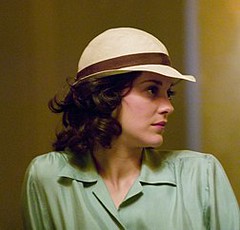
That is why it was even more disappointing that–though Billie’s romance was central to the plot of this new film and it was closer to the truth in almost every way–”racebending” was still employed, unapologetically. Marion Cotillard still introduces herself as half-Indian in her first scene. She makes it clear that she’s been scorned for it, saying that most guys don’t like that about her. (I am left with the impression that it isn’t “most guys” who wouldn’t like that about Billie, but rather “most guys in Hollywood.”)

Which is baffling. Michael Mann, the director of Public Enemies, was also the director of Last of the Mohicans and Heat. He played a large part in launching the careers of actors of color like Wes Studi and Eric Schweig in the 1990s. Though Mann keeps the context of Billie’s heritage intact in the film, and has a history of working with First Nation actors, we are left with Cotillard–who, like Phillips before her, is far removed from the Wisconsin reservation where Frechette lived most of her life. The only way to let the audience know Cotillard is playing an Indian is for the actors to come straight out and say it, as if denied the use of a buckskin dress, Hollywood simply didn’t know how to introduce an audience to a First Nations woman in a speakeasy.

Billie Frechette is the sole heroine in these Dillinger films, where tough guy gangsters are mowed down in hails of bullets and G-men don’t bother to flash their badges before opening fire. Yet, the first thing the film makers want the audience to know is that she is half Indian. It makes me wonder: If that detail about her is so important, why was this overlooked by the casting directors?

We are meant to feel sympathetic for Billie in Public Enemies and Dillinger. Not much good happens to her. She goes to jail and is tortured by the FBI for little more than falling in love with the wrong guy.

The films take pains to suggest she was with that wrong guy because no one wanted to dance or drink with an Indian. Well, if anyone is responsible for that last plight of Billie onscreen, it is Hollywood itself. Crime may not pay, but Hollywood–for whatever reason–still thinks racebending will.
Comment:  For more on Public Enemies, see Cotillard's Discovery of the Menominee and (Mis)casting in Public Enemies.

March 22, 2011

Johnny Depp's track record

Speaking of Johnny Depp's movies and pirates of the Caribbean....

Whenever we discuss Depp on Facebook's NativeCelebs page, people rush to his defense. He's an Indian because he's part Cherokee, they'll say. He starred in Dead Man and The Brave, so he can play Indians. Let him play Tonto in The Lone Ranger and he'll show us his stuff.

But we don't have to imagine Depp's sensitivity to Native portrayals in film. He already has a notable track record in this area:


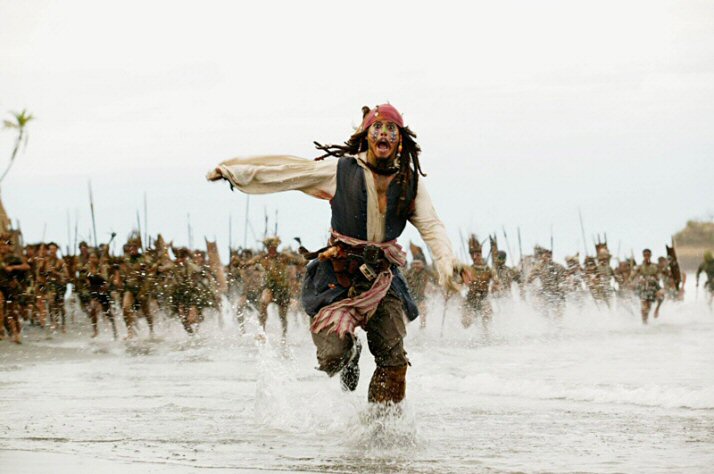
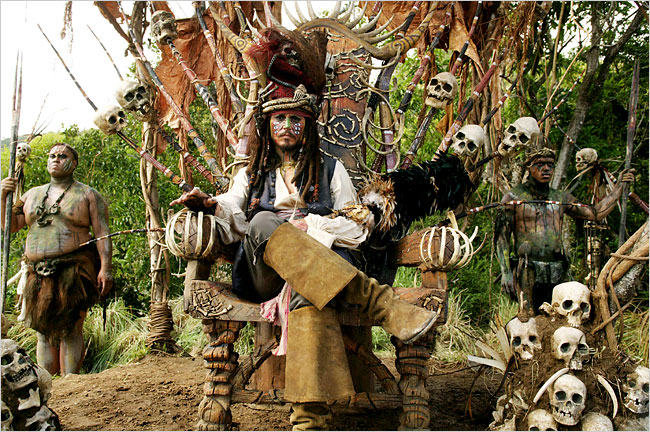
Strike one: Pirates of the Caribbean: Dead Man's Chest depicts Caribbean Indians as mindless, murderous cannibals. Depp did nothing to change or protest this depiction.

Strike two: Public Enemies co-stars Marion Cotillard as John Dillinger's Menominee girlfriend. Depp did nothing to get a Native actress hired for the role.

Strike three: Rango features Gil Birmingham as Wounded Crow, a stereotypical stoic Indian type. Depp did nothing to make this character more three-dimensional.


Three strikes and you're out, Johnny.

To those who say Depp is only an actor, not a producer, I say rubbish. Arguably none of these movies would've been made without Depp's participation. The Pirates sequels certainly wouldn't have been. He had the clout to ask for changes, at least. Whether they were made or not, he would've been on record advocating accurate representations of Indians in Hollywood.

Instead he did nothing. But he's the great red hope who'll make Tonto a hero and role model for a generation of Natives? Somehow, I doubt it.

In short, what has Johnny Depp done for Indians lately? Not much.

For more on the Lone Ranger, see The Lone Ranger as Don Quixote? and Marty Two Bulls on Johnny Depp. For more on casting issues in general, see Oprah Winfrey the Indian? and No Indians at the 2011 Oscars.

March 27, 2010

Cotillard's discovery of the Menominee

Marion Cotillard Interview PUBLIC ENEMIES

By Steve 'Frosty' WeintraubQuestion: Aside from the accent, what were the other challenges in creating this Midwestern American woman when you’re French and the French are supposed to be very sophisticated? Can you de-sophisticate yourself to play this woman?

Cotillard: I don’t think that I’m that sophisticated. Maybe I’m not aware of it, I don’t know. I wouldn’t say that it was a challenge, but it was so interesting. I never thought that I would have to play an Indian, well half French, but an Indian woman in my life. I got to discover Native American history and American history. So it was more like I opened a box with a lot of treasures about a culture that is not mine, but that is so interesting. I met these people from Menominee Tribe and it’s an amazing culture. I met with really amazing people. I was very lucky to be in a situation that I had to be one of them. I had to be one of the American history which is amazing for a hundred percent French girl. But I would say that the only big challenge for me was definitely the accent and that the rest of it was…it was the accent and also, I mean it was the biggest challenge to let it go and not think about it than to actually work on the accent. I think that when you work you can get somewhere. But all the rest was just a joy.
Comment:  For more on the subject, see (Mis)casting in Public Enemies and Dillinger's Menominee Moll.

July 09, 2009

(Mis)casting in Public Enemies

Last year I posted an item on Dillinger's Menominee Moll. Just recently I posted an item on Authenticity in Public Enemies. I failed to make the connection between the two...until now.

Michael Mann's biopic of John Dillinger features Dillinger's accomplice Billie Frechette. Frechette herself reminds us of her past.

Primary Sources:  'What I Knew About John Dillinger'--By His SweetheartThe Chicago Herald and Examiner originally published a multi-part article written by Evelyn "Billie" Frechette in August 1934. In it, Frechette told of her life with John Dillinger.

Born on Wisconsin Indian Reservation.

I was born on an Indian reservation at Neopit, Wis., sixty miles from Green Bay. I had two brothers and two sisters. My father died when I was 8 years old. He was French and pronounced his name without the "e," like Freshet.

My mother was half French and half Indian. Her tribe was the Menominees. They called them the wild-rice eaters. They used to have their hunting ground around Wisconsin and Michigan a long time ago, before the white man came and pushed them around.

Thinks of Indians Who Roamed Hills.

I think about that sometimes when I look out through the bars in the window at the hills and the trees here in Michigan. I get to thinking that my people use to roam around over those hills--long before the white man came along with his rules about harboring outlaws.

And I get to thinking that maybe the Indians had rules about things like that, too. Maybe if they caught a girl that was running around with an enemy chief they'd hold her and wait for him to come for her so they could kill him.

But I figure they would let her go after they killed him.

Recalls Working on Reservation as Child.

Nothing happened to me when I was a child. I don't remember anything that happened to me that was unusual. We had to work around the reservation with our Indian relatives and neighbors. My mother had a hard time bringing us up.

I remember I had an uncle that the government people thought a lot about. They sent him to Washington to do things for the Indians and he was a big man.

I got most of my schooling in a mission school on the reservation and then when I was 13 I went to government school at Flandreau, S.D. I stayed there for three years and then I went to live with my aunt in Milwaukee.

I worked as a nurse girl--when I could get work and that wasn't very often. I wanted to come to Chicago. I hadn't been any place in my life and Chicago was a big and wonderful place to me.
Comment:  Apparently Frechette was 1/4 Menominee by blood but considered herself an Indian. The question arises: Why hire Marion Cotillard to play Frechette? Why not hire a part-Indian actress instead?

Because Cotillard won an Oscar for La Vie en Rose? I saw that movie, but did anyone else? Cotillard was good but it wasn't that great of a movie.

So how many viewers opted to see Public Enemies because of Cotillard? Not many, I'm guessing.

Was Cotillard's presence a big selling point? Not in any advertising I've seen. I don't think any of the critics are saying she "stole" the movie or anything like that.

I think introducing an unknown (to mainstream audiences) Native actress opposite Depp would've been more of a selling point. "The big story is how [little-known Native actress] goes toe-to-toe with Depp and holds her own," the press might've written. "A star is born," etc.

I don't know how much Cotillard got for playing Frechette, but a Native actress would've gotten less. Perhaps much less. Since this movie probably won't make money, that would've been a selling point for investors.

Finally, Mann and company made a big deal about the movie's authenticity. Well, it would've even more authentic if it had gone into Frechette's reservation background and used a Native actress to portray it. How many people know John Dillinger was two degrees of separation from the Menominee tribe of Wisconsin?

For more on the subject, see Friday, Tonto, Jacob Black et al.

June 30, 2009

Authenticity in Public Enemies

We don't know if the upcoming Lone Ranger movie will be authentic, but another Johnny Depp vehicle demonstrates the importance of authenticity:

Review:  'Public Enemies'Though any number of name actors, including Lili Taylor as a confident sheriff and Giovanni Ribisi as gangster Alvin Karpis, make appearances, what's unusual about "Public Enemies" is Mann's determination not to have any face be an ordinary one.

A full 15 people (led by Avy Kaufman and Bonnie Timmerman) are credited with casting work on the film, and every face that appears on screen, from the members of Purvis' Chicago FBI squad to youthful junior G-men, are clearly hand-picked for individuality and impact.

Mann's attention to nominally small things, his insistence that every detail be authentic, including the clothes (Colleen Atwood is the costume designer) and the often historic locations (Nathan Crowley is production designer), lend a sense of rightness to the entire endeavor.

One of the interesting side effects of this exceptional care is to make "Public Enemies" so real it seems to transcend its period and exist out of time. Though the Depression was a major factor in Dillinger's career, we don't see or feel it all that much. What we get instead is the sense of a man whose name has lasted until now for a reason and, if the movies have anything to say about it, will last longer still.
Comment:  Apply the above lessons to any Native-themed movie. Choosing Native faces rather than generic ethnic faces gives the movie more impact. The attention to accurate details gives the movie a sense of "rightness." The movie feels so real that you willingly suspend your disbelief. You're transported out of your seat into the world on the screen.

This is how Michael Mann makes critically acclaimed movies.

Mann's movies might also make money if they weren't star vehicles: Colin Farrell and Jamie Foxx (Miami Vice), Tom Cruise and Jamie Foxx (Collateral), Will Smith (Ali), Al Pacino and Russell Crowe (The Insider), Robert DeNiro and Al Pacino (Heat). Only Collateral made money domestically.

Incidentally, Mann also made The Last of the Mohicans with Daniel Day-Lewis and Russell Means. Not the greatest movie, but at least it made money. Authentic movie-making plus authentic (and low-budget) cast = profit.

For more on the subject, see The Best Indian Movies.