Showing posts with label San Manuel. Show all posts

September 01, 2012

San Manuel builds Serrano village

BIG BEAR: Dedication for recreated Serrano village setIt takes a village to build a village and after a full weekend of work that began Aug. 25, members of the San Manuel Band of Mission Indians will join San Manuel Tribal Unity and Cultural Coordinator James Ramos and board members of the Big Bear Valley Historical Society to formally dedicate two new structures into a recreated Serrano Indian village set on the grounds of the Big Bear Museum in Big Bear.

The ramada, a cedar framed and willow thatched shade structure, and an acorn granary, weaved from the branches of the willow tree, join a previously constructed traditional Serrano Indian domed shaped home (kiiè) which has become an annual activity of the Yuhaaviatam Cultural Camp organized through the tribe’s Tribal Unity and Cultural Awareness Program.
Comment:  For more on San Manuel, see San Manuel Partners with Local Ballclub and San Manuel Buys Sacred Spring.

Below:  "Members of the San Manuel, Santa Rosa and Pechanga reservations build a cedar ramada. A ramada and an acorn granary are set to be dedicated at the Big Bear Museum on Sept. 3, 2012."

March 19, 2012

San Manuel partners with local ballclub

San Manuels get naming rights at 66ers Stadium

By Andrews EdwardsThe Inland Empire 66ers' home stadium will be renamed as San Manuel Stadium, according to an announcement of a "major new partnership" between the Single A ballclub and the San Manuel Band of Mission Indians.

A news release revealed the new name by announcing a media conference is scheduled to take place at the downtown San Bernardino stadium on Thursday.
And:The San Manuel Band of Mission Indians, which operates San Manuel Indian Bingo & Casino near Highland, currently holds naming rights to San Manuel Amphitheater at Glen Helen Regional Park in Devore.

The tribe has also made sports a focal point of its casino advertisements and non-gaming enterprises, such as the Sportswatch Bar & Grill in Highland. The tribe also advertises at Dodger Stadium and Staples Center, home to the Lakers, Clippers and Kings.
Comment:  For more on naming rights, see Foxwoods Bets on Spider-Man.

Below:  "The Inland Empire 66ers' home stadium in San Bernardino on Monday, March 19, 2012. Arrowhead Credit Union Ballpark will be renamed to San Manuel Stadium." (Rachel Luna/Staff Photographer)

December 30, 2011

San Manuel buys sacred spring

An excellent example of how casinos let Indians restore and preserve their culture:

BIG BEAR: Tribe acquires sacred site

By David OlsonYears ago tribal members couldn’t even get to Big Bear to look from behind the fence at the spring they heard about in the creation story. The old cars they drove couldn’t make it up mountain roads, Ramos said. Buying the land was unthinkable until gaming money flowed in.

“This is part of spending money to purchase a part of our culture that, unlike gaming, will last forever,” Ramos said.

Ramos declined to reveal the price to buy the four acres that includes the hot spring.

Casino revenue is a key reason why San Manuel and other tribes have vibrant cultural-preservation programs, said Cliff Trafzer, a professor of history at UC Riverside and an expert on Southern California Indian culture.

“Gaming has contributed in a major way to the revitalization of tribal culture, and not just San Manuel culture,” Trafzer said.

In addition to land purchases, casino income gave the San Manuel and other tribes the resources to hire linguists and others to write down and teach languages that were in danger of dying, he said.

Tribes without casinos often are too poor to buy culturally significant land or launch extensive cultural-preservation programs, Trafzer said.
Comment:  For more uses of Indian gaming money, see Tribal Infomercials in Oklahoma and Pechanga to Sponsor LA Film Festival.

Below:  "San Manuel Band of Mission Indians Tribal Chairman James Ramos talks about the history behind the Pan Hot Springs which is sacred to the San Manuel tribe and was recently bought the property." (Mark Zaleski)

September 26, 2011

First Nations Experience TV channel

Historic Native American channel launches in Southern CaliforniaThe first Native American TV channel in the United States went on the air September 25 with the launch of FNX: First Nations Experience Television. FNX is a new multimedia platform featuring authentic voices and stories reflecting the reality of the Native American experience and that of indigenous peoples worldwide. FNX is a 24/7 high definition (HD) multi-platform digital media vehicle created through a partnership between the San Manuel Band of Mission Indians and KVCR, a PBS member station located in California’s Inland Empire.

"This marks the birth of an innovative project that has been in the works for 7 years now,” said Larry Ciecalone, President/CEO of KVCR/FNX. “The FNX Channel launched at 7:00 p.m. in Southern California on KVCR 24.2 digital. It is a TV channel dedicated to the Native American experience and the first of its kind in the nation. We developed this concept with our founding partner, San Manuel Band of Serrano Mission Indians. KVCR is pleased to offer this experience to Southern California viewers and will launch the channel nationally next year."

FNX launched in Southern California, the second largest market in the United States, with a potential audience of 18 million viewers. Within one year, FNX plans to expand and lead the way as a producer (via the Internet and over-the air, satellite and cable broadcast systems) of authentic First Nations storytelling. Programs will include varying genres including documentaries, sports, feature film, drama series, news and comedy.

"Today, Indian Country can take pride in this first major step toward establishing a communications institution to secure a national and international presence utilizing the television medium–a communications medium that all Native and indigenous people can utilize to tell our stories about our cultures and history," said San Manuel Vice Chairwoman Lynn Valbuena.
FNX Native Television Channel LaunchesPrograms will include varying genres including documentaries, sports, feature film, drama series, news and comedy. The inaugural program line-up included “Apache 8,” the compelling story of an all-female White Mountain Apache firefighting crew, and “Good Meat,” an engaging documentary about one man’s journey to improve his health by going back to a traditional Lakota diet that included buffalo.

FNX will initially air six-hour blocks of Native programming repeated daily, and is adding content and new programs over the next few months to expand the schedule. Within a year, the channel will have 24-hour all-Native programs and will be available to Indian country via Internet streaming.

“Native America is the foundation for our nation,” said Charles Fox, FNX executive director and Chief Operations Officer. “Much of our culture, language, laws and place are based on traditional Native American cultures and practice. For the first time in our nation’s history, there will be a place where all people can discover, appreciate and re-examine our common bond and shared values. That place is FNX: First Nations Experience.”

As members of the World Indigenous Television Broadcast Network, FNX is the first multimedia venture in the United States created to accurately educate the general public about Native American realities.
Comment:  This is something like the third or fourth claim of creating the "first Native American TV channel." They usually fall into neglect after a year or two of trying to make a difference.

I imagine a lot of organizations would dispute the "the first multimedia venture in the United States created to accurately educate the general public about Native American realities." For instance, the National Museum of the American Indian, the Indian Country Today Media Network, and Buffy Sainte-Marie's Cradleboard Project. Indeed, every Native-themed museum and educational organization is probably multimedia these days.

Other than that, FNX is a nice achievement. With the backing of the wealthy and progressive San Manuel Band, it may actually succeed.

For more on the subject, see San Manuel Launches TV Channel and TV Shows Featuring Indians.

Below:  "FNX Executive Director Charles Fox, San Manuel Vice Chairwoman Lynn Valbuena, FNX Operating Board Chairman Tim Johnson, and President/CEO of KVCR/FNX Larry Ciecalone counting down to pressing the button that launched FNX on the air."

May 14, 2011

San Manuel's PR strategy

San Manuel Band of Serrano Mission Indians Gets the Message Out with Television AdvertisingThe San Manuel band of Serrano Mission Indians, located in Highland, California near San Bernardino, have for years been producing educational commercials (see them on the tribe’s website, sanmanuel-nsn.gov) about their tribe and its contributions to the community. It’s an interesting PR strategy in an era when politicians don’t think twice about scapegoating tribal gaming, for any number of reasons. We spoke with communications director Jacob Coin.

What was the message?

We wanted to show what gaming revenues were being used for. The first wave of tribal compacts were signed in 1999, and our message to the public was that your vote helps us be more self-sufficient. We wanted to say to people, If you vote for Proposition 5, in 1998, or Proposition 1A in 2000, you’re voting for schools and fire stations. You’re voting for Indian self-determination.

So the commercials are no longer a statewide effort—why does the San Manuel Band keep making them?

We do two to three of them a year, and we show them to focus groups, and what we’ve found is that people are really interested in the history. And I think it’s important for me to point out that these are made by the tribal government side, not the gaming side. We know that the public would rather learn about history than see a casino ad, and we’re proud of our history and the positive contributions we’ve made to the communities here in the San Bernadino Valley.
Comment:  San Manuel may have more money per capita than any other tribe, which makes this strategy possible. But it's using its money wisely: reaching out with business ventures, charitable donations, and this PR campaign. Other tribes should strive to emulate the San Manuel model.

For more on the subject, see San Manuel Launches TV Channel and TV Spots About San Manuel History.

March 30, 2011

San Manuel donates to Japan

San Manuel tribe hands out money, awards

By Michel NolanOn Tuesday, the People of the Pines shared financial assistance and hope.

Members of the San Manuel Band of Mission Indians, who call themselves "Yuhaviatam," or People of the Pines, hosted their third annual Forging Hope luncheon by giving to those who give.

The luncheon brought together nonprofit groups for an awards ceremony at San Bernardino's National Orange Show Events Center, where the tribe's Yawa' Award was bestowed upon four charities.

In addition to the Yawa' Awards, Ramos announced the tribe would provide $100,000 to the American Red Cross--Inland Empire Chapter--and $50,000 to the International Medical Corps for relief efforts to help victims of the earthquake and tsunami in Japan.
Comment:  For more on the subject, see Natives Raise Funds for Japan.

January 07, 2011

San Manuel's motocross team

AMA SX:  San Manuel Yamaha Previews Anaheim Opener

Superstar James Stewart is motivated to make up for his disappointing injury-hit 2010 campaign.Team San Manuel Yamaha--Presented by Red Bull--is excited to announce that it’s 2011 racing effort will be led by returning Team rider and multi-time Supercross Champion James Stewart, along with AMA MX Series 2009 450 Class “Rookie of the Year” Kyle Regal. After a disappointingly short season in 2010, Stewart has been intensely focused on his return to the track this Saturday, January 8th, at Anaheim Angel’s Stadium, in pursuit of his third Supercross Championship Title. “I’m super excited to get back to racing this weekend. I’ve been anticipating my return for months.”And:About Team San Manuel

Formed in 2006, Team San Manuel is a unique partnership between the San Manuel Band of Mission Indians and L&M Racing, LLC, with the sole purpose of reaching out to Native and non-Native communities and sharing with them the value of perseverance and dedication. Building a winning team comprised of top-notch talent and community service, Team San Manuel honors the Serrano belief of caring for our community. (www.sanmanuelracing.com)

About L & M Racing

L&M Racing was formed in 2006 by Owner/Team Manager Larry Brooks and partner Mike Kranyak. Operating as Team San Manuel Yamaha, the team has garnered two Supercross Championship titles in the last three race seasons.
Comment:  For more on the subject, see Pala Raceway's Origin and Barona's Motocross Training Center.

Below:  "San Manuel Yamaha's James Stewart."

October 29, 2010

KCET and San Manuel annouce awards

KCET and San Manuel Band of Mission Indians Award Local Leaders and Broadcast Special Programming in Honor of American Indian Heritage MonthAs part of its ongoing commitment to cultural diversity and in celebration of American Indian Heritage Month, KCET has partnered with San Manuel Band of Mission Indians to honor four extraordinary leaders from our local community in this very special inaugural awards ceremony. The American Indian Heritage Month Leadership Awards recipients include: Michelle de Armas (Pueblo of Isleta, New Mexico), Richard Gomez (Santa Ynez Band of Chumash Indians, California), Elton Naswood (Navajo, Arizona), Ian Skorodin (Choctaw, Oklahoma). Each of these individuals has made contributions to local communities in Southern California in the areas of cultural/language preservation, social services, arts, business and education.

The American Indian Heritage Month Leadership Award recipients will be honored throughout the month of November on KCET with a short video profile featuring each honoree’s story. KCET and the San Manuel Band of Mission Indians will also recognize the exemplary leadership and dedication of the recipients during an awards celebration hosted by Hattie Kauffman, Emmy® Award winning reporter and national news correspondent for the CBS Early Show in Los Angeles. The event will be held on Tuesday, November 9, 2010, at the KCET studios in Los Angeles.
Details on some of the honorees:Michelle de Armas--Michelle de Armas serves as Program Coordinator of Diversity Development for Fox Entertainment Group, whose goal is to incorporate diverse voices into every aspect of the Fox business. Since 2008, she has also coordinated the Fox Journey to Excellence Program (JEP), an innovative mentoring project, and from 2007 has coordinated the American Indian Summer Institute Program (AISI). These initiatives are aimed at providing high school and college-aged students of underrepresented backgrounds an exploration of various career opportunities. de Armas has gone above and beyond her duties to provide students with a unique and rewarding experience through academic workshops, career development seminars, and mentorship programs. In addition, each summer de Armas brings together industry veterans with AISI members to create public service announcements that shed light on issues facing American Indian communities.

Ian Skorodin--Ian Skorodin is an iconic American Indian filmmaker and philanthropist, who has produced award-winning films and television programs with an American Indian point of view. In addition to his film work, Skorodin founded the Barcid Foundation, a non-profit organization dedicated to the causes of indigenous people. The foundation is in the process of preserving all archival American Indian materials and provides multimedia production for related projects. Skorodin also founded the Los Angeles Skins Fest, a film festival that gives American Indians the opportunity to showcase their talent and gain distribution. Recognizing the importance of investing in our youth, he not only created a youth program for the LA Skins Fest, but has also taught at the Weengushk Film Institute in M’Chigeeng Canada.
Comment:  It's not clear de Armas's efforts have made a difference in telling more Native stories or hiring more Native actors.

Skorodin's LA Skins Fest competes with Joanelle Romero's Red Nation Film Festival for attention during Native American Heritage Month (November).

For more on the subject, see Indian TV and Film Center Flops and San Manuel Launches TV Channel.

June 16, 2010

San Manuel launches TV channel

Donation establishes the Nation’s First 24-Hour Native American TV ChannelA $6 million donation by the San Manuel Band of Mission Indians will allow San Bernardino-based KVCR Television to launch the nation’s first 24-hour Native American television channel, tribal leaders and the station announced on Wednesday, June 16.

The Channel is a groundbreaking media initiative emphasizing the factual history, culture and current events of Native Americans and Alaskan Natives. Planned to reach the airwaves in spring 2011, this one-of-a-kind channel will tell the stories of indigenous North American peoples and is the result of an ongoing partnership between KVCR and San Manuel.

“We fully anticipate this unique channel to become a model for public-television programming across the country,” said, Larry R. Ciecalone, President of KVCR, a Public Broadcasting System affiliate. “The commitment of the San Manuel tribe to informing audiences about the contributions and achievements of Native Americans in history and modern times is precedent setting.”

This is the first time a Native American tribe has taken the lead in using a powerful medium to plan, produce and communicate cultural, historical and contemporary messages to be told on a scale previously not possible, Ciecalone added.
And:Noted Native American actor Wes Studi, who earned accolades for his work in Academy Award-winning films such as “Dances with Wolves” and “The Last of the Mohicans,” praised KVCR and San Manuel for their vision and commitment.

“As the first TV channel of its kind, it will be in a unique position to expose viewers to the untold stories of Native Americans. The channel will be in a position to break stereotypes while preserving and celebrating our rich culture and collective history before a larger audience,” Studi said.

Establishing more outlets for Native American produced film and television is an important focus for Native American and filmmakers.

“There is a wealth of content produced by, and featuring Native American talent,” said Georgina Lightning, director of “Older than America,” an award winning motion picture of contemporary suspense that focuses on the lasting impacts of Indian boarding schools.

“This channel provides a needed forum for Native American artists, a common ground on which we can share our unique perspectives and express ourselves creatively.”
San Manuel Band of Mission Indians, KVCR to launch new TV channel

By Joe NelsonThe San Manuel Band of Mission Indians on Tuesday announced it is partnering with San Bernardino-based KVCR Television to air the nation's first American Indian channel.

In the last five years, the tribe has produced documentaries on the history of the tribe and California Indians for the local public television station, which have been syndicated on the PBS television network, said Jacob Coin, spokesman for San Manuel.

The new channel, which has yet to be named and will operate on a 24-hour, seven-day-a-week basis, is expected to begin operation in Spring 2011 under an initial 3-year contract. The channel is being funded by a $6 million donation from San Manuel.

Programming will be overseen by a five-member operating board. News, feature films, entertainment and cultural programs geared toward the contemporary American Indian experience is the aim of the channel, Coin said.
Comment:  This must be the fifth or sixth time someone has claimed to create the first Native TV channel. But if they mean the first 24-hour channel on the actual television, not the Internet, this indeed may be a first.

For more on the subject, see NWIN on Cable TV and TV Shows Featuring Indians.

Below:  The source of San Manuel's funding.

April 30, 2010

Magic Johnson at San Manuel

Earvin "Magic" Johnson speaks to business group at San Manuel

By Michael J. SorbaJust like he dished dimes to the likes of Kareem Abdul-Jabbar and James Worthy during his illustrious NBA career, Earvin "Magic" Johnson lobbed a few assists to local business owners Thursday at San Manuel Indian Bingo and Casino.

The Hall of Famer offered business advice and strategies as keynote speaker during the final installment of a six-part Business Insight Series sponsored by the county's Economic Development Agency, Estrada Strategies and San Manuel.

"I'm a control freak and I don't apologize for it," Johnson told the audience of about 300. "Because I know if it's in my hands, we're going to win."

Johnson, who has worked as a pitch man in the casino's television commercials, touched on his athletic career, which included an NCAA National Championship and five NBA titles. But most of his talk focused on the successful philosophies he's used as an entrepreneur.
Comment:  For more on related subjects, see Abdul-Jabbar Kicks Off NIGA 2010 and The Facts About Indian Gaming.

March 25, 2010

People of the Pines documentary

KVCR-TV and San Manuel to Debut Documentary on California Native American History of Resistance and Survival

Four Part Television Series to Take Viewers through Stories of Struggle and Perseverance as Told by California Indians and Noted HistoriansKVCR-TV in partnership with the San Manuel Band of Mission Indians has produced a new four-part documentary series on the history of near extinction that was faced by California Tribal communities following contact with European and American powers. The series will air on KVCR over four consecutive Mondays starting April 5th at 8:00 p.m. Entitled “The People of the Pines, The California Native” the programs are a third installment of documentaries that have expanded from profiling the San Manuel Band of Mission Indians into a broader account of the history shared by the state’s indigenous peoples and communities.And:The series covers a period of time spanning the internment of natives into the Spanish Mission System to the mid 20th Century when native veterans of World War II returned home to find their tribes terminated through a single action of congress.

In order to get these accounts KVCR crew traveled the state of California and beyond to speak to Native Americans who recount the shared history of their communities. This including the Modoc Tribe which was split between Oregon and Oklahoma following a protracted war that resulted in the death of a United States general and a forced removal of half the tribe to what was then Indian Territory (Oklahoma).

Historians and Native Americans cover the chronology of this history as painted upon the backdrop of American and world history. Discussions focus on various manners in which California Indians fought to maintain and remain within their ancestral lands and preserve their ways of life. Broken treaties, major military campaigns, and the heroic actions of native leaders such as Santos Manuel, leader of the San Manuel Band of Mission Indians, are recounted by their descendants who candidly share the tragedies and triumphs that are part of the shared identity of over 100 tribal communities located in all corners of California.
Comment:  Another beneficial result of Indian gaming....

For more on the subject, see Native Documentaries and News.

March 12, 2010

Video of "First to Be Counted"

A video of the Census event noted in Pix of "First to Be Counted" and Indian Counted First in Southern California:


Comment:  At 45:14, this video is too long for the average viewer. For the first two minutes, for instance, you don't see anything but words on a black screen.

But it's worth glancing at for at look at the San Manuel Band of Mission Indians. I believe this tribe is the only federally recognized one in the greater Los Angeles area.

Even though San Manual's casino has made it one of the nation's richest tribes, you can see these are still semi-traditional Indians. They aren't a bunch of tanned white people pretending to be Indians.

For more on that subject, see The Facts About Indian Gaming.

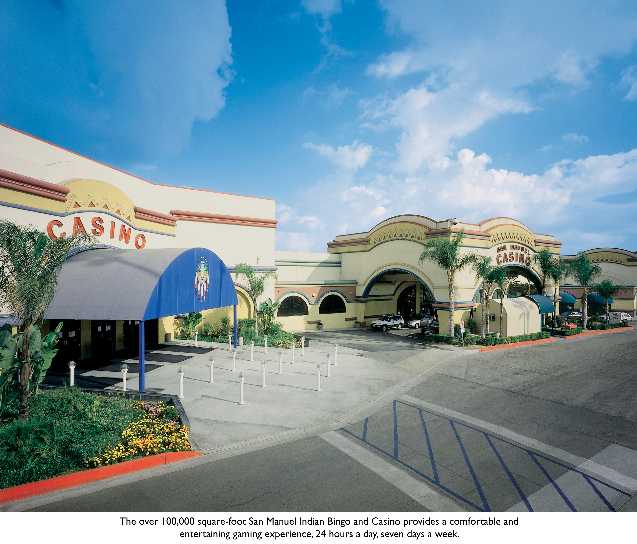
Below:  The San Manuel Indian Bingo & Casino.

March 07, 2010

Pix of "First to Be Counted"

As noted in Indian Counted First in Southern California, Pauline Murillo of San Manuel was the first person the 2010 Census counted in the Los Angeles region. Here are some photos of the event:

2010 California Indian Census's Photos--First to Be Counted

For more on the subject, see Oneidas Undercounted in 2000 Census and Video of My Census Meeting.

Below:  Pauline "Dimples" Murillo says a few words.

March 06, 2010

Indian counted first in Southern California

Count begins at San Manuel

By Joe NelsonU.S. Census Regional Director James Christy on Friday enumerated San Manuel tribal elder Pauline Murillo, making her the first person counted in the Los Angeles region for the 2010 Census.

"We made history here today," Christy said during a special ceremony outside the San Manuel Tribal Community Center.

Tribal Chairman James Ramos stressed the significance of methodically and thoroughly counting American Indians in the census so that they be eligible for some of the $400 billion in federal funds earmarked for health care, education and other programs.

"This is a big statement. We want to make sure every Indian person is properly accounted for," Ramos said.
San Manuel elder is first Southern Californian counted in 2010 Census

By David OlsonMost Americans will receive their census forms in the mail later this month, but James Christy, the regional director of the U.S. Census Bureau, went to Pauline Murillo's home to personally ask her the 10 questions on this year's survey.

Murillo, 76, is a beloved figure in the tribe, a leader in preserving the Cahuilla language and in educating people of the Serrano people's history and culture.

"We've been here forever, and it's about time we get counted," Murillo said after a census celebration held outside the tribal community center, on the San Manuel Reservation in the foothills above Highland.

Christy said the Census Bureau chose Murillo to honor American Indians and their status as the first inhabitants of what is now the United States.
Confirming the event's importance is this item:

House Passes Baca Legislation Promoting Accurate Census Count in Indian Country

Legislation Calls for Tribal Elders to be Involved in Census Awareness ActivitiesToday, the House of Representatives passed legislation introduced by Congressman Joe Baca (D-Rialto) to promote a more accurate census count of our nation’s Native American Communities. H. Res. 1086, the Tribal Elders Key to Census Accuracy in Indian Country Resolution, recognizes the significance of the 2010 Census, and encourages tribal communities to have an elder serve as the first member of that community to answer the 2010 Census. The bill passed the House with a 415 to 1 vote.

“The 2010 Census will be used as the basis for future federal funding for Medicaid and over 1,400 other vital programs,” said Congressman Baca. “Full participation in the upcoming Census is essential to the well being of all our Native American communities. In the Inland area, the San Manuel Band of Mission Indians has already proposed to name an elder as the first member of their community to answer the 2010 Census. By encouraging all our nation’s tribal communities to follow this same approach, my legislation will lead to a more accurate count and ensure that Native Americans receives the proper federal funding they are due.”

The 2010 Census is a massive undertaking that is of vital importance to all of America’s communities and families. The federal government uses census data to determine funding levels for localities for everything from education, public safety and judicial programs, public transportation, and nutrition and public health programs. In addition, census information is used to determine local representative boundaries for both state and federal elective offices. Elders are looked upon as trusted leaders in most Native American communities. With their strong levels of influence, they can help better carry the message of how important an accurate 2010 Census Count is to our future.

“The census provides information that is necessary to everyone from government to business,” added Rep. Baca. “I thank my colleagues in the House for acting quickly to pass this critical legislation, which respects the proud heritage of our Native Americans by involving tribal elders in the 2010 Census process. There is too much at stake--we can not afford an undercount in Indian Country, or for that matter, in any other community across the United States.”
Comment:  I believe the only representative who voted no was Ron Paul, which tells you something.

The San Manuel event obviously got some media coverage, but I heard it was a mess. People didn't know who the first form filler would be. Film crews weren't there to record Murillo as she completed her form. Other tribes weren't invited, so many of the seats were empty. The Census staff ran out of bumper stickers and other handouts. Etc.

It seems like the people in charge are overworked, underqualified, or both. Which still amazes me. With 10 years to plan this Census, it should be running like clockwork. Instead, an outsider like me is proposing an Internet communications strategy with six weeks to go because no one's made it happen yet.

For more on the subject, see Oneidas Undercounted in 2000 Census and Video of My Census Meeting.

Below:  "Pauline Murillo, 76, an elder of the San Manuel Band of Mission Indians, is the first person in the Southern California region officially counted in the 2010 census. The U.S. Census Bureau is increasing efforts to accurately count American Indians in this decade's survey." (Silvia Flores/The Press-Enterprise)

November 26, 2009

TV spots about San Manuel history

The San Manuel Band of Serrano Mission Indians is running a series of commercials here in LA about their history. Here's the history in question:

San Manuel:  the early years

By G. W. AbersoldA casual reading of the historical record is appalling. Carey McWilliams in his classic book, “Southern California Country,” calls the Franciscan mission program of Father Junipero Serra, a legend or a myth.

According to the myth, “the missions were havens of happiness, places of song, laughter, good food and adoration of Christ.” In truth, the Indians, including the Serranos, endured forced labor, rape, children separated from their parents, starvation, imprisonment and other atrocities. So McWilliams records.

Far more Indians were killed than were ever converted to Christianity.

Why did Santos Manuel lead the Serranos in 1866 out of the mountains? Because their lands around Big Bear were increasingly valuable. Gold had been discovered. Logging was big business.

The San Bernardino militia, made up of Mormon ranchers and refugees from the Civil War, accused the Indians of the mountains of cattle rustling. They slaughtered hundreds of Indians to get their land.
Comment:  The commercials show the San Manuel Indians in sepia-toned colors living peacefully in the hills. Then the narration notes the advent of trouble (see above). In one ad, Santos Manuel leads the Serranos away from their old homes. In another, the past fades to the present with a smiling shot of the San Manuel chairman.

The ads don't say anything about San Manuel's casino or other enterprises. The tribe has other commercials for that purpose. These historical ads leave viewers with a standard message about survival, sovereignty, and self-reliance.

The purpose of these ads seems to be to raise awareness of the tribe. I don't know how effective they are, but I think they're a good idea. As I've said before, tribes need to be proactive in telling their stories and reminding people they're still here.

For more on the subject, see Pechanga Documentary on TV and The Facts About Indian Gaming.

Below:  "The San Manuel Business Committee, front row, sitting, Chairman James Ramos and Vice Chairwoman Lynn Valbuena; back row, Richard LeRoy, Jr., Treasurer Audrey Martinez, Leroy Hernandez, Stephanie Bustamonte and Jamie Barron."

August 29, 2008

World's largest bingo hall?

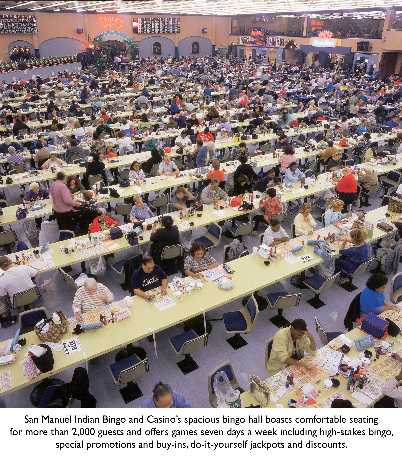
San Manuel to bring Guinness World RecordsSan Manuel Indian Bingo and Casino, and the Auto Club Speedway will be bringing the game of bingo to thousands of sports enthusiasts on Sunday, Aug. 31, when San Manuel attempts to reclaim its world title for the “Largest Bingo House.” The event will be held during the Pepsi 500 race.

San Manuel first gained the title of “Largest Bingo House” in July 2006, when it broke the Guinness World Record with more than 53,000 bingo participants at Dodger Stadium. The following year, a group in Columbia beat San Manuel's record, but now San Manuel is determined to win it back.
Comment:  For more on the subject, see The Facts About Indian Gaming.

August 24, 2008

Gaming fosters music studio

Only one Short Dawg Tha NativeRaymond "Shorty" Galvan, 30, began his journey as a singer at the tender age of 5, learning Cahuilla bird songs from his grandmother. Galvan is a member of the San Manuel Tribe of Mission Serrano Indians, and is also part Cahuilla Indian.

"I am not really using the rez life to influence my music, but I am using my music to educate about what's going on on the rez and what's going on in the world, and how I see it through my eyes," he said.

Thanks to his tribe's success in gaming and multiple business investments, he has invested his income into his love of music as the owner of Voodoo Nation Records Inc., located on the San Manuel reservation near Highland. The first notable improvement to life on the rez was the implementation of running water and electricity, he said.

August 10, 2008

The NB3 Challenge

PGA Tour Winner Notah Begay III Hosts Inaugural Golf Tournament to Benefit Native American YouthNotah Begay III, four-time PGA TOUR winner, proudly announces a first-of-its-kind golf tournament to raise awareness and funding for the improved health and wellness of Native American youth on Indian reservations nationwide. The Notah Begay III Foundation Challenge (NB3 Challenge) was conceptualized by Notah with the goal of educating the American public on the strong need within Indian communities to help children improve their lives through sport.

The event will be made possible by two Indian nations--Oneida Indian Nation of New York and San Manuel Band of Serrano Mission Indians of California--demonstrating the collaboration of tribes in donating time and resources to this important cause. The tournament further presents an opportunity to showcase the significant strides Indian nations have made in recent years to create a more promising future for their youth and their communities as a whole.

April 25, 2008

San Manuel tackles Darfur crisis

The Stars Come Out to San Manuel Casino to Support Darfur Relief

World Series of Poker(R) Champion Annie Duke and Academy Award Nominee(R) Don Cheadle Host Star Studded Event to Raise Awareness for the Darfur Crisis in AfricaOn Thursday, May 8, professional Poker player Annie Duke and Academy Award nominee(R) Don Cheadle will be onsite at San Manuel Indian Bingo and Casino in Highland. They will be hosting a celebrity Poker tournament and exclusive VIP after party to raise awareness and funds for the Ante Up For Africa project with proceeds going to the Not On Our Watch Project.

(NOOW), which was founded by actors George Clooney, Don Cheadle, Matt Damon, and Brad Pitt, has embarked to focus global attention and resources towards putting an end to mass atrocities around the world. The group has adopted the crisis in Darfur, Africa, as its inaugural campaign. Drawing on the powerful voices of artists, activists and cultural leaders, (NOOW) generates lifesaving humanitarian assistance and protection for the vulnerable, marginalized and displaced.

"The crisis in Darfur is an issue very close to my heart," said the organization's co-founder, Don Cheadle. "San Manuel understands the severity of this crisis and is helping us use the popularity of Poker to spread the word."