Showing posts with label We Shall Remain. Show all posts
Showing posts with label We Shall Remain. Show all posts
January 30, 2011
Documentary on reviving Wampanoag
In my Pictographs blog, filmmaker Anne Makepeace talks about her documentary on reviving the Wampanoag language. She was inspired by producing the After the Mayflower episode of We Shall Remain.


October 19, 2010
Traficant cites TV show for casino
Traficant cites treaty
Says 1800s document clears hurdles for casino; residents split on plan
By Kelly SmithTraficant is promoting the project for the Indigenous Tribal Affiliates of Native America and the Munsee Delaware Indian Nation, and used the meeting Tuesday to discuss the legalities.
"I'm going to talk to you about the legal grounds here. Because it's just not happenstance that it's the Munsee-Delaware Indian Tribe," Traficant said.
He went on to cite the PBS series "We Shall Remain," explaining that the Munsee-Delaware Indians sided with the Americans during the War of 1812 and signed a treaty with the United States. Traficant believes this treaty will help at the federal level, where the Munsee-Delaware tribe must be recognized in order to receive a gaming license.
"The attorneys feel the treaty that exists between the Munsee-Delaware and Uncle Sam will be significant enough to make it happen," Traficant said. Comment: This story has been floating around the Internet for the last couple weeks. It keeps getting sillier and sillier. Now Traficant is citing a treaty he saw on a TV show to justify building an Indian casino. What's next: information gleaned from his granddaughter's kindergarten assignment? If called upon to prove his claim, will Traficant say his dog ate the homework?
An earlier article referred to the Itana Indian Tribe of Utah. One problem with that story, I said. There's no such thing as the Itana Indian Tribe of Utah.
My response to that article:Someone missed the real story here. Traficant is dealing with a self-proclaimed or imaginary tribe. Is he trying to defraud the public? Or is someone trying to defraud him?
Gaming obviously isn't the story since the feds will never recognize a nonexistent tribe or take its land into trust. Judging by the latest article, I'd say Traficant is the one doing the defrauding. No one would swallow this much nonsense about Indians without checking first.
What's an ITANA?
Turns out the article was referring to ITANA (Indigenous Tribal Affiliates of Native America), an organization without a single mention on the Internet. At best it's filled with fake Indians, some of whom may have a few drops of Native blood. In other words, wannabes. At worst it's nonexistent: a fiction invented by Traficant to defraud people.
Whatever ITANA is, it's a joke. It doesn't have a chance in hell of being recognized as a tribe. At least the Munsee-Delaware Indian Tribe includes the remnants of some actual tribes. But it also doesn't have much chance of being recognized as a tribe.
Even if the War of 1812 treaty were valid, it wouldn't matter. To be recognized, a tribe has to prove its continuous political and cultural existence. Existing at one time isn't enough. That's the starting point for a multimillion-dollar research project requiring years of work to produce volumes of information, not proof by itself.
I'm pretty sure there's no Ohio Indian tribe with a valid claim to recognition. The safe bet is that the state will never have an Indian casino. If Traficant wants to place a wager on it, I'd be glad to take his money.
This story gets a Stereotype of the Month entry for its "anyone who claims to be an Indian can open a casino" presumption. Needless to say, that's wrong.
For more on the subject, see The Facts About Indian Gaming.
Says 1800s document clears hurdles for casino; residents split on plan
By Kelly Smith
"I'm going to talk to you about the legal grounds here. Because it's just not happenstance that it's the Munsee-Delaware Indian Tribe," Traficant said.
He went on to cite the PBS series "We Shall Remain," explaining that the Munsee-Delaware Indians sided with the Americans during the War of 1812 and signed a treaty with the United States. Traficant believes this treaty will help at the federal level, where the Munsee-Delaware tribe must be recognized in order to receive a gaming license.
"The attorneys feel the treaty that exists between the Munsee-Delaware and Uncle Sam will be significant enough to make it happen," Traficant said.
An earlier article referred to the Itana Indian Tribe of Utah. One problem with that story, I said. There's no such thing as the Itana Indian Tribe of Utah.
My response to that article:
Gaming obviously isn't the story since the feds will never recognize a nonexistent tribe or take its land into trust.
What's an ITANA?
Turns out the article was referring to ITANA (Indigenous Tribal Affiliates of Native America), an organization without a single mention on the Internet. At best it's filled with fake Indians, some of whom may have a few drops of Native blood. In other words, wannabes. At worst it's nonexistent: a fiction invented by Traficant to defraud people.
Whatever ITANA is, it's a joke. It doesn't have a chance in hell of being recognized as a tribe. At least the Munsee-Delaware Indian Tribe includes the remnants of some actual tribes. But it also doesn't have much chance of being recognized as a tribe.
Even if the War of 1812 treaty were valid, it wouldn't matter. To be recognized, a tribe has to prove its continuous political and cultural existence. Existing at one time isn't enough. That's the starting point for a multimillion-dollar research project requiring years of work to produce volumes of information, not proof by itself.
I'm pretty sure there's no Ohio Indian tribe with a valid claim to recognition. The safe bet is that the state will never have an Indian casino. If Traficant wants to place a wager on it, I'd be glad to take his money.
This story gets a Stereotype of the Month entry for its "anyone who claims to be an Indian can open a casino" presumption. Needless to say, that's wrong.
For more on the subject, see The Facts About Indian Gaming.
December 05, 2009
Pix of After the Mayflower
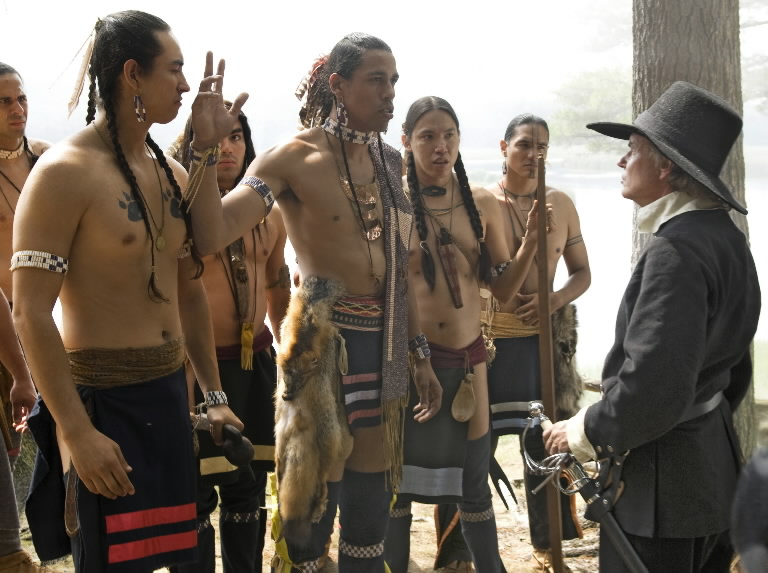
Photos of filming After the Mayflower, the first episode of PBS's We Shall Remain series, directed by Chris Eyre.
John Goff's Photos--WE SHALL REMAIN filming from July 2008
For more on the subject, see Native Documentaries and News.

John Goff's Photos--WE SHALL REMAIN filming from July 2008
For more on the subject, see Native Documentaries and News.
September 30, 2009
We Shall Remain in Utah's schools
American Indians focus of new Utah curriculum
By Wendy LeonardLike all kids in Utah, American Indian children are required by law to attend school, but they are rarely taught about their own history, culture or customs. Recent legislation aimed to change that, by footing the bill for the development of curriculum that can be taught to any age group, but specifically to students in 4th and 7th-grade Utah Studies programs.
"I think for too long the American Indian story has been considered only a 19th Century story," said Elizabeth Player, an educator hired to work with the University of Utah's American West Center to develop 24 lesson plans, including glossaries, mini-histories, interactive maps of original territories and more for Utah teachers to incorporate more of the American Indian heritage into current teaching plans. "This shows that our Utah American Indians are here, they're vital, they're living their culture. To make sure that our students are seeing that in their classrooms is going to make a big difference."
The new comprehensive study program for K-12 educators in all Utah schools delivers such tidbits as the fact that the Ute Indian tribe manages one of the largest herds of buffalo in the country, Paiute men historically grew beards when few Native Americans can, and the Navajo Nation has its own president, vice president and government apart from the United States government. And:"One of the needs of American Indian students is that they work together to figure things out," Player said. Her favorite lesson plan incorporates all five Utah tribes, focusing on the different skills they showcase such as Navajo weaving, Paiute basket making, Utah buckskin tanning, Goshute botany and Shoshone bead work. "It's engaging and provides the collaborative environment where they learn best," she said. "It's just a real fun lesson."
Lesson plans are based on KUED's production of five documentaries about the prominent tribes in Utah, "We Shall Remain: A native history of America and Utah," as the two collaborated on the major curriculum project for Utah schools. DVDs of the episodes are contained in a binder with the 24 lesson plans and other instructional materials that were recently sent out to all parochial, private, public and charter schools in the state. Workshops are also being held in various districts through December, to introduce teachers to the materials. Educators who attend the workshops receive their own grade-specific teaching materials from the American West Center's project.
"The history of Utah, and indeed of the United States, looks significantly different when viewed from the Indian perspective," said Matthew Basso, history and gender studies professor at the U. and director of the American West Center. "It is essential for students to learn about Utah's tribes' long struggles for survival and why those struggles occurred. It is just as essential for students to realize that while each of these tribes has had setbacks and tragedies, they have also had triumphs." Comment: Montana has developed a whole school curriculum about its Indian tribes. Now Utah seems to be following its lead.
Interesting to note the role of We Shall Remain in this story. PBS produced a fine series telling genuine Native stories. Now its themes and messages are filtering into the school system.
In other words, the good media is driving out the bad. Hence the need for more good media. Along with (my) criticism to ensure it remains good. <g>
For more on the subject, see Native Documentaries and News.
By Wendy Leonard
"I think for too long the American Indian story has been considered only a 19th Century story," said Elizabeth Player, an educator hired to work with the University of Utah's American West Center to develop 24 lesson plans, including glossaries, mini-histories, interactive maps of original territories and more for Utah teachers to incorporate more of the American Indian heritage into current teaching plans. "This shows that our Utah American Indians are here, they're vital, they're living their culture. To make sure that our students are seeing that in their classrooms is going to make a big difference."
The new comprehensive study program for K-12 educators in all Utah schools delivers such tidbits as the fact that the Ute Indian tribe manages one of the largest herds of buffalo in the country, Paiute men historically grew beards when few Native Americans can, and the Navajo Nation has its own president, vice president and government apart from the United States government.
Lesson plans are based on KUED's production of five documentaries about the prominent tribes in Utah, "We Shall Remain: A native history of America and Utah," as the two collaborated on the major curriculum project for Utah schools. DVDs of the episodes are contained in a binder with the 24 lesson plans and other instructional materials that were recently sent out to all parochial, private, public and charter schools in the state. Workshops are also being held in various districts through December, to introduce teachers to the materials. Educators who attend the workshops receive their own grade-specific teaching materials from the American West Center's project.
"The history of Utah, and indeed of the United States, looks significantly different when viewed from the Indian perspective," said Matthew Basso, history and gender studies professor at the U. and director of the American West Center. "It is essential for students to learn about Utah's tribes' long struggles for survival and why those struggles occurred. It is just as essential for students to realize that while each of these tribes has had setbacks and tragedies, they have also had triumphs."
Interesting to note the role of We Shall Remain in this story. PBS produced a fine series telling genuine Native stories. Now its themes and messages are filtering into the school system.
In other words, the good media is driving out the bad. Hence the need for more good media. Along with (my) criticism to ensure it remains good. <g>
For more on the subject, see Native Documentaries and News.
June 29, 2009
May 30, 2009
May 24, 2009
Reflections on We Shall Remain
A few final thoughts on PBS's We Shall Remain series:
Geographically, it covered New England, the Great Lakes, the Southeast, the Southwest, and the Great Plains. Pretty comprehensive for five episodes. The only region missing was the far West (California, the Great Basin, the Pacific Northwest, Alaska).
Historically, it covered the 17th century, 1800-1820, 1820-1840, 1870-1890, and the modern era. Again, pretty good. The only eras missing were most of the 18th century (French and Indian War, American Revolution) and the middle of the 19th century (westward expansion, Mexican War, Civil War).
Did the episodes get better as the series went on? I don't think so. In fact, I think the earlier episodes were slightly better--more thought-provoking with fewer problems.
Was Wounded Knee "among the best TV documentaries ever made," as one critic claimed? No, it wasn't even among the best documentaries of this series. It was a good documentary, but nothing that would blow most people away.
Will We Shall Remain "go a long way in repairing the woefully inadequate misrepresentations of American Indian history in the country’s educational institutions and in popular culture," as one critic predicted? Not as long as the only viewers are on PBS. If it were taught in every school in the nation, it might have an effect. But since when has PBS been able to influence the curriculum in every school in the nation?
As a whole, We Shall Remain is one of the best Native-themed series ever. All five episodes were better than average. It's right up there with The Native Americans and 500 Nations--two other fine series that challenged people's misperceptions but didn't change their minds overall.
Final ratings:
Tecumseh's Vision: 9.0.
After the Mayflower: 8.5.
Geronimo: 8.5.
Trail of Tears: 8.0.
Wounded Knee: 8.0.
For more on the subject, see Native Documentaries and News.
Tecumseh's Vision: 9.0.
After the Mayflower: 8.5.
Geronimo: 8.5.
Trail of Tears: 8.0.
Wounded Knee: 8.0.
For more on the subject, see Native Documentaries and News.
May 23, 2009
Final quotes in Wounded Knee
Continuing the discussion of Wounded Knee, the fifth episode of PBS's We Shall Remain series:
The final series of quotes ends the series on a powerful note:Despite the chaos that followed in its wake, Wounded Knee would prove to be a turning point in the history of Native people. (narrator)
We needed to let the rest of the world know what was going on. Two states over, they had no idea about Indian people. We were just invisible. We were the ones that kicked the doors open on the Indian issue and let the world see. (Madonna Thunder Hawk)
The good that came out of Wounded Knee was the entry into American Indian political life of people who had not been there before, who had not had a real voice. People learned they could tackle problems, create opportunities. And I think that coming out of Wounded Knee, people knew they could make a difference. (Robert Warrior)
There was a lot of sense of we're important, and we can do something within our own people, our own tribe, our own homes. I didn't go back to what I was doing before. I felt maybe I could do something to help not only my people, but other people. (Ken Tiger)
Native activism would spur the revitalization of Native cultures. In the years following the siege of Wounded Knee, Indians would create tribal schools, and cultural institutions, charged with preserving Indian traditions and passing them on. (narrator)
In the '60s and early '70s these were still emerging ideas, about reconnecting with traditional culture, language, religion. It was starting to happen, but this became the majority sentiment in the space of just a handful of years. It was really about identity, it was about affirming we're still here, we want to be here, and we want to be here on our own terms. (Paul Chaat Smith)
Whatever went on in '60s and '70s, it's an extension, it's a continuation. It's no different than what King Philip was about, what Crazy Horse was about. And whatever means and manner we could since the Europeans arrived here, we've had to fight for our survival. (John Trudell)
What the 1973 occupation did was, people started saying, "Hey, we're Indians. It's okay to be Indian. We are Indian. We really should be who we are."
The struggle we had in the 21st century is to remain ourselves. Every one of us has to do our part to remain Lakota, to remain Indian. And to teach our children. To teach our grandchildren. And make sure that there will be children sitting in sweat lodge, standing at the Sun Dance, in 1,000 years. (Charlotte Black Elk)
Also, it's somewhat misleading to conflate Native activism and Wounded Knee II. As I said before, Native activism began several years earlier and would've continued with or without the occupation.
Interesting that the producers found some Indians to criticize Geronimo, but couldn't find any Indians with a negative take on Wounded Knee II. In fact, no one was even willing to say "mistakes were made" or "it was a complex situation." This is what I call spinning: taking a failed occupation and turning it into the most significant event of the century.
For more on the subject, see Connections in Wounded Knee and Review of Wounded Knee.
The final series of quotes ends the series on a powerful note:
The struggle we had in the 21st century is to remain ourselves. Every one of us has to do our part to remain Lakota, to remain Indian. And to teach our children. To teach our grandchildren. And make sure that there will be children sitting in sweat lodge, standing at the Sun Dance, in 1,000 years. (Charlotte Black Elk)
Also, it's somewhat misleading to conflate Native activism and Wounded Knee II. As I said before, Native activism began several years earlier and would've continued with or without the occupation.
Interesting that the producers found some Indians to criticize Geronimo, but couldn't find any Indians with a negative take on Wounded Knee II. In fact, no one was even willing to say "mistakes were made" or "it was a complex situation." This is what I call spinning: taking a failed occupation and turning it into the most significant event of the century.
For more on the subject, see Connections in Wounded Knee and Review of Wounded Knee.
May 22, 2009
Connections in Wounded Knee
Continuing the discussion of Wounded Knee, the fifth episode of PBS's We Shall Remain series:
Here are a few random thoughts inspired by Wounded Knee.
Before turning to violence as a "last resort," the traditional Oglala Sioux exhausted their political and legal options. Here's how one woman described their everyday existence in 1973:We’ve always been peaceful, and pretty much mind our own business, making our living and raising our family, law-abiding. Don't these people belong to the "Fighting Sioux" culture? Aren't they proud of being warriors, of getting their way through violence?
Not this woman, apparently. Which goes to prove my point. Soldiers and football players may think of themselves as warriors, but housewives probably don't. The whole "fighting" bit is a stereotype, not an accurate reflection of modern Sioux culture.
The occupation is the exception that proved the rule. Every Lakota Indian except the few hundred at Wounded Knee did not resort to fighting. They continued to seek solutions through the usual political and legal channels.
The White House didn't intervene because it was distracted by Watergate. Just a few years earlier, Richard Nixon signaled a new direction for Indian affairs. Eventually he signed several pieces of landmark legislation.
This contradicts Russell Means's assertion that Indians were facing cultural extinction in 1973. In 1953 or 1963, maybe, but not 1973.
Whenever the low point was, Indians were past it by then. With the occupation of Alcatraz, the Trail of Broken Treaties, and Nixon's legislation, they were on the road to recovery. With or without Wounded Knee II, they would've continued revitalizing their cultures.
In the boarding-school segment, children sing the Ten Little Indians song over the photographs. I don't know if this was a recreation or an actual recording, but I presume Indian children were taught to sing the song.
In other words, they were forced to contribute to their own brainwashing. The song reinforced the idea that Indians were cute and childlike, not mature and sophisticated.
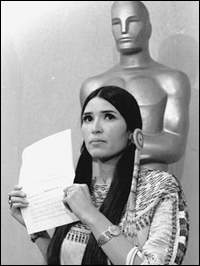
Sacheen Littlefeather gave her speech at the Oscars during the occupation. Although she talked about stereotypes in movies, Marlon Brando may have been reacting to the news. Backstage, Littlefeather (aka Maria Cruz) said Brando was heading to Wounded Knee, but he never got there.
For more on the subject, see Spinning in Wounded Knee and Review of Wounded Knee.
Here are a few random thoughts inspired by Wounded Knee.
Not this woman, apparently. Which goes to prove my point. Soldiers and football players may think of themselves as warriors, but housewives probably don't. The whole "fighting" bit is a stereotype, not an accurate reflection of modern Sioux culture.
The occupation is the exception that proved the rule. Every Lakota Indian except the few hundred at Wounded Knee did not resort to fighting. They continued to seek solutions through the usual political and legal channels.
This contradicts Russell Means's assertion that Indians were facing cultural extinction in 1973. In 1953 or 1963, maybe, but not 1973.
Whenever the low point was, Indians were past it by then. With the occupation of Alcatraz, the Trail of Broken Treaties, and Nixon's legislation, they were on the road to recovery. With or without Wounded Knee II, they would've continued revitalizing their cultures.
In other words, they were forced to contribute to their own brainwashing. The song reinforced the idea that Indians were cute and childlike, not mature and sophisticated.
For more on the subject, see Spinning in Wounded Knee and Review of Wounded Knee.
May 21, 2009
Bottom line in Wounded Knee
Continuing the discussion of Wounded Knee, the fifth episode of PBS's We Shall Remain series:
Correspondent Melvin Martin weighs in with his thoughts on the occupation:Wounded Knee: The Bottom Line
By Melvin Martin
During the siege at Wounded Knee (aka WKII), I was a 20-year old soldier assigned to a field rocket artillery unit in West Germany. My main motivation for serving in the U.S. Army as an enlistee (from 1971-1974) was that I was raised to thoroughly believe that military service was a mandatory duty for all of the able-bodied males in my family. My maternal grandfather was in the 101st Airborne Division for three years in Europe until the fall of Nazi Germany. My father served in the U.S. Air Force during the Korean War as a radio operator on B-29 reconnaissance flights over North Korea where he and his crew members took enemy fire on numerous occasions. Several uncles and older cousins also joined the Navy and the Marines in both conflicts.
As a child all of my playthings were a wide assortment of toy pistols, rifles, knives, bayonets, grenades and combat field accessories. The only game the neighborhood kids and I played with any seriousness (and for up to 12 hours as day at times) was “Army.” All of my heroes, real and cinematic, were the courageous men who fought in World War II, in both Europe and the Pacific, and especially those warriors who maintained a lone outpost against an enemy of superior numbers, firepower, and monstrously evil intent.
As a troop who had completed training and had been in the Army for about a year and a half when WKII began in February of 1973, and had first-hand knowledge of the sheer lethality of the arms and logistics that the government agents employed, I was totally amazed at how a group of poorly armed and outfitted militants could take such a stand for 71 days. On this point alone, as an ex-soldier, I will always salute AIM and their associates for their bravery at “the Knee.”
But as an enrolled member of the Oglala Sioux Tribe of Pine Ridge Agency (and one who has been considered an elder for the past six years), the sole bottom line regarding WKII is this: did the overall quality of life improve for our people after the takeover?
My answer to this question is an unequivocal NO!
In 1974, before leaving for college on the GI Bill, I took a few photos of the "downtown" Pine Ridge area. I came back in 2004 and aside from a Pizza Hut and a "Taco John's," the scenery was absolutely unchanged. These photos are a powerful metaphor to me of the extreme dysfunction of the tribe and especially of the tribal leadership. These photos tell me, every time I look at them, that we as a tribe--that we as a people--have been disastrously stuck in time.
There were a few notable changes I observed in 2004--there were more unemployed, more high school drop-outs, more Chicano-oriented Oglala gangbangers, more “Chicano-acting” ex-felons, more alcoholics, more paint sniffers, more unwed teen mothers, more packs of roving dogs (some wild), more filth, more garbage, more graffiti, more physical decay of the infrastructure and private residences, and much more sheer poverty than ever before.
There were more illiterate people, more obese people, more sick people, more crippled people, more homeless people, more mentally broken people and much, much more of the same old fat-butted leaches, slithering parasites and blood-sucking giant gnats on parade in late model cars, trucks and SUVs--bloated to the bursting point via the riches of years and years of privately accumulated wealth uncontrollably tapped from the excesses of government largesse. They waddled slowly about the “rez” with heavy, stretch-marked guts that had been shaped and formed, and hanging just inches from mid-point at the tops of their chubby thighs--from decades of unbridled nepotism, favoritism, sweetheart deals, hush money, and a myriad of graft.
The full-blooded traditional people were noticeably a lot less in number and the majority of the Oglala youth were of mixed racial identities, mainly Hispanic, white and African-American--and the lowest of low end rap was their lingua franca.
People still burned their garbage in 55-gallon drums in their backyards (or front yards) and the air was thicker with smoke and smellier than ever before.
What I saw was what I saw--and the proof was definitely in the pudding--nothing much had changed since 1973 and most aspects of life for the Oglala people had simply deteriorated horribly.
Whatever AIM had set out to do at WKII, aside from their declared objectives of an affirmation of treaty rights, an investigation into BIA corruption, and the displacement of the regime-in-power then, it was all too obvious to me that hardly anything of substance had been accomplished. If AIM and their supporters had but just one goal, to improve the lot of the Oglala people, they had failed miserably. Comment: Good point, Melvin. The Indians in Wounded Knee mainly talked about their symbolic achievement. But is that the best measure of success? If the choice was abstract symbolism or tangible prosperity, I think most people would opt for the latter.
So Wounded Knee II made Indians proud but didn't revitalize any treaties, get Dick Wilson removed, or improve Sioux lives. I guess Indian pride is priceless, or we'd be calling the occupation a failure.
For more on the subject, see Debate in Wounded Knee and Review of Wounded Knee.

Correspondent Melvin Martin weighs in with his thoughts on the occupation:
By Melvin Martin
During the siege at Wounded Knee (aka WKII), I was a 20-year old soldier assigned to a field rocket artillery unit in West Germany. My main motivation for serving in the U.S. Army as an enlistee (from 1971-1974) was that I was raised to thoroughly believe that military service was a mandatory duty for all of the able-bodied males in my family. My maternal grandfather was in the 101st Airborne Division for three years in Europe until the fall of Nazi Germany. My father served in the U.S. Air Force during the Korean War as a radio operator on B-29 reconnaissance flights over North Korea where he and his crew members took enemy fire on numerous occasions. Several uncles and older cousins also joined the Navy and the Marines in both conflicts.
As a child all of my playthings were a wide assortment of toy pistols, rifles, knives, bayonets, grenades and combat field accessories. The only game the neighborhood kids and I played with any seriousness (and for up to 12 hours as day at times) was “Army.” All of my heroes, real and cinematic, were the courageous men who fought in World War II, in both Europe and the Pacific, and especially those warriors who maintained a lone outpost against an enemy of superior numbers, firepower, and monstrously evil intent.
As a troop who had completed training and had been in the Army for about a year and a half when WKII began in February of 1973, and had first-hand knowledge of the sheer lethality of the arms and logistics that the government agents employed, I was totally amazed at how a group of poorly armed and outfitted militants could take such a stand for 71 days. On this point alone, as an ex-soldier, I will always salute AIM and their associates for their bravery at “the Knee.”
But as an enrolled member of the Oglala Sioux Tribe of Pine Ridge Agency (and one who has been considered an elder for the past six years), the sole bottom line regarding WKII is this: did the overall quality of life improve for our people after the takeover?
My answer to this question is an unequivocal NO!
In 1974, before leaving for college on the GI Bill, I took a few photos of the "downtown" Pine Ridge area. I came back in 2004 and aside from a Pizza Hut and a "Taco John's," the scenery was absolutely unchanged. These photos are a powerful metaphor to me of the extreme dysfunction of the tribe and especially of the tribal leadership. These photos tell me, every time I look at them, that we as a tribe--that we as a people--have been disastrously stuck in time.
There were a few notable changes I observed in 2004--there were more unemployed, more high school drop-outs, more Chicano-oriented Oglala gangbangers, more “Chicano-acting” ex-felons, more alcoholics, more paint sniffers, more unwed teen mothers, more packs of roving dogs (some wild), more filth, more garbage, more graffiti, more physical decay of the infrastructure and private residences, and much more sheer poverty than ever before.
There were more illiterate people, more obese people, more sick people, more crippled people, more homeless people, more mentally broken people and much, much more of the same old fat-butted leaches, slithering parasites and blood-sucking giant gnats on parade in late model cars, trucks and SUVs--bloated to the bursting point via the riches of years and years of privately accumulated wealth uncontrollably tapped from the excesses of government largesse. They waddled slowly about the “rez” with heavy, stretch-marked guts that had been shaped and formed, and hanging just inches from mid-point at the tops of their chubby thighs--from decades of unbridled nepotism, favoritism, sweetheart deals, hush money, and a myriad of graft.
The full-blooded traditional people were noticeably a lot less in number and the majority of the Oglala youth were of mixed racial identities, mainly Hispanic, white and African-American--and the lowest of low end rap was their lingua franca.
People still burned their garbage in 55-gallon drums in their backyards (or front yards) and the air was thicker with smoke and smellier than ever before.
What I saw was what I saw--and the proof was definitely in the pudding--nothing much had changed since 1973 and most aspects of life for the Oglala people had simply deteriorated horribly.
Whatever AIM had set out to do at WKII, aside from their declared objectives of an affirmation of treaty rights, an investigation into BIA corruption, and the displacement of the regime-in-power then, it was all too obvious to me that hardly anything of substance had been accomplished. If AIM and their supporters had but just one goal, to improve the lot of the Oglala people, they had failed miserably.
So Wounded Knee II made Indians proud but didn't revitalize any treaties, get Dick Wilson removed, or improve Sioux lives. I guess Indian pride is priceless, or we'd be calling the occupation a failure.
For more on the subject, see Debate in Wounded Knee and Review of Wounded Knee.
AIM's misdeeds too "complex" to cover?
Continuing the discussion of Wounded Knee, the fifth episode of PBS's We Shall Remain series:
Here's another response to the Controversy in Wounded Knee:
PBS Series Criticism Shouldn't Detract From Show's Worth
By Kevin AbourezkWhen I watched the show last week, I have to say I felt proud of the activists' efforts to gain rights for their people. My grandmother, who lives on the Pine Ridge Indian Reservation, has always told me she remembers men never wore their hair long before the American Indian Movement came to town.
The activists made Indians proud to be Indian again, she said.
But I've never really believed in the power of militant protest to affect real change. That sort of change seems born only of peaceful protest.
Still, AIM's siege focused America's attention on the plight of the American Indian. And it inspired generations of young Indians to stand up and speak out for their their rights. To this day, names like Means, Bellecourt and Banks carry a weight unfamiliar to nearly any other modern Indian leader.
That said, I recognize AIM's faults, too.
As did the makers of the PBS mini-series, I believe.
The Wounded Knee episode described how AIM ransacked a museum in the village and burned down a courthouse in Custer before driving to Wounded Knee. Those acts must not be forgotten, or minimized.
But neither should those acts be used to invalidate AIM's impact on Indian identity. Comment: I think Abourezk means AIM ransacked a trading post, not a museum.
Yes, those are the two worst things mentioned in the film. The ransacking gets 1-2 sentences in a 80-minute episode. The courthouse incident happened before Wounded Knee and therefore wasn't an outcome of Wounded Knee.
So much for AIM's misdeeds at Wounded Knee.
If the filmmakers were aware of the dozens of problems outlined in the victims' letter, they didn't mention them. I'm sure they were aware of them--but they consciously chose to ignore them and present a rosy picture instead. The word for that is propaganda.
Abourezk continues with a line of defense similar to the producers':However, this episode's intent was clearly not to comprehensively describe this confusing event but to describe the siege's place in the evolution of Indian identity and political awareness.
Because that's what good storytellers do--take a subject, hone it to a fine edge and add that human spark every great story needs. If they aim to tell every facet of a complex topic like Wounded Knee, they inevitably fail to connect to their audience.
And in losing their audience, they fail in their mission. A few comments on this:
Talking briefly about the charges of death and destruction wouldn't have muddied the narrative. But it might've muddied the message: that AIM was a heroic organization without significant flaws.
The "siege's place in the evolution of Indian identity and political awareness" includes the occupation's negative consequences. Why is it that AIM is no longer a political force, that other rebellious acts rarely occur, and that Indians are stereotyped as angry activists? Could it be because AIM went too far and partially discredited the whole idea of Indian activism?
The sanitized Wounded Knee undoubtedly will connect with audiences who want a pro-Indian message of affirmation. Those audiences probably will include many Indians and their liberal supporters.
I suspect it won't connect with the American mainstream that dislikes angry and violent activism. I suspect those audiences would prefer a more critical look at such activism. Especially if they learn about all the misdeeds the episode covered up.
Solution to the problem
But Abourezk does have a point. Describing all the complexities of the charges and countercharges would've turned viewers off. Objectively describing the death and destruction would've turned viewers off too--which is why the producers chose not to do it.
The key to this is the word "choice." The producers weren't forced to make the best of a bad situation. They chose to do this story. Therefore, they're responsible for the outcome.
The solution they were looking for was not to tell a sanitized story. Rather, they should've chosen to tell a different story.
I would've said don't go with Wounded Knee II just because it's (in)famous. And don't go with it because the Indians finally gave up without accomplishing anything except a symbolic public-relations victory. Instead, pick one of the lesser known stories where Indians triumphed without resorting to death or destruction. Perhaps one of the times they won a major court case or got landmark legislation passed in Congress.
For more on the subject, see Debate in Wounded Knee and Review of Wounded Knee.
Here's another response to the Controversy in Wounded Knee:
PBS Series Criticism Shouldn't Detract From Show's Worth
By Kevin Abourezk
The activists made Indians proud to be Indian again, she said.
But I've never really believed in the power of militant protest to affect real change. That sort of change seems born only of peaceful protest.
Still, AIM's siege focused America's attention on the plight of the American Indian. And it inspired generations of young Indians to stand up and speak out for their their rights. To this day, names like Means, Bellecourt and Banks carry a weight unfamiliar to nearly any other modern Indian leader.
That said, I recognize AIM's faults, too.
As did the makers of the PBS mini-series, I believe.
The Wounded Knee episode described how AIM ransacked a museum in the village and burned down a courthouse in Custer before driving to Wounded Knee. Those acts must not be forgotten, or minimized.
But neither should those acts be used to invalidate AIM's impact on Indian identity.
Yes, those are the two worst things mentioned in the film. The ransacking gets 1-2 sentences in a 80-minute episode. The courthouse incident happened before Wounded Knee and therefore wasn't an outcome of Wounded Knee.
So much for AIM's misdeeds at Wounded Knee.
If the filmmakers were aware of the dozens of problems outlined in the victims' letter, they didn't mention them. I'm sure they were aware of them--but they consciously chose to ignore them and present a rosy picture instead. The word for that is propaganda.
Abourezk continues with a line of defense similar to the producers':
Because that's what good storytellers do--take a subject, hone it to a fine edge and add that human spark every great story needs. If they aim to tell every facet of a complex topic like Wounded Knee, they inevitably fail to connect to their audience.
And in losing their audience, they fail in their mission.
I suspect it won't connect with the American mainstream that dislikes angry and violent activism. I suspect those audiences would prefer a more critical look at such activism. Especially if they learn about all the misdeeds the episode covered up.
Solution to the problem
But Abourezk does have a point. Describing all the complexities of the charges and countercharges would've turned viewers off. Objectively describing the death and destruction would've turned viewers off too--which is why the producers chose not to do it.
The key to this is the word "choice." The producers weren't forced to make the best of a bad situation. They chose to do this story. Therefore, they're responsible for the outcome.
The solution they were looking for was not to tell a sanitized story. Rather, they should've chosen to tell a different story.
I would've said don't go with Wounded Knee II just because it's (in)famous. And don't go with it because the Indians finally gave up without accomplishing anything except a symbolic public-relations victory. Instead, pick one of the lesser known stories where Indians triumphed without resorting to death or destruction. Perhaps one of the times they won a major court case or got landmark legislation passed in Congress.
For more on the subject, see Debate in Wounded Knee and Review of Wounded Knee.
May 20, 2009
Debate over Wounded Knee
Continuing the discussion of Wounded Knee, the fifth episode of PBS's We Shall Remain series:
Here are more details on the Controversy in Wounded Knee as reported by PBS's ombudsman Michael Getler. First, a few excerpts from the Wounded Knee Victims and Veterans Association's letter of protest:This film attempts to explain away the destruction of the village by invoking historical issues (broken treaties, Indian boarding schools, government-sponsored relocation, etc.) and by rationalizing the criminality of the perpetrators. One of the film's worst transgressions is its contemptible disregard for the real victims of Wounded Knee, the villagers who lived there. Aside from a brief statement from one of the Indian hostages, Agnes Gildersleeve, the villagers' stories are virtually absent from this film. 'Wounded Knee' does not even show how AIM systematically tore the village apart and reduced it to complete devastation. The film does not mention that AIM looted the town, stole people's personal possessions, slaughtered cattle in their bedrooms, fire-bombed their homes and vehicles, and desecrated their churches. AIM occupiers stole or destroyed a collection of priceless Indian artifacts when they pillaged the Wounded Knee museum. Rather than condemn AIM violence, 'Wounded Knee' serves as a mouthpiece for the perpetrators who spew their distortions and lies without challenge. To glorify AIM in this way is not only deceitful, it is offensive. This film cheapens genuine Indian valor and heroism.
For a documentary that purports to be about the armed takeover of a community and its consequences, these are serious shortcomings that demand a response. From a philosophical point of view, the argument that the terror, violence, theft, and loss of life associated with the razing of an Indian village were somehow justified is an argument that is fundamentally flawed and must be exposed. And:The hostages: 'Wounded Knee' leaves the false impression that the hostages were free to leave once Senators McGovern and Abourezk arrived. This is akin to people breaking into your house and holding you against your will until the authorities arrive and declare that you are now free to leave and turn over all your worldly possessions to the invaders. The truth is, the hostages were never really free, and the media presence may have been the only reason they were not further brutalized. The film fails to report Agnes Gildersleeve's statement that she would give up her home ' . . . only over my dead body. If you're going to burn my home, I'll go with it.' Nor does the film report Dennis Banks's reply, 'That can be arranged.' Agnes's only mention of her status as a hostage is relayed via her captor Russell Means. She is not shown speaking candidly about her predicament. This technique of having the criminal speak on behalf of his victim is patently biased and propagandistic. And:Film narrative: 'After stripping bare the Wounded Knee Trading Post, the village's only store, the protesters took over a local church, holding the minister and other white residents hostage.' In fact, the majority of hostages were enrolled members of various tribes. The film fails to mention that the militants later burned the Trading Post to the ground and that the hostages were threatened and intimidated into making complimentary statements about their captors when the media was present and the cameras were filming. 'Wounded Knee' completely papers over the fact that the captives were always under duress. The letter includes six pages of charges that Wounded Knee lied or misled viewers about what happened. It's worth reading if you want to understand the controversy.
The producer responds
Producer Mark Samels responded to this letter as follows:The film 'Wounded Knee' was reviewed at various stages in its production, from script treatment to final cut, by a group of prominent scholars of Native American history, who served as advisors to We Shall Remain, the ground-breaking series on Native history of which 'Wounded Knee' is a part. In addition, 'Wounded Knee' was reviewed by several program advisors who are expert in this particular chapter of Native history.
Our film was not intended to be a comprehensive history of either the American Indian Movement or the village of Wounded Knee. Instead, it was designed to focus on what happened at Wounded Knee during the 1973 occupation, and what role the siege played in the larger story of Native Americans in the 20th century. We were particularly concerned with the events preceding the siege that contributed to a sense of dislocation and desperation in many Native communities across the country. And we were interested in what effect the occupation, and its widespread media coverage, had on Indians far removed from Wounded Knee.
We believe there is ample evidence in the film of AIM's controversial use of armed confrontation and violence, from the preceding events in nearby Custer—where AIM members attacked and laid waste to the courthouse—to the sacking of a family-owned store in Wounded Knee. Archival footage featured in the film clearly shows devastation in the village during the siege, as Mayor Dick Wilson characterizes AIM members as 'hoodlums' and 'clowns.' As one of the interviewees states in the film, 'Where AIM goes, chaos often follows.'
Our producers took great pains to be even-handed in the portrayal of the siege at Wounded Knee. This is a difficult piece of American history and we believe our film presents it with the care and complexity it deserves. A few comments on this:
The four previous films took place in the distant past, when the number of observers was small and historical records were fragmentary. That's why the episodes had to rely on the informed opinions of historians.
In contrast, many of the participants at Wounded Knee are still alive. There's little or no excuse for not seeking out a wide range of testimony, including the Natives and non-Natives whom the occupation victimized.
With all the "prominent scholars" and "program advisors" consulted, how many of them were non-Natives who opposed the occupation? One or two?
Judging by the on-screen testimony, the pro-occupation forces outnumbered the anti-occupation forces by about 10-1. PBS may think that's fair, but I don't.
The prior events in the town of Custer don't tell us anything about how the occupiers acted at Wounded Knee. The "sacking" of the store was mentioned only in passing. The archival footage featured in the film did not clearly show anything I'd label as "devastation." The two comments Samels quoted are about the only negative statements uttered about AIM.
In short, I'd give Samels a fail on his "great pains to be even-handed." Trail of Tear seemed evenhanded in contrasting Major and John Ridge vs. John Ross. Wounded Knee was mostly propaganda. Well-done propaganda about an important issue, to be sure, but propaganda nonetheless.
The ombudsman responds
Ombudsman Michael Getler responds to Samels:In his response, Samels mentions twice that the series was reviewed by "a group of prominent scholars of Native American history" and by "several program advisors who are expert in this particular chapter of Native history." Having said that, it seems to me that PBS ought to present Trimbach's complaints to these scholars or, even better, a small group of scholars not connected to the program, for some kind of more detailed reply. This might take a while but it seems worth it, especially since there are a lot of teaching materials associated with the series.
Samels is also almost certainly correct that this film "was not intended to be a comprehensive history of either the American Indian Movement or the village of Wounded Knee." Nevertheless, this is PBS, where people, and students, look for authenticity, and the segment on Wounded Knee is likely to be at the forefront of material on the subject for a long time. So going back and taking a second look at these challenges, responding more fully, and making changes, at least online, if warranted, seems worthwhile to me. I'd say Getler is putting it very mildly. I don't know how many schools are planning on using We Shall Remain in class, but this could be the most prominent work on Wounded Knee for a generation. I'd say PBS should address the charges and publish a response to them. Post it on the website, put it in the next edition of the DVD, or both.
If PBS were really brave, it could include the text of the victims' letter--as an addendum, appendix, or bonus feature. If Samels thinks he covered the occupation's negative side, he should have no objection to this additional information. The information can't contradict the film unless the film was wrong, right?
Once again, I'm not saying all the victims' charges are valid. I'm saying PBS was negligent by not even mentioning the charges (and countercharges). It'll be more negligent if it lets schools use Wounded Knee without further elaboration.
For more on the subject, see Spinning in Wounded Knee and Review of Wounded Knee.
Here are more details on the Controversy in Wounded Knee as reported by PBS's ombudsman Michael Getler. First, a few excerpts from the Wounded Knee Victims and Veterans Association's letter of protest:
For a documentary that purports to be about the armed takeover of a community and its consequences, these are serious shortcomings that demand a response. From a philosophical point of view, the argument that the terror, violence, theft, and loss of life associated with the razing of an Indian village were somehow justified is an argument that is fundamentally flawed and must be exposed.
The producer responds
Producer Mark Samels responded to this letter as follows:
Our film was not intended to be a comprehensive history of either the American Indian Movement or the village of Wounded Knee. Instead, it was designed to focus on what happened at Wounded Knee during the 1973 occupation, and what role the siege played in the larger story of Native Americans in the 20th century. We were particularly concerned with the events preceding the siege that contributed to a sense of dislocation and desperation in many Native communities across the country. And we were interested in what effect the occupation, and its widespread media coverage, had on Indians far removed from Wounded Knee.
We believe there is ample evidence in the film of AIM's controversial use of armed confrontation and violence, from the preceding events in nearby Custer—where AIM members attacked and laid waste to the courthouse—to the sacking of a family-owned store in Wounded Knee. Archival footage featured in the film clearly shows devastation in the village during the siege, as Mayor Dick Wilson characterizes AIM members as 'hoodlums' and 'clowns.' As one of the interviewees states in the film, 'Where AIM goes, chaos often follows.'
Our producers took great pains to be even-handed in the portrayal of the siege at Wounded Knee. This is a difficult piece of American history and we believe our film presents it with the care and complexity it deserves.
In contrast, many of the participants at Wounded Knee are still alive. There's little or no excuse for not seeking out a wide range of testimony, including the Natives and non-Natives whom the occupation victimized.
With all the "prominent scholars" and "program advisors" consulted, how many of them were non-Natives who opposed the occupation? One or two?
Judging by the on-screen testimony, the pro-occupation forces outnumbered the anti-occupation forces by about 10-1. PBS may think that's fair, but I don't.
In short, I'd give Samels a fail on his "great pains to be even-handed." Trail of Tear seemed evenhanded in contrasting Major and John Ridge vs. John Ross. Wounded Knee was mostly propaganda. Well-done propaganda about an important issue, to be sure, but propaganda nonetheless.
The ombudsman responds
Ombudsman Michael Getler responds to Samels:
Samels is also almost certainly correct that this film "was not intended to be a comprehensive history of either the American Indian Movement or the village of Wounded Knee." Nevertheless, this is PBS, where people, and students, look for authenticity, and the segment on Wounded Knee is likely to be at the forefront of material on the subject for a long time. So going back and taking a second look at these challenges, responding more fully, and making changes, at least online, if warranted, seems worthwhile to me.
If PBS were really brave, it could include the text of the victims' letter--as an addendum, appendix, or bonus feature. If Samels thinks he covered the occupation's negative side, he should have no objection to this additional information. The information can't contradict the film unless the film was wrong, right?
Once again, I'm not saying all the victims' charges are valid. I'm saying PBS was negligent by not even mentioning the charges (and countercharges). It'll be more negligent if it lets schools use Wounded Knee without further elaboration.
For more on the subject, see Spinning in Wounded Knee and Review of Wounded Knee.
May 19, 2009
Spinning in Wounded Knee
Continuing the discussion of Wounded Knee, the fifth episode of PBS's We Shall Remain series:
In First Look at We Shall Remain, I commented on the Wounded Knee episode, saying:I didn't sense any criticism of AIM or the Wounded Knee occupation. It looks as though Dennis Banks, Russell Means, John Trudell et al. are spinning this incident as a grand gesture of Native power and independence. In response, Mark Anquoe of AIM West wrote:I would argue that incidents like Wounded Knee, the Alcatraz occupation, the Mount Rushmore occupation, and the BIA office takeover were grand gestures of Native power and independence. That is certainly not meant to imply that the actions of AIM, UNA or IOAT were beyond reproach in any way. Many mistakes and missteps were made by many people, both leaders and followers. That however, does not change the fact that these events are now symbols of Native power and independence. If one cares to look deeper into any historical incident or figure, it always becomes quickly apparent that real life events are more complex than the historical symbols they become, and real life human beings are more fallible than the leaders into which they morph in a community's retrospective consciousness.
As such, I think its unfair of you to imply that Wounded Knee could only be a symbol of Native power and independence by way of the deceitful tactics of a spin doctoring. First of all, I believe "spinning" is a shortened form of "putting a positive spin" on something. FDR was spinning the Great Depression when he said, "The only thing we have to fear but fear itself." Bush was spinning his invasion of Iraq when he stood before the "Mission Accomplished" sign.
You could say both were trying to rally Americans to the cause. Or you could say both were trying minimize (cover up) the disheartening news. But I don't think they were literally trying to deceive the public. They were trying to shade the truth--to sugar-coat it.
If you ask me, a liar is someone who says black is white. In contrast, a spin doctor says gray is really off-off white. I'd say there's a difference.
In short, I don't think spinning is always negative. I definitely don't think it's always deceitful.
On to Wounded Knee
I agree with you that Wounded Knee II, Alcatraz, etc. were grand gestures and symbols of Native power and independence. I didn't mean to say they weren't.
Perhaps I should've said, "Dennis Banks, Russell Means, John Trudell et al. are spinning this incident as a grand gesture of Native power and independence and nothing else." In other words, they're saying Wounded Knee II was a positive event with no negative repercussions--no downside.
Having watched the episode, I'd say my impression was right. The AIM leaders did spin Wounded Knee as a grand gesture of Native power and independence and nothing else. They didn't say one word about the lives lost, the property destroyed, or AIM's implosion as a political force. The narrator hinted at a few negatives, but they didn't.
I understand what they were doing; it's probably not wise to admit malfeasance on camera. And I agree about Wounded Knee's symbolic importance. But I still say their comments were spinning. A more honest appraisal would've gone something like this:We did a lot of stupid things. Things I regret and would make amends for if I could. It's no excuse, but we were young and feeling our oats. It was our first taste of political power.
But still, it was a grand gesture of Native power and independence. Wounded Knee saw a group of Indians with hunting rifles standing up against the mechanized armed forces of the United States. The spirit of those Indians is what we value, regardless of the controversial circumstances that brought them there. If my position still isn't clear, compare your comments to theirs. Although you were a bit vague, you noted the problems at Wounded Knee. They didn't.
I'd say you put a positive spin on Wounded Knee. They put a much more positive spin on it. The critics put a wholly negative spin on it. I, of course, have presented both sides fairly and impartially. <g>
For more on the subject, see Controversy in Wounded Knee and Review of Wounded Knee.
In First Look at We Shall Remain, I commented on the Wounded Knee episode, saying:
As such, I think its unfair of you to imply that Wounded Knee could only be a symbol of Native power and independence by way of the deceitful tactics of a spin doctoring.
You could say both were trying to rally Americans to the cause. Or you could say both were trying minimize (cover up) the disheartening news. But I don't think they were literally trying to deceive the public. They were trying to shade the truth--to sugar-coat it.
If you ask me, a liar is someone who says black is white. In contrast, a spin doctor says gray is really off-off white. I'd say there's a difference.
In short, I don't think spinning is always negative. I definitely don't think it's always deceitful.
On to Wounded Knee
I agree with you that Wounded Knee II, Alcatraz, etc. were grand gestures and symbols of Native power and independence. I didn't mean to say they weren't.
Perhaps I should've said, "Dennis Banks, Russell Means, John Trudell et al. are spinning this incident as a grand gesture of Native power and independence and nothing else." In other words, they're saying Wounded Knee II was a positive event with no negative repercussions--no downside.
Having watched the episode, I'd say my impression was right. The AIM leaders did spin Wounded Knee as a grand gesture of Native power and independence and nothing else. They didn't say one word about the lives lost, the property destroyed, or AIM's implosion as a political force. The narrator hinted at a few negatives, but they didn't.
I understand what they were doing; it's probably not wise to admit malfeasance on camera. And I agree about Wounded Knee's symbolic importance. But I still say their comments were spinning. A more honest appraisal would've gone something like this:
But still, it was a grand gesture of Native power and independence. Wounded Knee saw a group of Indians with hunting rifles standing up against the mechanized armed forces of the United States. The spirit of those Indians is what we value, regardless of the controversial circumstances that brought them there.
I'd say you put a positive spin on Wounded Knee. They put a much more positive spin on it. The critics put a wholly negative spin on it. I, of course, have presented both sides fairly and impartially. <g>
For more on the subject, see Controversy in Wounded Knee and Review of Wounded Knee.
May 18, 2009
Controversy in Wounded Knee
In Review of Wounded Knee, I critiqued the storytelling aspects of the fifth episode of PBS's We Shall Remain series. Now I'll concentrate on the content.
Except for some minor quibbles with After the Mayflower, no one has protested the authenticity of the We Shall Remain episodes. Until now, that is. Wounded Knee has elicited some angry responses:
We Shall Remain: Wounded KneeI've seen this film and am sad to report it is full of distortions, half-truths, and outright falsehoods. Many Indians are disappointed with how this film was put together. The producer, Stanley Nelson, shows that he has an agenda in favor of the perpetrators, leaders of the American Indian Movement (AIM). In this highly offensive throwback to AIM terror and violence, the old guard leaders are free to lie and distort without challenge or balance. The real victims of Wounded Knee, the villagers who lived there and who lost everything they owned, are nearly invisible in this film. Most of them were Indians. It's laughable to hear old fart Russell Means speak on behalf of his victim, Agnes Gildersleeve, who was always under duress to say nice things about her captor when the cameras were rolling. Nelson chose to omit any footage of the devastation visited upon the village during its 71-day demise. There's nothing about Ray Robinson who was shot in the leg by an AIM leader and left to die. Anna Mae Pictou Aquash, another AIM victim, was written out the script as well. Check IndianCountryNews.com for the latest on this developing story of how PBS was hoodwinked into fronting for this film. "Wounded Knee" is mostly a predictable montage of vintage AIM propaganda. It makes a mockery of true Indian heroism shown in previous segments. News Alert: PBS Accused of Distorting Indian HistoryA group calling themselves The Wounded Knee Victims and Veterans Association (WKVAVA) has issued a scathing letter to Paula Kerger, president and CEO of PBS. The letter, faxed to PBS headquarters on May 10, accuses the organization of fronting what the group says is a distorted film on Indian history, the last in the "American Experience--We Shall Remain" series. The film, entitled "Wounded Knee," describes the occupation of the historic village in 1973 by members and supporters of the American Indian Movement (AIM). Wounded Knee, the site of an Indian massacre in 1890, sits near the southern border of the Pine Ridge Reservation in South Dakota. The FBI and the U.S. Marshal Service erected roadblocks around the small town after AIM members looted the store, set fires, and shot at responding emergency crews. AIM leaders held 11 residents hostage. The occupation lasted 71 days as government lawyers tried to negotiate a peaceful end to the hostilities. The conflict left the village in shambles. Two occupiers were shot to death, although rumors persist that several victims were murdered behind the scenes during heated arguments and interrogations.
The group charges PBS with failure to hold "Wounded Knee" to PBS standards for editorial integrity, fairness, and historical accuracy. Many of the association's complaints center on the film's lack of information about the Wounded Knee villagers. "The real victims of Wounded Knee were the people who lived there," said Joe Trimbach, author of the book, American Indian Mafia (americanindianmafia.com). 'Most of the residents were Indians. They lost everything they owned and yet they are invisible in this film. It doesn't even show the devastation.' Upon learning that PBS had omitted his book from their bibliography, Trimbach contacted their legal department. PBS has since added Trimbach's book to the list. 'We call Mafia, 'The history book they do not want you to read.' Well, here's a good example. We try to tell the truth about what happened and some people don't want to hear it.' Reality check: It's true Wounded Knee says nothing about the town being devastated or in shambles. But this press release doesn't tell us much either. Exactly how much property was "devastated"? Were these wanton acts of destruction or the inevitable results of housing an occupying army for 71 days? Were the victims innocent villagers or GOON squad members who harassed and intimidated innocent villagers?
Without more information, we're left with a "he said, she said" situation. One side offers pro-occupation propaganda and the other offers anti-occupation propaganda.
"Demolition" of Wounded KneeJoAnn Gildersleeve Feraca, daughter of Wounded Knee residents Clive and Agnes Gildersleeve, recalled what it was like to watch the steady demolition of her community while the media appeared oblivious to the destruction. 'The reporters did one of the worst disservices to real news gathering that I have ever seen. The media wanted to film a western. They created the good guys and the bad guys, and never even had to pay for ruined property and lives. And now we have a film from PBS that pays homage to the perpetrators all over again. My parents suffered greatly at the hands of their assailants. They were taken hostage. Their trading post store was burned to the ground. They even stole my mother's wedding ring and gold bracelet. My parents lost everything they had spent a lifetime building.' Reality check: Wounded Knee says the protesters "stripped" the Gildersleeves' store, but doesn't say why. It avoids more inflammatory words such as "robbed" or "pillaged."
If they "stripped" the store to feed their people or to pay the Gildersleeves back for years of unfair store policies, someone could strain to justify that morally. But it's hard to imagine a reason for taking Mrs. Gildersleeve's wedding ring or burning down the store.
Here the victims' group has a point. I don't know what really happened, but Wounded Knee doesn't even mention the protesters' grievances or actions against the Gildersleeves' store. This is the mark of a propaganda piece.
As for the hostages, Wounded Knee quotes Mrs. Gildersleeve saying they weren't hostages and she feared the feds coming in and killing everyone. The person above claims she said this because Russell Means was standing nearby and intimidating her. Without more information, this is another "he said, she said" situation.
Deaths of suspected spiesPaul DeMain, editor of News from Indian Country (IndianCountryNews.com), said that parts of the film "take us to a well-charted fantasyland" because it fails to hold AIM accountable. 'AIM leaders Dennis Banks, Russell Means, and Madonna Thunderhawk [all featured in the film] are named co-conspirators in several murders, like that of civil rights worker Perry Ray Robinson.' Robinson, a colleague of Martin Luther King, was said to be the only black man inside the village during that period of the occupation. AIM is believed to have buried his body near Wounded Knee Creek in an effort to keep his death a secret. Added DeMain, 'These same AIM leaders were involved in the execution of Annie Mae Pictou Aquash. They are not heroes. Several people tried to warn Producer Stanley Nelson and PBS about this. They chose to ignore us.' The group has called for justice for Robinson and for Pictou Aquash who was murdered in 1975 because AIM leaders mistakenly thought she was a government informant. Pictou Aquash was also at Wounded Knee but does not appear in the film. Reality check: Wounded Knee mentions that the FBI had sources of information--i.e., spies--within the occupation. This made the protesters suspicious and paranoid about each other. It led to "purported cases of people who disappeared, and were killed."
That's a pretty weak statement for what could well be murder. Note the passive tense. Who did the killing...the people whom the documentary is painting as noble warriors?
Wounded Knee didn't have to take DeMain's position and denounce AIM's leaders as executioners. But it spent 10 minutes on historical subjects that were only tangential to the occupation. It could've spent a couple of minutes presenting both sides of the issue.
After the occupation
Pictou Aquash died after the occupation was over. According to Wounded Knee, two FBI agents and more than 60 AIM supporters were killed in the following three years. Meanwhile, the government filed more than 500 indictments against AIM members--most of which it later dropped. AIM fell into disarray and violent infighting and would never again have the same impact.
These statements are terribly vague. Who killed the 60-plus AIM supporters? Rogue federal agents? Rogue AIM members? Regular AIM members acting at the behest of AIM's leaders? Or...? Was this part of the "violent infighting," or was that something else?
The two dead FBI agents presumably were the ones Leonard Peltier was convicted of killing. Yet Wounded Knee doesn't mention Peltier. If you're going to talk about the occupation's legacy, isn't his case part of it?
The episode wasn't obligated to cover the occupation's aftermath in depth. But the fact that some of the on-camera speakers were "named co-conspirators in several murders" seems significant. How do you avoid mentioning something about that?
Again, the episode wasn't obligated to take the victims' position. But at least present the controversy. Say so-and-so was accused of complicity in murder and so-and-so denies it. Don't ignore the issue as if it doesn't exist.
All in all, the victims' group has a valid argument. Wounded Knee downplayed or ignored several significant controversies. It gave us too much propaganda and not enough hard facts.
For more on the subject, see Native Documentaries and News.
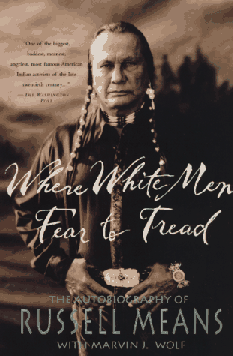
Except for some minor quibbles with After the Mayflower, no one has protested the authenticity of the We Shall Remain episodes. Until now, that is. Wounded Knee has elicited some angry responses:
We Shall Remain: Wounded Knee
The group charges PBS with failure to hold "Wounded Knee" to PBS standards for editorial integrity, fairness, and historical accuracy. Many of the association's complaints center on the film's lack of information about the Wounded Knee villagers. "The real victims of Wounded Knee were the people who lived there," said Joe Trimbach, author of the book, American Indian Mafia (americanindianmafia.com). 'Most of the residents were Indians. They lost everything they owned and yet they are invisible in this film. It doesn't even show the devastation.' Upon learning that PBS had omitted his book from their bibliography, Trimbach contacted their legal department. PBS has since added Trimbach's book to the list. 'We call Mafia, 'The history book they do not want you to read.' Well, here's a good example. We try to tell the truth about what happened and some people don't want to hear it.'
Without more information, we're left with a "he said, she said" situation. One side offers pro-occupation propaganda and the other offers anti-occupation propaganda.
"Demolition" of Wounded Knee
If they "stripped" the store to feed their people or to pay the Gildersleeves back for years of unfair store policies, someone could strain to justify that morally. But it's hard to imagine a reason for taking Mrs. Gildersleeve's wedding ring or burning down the store.
Here the victims' group has a point. I don't know what really happened, but Wounded Knee doesn't even mention the protesters' grievances or actions against the Gildersleeves' store. This is the mark of a propaganda piece.
As for the hostages, Wounded Knee quotes Mrs. Gildersleeve saying they weren't hostages and she feared the feds coming in and killing everyone. The person above claims she said this because Russell Means was standing nearby and intimidating her. Without more information, this is another "he said, she said" situation.
Deaths of suspected spies
That's a pretty weak statement for what could well be murder. Note the passive tense. Who did the killing...the people whom the documentary is painting as noble warriors?
Wounded Knee didn't have to take DeMain's position and denounce AIM's leaders as executioners. But it spent 10 minutes on historical subjects that were only tangential to the occupation. It could've spent a couple of minutes presenting both sides of the issue.
After the occupation
Pictou Aquash died after the occupation was over. According to Wounded Knee, two FBI agents and more than 60 AIM supporters were killed in the following three years. Meanwhile, the government filed more than 500 indictments against AIM members--most of which it later dropped. AIM fell into disarray and violent infighting and would never again have the same impact.
These statements are terribly vague. Who killed the 60-plus AIM supporters? Rogue federal agents? Rogue AIM members? Regular AIM members acting at the behest of AIM's leaders? Or...? Was this part of the "violent infighting," or was that something else?
The two dead FBI agents presumably were the ones Leonard Peltier was convicted of killing. Yet Wounded Knee doesn't mention Peltier. If you're going to talk about the occupation's legacy, isn't his case part of it?
The episode wasn't obligated to cover the occupation's aftermath in depth. But the fact that some of the on-camera speakers were "named co-conspirators in several murders" seems significant. How do you avoid mentioning something about that?
Again, the episode wasn't obligated to take the victims' position. But at least present the controversy. Say so-and-so was accused of complicity in murder and so-and-so denies it. Don't ignore the issue as if it doesn't exist.
All in all, the victims' group has a valid argument. Wounded Knee downplayed or ignored several significant controversies. It gave us too much propaganda and not enough hard facts.
For more on the subject, see Native Documentaries and News.
May 17, 2009
Review of Wounded Knee
Here's my review of Wounded Knee, the fifth episode of the PBS series We Shall Remain. In this part I'll concentrate on the storytelling aspects.
Wounded Knee was written by Marcia Smith and directed by Stanley Nelson. I don't think they're Native, but they are well-qualified. The episode takes the same pro-Indian approach as the previous ones.
Wounded Knee consists mainly of archival film footage, archival photos, and talking-heads interviews with the people involved. No real problems here.
The episode starts with some overly portentous talk. Indians were doomed, it implies, unless they rose up and fought at Wounded Knee. Here's Russell Means:We were about to be obliterated culturally. Our spiritual way of life, our entire way of life, was about to be stamped out. And this was a rebirth of our dignity and self-pride. And here's the narration:The protesters called for a federal investigation of corruption on reservations in South Dakota and immediate Senate hearings on broken treaties with Indian nations. But as we quickly learn, Wounded Knee II was really about the corrupt administration of Oglala Sioux chairman Dick Wilson. While that may have been a life-and-death issue on the Pine Ridge reservation, it didn't threaten America's other 500-plus tribes. The opening rhetoric is somewhat overblown.
The controversy
The occupation of Wounded Knee has generated much controversy. The protesters were heroes and martyrs, the protesters were thugs and criminals, etc. Wounded Knee mainly takes the former position and glides over the ensuing charges and countercharges.
Critics of Wounded Knee II have said this episode is nothing but propaganda. Well, yes and no. I'd say it takes a pro-Indian position, but that's been true of all the We Shall Remain episodes. They've emphasized the positive and deemphasized the negative.
Maybe Wounded Knee is 80% positive whereas other episodes were "only" 70% or 60% positive. But filmmakers are allowed to have a point of view. Indeed, it's basically unavoidable.
The question is whether Wounded Knee has omitted any significant information. Not being a student of the occupation, I don't know about that. I'll cover the issue in an upcoming posting.
I questioned choosing Wounded Knee as a subject, but now I have a sense of why they did it. The Lakota-oriented story lets them mention Plains Indian stereotypes, the Wounded Knee massacre, and the end of the Indian wars. It also let them bring the narrative up to date: the boarding-school era, relocation and assimilation, and the resurgent '60s.
Still, they could've covered the last century of developments using other subjects as well. And they would've avoided the critics' attacks on We Shall Remain's credibility. So I'm not convinced their choice was the best one.
The lack of drama
In the middle of the narrative, Wounded Knee devotes about six minutes to boarding schools and three to relocation. Since the occupation dragged on for 71 days, this is perhaps understandable. But it points to a problem with focusing on Wounded Knee II. For most of the occupation, not that much happened.
The boarding-school segment is illustrated with ledger-style animations drawn in a childlike fashion. These drawings show Native children being forced onto buses, having their hair cut, etc. Unfortunately, they're too crude and primitive to convey the horror of the events. Live-action recreations with screaming children probably would've been more expensive, but they would've worked better.
About half the episode focuses on the occupation's first 3-4 days, when tensions were at a boiling point. Nobody knew if the feds would invade and a battle would break out.
But for the last eight or so weeks of the ten-week occupation, people merely hunkered in their bunkers, waiting. In the end, the occupiers gave up without having their key demands met. They had to settle for meetings and talks that inevitably produced nothing.
In short, Wounded Knee II wasn't that dramatic of a story. Again, it was a problematical choice for the final episode.
Wounded Knee ends with some soaring rhetoric about the occupation's importance, but again I don't quite buy it. The episode suffers from a common problem in documentaries. The filmmakers have chosen to spend huge amounts of time and money making the film, so they have to convince viewers the subject is critical. Hence it becomes the central event in history to the exclusion of everything else.
In Native Nations: Standing Together, the 1960s protests and the Trail of Broken Treaties were the turning points in modern Native history. In Alcatraz Is Not an Island, the occupation of Alcatraz was the turning point in modern Native history. In any documentary on Indian gaming, the Cabazon decision and the passage of IGRA were the turning points in modern Native history.
You see what I mean? These events happened on a continuum of change. There was no one turning point. Any documentary that suggests otherwise is somewhat misleading.
Conclusion
Don't get me wrong. Wounded Knee is a fine documentary on an important subject. But for the reasons stated above, I wouldn't say it was the best TV documentary ever. Unlike some critics, I wouldn't even say it was the best episode of We Shall Remain. Rob's rating: 8.0 of 10.
For more on the subject, see Native Documentaries and News.

The controversy
Critics of Wounded Knee II have said this episode is nothing but propaganda. Well, yes and no. I'd say it takes a pro-Indian position, but that's been true of all the We Shall Remain episodes. They've emphasized the positive and deemphasized the negative.
Maybe Wounded Knee is 80% positive whereas other episodes were "only" 70% or 60% positive. But filmmakers are allowed to have a point of view. Indeed, it's basically unavoidable.
The question is whether Wounded Knee has omitted any significant information. Not being a student of the occupation, I don't know about that. I'll cover the issue in an upcoming posting.
Still, they could've covered the last century of developments using other subjects as well. And they would've avoided the critics' attacks on We Shall Remain's credibility. So I'm not convinced their choice was the best one.
The lack of drama
But for the last eight or so weeks of the ten-week occupation, people merely hunkered in their bunkers, waiting. In the end, the occupiers gave up without having their key demands met. They had to settle for meetings and talks that inevitably produced nothing.
In short, Wounded Knee II wasn't that dramatic of a story. Again, it was a problematical choice for the final episode.
In Native Nations: Standing Together, the 1960s protests and the Trail of Broken Treaties were the turning points in modern Native history. In Alcatraz Is Not an Island, the occupation of Alcatraz was the turning point in modern Native history. In any documentary on Indian gaming, the Cabazon decision and the passage of IGRA were the turning points in modern Native history.
You see what I mean? These events happened on a continuum of change. There was no one turning point. Any documentary that suggests otherwise is somewhat misleading.
Conclusion
Don't get me wrong. Wounded Knee is a fine documentary on an important subject. But for the reasons stated above, I wouldn't say it was the best TV documentary ever. Unlike some critics, I wouldn't even say it was the best episode of We Shall Remain. Rob's rating: 8.0 of 10.
For more on the subject, see Native Documentaries and News.
May 16, 2009
Alternatives in Geronimo
Continuing the discussion of Geronimo, the fourth episode of PBS's We Shall Remain series:
It's always interesting to me to think of how history could've been different, and the We Shall Remain series has provided a lot of fodder for this.
Geronimo's story happened much too late to stem the tide of US history. But it's possible he and the Chiricahuas could've preserved most or all of their Apacheria homeland. Let's see how it could've happened.
First, there's the scenario in Jake Page's Apacheria, which I've mentioned before:In this riveting, action-packed alternate history, the Apaches forge their own bold nation and enter the world of racketeering and politics--all the while maintaining their traditional ways--as a new neighbor to a United States that will never be the same again....
In 1884 only one thing stood in the way of United States expansion: the Apaches. The U.S. Army believed it could easily defeat this ragtag band of savages who viewed one another more as rivals than allies. But one of those "savages" was a military genius: Juh, "He Who Sees Ahead." It was Juh's vision that persuaded the various tribal leaders to set aside their differences and work together, thus turning the disconnected bands of warring Apaches into the most cohesive fighting force the West had ever seen--and crushing the invading army.
Thus was born Apacheria--the Apache Nation--and a world where Juh and his son, Little Spring, matched wits and weapons with a cast ranging from Teddy Roosevelt and Carrie Nation to Al Capone and J. Edgar Hoover. A world where it was best to stand with the Apaches, and never against them.... In short, Arizona in the 1880s was up for grabs like the Ohio Valley in the 1810s. Apacheria postulates that Juh could've played a role similar to Tecumseh's, who almost led his confederacy to victory.
In reality, Juh died just before the events of this novel. I don't know if he had the "vision thing" or could've united the disparate bands. But the Apacheria scenario itself is plausible. If not Juh, someone could've done it. Perhaps another Apache leader whose life was cut short.
The Chiricahuas' first agreement with the Americans fell apart after Cochise died. If he had lived a few years longer, the outcome might've been different.
Dreaming away the whites
Nochaydelklinne (called the Dreamer in Geronimo) was leading an Apache revival similar to Tenskwatawa's when he was killed in an Army attack. If he had survived, he could've been a unifying force. His movement was spiritual, but a military leader like Tecumseh could've wielded the bands as a weapon.
A website describes Nochaydelklinne's effect on the Apaches:For ten years, Nochaydelklinne dreamed his way into the subconscious of his people, arousing them to a fervor of devotion and trust. He was probably of the White Mountain band, although different scholars tell different ancestry. It is know that he stayed among the San Carlos and Fort Apache reservations, and he had become the center of revival-type Apache gatherings which preached that the whites would soon be driven away and that two chiefs would soon return from the dead. This caused great excitement among the bands and led to the Ghost Dance, which caused so much worry to the Army.
The Apaches were not one tribe as in other cultures. They were independent bands, and some of them were bitter enemies. The government refused to recognize this distinction, and when it forced a number of bands from Arizona and New Mexico together onto the San Carlos Reservation, it was only a matter of time before hostilities erupted. As the Apache watched in growing desperation, they became crowded with their enemies, whites overran their lands, and dishonest agents sold their rations, forcing them to go hungry. Apaches everywhere accepted the promises of Nochaydelklinne.
By 1881, Nochaydelklinne was a full-fledged prophet attracting larger and larger crowds. ... Already, Apaches who had previously been mortal enemies were beginning to fraternize. Scouts, who received passes from the Army to attend the revivals, overstayed their time and returned to camp exhausted, surly, and insubordinate, which was totally out of character because they had been completely loyal and trustworthy. Geronimo was corralled the second time because Tzoe ("Peaches") returned to San Carlos and told the Army his position. Geronimo could've prevented this by killing Tzoe--or, better yet, by treating him kindly.
More to the point, or if Gerinomo hadn't forced Chief Loco's people to accompany him, he wouldn't have had to worry about betrayal by disgruntled Chiricahuas. He might've been able to go on fighting and fleeing for years.
Finally, Geronimo probably doomed his chances with his death-dealing tactics. It doesn't seem likely that the US ever would've let a "vicious killer" roam free.
But what if Geronimo had done the opposite a la Robin Hood? Robbing the rich and giving to the poor, fighting the tyrannical government while helping the suffering settlers, acting nobly and never killing people unnecessarily. He probably would've gained more support as a folk hero than a villain--perhaps enough to earn a measure of freedom.
For more possible scenarios, see Was Native Defeat Inevitable? For more on Geronimo, see American Views in Geronimo and Review of Geronimo.
It's always interesting to me to think of how history could've been different, and the We Shall Remain series has provided a lot of fodder for this.
Geronimo's story happened much too late to stem the tide of US history. But it's possible he and the Chiricahuas could've preserved most or all of their Apacheria homeland. Let's see how it could've happened.
In 1884 only one thing stood in the way of United States expansion: the Apaches. The U.S. Army believed it could easily defeat this ragtag band of savages who viewed one another more as rivals than allies. But one of those "savages" was a military genius: Juh, "He Who Sees Ahead." It was Juh's vision that persuaded the various tribal leaders to set aside their differences and work together, thus turning the disconnected bands of warring Apaches into the most cohesive fighting force the West had ever seen--and crushing the invading army.
Thus was born Apacheria--the Apache Nation--and a world where Juh and his son, Little Spring, matched wits and weapons with a cast ranging from Teddy Roosevelt and Carrie Nation to Al Capone and J. Edgar Hoover. A world where it was best to stand with the Apaches, and never against them....
In reality, Juh died just before the events of this novel. I don't know if he had the "vision thing" or could've united the disparate bands. But the Apacheria scenario itself is plausible. If not Juh, someone could've done it. Perhaps another Apache leader whose life was cut short.
Dreaming away the whites
A website describes Nochaydelklinne's effect on the Apaches:
The Apaches were not one tribe as in other cultures. They were independent bands, and some of them were bitter enemies. The government refused to recognize this distinction, and when it forced a number of bands from Arizona and New Mexico together onto the San Carlos Reservation, it was only a matter of time before hostilities erupted. As the Apache watched in growing desperation, they became crowded with their enemies, whites overran their lands, and dishonest agents sold their rations, forcing them to go hungry. Apaches everywhere accepted the promises of Nochaydelklinne.
By 1881, Nochaydelklinne was a full-fledged prophet attracting larger and larger crowds. ... Already, Apaches who had previously been mortal enemies were beginning to fraternize. Scouts, who received passes from the Army to attend the revivals, overstayed their time and returned to camp exhausted, surly, and insubordinate, which was totally out of character because they had been completely loyal and trustworthy.
More to the point, or if Gerinomo hadn't forced Chief Loco's people to accompany him, he wouldn't have had to worry about betrayal by disgruntled Chiricahuas. He might've been able to go on fighting and fleeing for years.
But what if Geronimo had done the opposite a la Robin Hood? Robbing the rich and giving to the poor, fighting the tyrannical government while helping the suffering settlers, acting nobly and never killing people unnecessarily. He probably would've gained more support as a folk hero than a villain--perhaps enough to earn a measure of freedom.
For more possible scenarios, see Was Native Defeat Inevitable? For more on Geronimo, see American Views in Geronimo and Review of Geronimo.
May 15, 2009
American views in Geronimo
Continuing the discussion of Geronimo, the fourth episode of PBS's We Shall Remain series:
When Geronimo was running loose, Americans considered him a vicious killer. But once they caught him, their attitudes changed. The following quotes tell the tale:In a few short years, Americans came to view Geronimo in an entirely new way. When he had first arrived in Florida, crowds gathered at the prison to gawk at the wickedest Indian who ever lived. Eight years later, as Geronimo was being taken from Alabama to Oklahoma, crowds gathered again. This time they came to cheer a national hero.
What had changed was America itself. Geronimo’s surrender had ended the Indian Wars that had raged for nearly three centuries. (Narration)
Once that moment is perceived to be over, there is almost an immediate turn to a kind of nostalgic sensibility. Boy, you know, those were the days, right when we faced off against these challenging, dangerous Indian opponents. Gosh, I miss those times. (Philip J. Deloria)
Once the despised savage, Geronimo was now the valiant warrior who had held out against impossible odds. (Narration)
By the 20th century, Geronimo comes to stand for some of the values we hold most dear in America. The lone battler, the champion of his people, the guy who never gives up, the ultimate underdog.
He becomes an icon, a sentimental icon, of what was once a real enemy. And there’s something amazingly American about that transformation. (Historian)
While other Chiricahuas were kept under guard, Geronimo was allowed to travel. He attended expositions, and appeared in Wild West shows. (Narration)
Geronimo adopting, or seen to adopt, American culture represents a major symbolic victory. American civilization has arrived. Even Geronimo is now embracing it. (Historian)
1) Indians joined our culture (albeit unwillingly). They're part of us now. We've proved ourselves superior, so they saw the error of their ways. Now they're civilized instead of savages, just like us.
2) Indians were fierce and warlike--a "challenging, dangerous" foe. We had to be even stronger and tougher to defeat them. But we did it. Our victory over these "honored warriors" proves we're the greatest warriors of all.
As I said in Smashing People: :The "Honor" of Being an Athlete, if we really wanted to honor ferocious fighters, we'd honor those who almost defeated us: the Nazi blitzkreig, the Viet Cong, the jihadi terrorists. But these warriors showcased our weaknesses as well as our strengths. We didn't get to parade them to show how much better we were than them.
In other words, they punctured the myth of America's invincibility. They demonstrated that determined foes can beat the American fighting machine, at least temporarily. Hence they can't be our mascots. They're not tough in a primitive, outdated sort of way like our quaint li'l Indian savages.
Think of the macho type of man who walks down the street with a Doberman or pit bull on a leash. This is exactly the mentality embodied in an Indian mascot. "I have a mighty dog on my leash" is the same as "I have a mighty Indian on my logo." They're both ferocious creatures, but we tamed them. Now they belong to us.
For more on the subject, see Apache Views in Geronimo and Review of Geronimo.
Below: "Honoring" Indians as noble losers.
When Geronimo was running loose, Americans considered him a vicious killer. But once they caught him, their attitudes changed. The following quotes tell the tale:
What had changed was America itself. Geronimo’s surrender had ended the Indian Wars that had raged for nearly three centuries. (Narration)
He becomes an icon, a sentimental icon, of what was once a real enemy. And there’s something amazingly American about that transformation. (Historian)
1) Indians joined our culture (albeit unwillingly). They're part of us now. We've proved ourselves superior, so they saw the error of their ways. Now they're civilized instead of savages, just like us.
2) Indians were fierce and warlike--a "challenging, dangerous" foe. We had to be even stronger and tougher to defeat them. But we did it. Our victory over these "honored warriors" proves we're the greatest warriors of all.
As I said in Smashing People: :The "Honor" of Being an Athlete, if we really wanted to honor ferocious fighters, we'd honor those who almost defeated us: the Nazi blitzkreig, the Viet Cong, the jihadi terrorists. But these warriors showcased our weaknesses as well as our strengths. We didn't get to parade them to show how much better we were than them.
In other words, they punctured the myth of America's invincibility. They demonstrated that determined foes can beat the American fighting machine, at least temporarily. Hence they can't be our mascots. They're not tough in a primitive, outdated sort of way like our quaint li'l Indian savages.
Think of the macho type of man who walks down the street with a Doberman or pit bull on a leash. This is exactly the mentality embodied in an Indian mascot. "I have a mighty dog on my leash" is the same as "I have a mighty Indian on my logo." They're both ferocious creatures, but we tamed them. Now they belong to us.
For more on the subject, see Apache Views in Geronimo and Review of Geronimo.
Below: "Honoring" Indians as noble losers.
May 14, 2009
Apache views in Geronimo
Continuing the discussion of Geronimo, the fourth episode of PBS's We Shall Remain series:
With Geronimo finally in captivity, the US made a cruel decision. It would send the entire Chiricahua Apache tribe, including people who had lived peacefully at Turkey Creek and scouts who had faithfully served the Army to Florida. Five hundreds Chiricahuas, just a quarter of the tribe's former population, boarded a train. "They were all paying a terrible price for Geronimo’s brave but stubborn resistance," says the narration.
In Florida, families were separated. Children taken to boarding school. People used to the dry mountain air began dying of tropical diseases. Altogether 119 of the 500 died within three years.
As Geronimo notes, the Chiricahuas would spend 27 years as prisoners of war. Even so, the state of Arizona refused to allow them to return to their homeland. Eventually, the US relocated them to Fort Sill, Oklahoma, where many of them still live.
For more on the subject, see Fort Sill Apache Tribe--History.
The filmmakers speak
The filmmakers have made a big deal about getting both sides of Geronimo's story. Here's what they said:
Producer Profile: Dustinn Craig and Sarah ColtEarly on Craig and Colt decided to be as respectful and inclusive as possible in this project. They also had to figure out how to tackle what Craig called a “general tribal cynicism” in some Natives communities. Some Apaches when they learned of PBS‘s interest in such a documentary responded with: “Let me guess, it’s about Geronimo, right?” or “Oh, Geronimo again. Don’t you get enough of Geronimo?”
To overcome this skepticism, the duo decided that their film would not tell the story of the Chiricahuas by exploring just one man. They wanted to include the perspectives of others attached to the story, whether that included good or bad reflections of Geronimo.
“I think we, right to the very end of the project, wanted to portray a real, living and breathing person. We struggled to understand him,” Colt said. “He was a very complicated person.”
Part of the film also discussed how Geronimo was viewed by his community. At times, Geronimo was not as popular among his people as he is portrayed in today’s history books. The film also tackles his band’s raid on villages while being hunted down by the U.S. Cavalry. I think Craig and Colt are kidding themselves a bit. The Apaches guessed they would focus on Geronimo and they did. Though they discussed Cochise a little and mention Juh a few times, the show was basically about Geronimo.
True, they included "the perspectives of others attached to the story, whether that included good or bad reflections of Geronimo." So it was a reasonably balanced look at Geronimo. But it basically did "tell the story of the Chiricahuas by exploring just one man." We get little sense of what the Chiricahuas and other Apaches were doing if they weren't fleeing with Geronimo.
True, Geronimo's renegade actions became the biggest part of the Chiricahua story. And they tell us something important about US-Indian relations. But it's not clear that Geronimo's story is the most representative or informative one. Focusing on another Chiricahua leader might've told us more about what the Chiricahuas were going through.
Of course, focusing on Cochise or Juh or someone else wouldn't have earned PBS as much publicity or financial support. For marketing reasons, therefore, it was valid to focus on Geronimo rather than someone less well-known but more representative. But if that's the case, say so. Don't spin it as some broad-based look at the Chiricahuas when you barely mention anyone except Geronimo.
Apaches speak
The end of Geronimo includes a brief evaluation of his role in history. Three Chiricahua Apaches utter the following comments:Apache people suffered because of him. We all suffered with him.
Most of the tribe were angry with him, and they blamed him. We don’t look at him as a hero.
Well, he killed a lot of people. Why is he remembered when he did all these bad things? It’s because he put a mark on the American people. He put a scar on them. The narration sums up the situation:While other Apaches remained in the Southwest, the Chiricahua had paid dearly for Geronimo’s resistance. They were never allowed home. And...that's it.
The Chiricahuas have a right to be mad. The US wouldn't have relocated them to Florida if Geronimo hadn't gone on a rampage. It's human nature to blame the troublemaker in situations like these.
But the American response was irrational and immoral. Who would've guessed that the US would ship off people who had no connection to Geronimo except an accident of birth? To imprison people who had done exactly what the US wanted, who had even helped the US capture Geronimo, was unthinkable. Neither Geronimo nor anyone else could've predicted this.
Sure, you can blame Geronimo. But the larger portion of blame should go to the Americans. Apparently the US wanted to grind the Chiricahuas into the ground--to wipe out their existence as a functioning tribal entity. How else to explain keeping them as POWs for 27 years? Excluding Leonard Peltier, that must be the longest time American-born persons have been held as political prisoners.
The filmmakers could've interviewed lots of Apaches and other Indians to get a fuller picture of Geronimo's place in history. Instead, they gave us a few paltry quotes from the specific people Geronimo harmed. As a bold reexamination of Geronimo, this episode fails.
Rob speaks
Heck, even my opinion would've added some spice. My evaluation of Geronimo would go like this:
Early in his career, he seemed to be fighting for a cause: his people's freedom. As time went on, he started fighting more and more for himself. He went from being a revolutionary or a freedom fighter to an anarchist or nihilist.
In that sense he's something like Che Guevara or the people who launched the French Revolution. Their ideals may have been good, but harsh circumstances turned them bad. We remember them for their abstract ideals even as we condemn them for their actual crimes.
Similarly, people should remember Geronimo for what he represents: the never-say-die fighting spirit that drove him to challenge the US again and again. We can honor that spirit even as we condemn the man for his moral failings. We should encourage people to challenge the powers-that-be, to rise up against authority, whenever truth and justice demand it.
For more on the subject, see Rampaging in Geronimo and Review of Geronimo.

With Geronimo finally in captivity, the US made a cruel decision. It would send the entire Chiricahua Apache tribe, including people who had lived peacefully at Turkey Creek and scouts who had faithfully served the Army to Florida. Five hundreds Chiricahuas, just a quarter of the tribe's former population, boarded a train. "They were all paying a terrible price for Geronimo’s brave but stubborn resistance," says the narration.
In Florida, families were separated. Children taken to boarding school. People used to the dry mountain air began dying of tropical diseases. Altogether 119 of the 500 died within three years.
As Geronimo notes, the Chiricahuas would spend 27 years as prisoners of war. Even so, the state of Arizona refused to allow them to return to their homeland. Eventually, the US relocated them to Fort Sill, Oklahoma, where many of them still live.
For more on the subject, see Fort Sill Apache Tribe--History.
The filmmakers speak
The filmmakers have made a big deal about getting both sides of Geronimo's story. Here's what they said:
Producer Profile: Dustinn Craig and Sarah Colt
To overcome this skepticism, the duo decided that their film would not tell the story of the Chiricahuas by exploring just one man. They wanted to include the perspectives of others attached to the story, whether that included good or bad reflections of Geronimo.
“I think we, right to the very end of the project, wanted to portray a real, living and breathing person. We struggled to understand him,” Colt said. “He was a very complicated person.”
Part of the film also discussed how Geronimo was viewed by his community. At times, Geronimo was not as popular among his people as he is portrayed in today’s history books. The film also tackles his band’s raid on villages while being hunted down by the U.S. Cavalry.
True, they included "the perspectives of others attached to the story, whether that included good or bad reflections of Geronimo." So it was a reasonably balanced look at Geronimo. But it basically did "tell the story of the Chiricahuas by exploring just one man." We get little sense of what the Chiricahuas and other Apaches were doing if they weren't fleeing with Geronimo.
True, Geronimo's renegade actions became the biggest part of the Chiricahua story. And they tell us something important about US-Indian relations. But it's not clear that Geronimo's story is the most representative or informative one. Focusing on another Chiricahua leader might've told us more about what the Chiricahuas were going through.
Of course, focusing on Cochise or Juh or someone else wouldn't have earned PBS as much publicity or financial support. For marketing reasons, therefore, it was valid to focus on Geronimo rather than someone less well-known but more representative. But if that's the case, say so. Don't spin it as some broad-based look at the Chiricahuas when you barely mention anyone except Geronimo.
Apaches speak
The end of Geronimo includes a brief evaluation of his role in history. Three Chiricahua Apaches utter the following comments:
Most of the tribe were angry with him, and they blamed him. We don’t look at him as a hero.
Well, he killed a lot of people. Why is he remembered when he did all these bad things? It’s because he put a mark on the American people. He put a scar on them.
The Chiricahuas have a right to be mad. The US wouldn't have relocated them to Florida if Geronimo hadn't gone on a rampage. It's human nature to blame the troublemaker in situations like these.
But the American response was irrational and immoral. Who would've guessed that the US would ship off people who had no connection to Geronimo except an accident of birth? To imprison people who had done exactly what the US wanted, who had even helped the US capture Geronimo, was unthinkable. Neither Geronimo nor anyone else could've predicted this.
Sure, you can blame Geronimo. But the larger portion of blame should go to the Americans. Apparently the US wanted to grind the Chiricahuas into the ground--to wipe out their existence as a functioning tribal entity. How else to explain keeping them as POWs for 27 years? Excluding Leonard Peltier, that must be the longest time American-born persons have been held as political prisoners.
The filmmakers could've interviewed lots of Apaches and other Indians to get a fuller picture of Geronimo's place in history. Instead, they gave us a few paltry quotes from the specific people Geronimo harmed. As a bold reexamination of Geronimo, this episode fails.
Rob speaks
Heck, even my opinion would've added some spice. My evaluation of Geronimo would go like this:
Early in his career, he seemed to be fighting for a cause: his people's freedom. As time went on, he started fighting more and more for himself. He went from being a revolutionary or a freedom fighter to an anarchist or nihilist.
In that sense he's something like Che Guevara or the people who launched the French Revolution. Their ideals may have been good, but harsh circumstances turned them bad. We remember them for their abstract ideals even as we condemn them for their actual crimes.
Similarly, people should remember Geronimo for what he represents: the never-say-die fighting spirit that drove him to challenge the US again and again. We can honor that spirit even as we condemn the man for his moral failings. We should encourage people to challenge the powers-that-be, to rise up against authority, whenever truth and justice demand it.
For more on the subject, see Rampaging in Geronimo and Review of Geronimo.
May 13, 2009
Rampaging in Geronimo
Continuing the discussion of Geronimo, the fourth episode of PBS's We Shall Remain series:
Geronimo had agreed to stay on the San Carlos reservation a second time. For two years it seemed peace had arrived. Most of the Chiricahuas felt settled. But not Geronimo. He didn’t like farming and felt pushed around by white officials. Finally, he had had enough.
Let's note that most of the Chiricahuas had been settled for a decade or more. Even Geronimo had lived on the rez for six years. At this point I don't see how Geronimo could've claimed he was fighting for his people's freedom--not that he claimed that, of course.
In 1885, Geronimo and 150 Chiricahuas fled their homes in Turkey Creek. US troops pursued. It was Geronimo's third flight from servility.
According to Geronimo, the Indians killed anyone who crossed their path. Otherwise the survivors would inform the Army. "It was terrible to see little children killed," someone says, "but soldiers killed our children too."
At one point Geronimo feigned friendship with a rancher. After feasting on mutton, he shot and stabbed the host and his wife and children. He would’ve killed a White Mountain Apache family living on the ranch too, but members of his band intervened, forcing him to back down.
Historian Philip J. Deloria's take on this rampage:He was driven, and his people were driven, to such a sense of desperation and futility and humiliation, that striking back in anger could take, oftentimes, really quite awfully horrific sorts of forms.
You don’t take over a continent in an easy way, and you don't give up a continent without fighting hard. So there’s a long history that everyone understands, that that’s what the fight's about and it's going to be bloody and awful and violent and painful. Most of the settlers in Southwest now saw Geronimo as simply a vicious killer. Every time someone got raided or killed, they blamed the Chiricahuas, even if they were far away. That’s because Geronimo was bragging about his accomplishments.
But by 1886, even Geronimo was getting tired of running. Morale was low and a sense of doom hung over the Chiricahua resistance. Geronimo negotiated terms of surrender with General Crook. If Geronimo's people spent two years in an East Coast prison, they could return to Arizona.
One last fling
Incredibly, Geronimo changed his mind and fled a fourth time. No one knows what he might've been thinking. "I don’t think he had a coherent plan for a survival strategy to last a decade," someone says.
"He gave no quarter to anyone, and asked no favors," said the narration.The terror, the psychological trauma, that Geronimo wrought at the end created this fantasy, the great American Western fantasy: surrounded by Indians, they’re going to kill us all. Ranchers pleaded with the White House for protection. Journalists flocked to Southwest and provided lurid and riveting accounts of the fugitives. The headlines included:Atrocities
Butchered
Bloodthirsty
Terrorism prevails
$2,000 for his head
Geronimo’s Death Demanded Because Crook had allowed Geronimo to escape, federal officials replaced him with General Miles. He requested thousands of reinforcements. This leads to a massive manhunt: 5,000 US troops, 3,000 Mexican troops, and 1,000 vigilantes against 39 Chiricahua fugitives.
Yet they never succeed in capturing a single man, woman, or child. "If that isn’t brilliant," someone says, "nothing is."
The narration sums up the popular view of Geronimo:That’s when he really becomes the most famous Indian in the West, and in the phrase of the day, the worst Indian who ever lived.
Geronimo assumes an important symbolic status. His resistance is seen as the last resistance, not only of Chiricahua Apache people, but of Indian people in North America. After a few months of this, Geronimo finally surrendered to Miles. This time it was for good.
A few thoughts
In his last two rampages, Geronimo acted like a criminal who's escaped from prison. People in this position often don't flee quietly to another state or country, which would be the smart thing to do. Instead, they go on a shooting spree, practically daring the authorities to catch them. This kind of irrational macho fever seems to have gripped Geronimo.
Of course, I'm sure the episode has exaggerated Geronimo's responsibility for everything that happened. At one point it mentions that Geronimo was Chief Juh's spokesman, but later Geronimo seems to be making the decisions and Juh is following him. This is what happens when you focus on one person's story.
I don't think the episode mentions any other Apache warriors--e.g., Mangas Coloradas, Victorio, Nana--by name. What were their roles and motivations in the Chiricahua resistance? Were they fighting for a principle or for personal reasons?
It's a shame Geronimo doesn't give us any death tolls or estimates. How many American soldiers and civilians did the Chiricahuas kill in raids and battles? How many Apache warriors and noncombatants did the Americans kill? This would give us a better sense of whether the response was proportional to the stimuli.
When people say Chiricahuas, Apaches, or Indians are "savage," how much of this feeling is based on Geronimo's final spree? A lot of it, apparently, even though only a few Chiricahuas were involved involved. Geronimo did some bad things, but it's grossly unfair to tar other Indians with the same broad brush.
For all the times Geronimo surrendered, it's interesting that the US didn't put him on trial or execute him summarily. Instead, it treated him as a prisoner of war. I wonder what's the story behind that.
Did the Americans calculate that Geronimo would go on fighting unless they took the death penalty off the table? Were they worried that legal proceedings would expose their official misconduct? A shrewd lawyer might've blamed the US for breaking its treaties and turning Geronimo into an enemy. Did they sincerely think Geronimo deserved to be treated as a POW rather than a criminal? Perhaps they didn't have enough evidence to convict him, or knew the charges against him were exaggerated.
If the people who knew Geronimo personally didn't execute him as a murderer, I don't think we should call him a murderer. Not without a few asterisks, at least. He was a complex figure, just as the show asserted.
For more on the subject, see Resistance in Geronimo and Review of Geronimo.
P.S. I'm guessing Geronimo didn't go around bare-chested shooting stone-tipped arrows most of the time.
Geronimo had agreed to stay on the San Carlos reservation a second time. For two years it seemed peace had arrived. Most of the Chiricahuas felt settled. But not Geronimo. He didn’t like farming and felt pushed around by white officials. Finally, he had had enough.
Let's note that most of the Chiricahuas had been settled for a decade or more. Even Geronimo had lived on the rez for six years. At this point I don't see how Geronimo could've claimed he was fighting for his people's freedom--not that he claimed that, of course.
In 1885, Geronimo and 150 Chiricahuas fled their homes in Turkey Creek. US troops pursued. It was Geronimo's third flight from servility.
According to Geronimo, the Indians killed anyone who crossed their path. Otherwise the survivors would inform the Army. "It was terrible to see little children killed," someone says, "but soldiers killed our children too."
At one point Geronimo feigned friendship with a rancher. After feasting on mutton, he shot and stabbed the host and his wife and children. He would’ve killed a White Mountain Apache family living on the ranch too, but members of his band intervened, forcing him to back down.
Historian Philip J. Deloria's take on this rampage:
You don’t take over a continent in an easy way, and you don't give up a continent without fighting hard. So there’s a long history that everyone understands, that that’s what the fight's about and it's going to be bloody and awful and violent and painful.
But by 1886, even Geronimo was getting tired of running. Morale was low and a sense of doom hung over the Chiricahua resistance. Geronimo negotiated terms of surrender with General Crook. If Geronimo's people spent two years in an East Coast prison, they could return to Arizona.
One last fling
Incredibly, Geronimo changed his mind and fled a fourth time. No one knows what he might've been thinking. "I don’t think he had a coherent plan for a survival strategy to last a decade," someone says.
"He gave no quarter to anyone, and asked no favors," said the narration.
Butchered
Bloodthirsty
Terrorism prevails
$2,000 for his head
Geronimo’s Death Demanded
Yet they never succeed in capturing a single man, woman, or child. "If that isn’t brilliant," someone says, "nothing is."
The narration sums up the popular view of Geronimo:
Geronimo assumes an important symbolic status. His resistance is seen as the last resistance, not only of Chiricahua Apache people, but of Indian people in North America.
A few thoughts
In his last two rampages, Geronimo acted like a criminal who's escaped from prison. People in this position often don't flee quietly to another state or country, which would be the smart thing to do. Instead, they go on a shooting spree, practically daring the authorities to catch them. This kind of irrational macho fever seems to have gripped Geronimo.
Of course, I'm sure the episode has exaggerated Geronimo's responsibility for everything that happened. At one point it mentions that Geronimo was Chief Juh's spokesman, but later Geronimo seems to be making the decisions and Juh is following him. This is what happens when you focus on one person's story.
I don't think the episode mentions any other Apache warriors--e.g., Mangas Coloradas, Victorio, Nana--by name. What were their roles and motivations in the Chiricahua resistance? Were they fighting for a principle or for personal reasons?
It's a shame Geronimo doesn't give us any death tolls or estimates. How many American soldiers and civilians did the Chiricahuas kill in raids and battles? How many Apache warriors and noncombatants did the Americans kill? This would give us a better sense of whether the response was proportional to the stimuli.
When people say Chiricahuas, Apaches, or Indians are "savage," how much of this feeling is based on Geronimo's final spree? A lot of it, apparently, even though only a few Chiricahuas were involved involved. Geronimo did some bad things, but it's grossly unfair to tar other Indians with the same broad brush.
For all the times Geronimo surrendered, it's interesting that the US didn't put him on trial or execute him summarily. Instead, it treated him as a prisoner of war. I wonder what's the story behind that.
Did the Americans calculate that Geronimo would go on fighting unless they took the death penalty off the table? Were they worried that legal proceedings would expose their official misconduct? A shrewd lawyer might've blamed the US for breaking its treaties and turning Geronimo into an enemy. Did they sincerely think Geronimo deserved to be treated as a POW rather than a criminal? Perhaps they didn't have enough evidence to convict him, or knew the charges against him were exaggerated.
If the people who knew Geronimo personally didn't execute him as a murderer, I don't think we should call him a murderer. Not without a few asterisks, at least. He was a complex figure, just as the show asserted.
For more on the subject, see Resistance in Geronimo and Review of Geronimo.
P.S. I'm guessing Geronimo didn't go around bare-chested shooting stone-tipped arrows most of the time.
May 12, 2009
Resistance in Geronimo
Continuing the discussion of Geronimo, the fourth episode of PBS's We Shall Remain series:
Relocation
As we learned in Freedom Fighters in Geronimo, Cochise and the Chiricahua Apaches had agreed to live in peace on their ancestral homeland. The narrative continues:
With minimal interference from the US, the Apaches lived much as they always had, raiding into Mexico for horses and supplies. Two years later, Cochise died, and the agreement with the Americans was put at risk.
Cochise's death was an irreplaceable loss to the Chiricahuas but an opportunity to the US. With him gone, the Americans decided to move the Chiricahuas 150 miles north to a mosquito-ridden reservation called San Carlos. This would open the valuable Chiricahua land to American mining and settlement, and appease the Mexicans, who were fed up with Apache raiding.
The Chiricahuas reluctantly agreed to move. Geronimo said he'd go with them, but that night, he fled with Chief Juh and 700 Chiricahuas. It was the first of several times he would flee.
Unfortunately, he soon rode into a carefully-laid trap. Apache scouts surrounded him and the US forces carted him back to San Carlos in chains.
He thought they would execute him, but eventually they released him. But they forced him to wear an identity tag, attend a daily headcount, and obtain a pass to go anywhere. They ordered him to dig ditches and plant vegetables like a farmer, even though the land was poor. For four years he endured this unsatisfying life.
The Dreamer
In 1881, the Apaches were drawn to the startling message of a charismatic medicine man, called the Dreamer. A former military scout well-versed in American ways, he urged a return to traditional Apache life. Apaches came from miles around to attend his ceremonies.Apaches should not take revenge against the white man, the Dreamer said. Usen would see that the Americans suffered for their sins in the afterlife. It was a plea for unity and peace for a people who had seen little of either. San Carlos officials feared the medicine man might incite a revolt. They sent soldiers and Apache scouts to arrest or kill him. The Dreamer was wounded in a firefight. Enraged at the attack a on peaceful medicine man, the scouts turned their guns on the soldiers. When the battle was over, seven soldiers, 17 Apaches, and the Dreamer were dead.
The scouts who had "mutinied" were hanged. The New York Times called it a massacre as bad as Custer's Last Stand. The anxious Army called for reinforcements and soon San Carlos was swarming with soldiers. No one felt more endangered than Geronimo.
Thinking the Army would kill him next, Geronimo escaped and headed south with Juh and 72 Chiricahuas. In the Apache stronghold, Geronimo joined the greatest Apache force assembled since Cochise. It was the beginning of five years of bloody Chiricahua resistance--the last Indian war. They were the only Indians still fighting the US Army.
No more Mr. Nice Guy
We don't know the motivations of the other Apaches. But at this point, we can speculate about Geronimo's. He had lived in peace at San Carlos for four years, which implies some acceptance of the status quo. Unlike Tecumseh, he hadn't been a leader with a vision of tribal unity and independence. It seems his motives were mainly selfish: to stay alive and free.
Fearing for his life would be a valid reason to keep fighting the Army, but it wouldn't justify murder or mutilation. The episode doesn't say how "bloody" the rebellion was, but I presume some civilians died. Geronimo was losing the moral high ground his people had once occupied. Before the struggle had been to preserve Apache sovereignty; now it was to preserve himself.
Geronimo cemented this sense of entitlement when he came up with an audacious plan. Worried that he couldn't last long with his small force, he returned to San Carlos and abducted 400 Chiricahuas led by Chief Loco. They would join the resistance or he would shoot them.
Geronimo led Loco and his band on a harrowing trip to the stronghold. On the way, they fell into a Mexican ambush and 78 Apaches were killed. The survivors blamed Geronimo. "We were filled with gloom and despair," said one. "What had we done to be treated so cruelly by our own race?"
Life in the stronghold was hard. One Apache called Tzoe or Peaches returned to San Carlos on his own. Soldiers strung him up until he told them where Geronimo was.
When the Army breached the Apache stronghold, it was a shattering psychological blow. Geronimo had a premonition that the game was up. Reluctantly he and his followers agreed to return to San Carlos.
Summing it up
There's no excuse for kidnapping your own people and forcing them to join your crusade. Loco's followers wanted to settle down and that was their right. Geronimo didn't have the right to superimpose his wishes on theirs.
Not only was his plan immoral and inhumane, it was just plain dumb. If Geronimo couldn't convince the Apaches to join him voluntarily, he didn't have much of a chance. Loco's people wouldn't have fought bravely under duress. Rather, they would've hindered or ruined the runaways' efforts. When your goal is to move silently and swiftly, you don't want hundreds of malcontents getting in the way. They're only going to stall, complain, and threaten to leave.
So Geronimo's excuses for killing people were pretty much done. He'd have a hard time arguing he was fighting a war when his people were settling down, joining the Army as scouts, and hunting him like a common criminal. No, his glory days were definitely over.
For more on the subject, see Freedom Fighters in Geronimo and Review of Geronimo.
Relocation
As we learned in Freedom Fighters in Geronimo, Cochise and the Chiricahua Apaches had agreed to live in peace on their ancestral homeland. The narrative continues:
With minimal interference from the US, the Apaches lived much as they always had, raiding into Mexico for horses and supplies. Two years later, Cochise died, and the agreement with the Americans was put at risk.
Cochise's death was an irreplaceable loss to the Chiricahuas but an opportunity to the US. With him gone, the Americans decided to move the Chiricahuas 150 miles north to a mosquito-ridden reservation called San Carlos. This would open the valuable Chiricahua land to American mining and settlement, and appease the Mexicans, who were fed up with Apache raiding.
The Chiricahuas reluctantly agreed to move. Geronimo said he'd go with them, but that night, he fled with Chief Juh and 700 Chiricahuas. It was the first of several times he would flee.
Unfortunately, he soon rode into a carefully-laid trap. Apache scouts surrounded him and the US forces carted him back to San Carlos in chains.
He thought they would execute him, but eventually they released him. But they forced him to wear an identity tag, attend a daily headcount, and obtain a pass to go anywhere. They ordered him to dig ditches and plant vegetables like a farmer, even though the land was poor. For four years he endured this unsatisfying life.
The Dreamer
In 1881, the Apaches were drawn to the startling message of a charismatic medicine man, called the Dreamer. A former military scout well-versed in American ways, he urged a return to traditional Apache life. Apaches came from miles around to attend his ceremonies.
The scouts who had "mutinied" were hanged. The New York Times called it a massacre as bad as Custer's Last Stand. The anxious Army called for reinforcements and soon San Carlos was swarming with soldiers. No one felt more endangered than Geronimo.
Thinking the Army would kill him next, Geronimo escaped and headed south with Juh and 72 Chiricahuas. In the Apache stronghold, Geronimo joined the greatest Apache force assembled since Cochise. It was the beginning of five years of bloody Chiricahua resistance--the last Indian war. They were the only Indians still fighting the US Army.
No more Mr. Nice Guy
We don't know the motivations of the other Apaches. But at this point, we can speculate about Geronimo's. He had lived in peace at San Carlos for four years, which implies some acceptance of the status quo. Unlike Tecumseh, he hadn't been a leader with a vision of tribal unity and independence. It seems his motives were mainly selfish: to stay alive and free.
Fearing for his life would be a valid reason to keep fighting the Army, but it wouldn't justify murder or mutilation. The episode doesn't say how "bloody" the rebellion was, but I presume some civilians died. Geronimo was losing the moral high ground his people had once occupied. Before the struggle had been to preserve Apache sovereignty; now it was to preserve himself.
Geronimo cemented this sense of entitlement when he came up with an audacious plan. Worried that he couldn't last long with his small force, he returned to San Carlos and abducted 400 Chiricahuas led by Chief Loco. They would join the resistance or he would shoot them.
Geronimo led Loco and his band on a harrowing trip to the stronghold. On the way, they fell into a Mexican ambush and 78 Apaches were killed. The survivors blamed Geronimo. "We were filled with gloom and despair," said one. "What had we done to be treated so cruelly by our own race?"
Life in the stronghold was hard. One Apache called Tzoe or Peaches returned to San Carlos on his own. Soldiers strung him up until he told them where Geronimo was.
When the Army breached the Apache stronghold, it was a shattering psychological blow. Geronimo had a premonition that the game was up. Reluctantly he and his followers agreed to return to San Carlos.
Summing it up
There's no excuse for kidnapping your own people and forcing them to join your crusade. Loco's followers wanted to settle down and that was their right. Geronimo didn't have the right to superimpose his wishes on theirs.
Not only was his plan immoral and inhumane, it was just plain dumb. If Geronimo couldn't convince the Apaches to join him voluntarily, he didn't have much of a chance. Loco's people wouldn't have fought bravely under duress. Rather, they would've hindered or ruined the runaways' efforts. When your goal is to move silently and swiftly, you don't want hundreds of malcontents getting in the way. They're only going to stall, complain, and threaten to leave.
So Geronimo's excuses for killing people were pretty much done. He'd have a hard time arguing he was fighting a war when his people were settling down, joining the Army as scouts, and hunting him like a common criminal. No, his glory days were definitely over.
For more on the subject, see Freedom Fighters in Geronimo and Review of Geronimo.
Subscribe to:
Posts (Atom)