January 20, 2013

Sacred site in Parks and Recreation

The Two Parties episode of Parks and Recreation (airdate: 1/16/13) featured the return of Jonathan Joss as Ken Hotate, chief of the Wamapoke Tribe. Here's how it went:

Hotate enters a City Hall room filled with Indian artifacts for a meeting with Leslie Knope and company. Ann Perkins offers him water, which seems to upset him:KEN: Water. Like firewater? That's racist. And I do not appreciate it.

ANN [speaking fast]: No no no no no. I didn't mean it like that. I just meant, you know--

KEN [smiling]: I'm just messing with you.


They laugh nervously, but then:KEN: But seriously, I'll have a whiskey.Leslie explains who Hotate and the Wamapoke are. She points to murals that show Indians being run down by a train, threatened by a cannon, and (in a blurred-out section) dead.

In the past, Parks and Recreations has used murals to show Indians doing aggressive and offensive things. So these murals, in which white men are the only culprits, are a welcome change.

Below: Leslie reveals a portion of the mural normally covered up. It shows a "murder-y" scene.


The most prominent objects in the office are pottery vases and old photographs. There are also color photos of powwow dancers and a Plains headdress on a mannequin's head.

No doubt none of these things originated in Indiana, where the show is located. But as a modern tribe in a crossroads location, it's conceivable it could've adopted things from other cultures. In any case, the items aren't on screen long enough to create an impression.

Leslie wants to involve the Wamapoke in the Pawnee Commons, a kind of cultural park. Ken has an idea:KEN: What about, and I'm just spit-balling here, a large neon advertisement for the Wamapoke Casino. We have a new slogan that I'm quite proud of: "Our slots are downright filthy."

Leslie demurs, and Ken says he'll settle for the proposed Wamapoke playground.KEN: Why don't we retire to my longhouse and smoke the ceremonial peace pipe to celebrate?Leslie and Ann laugh nervously again because they don't know if he's joking again.

Battle of the Pawnee Commons

At the proposed site for the Pawnee Commons, a bulldozer is already digging. Councilman Jamm is there and Leslie asks what's going on.

Jamm has started building a Paunch Burger restaurant on Leslie's site. She thought she had another two weeks to finish a proposal and have it considered. Jamm says he doesn't care; he wants the Paunch Burger and Leslie can't stop him.

That night, Ann throws Leslie a bachelorette party, but she's consumed by the thought of losing her park. She hatches a plan:LESLIE: For almost 200 years, Pawnee repeatedly built factories, restaurants, and other stuff on land held sacred by the Wamapoke people. So we passed a law saying that if any sacred Wamapoke artifact was found on a development site, all construction must immediately stop.As she says this, she takes the Wamapoke objects she's retrieved from her office and buries them on the site.LESLIE [laughing evilly]: It would be terrible if that were to happen on this future Paunch Burger site.This is an accurate reflection of the Native American Graves Protection and Repatriation Act (NAGPRA) and similar state and local laws. Finding Native artifacts on a site can indeed hold up construction.

Even the date--almost 200 years ago--would be accurate for an Indiana town founded after the Indians lost the War of 1812. The writers are hitting on all cylinders at this point.

Leslie quickly realizes her actions were wrong. She convinces the other women at her party to help dig up the objects.

Next morning, everyone is exhausted, but they think they've gotten most of the objects. Groggy, Leslie accidentally "tweeps" a reporter, so she must rish to the site to see what she's set in motion. Councilman Jamm is already talking to the reporter, whose name is Tweep.JAMM: Look, I'm telling the truth here, lady. We haven't found any American Indian artifacts. Or regular Indian. Japanese. Muslim. Jewish. None of those weird countries.But a worker turns up shards of pottery, arrowheads, and a penis-shaped gummy candy from the bachelorette party. It's a PR nightmare, says Jamm's associate. The construction will have to stop until the Indian Affairs Commission weighs in.

Leslie 'fesses up

Back at the office, Leslie realizes she needs to tell Ken Hotate the truth before the Commission meets:LESLIE: In 1921 several Wamapoke families were moved from their homes, so that Pawnee could install a bumper-car track. In 1951, Pawnee made it illegal for people to "dance, or smell, like a Native American."

KEN: Why are you telling me all this?

LESLIE: Well, I--I want to raise the bar of awfulness, so that when I confess something to you, you have perspective.
She tells Ken what she did and apologizes profusely, but he is not happy.

At the Commission meeting, Ken says he's determined the artifacts couldn't have been buried in the lot. Leslie is about to confess her scheme, but Ken interrupts:KEN: I would like to go on record, speaking as a citizen of Pawnee, I do not like the way you went back on your deal with Councilwoman Knope. It reminds me of what the settlers of Pawnee did to my ancestors: the taking of their land without permission.

KEN [winking at Leslie]: You and Leslie had a deal. If that deal is not restored...well, I believe there are six Paunch Burgers in the Wamapoke Casino? Perhaps it's time we revisited those contracts.
Jamm's associate tells him to take down the Paunch Burger sign and wait for the official outcome. Then Leslie joins in the fun:LESLIE: In the spirit of fair play, I suggest we put on these authentic Wamapoke headdresses and dance around the table.

JAMM [appalled]: Absolutely not. That sounds highly offensive.

KEN: Does it, white man?

JAMM [suddenly doubting himself]: No. It's not offensive, so let's do it.

KEN: You first.

JAMM [putting on the headdress]: So clearly, this is not offensive.

KEN: It is offensive.

JAMM: I'm very sorry.

KEN: Take it off.


Analysis

Past episodes of Parks and Recreation have varied from bad to decent in terms of portraying Indians. But Two Parties is near perfect in this regard.

For starters, it revolves around a real issue: the Native concern for sacred land and artifacts. The portrayal of the legalities surrounding this issue is basically accurate.

Also, the chief is a modern businessman in a suit and tie. He's not a humble supplicant, but rather a commanding presence. He uses his casino clout to throw his weight around.

Moreover, all the jokes are on the white people. When Ken says something stereotypical, they don't know whether to take him seriously or not. His wicked sense of humor implies he's probably kidding, but they don't know any better because they're ignorant. (No one would take the initial "firewater" line seriously if they knew an Indian.)

Finally, the last scene hits a key point about broken agreements and stolen land. Non-Indians need to keep hearing this until they get it. Too often do we hear them say things like, "Indians lost so they forfeited the land." No. For the most part, Indians signed treaties before they lost, and their land was stolen during peacetime.

Even better, the episode makes fun of all the wannabes who wear headdresses because they don't know any better. Ken talks Jamm into wearing one because, again, Jamm is ignorant. (And racist, judging by his "weird countries" line.) If someone tells him the headdress is a fashion statement, he'll wear it.

But Ken sets the record straight with no more joking: It is offensive. Whether it's in a comedy or not, this is another message today's hipsters and mascot lovers need to hear. They may not get it until they hear it a hundred times, but it's start.

Indianz.com's brief commentary on the episode:

In The Hoop: Wamapoke Tribe returns to Parks and Recreation

For more on Parks and Recreation, see Drunken Savages in Parks and Recreation and Wamapoke Curse in Parks and Recreation.

Chickasaw trombonist plays with Chicago Symphony Orchestra

Young Chickasaw Trombonist Performs with Chicago Symphony OrchestraWhen 12 year-old Chickasaw Steven Warren first picked up a trombone, he had little idea how music would shape his life.

Now a 23 year old graduate student at Northwestern University, Mr. Warren is working hard to make his dreams come true.

Playing with the Chicago Symphony Orchestra for nine days last spring and again during Thanksgiving were major highlights in his life.

One of his teachers at Northwestern invited him to participate.

“Chicago Symphony has always been the ensemble I have looked up to and being asked by my teacher to play in the ensemble was a dream come true,”
Steven Warren said.

“It was amazing.”

The request was unique, considering only one or two Northwestern students each year are asked to perform with the Symphony.
Comment:  For more on Indians and orchestras, see Tate's Music Expresses Native Pride and Boise Philharmonic's Sacred Land.

Pine Ridge's Independence Through Music

Programs seeks to train musicians on Pine RidgeA unique program on the Pine Ridge Indian Reservation aims to give Oglala Sioux youth an outlet through music.

Independence Through Music matches young musicians on the Pine Ridge reservation with experienced, well-established Native singers and songwriters to learn the ropes of the music business. That includes everything from how to properly hold a microphone to planning a tour and creating a marketing plan.

Davidica Little Spotted Horse started the program two years ago. Little Spotted Horse is a professional musician who lives on Pine Ridge.

She says the program is meant to teach the youth how to become passionate about something.
Comment:  For more on Pine Ridge, see First Movie Theater on Pine Ridge and Lakota Casket Company.

January 19, 2013

Racist comments in Canadian newspapers

Some Canadian editorials have expressed racism against Indians--see Morris Mirror: Natives = "Terrorists" and Racism Against Idle No More. But the real vituperation is in the comments section. A posting about that:

Idle No More Protesters Accuse Calgary Sun Newspaper of RacismThe Calgary Sun found itself in the difficult position of being the newsmaker when Idle No More protesters staged a demonstration to accuse the publication of racism.

The protest, themed the Death of Racism, saw approximately 100 people march in a funeral-like procession outside the newspaper's northeast offices on Sunday, complete with a Grim Reaper costume and a headstone that read 'R.I.P. RACISM Jan 13, 2013'.

The demonstrators gathered to protest the comments and polls being published by the paper, which they say stir "the hate pot," the event's organizer, Gemini Award-winning actress Michelle Thrush, told 660 News.

"I just got really tired of seeing the comments that are being given permission by certain media outlets, and the polls that are taking place that are encouraging racism and that are giving brand new permission to stir up the hate pot,” she said.

In an editorial Monday morning, the paper fired back, saying that just because columnists on its pages may see some of the issues differently, it does not make the publication racist, and it went on to defend the discussions that go on its comments boards as a way of allowing "readers to engage in lively real-time debates.

"Yes, there is a tiny minority among the thousands of people who post comments on our website who can best be described in words not suitable for a family newspaper. Because comments can be posted directly, without vetting or moderation, they occasionally contain offensive, hateful and yes, racist material.

"It’s a problem every media outlet in the city faces."
It's a problem every media outlet faces...and most have done something about it. They've instituted vetting or moderation precisely to prevent racists and other trolls from drowning out people with their hate speech.

So the Calgary Sun's lack of action shouldn't impress anyone. It's dodging its moral responsibility.

Answering the ignorant commenters

An op-ed piece addresses some typical comments:

Idle No More commenters could use some lessons in critical thinking

By Matt Hendersonthe recent dialogue generated by Idle No More has made two things very clear: Firstly, indigenous people in this country had their land stolen and they want it back. Secondly, Idle No More has identified an undercurrent of racism in this country that few are willing to admit.

Take, for example, the reader comments in the Winnipeg Free Press and other news outlets. Now, I realize that these platforms are often the lairs for trolls who wish to issue slurs anonymously because they are so ill informed on issues and are angry people. But I think in this case, they speak volumes about the relationship between colonized and colonizer. The comments, many of which have had to be deleted from the Free Press website, are so offensive that one wonders where this hatred comes from. The comments attack indigenous people in this country because of who they are and what they look like and are fundamentally based on fear.

From a teacher's perspective, it has been interesting to examine these comments with my students as examples that lack logic and critical thinking. One of the common comments on the Winnipeg Free Press website relates to Chief Theresa Spence's figure. Several comments have attacked her physicality, and through some bizarre logic, have related this to her message.

Other breaches of logic sound very similar to Donnie B's comment on Jan. 12: "So working for a living and not idleing (sic) for handouts will be a hot topic?" Here we can identify a few problems related to critical thinking, logic and spelling.

Donnie is suggesting the Idle No More movement and the peaceful democratic protest thus far is not justified because indigenous people in this country do not work and are seeking handouts. I am not sure if Donnie works for Statistics Canada, but he can be assured that our labour force is comprised of many indigenous people. On reserve, this is another matter, but what Donnie must realize is that reserves are a colonial design and an act of apartheid.

The following comment suggests something even larger--a lack of historical understanding. "HIDHo" states on Jan. 12, "I think it is about time these people moved out of the past and into the 21st century. I would hope that the meeting is with an eye to ending all treaties, not signing new ones."

HIDHo fails to explain who "these people" are and that somehow the last 150 years of Canadian history are a mere detail. By his logic, HIDHo may wish that we stop teaching history in schools and universities. What's the point? That stuff was just in the past.
For more on Idle No More, see Young People Lead Idle No More and Idle No More's "Day of Action."

Below:  "Why are Portage and Main demonstrators vilified while activists such as Gandhi are widely admired?" (John Woods/Winnipeg Free Press Archives)

Young people lead Idle No More

What’s behind the explosion of native activism? Young people

By Joe FriesenErica Lee is a 22-year-old Cree woman raised by a single mother in a rough part of town. She’s the first of her family to finish high school, the first to go to university and, as an organizer of the Idle No More movement, she represents a sea change in Canadian life and politics.

When she was in high school in Saskatoon, Ms. Lee’s history teacher was a woman named Sheelah McLean, one of the four founders of Idle No More. Together they embody one of the movement’s most intriguing aspects: It has been led and organized almost entirely by young, university-educated women. But Idle No More is also shaped by a collision of demographic and historic forces: a very young population, rising levels of income and education and a community that has suffered decades of injustice. It reads like a recipe for a resistance movement.

So why is it taking off now and not five or 10 years ago? A critical mass of educated young people.

“One of the things I look at is the number of aboriginal students in university and college. In the early 1970s, the number was counted in the low hundreds. If you look now, you’ll find the number is around 30,000. It’s a staggering number, a wonderful indication of a major transformation,” said Ken Coates, Canada research chair in regional innovation at the University of Saskatchewan.

Prof. Coates describes Idle No More as part of a revolution of rising expectations. The number of aboriginal university graduates increased by a third between 2001 and 2006. Over that same period, incomes rose and employment grew. Forty-four per cent of those 25 to 64 now have some form of postsecondary credential. More and more young aboriginal people are connected to the mainstream economy, and more communities are finding some measure of prosperity through economic development. There’s a long way to go to achieve equality with the rest of Canada, but there are signs of progress.

“The whole balance in the first nations community is radically different than it was before,” Prof. Coates said. “They have companies, they have success, they have graduates. All these elements, which Canadians are not used to seeing, have made it so that first nations people are saying, ‘Why shouldn’t we aspire to more?’”
Comment:  For more on Idle No More, see Idle No More's "Day of Action" and Supervisor: Idle No More Is "Pointless".

Below:  "Idle No More organizer Erica Lee, a fourth-year University of Saskatchewan student, says she feels the pressure to succeed, but also realizes what a great opportunity she has been given." (David Stobbe)

Native Nations Inaugural Ball

Native Nations Inaugural BallJoin the Smithsonian's National Museum of the American Indian in celebrating the inauguration of the President of the United States. Situated only blocks from the United States Capitol building, the Museum is the perfect location to mark this historic event and to highlight the self-determination of Native nations. The Inaugural Ball will feature music, dancing and Native cuisine. Funds raised will support the educational programs of the National Museum of the American Indian.

Chaske Spencer, Master of Ceremony

Evening entertainment will feature:

Murray Porter Band
Martha Redbone
Crystal Shawanda
DJ Kiss Zuni
1491s
Gabriel Ayala
Gerry Barrett
The Grascals

The funds raised from the National Museum of the American Indian’s Inaugural Ball will allow the Museum to produce additional programs, help us correct misperceptions about Native history, and affirm the relevance and impact of Native Americans, past and present. With your support, the Museum can become the national platform for the discussion of topics relevant to Tribal Nations, both in the Museums in Washington, D.C., and New York, and in communities across the country.
Comment:  For details on Obama's inauguration in 2009, see Obama's Best Speech Ever? and Celebrating Obama's Inauguration.

Below:  Chaske Spencer.

January 18, 2013

Morris Mirror: Natives = "terrorists"

Manitoba newspaper sparks furor with racist editorialThe mayor of the southern Manitoba town of Morris is furious over what he calls racist comments about aboriginal people in a recent edition of the community newspaper.

"I'm shocked and appalled that somebody can write something like that and think that it was right and acceptable to say it," said Mayor Gavin van der Linde.

"We can have our opinions about what people do and that's fine. But the tone and the words he chose to use were totally unacceptable."

The editorial in the Morris Mirror, written by editor-in-chief Reed Turcotte and published in the current edition, states that "in some cases, natives are acting like terrorists in their own country. Indians/Natives want it all but corruption and laziness prevent some of them from working for it."

On the same page is a cartoon depicting a traditional First Nation person holding a small campfire in his hand and sending out smoke signals.

The caption on the cartoon states: “Before they were partially wiped out by white men’s diseases, the Canadian Indian had a highly evolved society built around the world’s first cellphone.”

Turcotte, who said he has received about 37 inquiries from media outlets across North America, has since issued an apology. He said a special edition of the paper will be published Friday.

But van der Linde calls the apology weak and meaningless.

"It was an attempt at an apology. He then went and tried to justify himself and so in my opinion, that's no apology at all," van der Linde said.

"If you apologize, just apologize, you don't have to go and re-justify your opinion."
Here's the cartoon in question:


The most obvious question is: How is it relevant to show an Indian from hundreds of years ago in a debate about today's Indians? Answer: It isn't. This cartoon does nothing except insinuate that Indians are primitive and barbaric compared to white men. Not only then, but now.

Even as an attempt to belittle Indians of the past, the cartoon fails. Some Indians did use smoke signals--and that system was more advanced than any communications used contemporaneously by white men. Primitive Euro-Americans didn't have anything better than hand-carried messages until Alter invented the telegraph in 1836.

In other words, for most of their existence, Indians had better communications technology than the white man.

Newspaper "apologizes"

'Racist' view getting support, rural Manitoba editor saysThe editor of a small-town Manitoba newspaper at the centre of a firestorm over comments that labelled some aboriginal people lazy, corrupt and terrorists, claims most people agree with him.

Morris Mirror editor-in-chief Reed Turcotte estimates that 75 per cent of the feedback he has received is from people who support his position.

In a one-paragraph comment, which appeared earlier this week in the Mirror, Turcotte gave a "thumbs down" to the Idle No More movement and wrote that some aboriginals "are demanding unrealistic expectations of the government and … in some cases, natives are acting like terrorists in their own country. Indians/natives want it all but corruption and laziness prevent some of them from working for it."

The comment grabbed national headlines and sparked outrage from several people, including Morris Mayor Gavin van der Linde, who said he was "shocked and appalled."

In the wake of the reaction on Thursday, Turcotte wrote, "We apologize to those we offended in that regards; however, we stand by the fact that the natives must work to get out of their situation rather than sit 'Idle No More.'"

The ongoing furor then prompted him to publish a special edition of the Mirror on Friday, in which he included 15 letters supporting his position and seven opposed.

Turcotte also printed a followup editorial stating that he believes "citizens, whether they are native or otherwise, have the right to protest and try and make their lives better."
Morris Mirror's Racist Cartoon And Editorial Prompt Non-ApologyIn a new editorial, Turcotte acknowledges First Nations' peoples right to protest and free speech, but references a recent Ipsos Reid poll that found a majority of Canadians think aboriginal people get too much support from taxpayers and that most of their problems are brought on by themselves.

The special edition also features a number of letters from readers, both in favour and against the editorial and cartoon (though more than half are in favour).

"I heard on the news this morning about your article regarding aboriginals being lazy.. [sic] I would just like to say congratulations for having the guts to say what everyone else is thinking," one of the letters reads.

In a letter of his own, the town's Mayor Gavin van der Linde, who has loudly denounced Turcotte's work, calls the cartoon and editorial " inappropriate and racist" and characterizes the editor's apology as "weak and meaningless."

On CBC's "Power And Politics" earlier this week, van der Linde said the print edition of the Mirror actually featured a more offensive version of the editorial. Turcotte told CTV News that the phrase "a type of paganism" was removed from the cartoon for the online version, according to The Canadian Press.
You can see the special edition here:

Morris Mirror--January 21, 2013

If a majority of Canadians think aboriginal people get too much support from taxpayers, what does that tell you? That aboriginal people actually do get too much support from taxpayers? Or that a majority of Canadians are ignorant if not racist?

I'd say the latter. Note that Turcotte hasn't even considered this possibility. He apparently thinks the "truth" is whatever the majority believes.

White man enforced dependence

A columnist answers the "laziness" charge that so many Canadians believe:

Racism, hunger and laziness: A First Nations youth perspective on Idle No More media coverage

By Sasha Chabot GaspeI have followed the Idle No More movement ravenously, consuming online Canadian media coverage, as well as the commentary section following every article. In these comments, it is clear that, in a purportedly enlightened country like Canada, racism against First Nations people is everywhere.

In particular, I'm struck by the repeated accusation of the laziness of First Nations people. The hypocrisy of such a characterization is astounding. In fact, few Canadians have taken any time to find out the facts, preferring instead to regurgitate the racist stereotypes that we've been fed by the media and the mainstream education system for generations.

As one commentator pointed out, it's 2013 and it's time for us to collectively grow up: Canadians, do your research and educate yourselves about the gross injustices, oppression, colonization, and frankly illegal activity perpetrated by the Canadian government against Aboriginal people for centuries.
And:Next, educate yourselves about oppressive legislation like the Gradual Civilization Act, the Gradual Enfranchisement Act and the Indian Act, which made it illegal for First Nations people to engage in many types of economic activities, to go to university, to join the armed forces, or to even learn how to read, without giving up their Indian status.

It will quickly become clear that the dependency you sometimes see in Aboriginal communities, what you short-sightedly identify as laziness, was in fact deliberately created by your government through policy and legislation.

Finally, educate yourselves about Residential schools--you'll soon understand the depth of physical and sexual abuse experienced by the over 100,000 Aboriginal children who were forced to attend these schools, in addition to the feelings of worthlessness and shame these children were made to feel towards their culture, their traditions, and the colour of their skin. You'll come to realize that the type of education given at these schools was intended to create a poor labouring class. You'll quickly discover that the last residential school was closed in 1996, a mere 17 years ago. And you'll understand that the intergenerational effects of the horrific traumas experienced at these schools are the reasons for the social problems you see now in many Aboriginal communities.

Hopefully, once you've done this research, you'll feel compassion, and you'll realize that centuries of abuse and oppression don't merely go away in the blink of an eye. It takes time--some might even say it takes seven generations.
For more on Idle No More, see Idle No More's "Day of Action" and Supervisor: Idle No More Is "Pointless".

First Native postmaster in Farmington

New postmaster is first American Indian, youngest so far in Farmington

By Jenny KaneSteve Begay became the youngest, and first American Indian postmaster in the Farmington Post Office's 134-year history on Friday.

Begay, originally from Shiprock, never thought he would become a postmaster, though he always has been a fan of the system, which he now will oversee.

"It's personal. You get a letter, you see the emotion in the letter," said Begay, who is 37 and a member of the Navajo tribe.
And:Upon return from his service overseas, Begay aspired to be either a firefighter or a police officer, and applied for both positions with the city of Tempe, Ariz. However, he also applied to another position with the city—one at the local post office.

"The post office was the first one to get back to me, so I took the job," Begay said.

Over the years, Begay worked at several other post offices before coming to the Farmington Post Office in 2005.
Comment:  The point isn't that Begay is the first Native postmaster in Farmington. The point is that Natives can be postmasters. It's one of those jobs you never associate with Natives.

For more unexpected Navajo jobs, see Navajo Engineer Receives Presidential Award and Navajo Architect Faces Sexism.

Poverty Point nominated as World Heritage Site

Poverty Point nominated for World Heritage List

By Jordan BlumLouisiana’s Poverty Point State Historic Site and its ancient mounds in West Carroll Parish are officially vying for a spot on the World Heritage List that includes such famous sites as the Taj Mahal, Stonehenge and the Grand Canyon.

Outgoing U.S. Interior Secretary Ken Salazar announced Thursday the nomination that was prepared by the state and the National Park Service. The nomination was submitted to the World Heritage Centre in Paris. The world list includes 962 sites in 157 countries, but only 21 in the U.S.

“The Poverty Point earthworks are the remarkable legacy of a prehistoric hunter-gatherer society that existed thousands of years ago,” Salazar said in the announcement. “Designation as a World Heritage Site not only would be an honor for both Louisiana and the United States, but also would be an invitation to domestic and international travelers …”

Lt. Gov. Jay Dardenne said this effort has been in the works for a while and that he is “optimistic” Poverty Point will be added to the list when a final decision is made in 2014. Being the “No. 1” recommended site by the federal government certainly helps, he said.
Comment:  For more on Indians and archaeology, see Cave of Blue Dolphins Woman Found and Indiana Jones's Criminally Bad Archaeology.

January 17, 2013

"Redskins" approaching a tipping point?

Cole: Change 'Offensive' Redskins Moniker

By Daniel NewhauserOne of only two Native American members of Congress said that the Washington Redskins should change its team name because it is racially offensive to the minority group.

Rep. Tom Cole, R-Okla., an enrolled member of the Chickasaw Nation, said on Thursday that he finds the name, a racial descriptor for indigenous Americans, deeply offensive and feels strongly that it should be changed.

“Come on. This is the 21st century. This is the capital of political correctness on the planet,” he said. “It is very, very, very offensive. This isn’t like warriors or chiefs. It’s not a term of respect, and it’s needlessly offensive to a large part of our population. They just don’t happen to live around Washington, D.C.”

He noted there is precedent for changing a name: The Washington Bullets changed its name to the Wizards out of sensitivity to the high rate of murders in the city. Other offensive ethnic terms attached to team names would not be tolerated, Cole said, so neither should this.


Cole joins Washington DC's mayor, comedian Katt Williams, and several sports columnists calling for the name to change. This led to a brief discussion on Facebook:

It seems like there's a groundswell of public discussion about the Redskins. Perhaps this can grow into a movement for changing the remaining mascots.

I wonder if this groundswell is tied into all the controversies recently: No Doubt, Victoria's Secret, Johnny Depp, Elizabeth Warren, Idle No More, etc. Perhaps these incidents are raising the collective consciousness that 1) Indians still exist and 2) they don't like to be stereotyped.I think that's right, Rob, but I also think the collective consciousness will focus only briefly if we don't keep hammering away at the issue. In DC, it seems much of the discussion arises from the public's anger over the injury to the quarterback. I'm not quite sure why that would be.I'm kind of afraid the Idle No More movement will peter out the way Occupy Wall Street did. But I'd love it if it became a permanent rallying cry for today's Natives. Sort of a modern-day social-media version of AIM, with less violence and more solidarity.

If that happened, I think it would raise awareness of a lot of Native issues. Everything from sovereignty and treaty rights to mascots and hipsters in headdresses. The problem isn't that people don't have access to information; it's that they don't pay attention to it.

For more on the Redskins, see Annenberg's "Redskins" Survey and Kickstarter Campaign to Change Redskins Name.

Jacoby Ellsbury's Native baseball camp

A day with Jacoby

Boston Red Sox centerfielder hosts baseball camp for Native youth

By Quentin Jodie
The plush manicured grounds inside the Salt River Fields at Talking Stick in Scottsdale, Ariz., was overrun with Native American kids between the ages of 8 to 16 on Saturday.

They took part in the Second Annual N7 Jacoby Ellsbury Baseball Camp on the same complex that is used by the Arizona Diamondbacks and the Colorado Rockies during the spring training session in Major League Baseball.

Ellsbury, who is a registered member of the Colorado River Indian Tribes and centerfielder for the Boston Red Sox, conducted his baseball camp to the tune of 130-plus kids, which included a few athletes from the Navajo reservation.

"It's great to see the kids' faces light up," Ellsbury said. "Last year we started out with 60 kids and this year we had 130 of them."
Comment:  For more on Jacoby Ellsbury, see Ellsbury Finishes 2nd for MVP Award and Ellsbury Wins Golden Glove.

Below:  "Boston Red Sox centerfielder Jacoby Ellsbury, center, poses with a group of kids before the start of the Second Annual N7 Jacoby Ellsbury Baseball Camp on Saturday at the Salt River Fields in Scottsdale, Ariz. Over 130 kids attended the camp." (Donovan Quintero)

Google drops racist apps

Google Play drops racial stereotype appsAs Tech Chronicles noted back in December, the Google Play store was offering a series of apps that let users alter photos to see what they might look like if they were old, fat, a punk … and Asian, Native American and other ethnic types.

The “Make me Asian” app, for instance, changed the shape of the person’s eyes, adds a rice paddy hat and “fu manchu” mustache. The “Make me Indian” app added a bird feather and “war paint” on the person’s cheeks, and modified the person’s eyes so that they appear angry.

The Android apps, developed by Kimberly Deiss, drew outrage from some quarters as racist and insulting, and prompted a petition on Change.org calling on Google to drop the apps.

Thursday, Change.org said that the apps have disappeared from the Google Play lineup. The petition netted nearly 10,000 signatures, which apparently was enough to convince the folks at Google they’d made a mistake, despite the apps being downloaded tens of thousands of times.
Comment:  For more on the subject, see Racist "Make Me Indian" App.

January 16, 2013

Idle No More's "Day of Action"

Idle No More protesters stall railway lines, highways

5-hour blockade of railways between Toronto, Ottawa and MontrealFirst Nations demonstrators stopped passenger railway traffic lines between Toronto, Ottawa and Montreal today, while others stalled major highways and rail lines in parts of Manitoba, Alberta, New Brunswick and Ontario as part of the Idle No More Movement's national day of action.

Protesters also gathered in Windsor, Ont., near the Ambassador Bridge to Michigan, slowing down traffic to North America's busiest border crossing for several hours, the CBC's Allison Johnson reported.

Activities including rallies, blockades and prayer circles were staged across the country Wednesday as part of the grassroots movement calling for more attention to changes that were contained in Bill C-45, the Conservative government's controversial omnibus budget bill that directly affected First Nations communities.

Aboriginal leaders say there has been a lack of consultation on changes to environmental protection regulations.
Idle No More protests, blockades spread across country

By Gloria Galloway and Oliver MooreProtests prompted by first-nations frustration with the federal government flared in at least six provinces Wednesday.

The “day of action” began quietly, but by lunchtime police in Windsor blocked one of two access roads to the Ambassador Bridge, which is the major trade crossing from southern Ontario to the United States, as protesters massed. A spokesman said the closing should not last long as natives were soon moving to a nearby parking lot.

A CN rail spokesman confirmed reports that protesters had blocked the main line in Manitoba, near Portage la Prairie. “We have stopped train traffic in the immediate area, and have obtained a court injunction,” Jim Feeny said.

A small group of people identified as members of the American Indian Movement were photographed blocking the CN rail line in Manitoba. Some members of the AIM, a militant group involved in the 1973 standoff at Wounded Knee, do not recognize the U.S.-Canada border.

Also Wednesday, VIA passenger trains in both directions were stopped by a blockade in the Marysville area, between Belleville and Kingston, where Tyendinaga Mohawks had pledged to block the line. Passengers whose itineraries require them to pass through the site of the blockade will be accommodated with ground transportation, VIA said in a statement.

The demonstrations were only a few of many planned for across the country. According to witnesses and news reports, protests were being held and roads blocked Wednesday in locations from coast to coast.
What's next?

Cross-Canada Indigenous Blockades Highlight Idle No More Tactics' Tensions

By David P. BallToday's plans for cross-country blockades to disrupt Canada's economy and infrastructure are revealing tensions within both the Idle No More movement and aboriginal leadership in the country, sparking debate over what tactics are appropriate in the quest for Native self-determination and who gets to police that line.

After more than a month of protests, hunger strikes, social media–organized flash mobs, round dances and teach-ins—and in the wake of Friday's meeting between national aboriginal leadership and Prime Minister Stephen Harper—the sincerity of Harper's pledge to focus on First Nations issues is being discussed heatedly among activists from coast to coast.

Also under discussion is what to do about it. There are those who want to continue action, in line with Chief Theresa Spence’s ongoing fast—which continues despite the January 11 meeting between Prime Minister Stephen Harper and 20 chiefs, including the National Chief of the Assembly of First Nations (AFN), Shawn A-in-chut Atleo. And there are those who think the goal of getting Harper to the table was met, and are willing to see what happens before conducting more action. At the root of the debate is whether the meeting was too little, too late, and whether it even signifies that Harper is finally taking aboriginal concerns seriously, which many doubt.

“The best way First Nations and other Canadians can express their disappointment with federal indifference is to translate their concerns into action,” said Patrick Madahbee, Grand Council Chief of the Anishinabek Nation, in a statement on January 15. “Harper may have pulled the wool over some people’s eyes last week in Ottawa, but Chief Theresa Spence is still fasting for justice. We call on other Canadians to be understanding and supportive of our efforts in the days ahead to demonstrate to members of the Harper caucus that they were not elected to ignore the will of the people.”
The Globe and Mail story above tells us more about what the status is:Shawn Atleo, the National Chief of the AFN, is taking time off to recuperate from a severe bout of stomach flu and exhaustion after last week’s intense negotiating session with chiefs and then Mr. Harper.

A number of first nations leaders are upset that Mr. Atleo proceeded with the meeting even though Mr. Harper refused to meet the demand of Theresa Spence, the Chief of Attawapiskat, who wanted Governor-General David Johnston to be in the room.

Those schisms within the AFN could come into play in the future as the government tries to negotiate a way out of the unrest that is being demonstrated across the country by supporters of Idle No More.

But the executive of the AFN says the work of preparing for future talks with the government is carrying on in Mr. Atleo’s absence and they are holding meetings to plot strategies going forward.
As does the CBC.ca story above:A key demand of the protesters and chiefs alike is for the government to back down on changes to environmental oversight in two recent omnibus bills.

"The complete gutting of all environmental approval, regulatory and enforcement mechanisms in Canada … mean that the reassertion of aboriginal and treaty rights are the last best hope to protect both First Nations' and Canadians' water, air and soil from being poisoned forever by big oil and mining corporations," said Clayton Thomas-Muller from the Canadian Indigenous Tar Sands Campaign.

The government opposes any changes.

Andrew McDougall, Prime Minister Stephen Harper's spokesman, said: "The government has no plans to reconsider its legislation."
Comment:  As Chief Theresa Spence continues to fast and Idle No More continues to protest, there's no resolution in sight. That means there's more drama to come.

For more on Idle No More, see Supervisor: Idle No More Is "Pointless" and Harper Meets Chiefs.

Below:  "Demonstrator Black Cloud blocks the Canadian National Railway line just west of Portage la Prairie, Manitoba January 16, 2013 as part of the 'Idle No More' movement. The 'Idle No More' movement started in December to protest federal omnibus bills and other legislation aboriginal people say erodes treaty rights." (Fred Greenslade/Reuters)

Pine Ridge = "food desert"

Stuck in 'Food Desert,' Pine Ridge Locals Look to Subway to Meet Nutrition Needs

By Astrid RodriguesAn area the size of Delaware and Rhode Island combined, the reservation is considered a "food desert," defined by the U.S. Department of Agriculture as a low-income community without ready access to healthy and affordable food. Ecoffey, who is also the Bureau of Indian Affairs superintendent for the Pine Ridge Agency, tells ABC News that healthy foods like fresh fruits and vegetables are unavailable because of what he says are limited resources.

"The opportunity just doesn't exist for many people across the reservation," he said.

Ecoffey said Subway offers that opportunity.

Tashina Banks, a member of the Cheyenne River Sioux tribe, is the hiring manager at the Pine Ridge Subway. She shared with ABC News the story of an elder woman from the community who was moved to tears during the store's grand opening week.

"She came in here and literally was crying because of what having this kind of a store or food restaurant in the community meant," Banks said. "Not only because you see people investing in our own community, but also because, she said, 'I haven't eaten a cucumber in years because they're so expensive.'"

There's only one large supermarket and typically the price of staple items across the reservation are more expensive because of its remote location.
Comment:  This article appeared before ABC's Children of the Plains special and my trip to South Dakota, but I just came across it.

For more on the subject, see Economic Development on Pine Ridge and Poverty Porn in Children of the Plains.

Mvskoke Media

Muscogee (Creek) Nation reinvents communications department

The department has evolved into Mvskoke Media, a multimedia arm providing information through print, radio, television and printing services to better serve the nation's citizens.

By Karen Shade
Mvskoke Media makes programs like NNT [Native News Today] for Willits and others in the tribe. MM is also behind Mvskoke Radio and Muscogee Nation News, the bi-monthly tribal newspaper.

Along with a graphics and printing services division, the three programs that make up Mvskoke Media push to provide news and information to all segments of the tribe’s population.

“We encompass all forms of media for the tribe,” said Christina Good Voice, Mvskoke Media manager. Formerly the multimedia editor for the Cherokee Phoenix, she was recruited by Muscogee (Creek) Nation Principal Chief George Tiger.

For many years, the Muscogee Nation had a communications department that was a catch-all for many functions--from public relations to newspaper production to audio-visual tech services. In July, the communications department evolved into Mvskoke Media, a multimedia arm providing information through print, radio, television and printing services.
Comment:  For more on Native journalism, see Top Native Stories of 2012 and Gary Farmer on Native Media.

Below:  "Host Jason Salsman interviews a subject for a story about adoption for Native News Today, a weekly TV news show produced by Mvskoke Media. The show airs Saturdays on KQCW, Tulsa’s CW Network."

January 15, 2013

Spence drama continues

Will Theresa Spence's hunger strike lose impact?

Attawapiskat chief's demands have at times seemed unclear, observers say

By Mark Gollom
Although a number of First Nations chiefs put pressure on her to end her crusade, Attawapiskat Chief Theresa Spence, so far, is continuing on with her month-long hunger strike.

Spence, who has been living on a diet of fish broth, vitamins and tea since Dec. 11, has insisted she will continue the protest until she gets a meeting with Prime Minister Stephen Harper and Gov. Gen. David Johnston to discuss "treaty issues."

But now that Harper has met with some First Nations leaders on Friday and Spence herself joined other chiefs at a ceremonial event at Rideau Hall with the Governor General, questions may rise as to what effectiveness her hunger strike will continue to have.

"I think the challenge that Chief Spence may face is that a lot of people thought they understood what [she was] looking for was a meeting between the Aboriginal People and the prime minister," said Chris Waddell, director of the School of Journalism and Communication at Ottawa's Carleton University.

"So for a lot of people, they will now say 'Well, there was a meeting between the Aboriginal People and the prime minister. So what's the problem? So if you want to continue the hunger strike, what is it exactly that you wanted that you didn't get that you would be able to get now.'"

Spence's demands at times have seemed unclear—whether or not she wanted a direct meeting with Harper and Johnson or if a meeting with First Nations leaders and the prime minister and Governor General would suffice.

Waddell said that a hunger strike is most effective if it's clearly linked to specific issues and specific demands, but that it appears in Spence's case, the issues seem to be nebulous.

"In this case, it appears that the reason for the hunger strike changes. When you try to attract attention by doing something like this, you, to some degree, risk losing some of that attention when it doesn't appear consistent to why you're doing it."
Who's in charge?

Spence continues to be the figurehead for Idle No More, and perhaps its spiritual and moral center. But as the following postings note, she doesn't lead or even speak for the movement.

Idle No More co-founder uneasy with Chief Spence

First Nations and hunger-striking chief don't speak for movement, co-founder saysOne of the originators of the Idle No More movement says she supports Attawapiskat Chief Theresa Spence, but is concerned with how the media is portraying her as the leader of the grassroots campaign.

"Idle No More is the face of all indigenous people, all grassroots people," Sylvia McAdam said Monday, following a forum with university students in Regina. "It's not just the face of one. We hardly have any communications with Chief Spence."

Spence has been limiting her food intake since Dec. 10, consuming only fish broth, water and medicinal tea in an effort to force a meeting attended by both Prime Minister Stephen Harper and Gov. Gen. David Johnston to address First Nations issues.
And:McAdam said recent coverage of the movement has focused on Spence and other First Nations chiefs, but insists they do not speak for the movement.

She said even the originators are not the official voice of the campaign.

"The founders have been looked toward for guidance and discussions, if that can be defined as leadership," she said.

McAdam also questioned the actions of some First Nations planning blockades at border crossings and rail lines.

"I think those portray a message of aggressiveness," McAdam said. "That's not peaceful.
Meanwhile, the Assembly of First Nations has met with Harper, but the chiefs also don't speak for Idle No More.

Idle No More co-founder supports Spence, not blockadesAmidst mounting protests throughout Canada, Prime Minister Stephen Harper agreed to a meeting with the Assembly of First Nations last week to address a number of aboriginal concerns, including the resolution of land claims and giving First Nations a “fair share” of resource development revenues.

The AFN also asked the Conservatives to reconsider the omnibus budget legislation, Bill C-45, which they say erodes treaty and indigenous rights.

However, McAdam said the AFN has different goals than the Idle No More movement and the organization cannot speak on behalf of the activists.

“It doesn’t begin to address the issue that Idle No More is attempting to stop and that’s the legislation that’s going through Parliament,” she said, adding that the agenda that emerged during Friday’s meeting between the AFN and Prime Minister Stephen Harper is too narrow to capture the essence of the grassroots movement.

“All I can say is no political organization can speak on behalf of Idle No More.

“We speak on different topics. We speak about removing the legislation that's going through parliament and we also speak on behalf of indigenous sovereignty, protection of land and water,” she said.
Comment:  It seems unlikely we'll reach a point where all the Native parties say, "Okay, we have exactly what we want." If Canada's tribal leaders were doing what the grassroots wanted, there'd be no need for Idle No More and it wouldn't exist.

In other words, how the tension between Idle No More, its founders, Chief Spence, and the other tribal chiefs will play out is anyone's guess. Stay tuned for more developments.

For more on Idle No More, see Supervisor: Idle No More Is "Pointless" and Harper Meets Chiefs.

Below:  "Attawapiskat Chief Theresa Spence, wearing a headdress, announced on Jan. 11 that she will continue her month-long hunger strike, in the hopes of getting a meeting with both Prime Minister Stephen Harper and Gov. Gen. David Johnston." (Fred Chartrand/Canadian Press)

50 Eskimo words for "snow"

There really are 50 Eskimo words for ‘snow’

By David RobsonAnthropologist Franz Boas didn’t mean to spark a century-long argument. Traveling through the icy wastes of Baffin Island in northern Canada during the 1880s, Boas simply wanted to study the life of the local Inuit people, joining their sleigh rides, trading caribou skins and learning their folklore. As he wrote proudly to his fiancee, “I am now truly like an Eskimo. . . . I scarcely eat any European foodstuffs any longer but am living entirely on seal meat.” He was particularly intrigued by their language, noting the elaborate terms used to describe the frozen landscape: “aqilokoq” for “softly falling snow” and “piegnartoq” for “the snow [that is] good for driving sled,” to name just two.

Mentioning his observations in the introduction to his 1911 book “Handbook of American Indian Languages,” he ignited the claim that Eskimos have dozens, or even hundreds, of words for snow. Although the idea continues to capture public imagination, most linguists considered it an urban legend, born of sloppy scholarship and journalistic exaggeration. Some have even gone as far as to name it the Great Eskimo Vocabulary Hoax. The latest evidence, however, suggests that Boas was right all along.

This debate has rumbled on partly because of a grammatical peculiarity of the Eskimo family of languages. Boas studied Inuit, one of the two main branches; the other is Yupik. Each has spawned many dialects, but uniting the family is a feature known as polysynthesis, which allows speakers to encode a huge amount of information in one word by plugging various suffixes onto a base word.

For example, a single term might encompass a whole sentence in English: In Siberian Yupik, the base “angyagh” (boat) becomes “angyaghllangyugtuqlu” to mean “what’s more, he wants a bigger boat.” This makes compiling dictionaries particularly difficult: Do two terms that use the same base but a different ending really represent two common idioms within a language, or is the difference simply a speaker’s descriptive flourish? Both are possible, and vocabulary lists could quickly snowball if an outsider were to confuse the two—a criticism often leveled at Boas and his disciples.

Yet Igor Krupnik, an anthropologist at the Smithsonian Arctic Studies Center in Washington, believes that Boas was careful to include only words representing meaningful distinctions. Taking the same care with their own work, Krupnik and others charted the vocabulary of about 10 Inuit and Yupik dialects and concluded that they indeed have many more words for snow than English does.
Comment:  For more on the subject, see 31 Eskimo Words for "Snow" and 100 Eskimo Words for "Snow"?

Park Service restores Alcatraz graffiti

Alcatraz pays tribute to Indian occupation

American Indians Activists' painted statement is emblazoned on tower once more

By Carl Nolte
The National Park Service does not usually approve of graffiti. "It's a federal offense," said Marcus Koenen, site supervisor for Alcatraz, the former prison that is now part of a national park.

However, the government has made an exception for graffiti left behind during the Indian occupation of the island--and it helped restore signs painted by hand on a landmark water tower.

"PEACE AND FREEDOM WELCOME HOME OF THE FREE INDIAN LAND," the writing says in red letters 4 and 5 feet high.

"We restored it because it has a social significance," Koenen said recently. "It is part of what this park is all about."
Comment:  For more on Alcatraz, see Review of Contrary Warrior and Indian Cultural Center at Alcatraz.

January 14, 2013

Columnist defends Mummers parade

Recently, Philadelphia's Mummers parade included white folks dressed as American Indians, Asian Indians, and blacks. Now another columnist has tried to defend this obvious racism. His key argument about why the parade was okay:

Thou Shalt Not Wear a Native American Headdress

By Thom NickelsWearing Native American headdresses used to be a rite of passage for most American boys. My childhood Boy Scout troop, for instance, had many halo and straight-up Native war bonnets that we wore during Scout Jamborees in Maryland along the Mason-Dixon line. Dressed up, we built campfires, put on war paint, and hunted one another down in a great Native American fantasy that usually ended in a great bonfire and a circle dance. (Today, a bonfire would be outlawed as "dangerous" and war paint as "unacceptable.") Such ceremonies taught us to be respectful and to honor the American Indian. These rituals were the high point of camp life, so much so that for the longest time I wanted to be an American Indian. Pretending I was American Indian was such an intense childhood obsession I'd take my bow and arrow, spear and halo war bonnet and lead charges against my faux cowboy or Calvary friends on the steep hills behind my house in Chester County. I didn't care that I was the only kid playing the part of an Indian because I saw the American Indian as a scared underdog in an unjust war with the land-stealing Calvary.

The girls in my Chester County country neighborhood would often don a headband with one feather sticking straight up in the back. They played Native squaws. In those days, nobody thought that outdoor theater like this was disrespecting Native culture. If anything, the opposite feeling was usually present: by our dressing up as American Indians, we felt we were honoring our true American ancestors in a special way.
Readers respond

Because this column appeared on the liberal-leaning Huffington Post, the comments were actually good--thoughtful and intelligent--for once. A sample:Matthew Atkinson

Sorry, but I am totally out of sympathy with your complaint, starting from the first sentence in which you decry "political correctness" with the pathetic cliche about a "warpath." This is not about your fond memories of pretending to be another race. For us (I am Native), headdresses are not costume pieces or decorations. They are holy. They indicate achievements and reverence akin to wearing a priest's stole--you don't simply put on a fake one and go play. For you to describe our ceremonial lives as mere "inconsequential minutiae" is PRECISELY the attitude of arrogance and cultural bigotry that makes our protectiveness necessary. The fact that you have a history of behaving in such ways is not a validation of the history, any more than the legacy of blackface is a defense of that. It's a shame that you've attached such nostalgia to bigotry as a rite of passage, but that's what makes this our problem.

Grafton Kevan

WTF.

American Indian people: "We find it offensive when you dress up as caricatures of us."

Thom Nickels: "We do it to honor you! You're being oversensitive! We're not gonna stop!"

Sane people: "..."

Clarification: Thom, you cannot honor somebody by doing something they find offensive. When somebody tells you they find something offensive, you can either ignore them, which is in your rights but disrespectful, or you can be respectful and comply with their wishes. You cannot honor somebody by being disrespectful.

This is not hard. The fact that you can write this many words about this topic and not stumble upon this simple fact is pretty impressive, though.

Celeste Smith

My father used to “play Indian” as a child too. The only problem was, he always wanted to be the “cowboy” which was ironic because we are Oneida/6 Nations People. He told me this was because the cowboys always won and the Indians always lost. Westerns were big (in the '50s) and of course, little kids emulated those stereotypes in play. The white kids in the neighbourhood thought it was great they had “real” Indians to chase and terrorize. You see the difference between us is that when you are done playing Indian you can take off the headdress. We cannot. We are stuck with dealing all those stereotypes you have created for us, good or bad, and we are the ones who have to live with them.

J-Roc77

Seems much of the time I see people complaining about 'political correctness' they are complaining about being called out for demeaning other cultures, race or ethnicity.

I find it interesting that you claim wearing a headdress as a rite of passage for your youth, totally oblivious to the rites of passage of the people you supposedly honor with such portrayals in your appropriation. Claiming it is just as much yours as the people who still use the traditions because you played with their culture, religion and traditions as a toy when you were a kid only shows the lowly stance you hold these people and their culture. It is a kids' toy to you, a romanticized idea or a source of amusement. It means something different to those who you claim are being overly sensitive and you refuse to acknowledge their side but insinuate they should accept yours as theirs.

You state you wanted to be a Native American is if it were a job or simply a lifestyle, have you ever played Mexican or black? Instead of warpaint you can wear black-face and you can pretend to fight against slavery or something, why not?

You are willingly ignorant to the other side of the story or to actually put some context into your actions. You are too busy in a mock defense of your right to speech, freedom etc. to realize your actions do not protect you from the consequences of your freedoms you choose to exercise.

Nancie Velasquez

I totally missed the part where you said the girls dressed up as "squaws." You do realize that that's a derogatory term right? What am I saying, of course you don't. That's the same as calling a black guy or gal a n*****. Let me suggest a past time for you to try next...go paint your face black and go out to see how people react. I'm so tired of people like you saying others are overly sensitive about our heritage and culture.
I posted some additional thoughts as a comment too:

What you and all those children were respecting, Thom, is a clownish caricature of Native culture. You know, the savagery of primitive people whooping and dancing and committing other acts of wild abandon. That's not what Native cultures were like.

You were not respecting real Native cultures--either those that existed then or those that exist now. If you were, you'd be volunteering on a reservation, supporting Idle No More, or writing pro-Indian columns. I'm guessing your "childhood obsession" hasn't translated into any of these actions.

Respecting a caricature of Indians is exactly like respecting blacks by supporting minstrel shows, Aunt Jemima, and Amos 'n' Andy. Do you consider those fair and honorable representations of blacks? If there's a difference, explain it to us, because I don't see it.

Nickels tries again

Nickels's closing argument is worth noting too. He tries to shift gears radically and ends up proving his critics' point:Two years ago, a male acquaintance of mine dressed up as a 19th-century Turkish sultan for a Halloween ball. He was walking with friends across North Broad Street when he was attacked by another man who said he was insulting Islam. My friend was beaten pretty badly and spent a day in the hospital.

Now, dressing up as a 19th-century Turkish sultan is something straight out of an MGM movie set. A costume like that, to the modern mind, has a storybook quality with only a vague connection to Islam. Yet somebody was outraged and took matters into their own hands.

Welcome once again to our super-hypersensitive world.
The response I posted:

What exactly is the point of your Turkish sultan anecdote? First you say you had a deep childhood reverence for Native cultures. As demonstrated by your cartoonish costumes and mock savagery, presumably. Then you say your "Turkish" acquaintance, and by implication the costumed Mummers, had only "a vague connection" to reality. In other words, these people were falsifying an ethnic group, not honoring it.

Which is it? Were the Mummers trying to "honor" Indians the way you supposedly did in childhood? If so, why did they wear phony costumes only vaguely connected to reality? Or were they and you stereotyping Indians because you were too ignorant to know any better? If so, why did you expect to get a pass for your belittling behavior?

Please elucidate.

For more on the subject, see Racist "Make Me Indian" App and Halloween = "Socially Acceptable Racism."

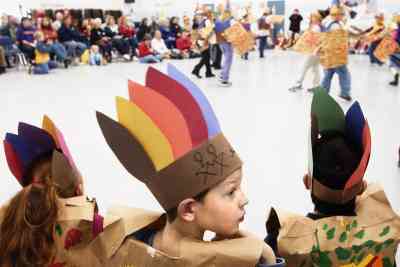
Below:  Kids who probably think about Indians the way Nickels did.

Supervisor: Idle No More is "pointless"

Two Officials Bash Mohawk Idle No More Protest; One Apologizes

By Gale Courey ToensingMassena Town Supervisor Joseph Gray has apologized for calling an Idle No More protest that shut down the Seaway International Bridge between New York state and the Province of Ontario on January 5 “pointless” and “foolish.” Protests are legitimate, he said in an apology in a new blog entry; he just wishes that future protests won’t shut down the bridge and inconvenience people.

Gray’s apology may be too little, too late to the countless Mohawk Indians who posted responses saying his comments were racist and insulting. Gray shared his thoughts three days after the January 5 Idle No More protest that closed the International Bridge between Massena, New York, and Cornwall, Ontario, for five hours. His blog entry is called Pointless Bridge-Closing Protests Must Stop. The protest drew 300-400 exuberant Mohawk Indians from both sides of the St. Lawrence River onto the International Bridge for several hours of marching, singing, drumming and a round dance at a highway roundabout on the Canadian side of the imposed international border. Dozens of Idle No More protests have swept across Canada, the United States, Europe, the Middle East and as far away as New Zealand and Japan over the past month in support of indigenous rights.
The conclusion of Gray's posting:Then, in a display of mind-reading ability, Gray wrote that “Most people can't tell you what any of these protests are about. In fact, some of the protesters probably don't really know why they are closing a bridge and what they hope to achieve. I don't make these comments out of hatred or because of any bias. I am simply appealing to reasonable adults in our communities to do the right thing and say we will not tolerate these disruptions in the future. There are plenty of other means of expressing your viewpoint.”

Gray’s blog posting had the buoyancy of a lead balloon. Within two days, it drew more than 160 comments, many of which were critical of him. Ron LeFrance, one of the three chiefs of the St. Regis Mohawk Tribe, posted a comment a day after Gray’s blog appeared. “It’s too bad you know so little about your neighbors and the struggles we face to survive as Mohawk people,” LaFrance wrote. LaFrance and Sub-Chief Eric Thompson attended the Idle No More protest. “The foolishness you refer to is what we refer to as STANDING up for our rights, something that has been taken away from you without you even realizing it,” LaFrance wrote. “These foolish people you are referring to keep your little excuse for a town afloat. If it wasn't for the people and businesses of Akwesasne, Massena would have dried up a long time ago. I don't know why we keep your economy from drying up when we hear and read crap like this. Malone is not that far away, think about it blow hole!”
Comment:  The Idle No More protests certainly have a point--several of them, in fact. And they're definitely not foolish. The attention they've drawn to Native issues in a short amount of time is a public relations triumph.

But Gray also has a point. Blocking traffic probably violates the law. Several people, including some Indians, have noted that blockades may make the protesters seem aggressive, violent, even criminal.

Right now, Idle No More is generating more good than bad will. The protesters don't want to lose that advantage. They may want to save the civil disobedience tactics for when they've run out of other options.

For more on Idle No More, see Harper Meets Chiefs and Idle No More = Occupy.

Below:  "An estimated 300-400 people took part in an Idle No More solidarity march across the International Bridge in Mohawk territory between New York and Cornwall, Ontario, on Saturday." (Lorraine White)