Showing posts with label funding. Show all posts

June 25, 2013

Saginaw Grant plans Eagle Lake

Film brings Native philosophy to mainstream

By Christina RoseActor Saginaw Grant, Meskwaki, is in the rare position of sharing the limelight with Johnny Depp in The Lone Ranger and beginning work on another Hollywood film, “Eagle Lake,” which will explore the wisdom of a respected Native elder.

Making films has given Grant an outlet to share the wisdom he received from his own grandparents and his personal experiences. “When I was growing up, I never imagined myself to be doing what I am doing now, but it happened in a way that gives me a way to talk to people. And some people listen to you, and some retain what is said.”

“Eagle Lake” is now in the earliest stages of pre-production after eight years of planning.

“The new film project has universal themes; its basis is bringing people, both children and adults, back to the basics of listening to our elders and remembering traditions,” casting director Lani Melisa said. “When they asked me to be the casting director, the script brought my attention to the story, that family it is so important. It’s about trying to bring people together and coming from Native philosophy of an elder.”
Comment:  For more on Saginaw Grant, see Hollywood Indians in Idle No More PSA and Blogger Attacked for Criticizing Depp.

June 23, 2013

Sanna: Goddess of the Sea

Here's an interesting project on Indiegogo:

Sanna: Goddess of the Sea

It's the stuff of Inuit Legend!Welcome!

My name is Ryan, and I would like to share with you a short comic book project I've been working on over the last year. It's based on the Inuit legend Sedna, or alternatively named Sanna: Goddess of the Sea. The story is a coming-of-age tale about a young Inuit woman who refuses to marry a mysterious suitor and her journey of personal and physical transformation.

This project is important to me because it is my first serious attempt at crafting a story through the medium of comics. I think it is especially important to Canada and the world that this aboriginal story be shared. My art directors have helped me through the hardest part of the process; visual development, layout, pacing, and penciling. Now I hope that you will back me for adding the inks, colors, and text. If you can help meet our financial goal you will help in bringing this project full-circle. Please check out the comic in the gallery.
Comment:  For more on the subject, see "Why Indigenous Literatures Matter" and Nanook Iluak in NORTHERN GUARD #1.

June 07, 2013

Rez sets crowd-funding record

REZ Sets Crowd-Funding Record on Seed&Spark

Production Of NYC Film School Alum That Will Shine Spotlight On The Life in Native American Reservation To Honor Late College Friend Was Funded Within 72 HoursSpecial Boy Films Ltd today announced that its short film project Rez has set a record for being the fastest growing campaign on Seed & Spark, the world’s first crowd-funding and digital distribution platform made just for independent films.

The production of Rez was crowd-funded within just 72 hours on Seed&Spark thanks to the overflowing support from the Native and independent film community. The film project also received a Spike Lee grant and a nod of approval from the famous filmmaker on social media.

Featuring a talented Native American cast, Rez tells the story about Daniel Nightbird, an Ojibwe teen living on the Leech Lake reservation. Daniel is taking care of his young sister alone and, down to his last dollar, is suddenly evicted. The eviction sets in motion a desperate search for a safe place on the Rez, which is harder to come by than even he imagined.

“There is no question that the presence of Native American stories has been largely missing from American film narratives. Rez seeks to change that, by showing the humanity in us all,” said Dominique DeLeon, the director and writer of Rez, and NYU film school alum.
Comment:  For more on funding Native movies, see More than Frybread Seeks Funding and Welch Movie Reaches Kickstarter Goal.

May 28, 2013

Crowdsourcing for trip to ghost village

Crowdsourcing wins trip to Bering Sea ghost village

By Rachel D'OroAn Anchorage poet gets to realize her dream to visit the ghost of a remote western Alaska village where her Inupiat Eskimo ancestors once lived, thanks to funds she raised through crowdsourcing.

Joan Naviyuk Kane far surpassed her goal of $31,000 that she said is needed for a two-week visit for 20 descendants of people who once lived on King Island, a tiny community built on stilts across the jagged face of the island. One benefactor alone donated $32,000 to Kane's campaign on United States Artists, a fundraising site.

Altogether, Kane raised slightly more than $49,000 through the nonprofit's USA Projects.

"I'm still in disbelief," Kane, 35, said Tuesday. "I've been trying to wrap my head around it."
Comment:  For more on Alaska Native projects, see Kickstarter Campaign for Indigenous Kayaks.

Below:  "In this photograph from Wednesday, May 15, 2013, in Anchorage, Alaska, photographs of Alaska's King Island and former residents of the Inupiat Eskimo village by the same name that was abandoned decades ago are seen. Anchorage poet Joan Naviyuk Kane, whose ancestors once lived there, is hoping to fund a visit to the crumbling ghost village for herself and other descendants of past residents through a crowd sourcing site." (Rachel D'Oro/AP)

May 15, 2013

Kickstarter campaign for indigenous kayaks

Qayaq Co-Op Campaigns on Kickstarter for $25K To Build High-Tech, Indigenous Boats

When Traditional Culture Meets High-Tech Construction, The People Can Qayaq Forward

By Ralph Richardson
More than 10,000 years ago, Eskimos constructed the first kayaks from stitched seal and other animal skins by stretching them across a wood or whalebone-skeleton frame. Called skin boats, they used them to hunt on the inland lakes, rivers and coastal waters of the Arctic Ocean, North Atlantic Ocean, Bering Sea and North Pacific Ocean.

Today, kayaking is one of the fastest growing sports in North America, with nearly 8 million active participants in the U.S. alone, up from 3.5 million just 10 years ago, according to the National Sporting Goods Association.

With its rising popularity, David Michael Karabelnikoff (Aleut/Athabaskan) noticed kayaking equipment was primarily being mass-produced. So, in August 2012, Karabelnikoff established Qayaq Co-Op with co-founders Julian Jacobes and Martin Leonard III.

The Co-Op’s mission is twofold, Karabelnikoff explains: To inspire a movement in Southeast Alaska to revitalize canoe building and paddling, while encouraging youth to learn science, technology, engineering and math (STEM), and to produce top quality kayaks that elite athletes would seek for their own use on the water. While the nonprofit embraces traditional Native craftsmanship, it also updates the kayaks, canoes, and skin boats with digital manufacturing and fabrication technology.
Comment:  For more on Inuit business, see Nunavut Resources Corporation Seeks Financing.

July 21, 2011

More than Frybread seeks funding

More Than Frybread Film Seeks Finishing FundsHolt Hamilton Productions, the producer’s of hit Native American Films Turquoise Rose, Blue Gap Boy’z and Pete & Cleo move closer then ever in completing their fourth, and potentially biggest cult film, More Than Frybread!

The mockumentary film tells the story of the First Annual State of Arizona Frybread Championship between the 22 federally recognized Native American Nations within Arizona. Each Nation sends one person to represent their tribe and compete for the coveted ‘Arizona Frybread Championship’ title. The film follows five individuals from the Navajo, Hopi, Yavapai-Apache, Hualapai, and Tohono O’odham Nations as they journey from their homelands to the state championship that will be held in Flagstaff, Arizona.

The filming was completed in May of 2010 and has been in post-production ever since. “We are extremely excited with the receptions we’ve already received for this film! We want to get this film out to the people!” Director Holt Hamilton commented in an interview earlier. Hamilton also went on to say, “We also want to take our time and get this film right. We’ll bring it to theatres when it is ready.”

The film is seeking additional finishing funds through an online fundraising website at www.Kickstarter.com. “We are in need of a few more dollars to cover our extended time in post-production. Doing things right, isn’t always the cheapest.” Stated producer Travis Hamilton. He continued by saying, “We want to let our audience know they can have a direct impact on the progress of this film by donating as little as one dollar.”
The movie's Kickstarter page:

More Than Frybread--a Holt Hamilton Film

A Narrative Film project in Mesa, AZ by Travis Holt HamiltonThe Story

Our story follows five frybread-making gurus from the twenty-two federally recognized Indigenous Nations in Arizona as they prepare and compete in the ultimate frybread challenge. The five frybread extraordinaires we follow in the film include: Buddy Begay (Navajo), Sharmayne Cruz (Tohono O'odham), Sammy Powsky (Hualapai), Sunshine Smith (Yavapai/Apache) and Betti Muchvo (Hopi) who bring their skills, their nations' pride and their foolproof determination to compete for the frybread title at the 1st Annual Arizona Frybread Championship held in Flagstaff, Arizona! The film is full of outrageous frybread humor that will keep audiences laughing long after the end credits have rolled!

View our website for more information: www.frybreadmovie.com
Comment:  For more on the subject, see Crowd Funding for Native Projects and Preview of More than Frybread

July 08, 2011

Welch movie reaches Kickstarter goal

‘Winter in the Blood’ Meets its Funding GoalAn update on the quest by filmmakers Alex and Andrew Smith to secure funding to bring James Welch’s novel Winter in the Blood to the screen. This arrived in our in-box moments ago:

Thank you!

We made it! We reached our Kickstarter goal of $60,000! And with time to spare! We want to thank everyone who pledged. Please watch our blog in the coming days to see your name on our list of favorite people. Thanks to you, we are able to bring interns, like the up-and-coming Deidra Peaches, to the film set on the Hi-Line.
Comment:  Good example of the crowd-funding approach that's becoming common in Native filmmaking.

For more on the subject, see Welch's Book to Become Movie and Crowd Funding for Native Projects. For more on the subject in general, see The Best Indian Movies.

Below:  "The Winter in the Blood team is a big step closer to making their movie."

May 07, 2011

Billboard advocate seeks donations

A reaction to the project I noted in Billboards to Raise Awareness of Indians:

Speak Your Piece:  Fixing Ourselves

The bottom line, though, is that Indians need to fix ourselves on our own terms. They are the only terms anybody knows.

By Mary Annette Pember
Today I awoke to find that another white journalist has figured out that the United States was built on the death of its indigenous peoples and the theft of their lands.

He is sorry.

He cries and he wants to help the Indians.

He has beautiful poignant photos of many folks on Pine Ridge.

He, of course, chose to photograph the poorest, the intoxicated, the gang members and (God help me if I see another Hollywood picture of an angry, young Lakota guy looking attractive on horseback I may gag while ripping my hair out) many Indians on horses. How they love, love to put us, especially Plains Indians, on horses.

This young white journalist, Aaron Huey, comes cloaked in the righteous DIY nation of social media. But he still comes like all the others.

He comes with the assumption that he and other white folks have the tools that we want to help ourselves. He shows white America the plight of the American Indian and asks them to join him in helping us.

I really want to tell Mr. Huey that American Indians have had just about all the help that we can stand from white America.
Comment:  I don't mind that Huey is seeking to raise America's awareness of Indians. As I've said many times, I think this is a necessary step in the process. It's what I'm trying to do with my website, blog, and comic books. But now I have to question his methods.

Before I was under the impression that Huey was going to use his own funds. Maybe the profits from his book of photographs. In that case, I wasn't going to judge his billboard project too harshly. If he wanted to spend his own money that way, fine. It was worth a gamble to see if billboards could raise people's awareness better than other media.

But now Huey is soliciting our funds. That means we need to ask the usual questions, such as how much is going to overhead and how much is going to him. More important, we need ask if this is really the best use of the public's discretionary income. Even if we agree to spend it on the cause of America's raising awareness of Indians.

I think the average billboard costs something like $10,000. For that amount, you could create a lot of websites, social media projects, and homemade videos. You could fund a book, a comic book, some songs or pieces of art, or a short film. You could develop a pilot project for a school educational component.

I wouldn't rule out a billboard as a means of communication, but I wouldn't bet much on it either. As I said and Pember implies, the message below is pretty superficial. Who is the "we" it refers to? The boy or the horse? Is anyone likely to realize the boy is an Indian?

In other words, is this really the best use of $10,000 in donations? Until I see evidence to the contrary, I'd say no. I'd put the money into one of the projects I listed rather than a billboard.

As Pember suggests, there seems to be a lot of hubris here. Huey's feeling that he's discovered something he can fix. His reinventing the wheel rather than working with an existing organization. His belief that his photos are so remarkable they'll cause a breakthrough in awareness. None of these things is necessarily true.

For more on the subject, see Phony Indian Charities, Bea Arthur Gives $100,000 to College Fund, and Native Arts and Culture Foundation.

Below:  "For $150, you can have this poster of, yes, an Indian with his horse."

December 07, 2010

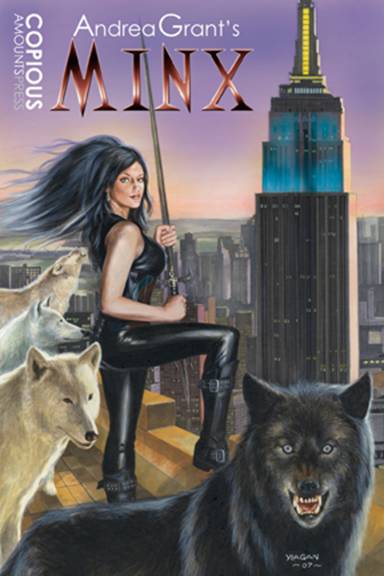
Grant seeks funding for MINX

Andrea Grant’s Minx goes viral

By Robert SodaroAndrea Grant, a Canadian-born poet, comic book writer, fashion editor, and pin-up model, based in New York City, has taken her 10-year comic-book project, Andrea Grant's Minx, and gone viral with it. She has just launched an online pitch via SoKap to secure funding for her project.

It is Grant’s intention to utilize this new approach to venture capitalism in order to raise some $12,000 over the next 159 days (ending 1/5/2011). Seeking money online is not a new concept, but it has become far more sophisticated over the past couple of years with people utilizing sites like SoKap and Kickstarter, which allow individuals to bring their proposals directly to their potential audience and tap into social media in order to raise funds. Potential donors receive graduated rewards based upon their level of donation. If the proposed total amount is not reached, no money is collected.

The comic book project that Grant is attempting to raise money for is to raise enough money to produce her comic in both serial and graphic novel form. What she is offering to individuals who contribute are incentives that range from a signed, first edition of issue #1, to the opportunity to “die” within the pages of the comic, to the chance to meet her in NYC for drinks and autographed copies of the comic. Suggested donations range from $10 to $275.

The story merges Native American mythology with clever contemporary fantasy, as it explores the duality of human nature and the thin line between dreams and reality. The series follows half-Native American, Minx, a struggling young artist in New York City, whose life is changed forever after suffering a vicious attack and slipping into a coma. Minx, however, doesn’t wake in the same world she left; but rather, she discovers herself in Dreamtime, an alternate reality that humans inhabit when they sleep. Needless to say, with this transition comes not only a great revelation but a profound responsibility as Minx evolves into a sophisticated warrior who is charged with protecting her Native peoples from a complex agenda seeking to transform nightmares into realities and realities into nightmares. More than just a vigilante born out of random coincidence: Minx’s role is the result of the synchronicity of the coinciding of elaborate conspiracy, ancient prophecy, and devastating betrayal.
Comment:  For more on funding projects, see Criminal Conversations Seeks Funding and Crowd Funding for Native Projects. For more on Native comic books, see The Best Indian Comics.

November 29, 2010

Criminal Conversations seeks funding

Criminal ConversationsThe Movie

CRIMINAL CONVERSATIONS is a romantic dramedy that unfolds amid somewhat unusual circumstances. A man meets up again with his ex-wife while his current wife is dying and his ex-wife’s current husband is suing her for divorce and trying to prove she is guilty of adultery. The tale unfolds on a small college campus in Santa Fe where Ted, whose dying wife has encouraged him to prepare for a new life without her, signs up for an acting course and discovers that his professor is his ex-wife, Alexandra.

Will Ted and Alexandra rekindle the love they shared long ago? Will Alexandra's soon-to-be ex, Frank, get the goods on her and Ted and claim adultery? Will Ted "fit in" with the much younger students in his class and fulfill his youthful dream of an acting career?

The Production Strategy

CRIMINAL CONVERSATIONS incorporates several key factors, including keeping the budget as low as possible while operating within union rules and regulations, putting as much money on the screen as possible, keeping the “above the line” costs lower than on most films, and attracting a name cast. The budget for CRIMINAL CONVERSATIONS is $50,000 for a 14-day shoot in Santa Fe, New Mexico.

CRIMINAL CONVERSATIONS has been written and specifically structured for low-budget production. The story focuses on a handful of characters and uses a limited number of locations that are readily accessible. The movie can be produced with minimal crew and no special effects. It is intended to be shot on HD using mostly ambient lighting.

And how did we get a famous actor like Wes Studi to star in our very-low-budget film? Well, it helps that he's a long-time friend of the director, Jules Rubin. And he lives here, and Wes has long been defying the mindset of casting Native Americans only in Native roles. Here he plays a romantic lead in a "straight" role and even gets to spout Shakespeare. Then, to add to the intrigue...Wes is playing opposite his lovely wife Maura Dhu Studi. We also have Anthony Arkin and we're keeping tabs on a number of other fine actors. We'll be casting some college students, as well.
And an e-mail from the producer:I'm so excited to be one of the producers on the film CRIMINAL CONVERSATIONS that Wes and Maura will star in. It's very low budget but it gives him the opportunity to play a non-Native romantic lead and for the two of them act together for the first time. Maura is an actress, teaches acting and even performs in Wes's band Firecat of Discord. I told her that singing back up with band is on my bucket list and she said she could handle that...can't wait.

I never thought I'd get to know a star like Wes and I'm always impressed with his skill, charisma, and dedication. We filmed a video of them at their house that will be posted on the fundraising website soon, but please go there now

http://www.indiegogo.com/Criminal-Conversations

and donate whatever you can and please use the tabs provided to send the link along to your friends and family.

All of us are doing this at little to no salary and we want to get started on pre-production so we can film in the spring.

All the information is there and photos and videos and news will be added as we go along.

Also, I'm developing a film, Bid Farewell to Her Many Horses, that will be partially filmed at Pine Ridge. ... George Burdeau, acclaimed director, writer, and producer is interested in working with me on this and Wes Studi wants to direct it. And the incredible Gary Farmer will star.

Thank you all.
Judy Bell
Belle Starr Productions
Santa Fe
Comment:  For more on the subject, see The Best Indian Movies.

June 25, 2010

Arts foundation requests submissions

Foundation announces inaugural grant guidelinesThe Native Arts & Cultures Foundation recently announced a call for submissions for its first round of grants to support the creative work of indigenous people in the contiguous United States, Alaska and Hawaii. Funding will be awarded to individuals, programs and organizations.

A total of $300,000 is available for distribution in amounts of up to $20,000 for individuals and programs. Applications and eligibility rules are available at www.nativeartsandcultures.org/programs.

“The Native Arts & Cultures Foundation celebrates the role of artists as culture bearers and critical thinkers,” said Reuben Roqueñi, NACF program director. “The creative process makes a profound contribution to intellectual inquiry and to the strengthening of communities.”
And:Earlier this spring, the foundation announced several new additions to its boards. Actor Adam Beach (Salteaux Tribe), known for his work in films such as “Flags of Our Fathers” and television shows such as “Law & Order: Special Victims Unit,” joined the NACF board of advisors, alongside singer Buffy Sainte-Marie (Cree). Keller George (Oneida Nation), well-known in Indian country for his work with the National Congress of the American Indians and the National Museum of the American Indian, joined the NACF board of directors.

NACF is supported in part by gifts from the Ford Foundation, the Yocha Dehe Wintun Nation and the San Manuel Band of Mission Indians.
Comment:  Sounds like Indian gaming is a major force behind this foundation. Which is good. As I've said many times, gaming is helping tribes in innumerable ways. Not only by funding necessary social services, but by contributing to projects such as NACF.

But $300,000 is akin to a drop in the bucket. I'd like to see gaming tribes put much more into artistic and cultural projects. When the amount hits $30 or $300 million, then we'll have something to talk about.

For more on the subject, see Casinos Fund Cultural Projects and Casinos Promote Culture.

Below:  How San Manuel pays for all its charitable investments.

June 23, 2010

Crowd funding for Native projects

Michael Cooke continues the debate begun in Rob Should Fight Poverty?! and Educational Value of Blogging and sidetracked in Whites Fighting Racism Are Racist?!Now, what you have are computer and writing skills. Those are tremendously powerful tools for change, that can make a difference.

So here's my invitation. Talk to some of your native American friends and create a project that will make a huge difference to native American people if it simply has the funding. The right project will not require an insane amount of money, and it will be inspiring the amount of change it can accomplish.

Once you have that project, go to my blog, this post: http://kitschchaos.com/blog/?s=crowd+funding and select a crowd funding solution you feel is the best fit for the project. This will involve writing about the project and enrolling people into contributing money to see the project fulfilled. It works beautifully especially if you really allow contributors to read your blog to see how the project is getting done and let them feel like they are really part of the success of the project.

This plays to your strengths, you can accomplish a lot. Just DO IT!
Mike's posting on crowd funding explains the basic idea and lists several sites, including:

http://www.kickstarter.com
http://www.quirky.com
http://www.indiegogo.com

I believe Norman Patrick Brown used Kickstarter to raise $15,000 to complete Rainbow Boy. So the idea can work.

I'm all in favor of this approach. I've heard good things about microlending--where NGOs give small loans to budding entrepreneurs in developing countries. Although you raise the money yourself and it isn't a loan, this is kind of the same idea. I.e., harnessing small amounts of money to get worthy projects underway.

Mike probably thinks I should use my computer and writing skills plus his crowd-funding idea to fight poverty. There's where we disagree. If I were to use crowd funding, it would be in the same fields I'm working in now: education and the arts.

Why? Again, because education is a long-term solution for social problems such as poverty. Creating educated Native leaders and professionals means empowering them to solve their own problems. It's the old "teach a person to fish" mentality that Mike can't refute or even address.

When I have a brilliant idea for which crowd funding might help, I'll consider pursuing it. Until then, I'll do what I do best. Namely, sharing the idea with those who can benefit from it now. Like a teacher or librarian, I'll empower them with the information. Then they can go forth and change the world.