October 16, 2014

Misty Upham dies

I tweeted about the disappearance of Misty Upham over the last week. Here's the sad outcome:

Coroner’s Office Confirms Body of Native Actress Misty Upham Found

By Levi RickertFriends and family of Misty Upham gathered on Thursday night after the county coroner’s office confirmed the body found earlier in the day was that of the 32-year-old actress.

Charlie Upham, father of the actress, was asked to identify his daughter’s body and he did so.

A search party discovered her purse, which contained her California driver license, about 1:00 p.m.–PDT Thursday afternoon within walking distance of the apartment Upham left on the evening of Sunday, October 5, 2014.

The three-person search and rescue party, which included her uncle, Robert Upham, then tied a rope to a tree to climb down a 150-feet ravine and discovered her body near the White River in Auburn, Washington. The two others in the search party were Robert J. Kennedy and Jeff Barehand.

The party then called 911.

Upham left her sister’s apartment on her own freewill and vanished into the night. Even though Upham’s family wanted the Auburn Police Department to exert more effort in finding her, the police department did not mount an effort in finding her since she left on her own freewill.

So the family mounted their own search and rescue parties find Upham. By Thursday some two dozen members of the American Indian community, including three tribal council members of the Muckleshoot Tribe, formed small groups to attempt to find her.


Misty Upham Confirmed Dead: Family Identifies Body, Meryl Streep and Melissa Leo Express Grief

By Scott FeinbergUpham's cause of death has not yet been determined. On Oct. 10, her father told THR that Upham suffered from bipolar disorder and was off her medication when she disappeared, leading him to believe that she may have been suicidal. On Thursday night, however, Rector said the family felt differently: "The family has stated that, after seeing the body, they still do not feel that Misty Upham committed suicide."

Rector also indicated that the family is enraged at the Auburn Police Department for what they say is a lack of assistance in the search to locate Upham. "First and foremost," she told THR, "the family wants everyone to know that the Auburn police did not help with this situation at all. They refused to help. When she disappeared on Oct. 5, the family knew something was seriously wrong—it was out of character for her to be gone so long without being in touch—and they repeatedly went to the police, who insisted there was no cause for concern."

There is apparently a history of hostility between the Auburn police and the Muckleshoot Reservation, on which several thousand Muckleshoot reside, that falls largely within Auburn. According to Rector, "Robert Upham led the search with the help of the Muckleshoot tribal community."

Auburn police did not immediately respond to a request for comment.

In the hours after the news broke, there was a huge outpouring of grief via social media from Upham's friends, fans and colleagues. Additionally, The Hollywood Reporter has exclusively obtained comments from two of Upham's most prominent costars, August's Meryl Streep and Frozen River's Melissa Leo.

Streep, who played the matriarch of the family for which Upham served as a caretaker in August: Osage County, wrote, "So so sad to hear this news—all our thoughts are with her family and with her beautiful spirit." Leo, whose character collaborated with Upham's to smuggle illegal immigrants from Canada into America in Frozen River, wrote, "Such a loss... so sad, so so sad."
Comment:  As you may know, I wrote a few articles about Misty and her movies. We were casual friends, and I attended one of her Hollywood events with her.

She called me "Grinch" and I called her "Grinchette," since she could be as contrary as I was. Good-bye, Grinchette.

October 15, 2014

Ban "Redskins" at Vikings game?

Native Americans plan to mount largest-ever Redskins protest at Vikings game

By John Woodrow CoxNext month, the Washington Redskins will fly to a state with a governor who has called their mascot racist, drive to a university with a president who wants their moniker changed, arrive at a stadium built with the help of a multimillion-dollar tribal donation and be greeted with what organizers hope is the biggest-ever protest of the team’s name.

Minnesota Native American leaders, student organizations and other activists have been preparing for weeks to stage demonstrations outside the University of Minnesota’s TCF Bank Stadium, where the Redskins will play the Minnesota Vikings on Nov. 2. Organizers say Native Americans from at least seven states intend to join.

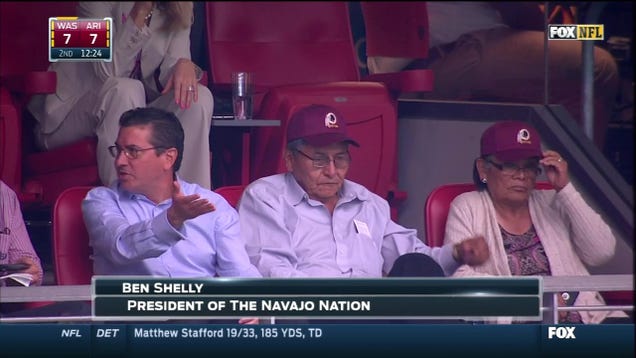
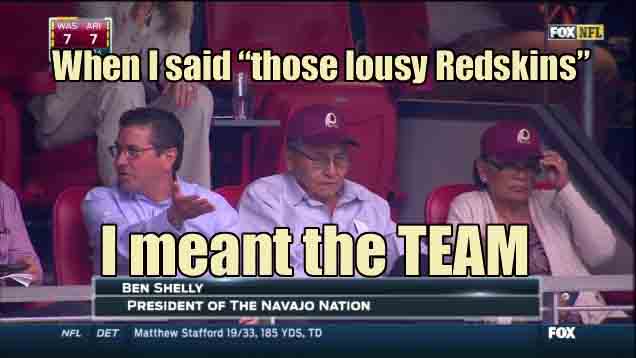
The game will probably draw even more attention after Native Americans on both sides of the issue made public appearances at Sunday’s game in Arizona. Before kickoff, more than 100 protesters marched outside the stadium as, not far away, a pregame party was held for Native Americans who support the Redskins. The team tweeted a photo of a Zuni family dressed in Redskins gear, and, during the game, Navajo Nation President Ben Shelly was shown on TV wearing a Redskins cap as he sat next to team owner Daniel Snyder.

Snyder has vowed to keep the name, which he contends honors Native Americans. The team has cited polls showing that a majority of Americans—and even a majority of Native Americans in one 10-year-old survey—do not find the team name offensive.

Opponents of the name hope the Nov. 2 protest will be much louder.
Minneapolis investigates banning Redskins name

The city’s attorney will say whether Minneapolis can prohibit the team’s name and mascot

By Ethan Nelson
After shaking up University of Minnesota administrators and other policymakers, the controversy surrounding the Washington Redskins has moved downtown to City Hall, where elected officials are mulling a ban on the NFL team’s name.

Because of a City Council vote earlier this month, the city attorney will investigate whether Minneapolis has legal authority to ban the football team’s name and logo when it plays the Minnesota Vikings at TCF Bank Stadium on Nov. 2.

Though the attorney’s office will provide its opinion by next Wednesday, some city leaders aren’t confident they can take legal action.

“I have my doubts,” said Cam Gordon, who represents the University and surrounding areas on the City Council.

He said there might be issues with the ban violating freedom of speech. And at a council committee meeting late last month, the councilman called the issue a “minefield.”
Groups press U to take on NFL, ban DC team's mascot from stadium

By Alex FriedrichThe University of Minnesota isn't using all its legal leverage to block the use of the Washington Redskins' name and logo at the university's stadium, say critics who have been pressuring the franchise to change its name.

St. Paul attorney Larry Leventhal, a board member of the National Coalition Against Racism in Sports and Media, contends that the team's use at a Nov. 2 game between the Minnesota Vikings and Washington at TCF Bank Stadium violates the university's stadium lease agreement with the Vikings.

"What we're observing is an apparent effort by the university to kind of give lip service to what the contract says," Leventhal said.

University officials have said they can only ask the Vikings not to use the controversial name and logo in connection with the game.

But Leventhal said the lease does give the university officials some legal power.

He said use of the logo and name "Redskins" violates this section of the contract:The Vikings shall not take any action or use any language in its use of the Facilities that might reasonably be expected to offend contemporary community standards, such as use of words regarding sexual acts, defamatory language, or language that might denigrate any class or group of people.Coalition members say many Native Americans and others find the "Redskins" name racially offensive and therefore subject to the clause.
Comment:  For more on the subject, see Navajo President Sits with Snyder and Natives Protest Redskins in Phoenix.

October 14, 2014

FedEx pressured to drop Redskins

Tribal chief: No FedEx until Redskins change team name

By Eliott C. McLaughlinA Native American chief has asked all tribal employees to refrain from using FedEx until the Washington Redskins changes its team name.

"Until the name of the NFL team is changed to something less inflammatory and insulting, I direct all employees to refrain from using FedEx when there is an alternative available," Osage Nation Chief Geoffrey M. Standing Bear penned in his directive to all employees.

The tribe also issued a news release saying that Redskins owner Daniel Snyder "chooses to stick with a brand which dictionaries define as disparaging and offensive. FedEx chose to endorse that brand through their sponsorship of Mr. Snyder's organization."

It concludes, "The Osage Nation chooses not to use FedEx services. We encourage other tribal nations to consider similar actions."
VizExplorer, a gaming company that does business with tribal casinos, is also halting its use of FedEx in Indian country.

Then there's this:

FedEx Votes Down Proposal To Drop Sponsorship Of ‘Redskins’ Stadium, Citing Some B.S.

By Eric GoldscheinOne major sponsor has finally made its collective feelings about the name public, via a motion at an annual shareholder’s meeting. Via Bloomberg:FedEx Corp. (FDX) shareholders rejected a proposal from the Oneida Indian tribe to “drop or distance” its ties to the Washington Redskins, including sponsorship of the team’s stadium.

The motion involving the National Football League was presented from the floor of the shipping company’s annual shareholder meeting in Memphis, Tennessee, today after FedEx won the right from federal regulators to omit it from its proxy materials. The Redskins have been under pressure to change their name from a group of Native Americans who argue it’s offensive.
The vote wasn’t even close, with 228.6 million shares against the proposal to change the name and 203,521 shares for it. Though FedEx would neither confirm nor deny whether this vote was for a binding proposal, the author of the Bloomberg article told SportsGrid that this “wasn’t a non-binding proposal.”
The column's conclusion:Sponsors can put as much distance between themselves and the name as they want, but until they cut ties altogether, they are complicit in continuing the usage of a slur for a football team. They might not have to stand up and defend it for themselves like Dan Synder does, but their implicit support should not go unnoticed.Comment:  For more on the subject, see FedEx Criticized for Sponsoring Redskins and FedEx Targeted for Sponsoring Redskins.

October 13, 2014

Navajo president sits with Snyder

Deadspin was the first to report perhaps the most interesting aspect of Sunday's Redskins game:

Disgraced, Soon-To-Be-Former Navajo Nation President Attends 'Skins Game

By Barry PetcheskyAs part of his campaign to convince you that his team's name isn't racist, Dan Snyder took in today's game with Ben Shelly, president of the Navajo Nation. Once again, Dan probably should have done a little more research.

Shelly is technically still president, but not for much longer. He got absolutely trounced in August's primary election, finishing seventh.

Shelly's a lame duck, and he'll be out of office on Jan. 14 when the new president is sworn in.


Many other news outlets picked up this curiosity and ran with it:

Daniel Snyder watches Redskins-Cardinals with the Navajo Nation president

Controversial Navajo Nation president and his wife join Washington Redskins owner in his VIP box at NFL game--as protesters gather against 'racist' name outside

Snyder is currently in a legal battle with the U.S. Patent office which cancelled his trademark last June calling it 'disparaging to Native Americans'

Before Sunday's game against the Arizona Cardinals, about 100 gathered outside of University of Phoenix stadium to protest the Redskins team name

Shelly finished seventh in August's presidential primary elections, and will be vacating office in January

By Ashley Collman
Shelly's decision to back Snyder makes him a minority in his tribe, which voted last April to formally oppose the Redskins name, 9-2.

Shelly has faced controversy ever since he entered office in 2011, when he was accused of stealing thousands of dollars from the tribe to benefit himself and his family members.

Those charges were eventually dropped when Shelly agreed to pay back the $8,250 he was accused of taking.

He also went behind tribal leaders backs to partner with Snyder previously, to sponsor a golf tournament with the NFL team owner's Original Americans Foundation (OAF).

When other Native American groups found out about OAF's sponsorship the day before the event, a few pulled out.
Not just a mascot

But Shelly wasn't just slouching in his chair looking embarrassed to be a sellout:

Shelly says he talked business with Snyder

By The Associated PressNavajo Nation President Ben Shelly says he talked business with Redskins owner Dan Snyder at Sunday's NFL game and not about the ongoing debate over the team's name and logo.

Shelly said Monday that he and Snyder spoke about expanding an agreement the tribe made with the team earlier this year.

The Redskins entered into a licensing agreement with Navajo Arts and Crafts Enterprise for the sale of tribal jewelry, rugs, sand paintings and other items at FedEx Field in Landover, Maryland.

Washington waived the licensing fee for the tribe and is working to open the agreement to the other 31 NFL teams.

Shelly talked to Snyder about other possible initiatives, including construction of an indoor sports pavilion on the reservation and funding for the Navajo Code Talkers Museum.
A Picture is Worth a Thousand Words: Navajo President Explains His Game Time Activities

By Levi RickertPresident Shelly met with Dan Snyder to discuss expansion of the licensing agreement to the other 31 NFL teams across the country.

“We have an enormous opportunity to bring more business to Navajo craftsmen and artisans,” President Shelly said. “This licensing agreement with the NFL has opened the door for new jobs and economic development for the Nation.”

“We were there on a mission,” President Shelly said, adding that the meeting between the Navajo Nation and the Washington NFL team was about more than football.

Director of the Navajo Nation Division of Economic Development, Albert Damon, has worked on the licensing agreement between the Navajo Nation and the Washington NFL team from the start of negotiations.

“This licensing agreement allows for growth of the Nation’s cottage industry for developing arts and crafts,” Damon said. “The Redskins offered first and the NFL issued the licensing agreement.

“Now we’re after the other teams,” he added.
Mocking Snyder's efforts

But people aren't buying the Shelly administration's spin:

The Redskins are trying really hard to convince you the team name isn’t racist

By Big SandayYou guys, the Washington Fightin’ Snyders are really, really trying hard to convince you that their team name isn’t racist. In fact, some of their best fans are even Native Americans so, you know, NOT RACIST! This new, odd push comes at a time when the outrage over the team name still simmers but remains in the background thanks to Roger Goodell’s ineptitude and other recent revelations over domestic violence in the league. But there’s the team, right there, making a big push during today’s game at Arizona to convince that you’re wrong about that team name.

Even though the Navajo Nation joined the fight to make the team change their name six months ago, television cameras caught Gun Slinger Snyder hosting Ben Shelly, the president of the Navajo Nation, in his box at the game. But before anyone thinks this is some sort of breakthrough, the Redskins invited various Native American groups to a pregame tailgate and Shelly has faced criticism from many in his own tribe for his seeming indifference to the team name controversy and even stirred up a feud when a Native American gaming group withdrew from a golf tournament meant to raise scholarships because the Redskins were a primary sponsor.
And more:

A cartoon by Ricardo Caté of "Without Reservations":


And one by Jack Ahasteen, political cartoonist for the Navajo Times:


Critics also had a field day with the photos of Snyder and Shelly in the owner's box. My effort below was one of several:


Comment:  For more on the subject, see Natives Protest Redskins in Phoenix and Redskins Fans Show Their "Respect."

Natives protest Redskins in Phoenix

Protesters March Against Redskins; Snyder Still Wooing Natives

By Jacqueline KeelerAt least 150 protesters, led by Amanda Blackhorse--the lead plaintiff in the trademark lawsuit that led to the cancellation of billionaire NFL owner Dan Snyder’s trademarks on the Washington football team’s name--gathered to protest the name Redskins in Glendale, Arizona, during Sunday’s NFL football game, Cardinals vs. Redskins.

The protesters began with a prayer led by Tohono O'odham elders and marched to University of Phoenix Stadium where luminaries like poet and writer Simon Ortiz (Acoma) spoke to the crowd about racism, colonization and against the use of Native people as mascots.

When Blackhorse spoke to the crowd, she said, “We are not here to fight amongst ourselves. We are not here to call them names or anything like that. We are here to raise awareness."

ICTMN reported in an earlier story that Zuni Tribal Governor Arlen Quetawki Sr. would attend Sunday’s game as Snyder’s guest. Quetawki was allegedly given at least 250 tickets by Snyder for tribal members to attend, including Navajo students and staff from Red Mesa High School (whose mascot is also the Redskins).


Tears of Protest at Redskins Game and How Dan Snyder Caused Them

By Nicolet Deschine ParkhurstAs protesters marched on Maryland, a street north of the UOP stadium, game attendees were walking towards the stadium. The group chanted sound bites such as “Humans are not mascots,” “What do we want? Respect. When do we want it? Now,” “Hey-hey-ho-ho, redface has got to go,” “Game over for racism,” and “R-word is a dictionary defined racial slur.” This is because cognitive dissonance can shake up a person’s preconceived notion with new information that they may not have considered before, making a person rethink and potentially challenge their own position and way of thinking.

During the rally, the speakers–including Blackhorse and renowned Acoma poet and writer Simon J. Ortiz–touched on different aspects of the mascot issue, including the current legal environment surrounding the team’s trademark, and the history behind the 40-year fight and national efforts to educate the public.

Dennis Welsh, a councilman from the Colorado River Indian Tribes in Arizona and California, and treasurer of the National Congress of American Indians, explained how the issue is deeper than the team’s name.

He drew the links to racism, colonialism and the structure of oppression, and emphasized the negative impacts on the self-esteem of Native youth, and protecting Native culture and identity.

Our goal was to raise awareness, and we did, on national television to millions of viewers as reporters took note of the protest and controversial name.There were fans from the Cardinals and Washington teams who gave fist bumps, thumbs up, and spoke words of encouragement. One particular Washington fan engaged in a civil, educational exchange with advocates and later said he supported the cause, but that he wasn’t aware of the controversy until recently.
Comment:  For more on the subject, see Navajo President Sits with Snyder and Redskins Fans Show Their "Respect."

Free stuff on Columbus Day!


As I tweeted:

A Columbus Day sale would make a good stunt for a Native performance artist. Tell a sales clerk that it means stuff is free for the taking.

Freebies

In the great man's "honor," here's my annual reposting of my soon-to-be-classic posting from 2009: Columbus tweets about his 1492 voyage and "discovery":

Columbus twitters

Also, my 1994 essay from the early days of my Native interest:

This Ain't No Party, This Ain't No Disco: A Columbus Day Rant

October 12, 2014

Rise of Indigenous Peoples' Day

Why Columbus Day is becoming Indigenous Peoples' Day:

Taking the Columbus Out of Columbus Day

By Rev. David FeltenAny claim that one might have to Columbus having been a noble explorer worth honoring with a Federal holiday is eclipsed by the reality of the inhumanity he visited upon his fellow human beings. It's long overdue that more of us get serious about doing something different with Columbus Day. Of course, any attempt at removing it from the roster of federal holidays would literally be making a federal case out of it--and retailers would likely cry foul over a lost opportunity to offer their wares at "Blowout Columbus Day Prices!" Along with those who, despite reality, can still deny the holocaust and those who would howl over historical revisionism, there are many challenges. Accusations of anti-Italian racism, anti-Catholic bigotry, and treasonous un-American activities are sure to be heard. But how does celebrating a fabricated and corrupt idol benefit the cause of Italians, Catholics, or the integrity of Americans' shared history?

But there are signs of change: this year marks both Portland schools and the City of Seattle's decision to celebrate "Indigenous People's Day" on the same day as Columbus Day. They join the cities of Berkeley, Minneapolis, and other municipalities across the country who have either replaced Columbus Day altogether or introduced an alternative Indigenous People's Day. These trail blazers are the first step in what will likely be a prolonged effort toward redefining an observance that needs way too many asterisks and footnotes to justify why it is still celebrated.

"Columbus Day" may very well be with us for yet another eighty years and beyond, but that's not to say that, over time, it can't be transitioned into a new kind of observance, a teachable moment of repentance and wide-eyed honesty about our shared past and hope for the future.

Indigenous People's Day (formerly known as Columbus Day) is likely to be a threat to those who claim the ideology of American Exceptionalism as their doctrine and faith--but what is more exceptional than honesty, repentance, and committing to a future of treating others with the dignity and respect due every human being? America might not be grown up enough to handle it, but hopefully, before another 80 years passes, Christopher Columbus will be a footnote to Indigenous People's Day (and not the other way around).
Salt in the wound: Why it’s time to move on from Columbus Day

By Joe GousseFor the vast majority of Americans, Columbus Day is a day to which they look forward. It’s a day off. A much needed reprieve. But for native people, it’s a solemn reminder of the great cost at which our present existence has come. It’s reminder of a history steeped in bloodshed and atrocity—after all, Columbus wrote freely in his diaries about the peaceful nature of the first natives he encountered and how “easily” they might be enslaved.

While the rest of us celebrate a day to watch Monday night football, or get some extra yard work in before the first frost, native people are left to consider the weighty reality of this nation’s history.

So where does that leave us as a society? Does it even matter? Should we do away with Columbus Day in its entirety? The answer, surprisingly, is no. A cogent solution is to reappropriate Columbus Day as “Indigenous Peoples Day”—which a number of cities across the U.S. observe—or “Native Americans Day.”

Honoring native people and culture in place of Columbus isn’t a cure-all. It doesn’t come close to healing gaping, historic wounds. But then again, nothing can. What observance of this day does do is properly refocus the spirit of the holiday. It creates something of utility from which we can stand together and honor the traditions of a people who have called these lands home since time immemorial.
Some details on how the designation came about in Seattle:

The Rise of Indigenous Peoples Day

By Matt RemleOn October 6, 2014, in a packed Seattle city hall council chambers room, the Seattle city council voted unanimously to rename the second Monday in October, the federal holiday Columbus Day, to Indigenous Peoples’ Day for the city of Seattle. The room erupted in emotion with loud cheers, the sound of drums and the sight of overjoyed, smiling and crying faces followed by an impromptu singing of the AIM song in the halls of Seattle city hall.

The Seattle city council vote followed the previous weeks unanimous vote by the Seattle school board to both establish the second Monday in October as a day of observance for Indigenous Peoples’ and to make a board commitment to the teaching of tribal history, culture, governance and current affairs into the Seattle public schools system.

The origins for both the Seattle city council and Seattle school board resolutions date back to 2011, when I was attending an Abolish Columbus Day rally in downtown Seattle. As I was listening to the beautiful songs of a local canoe family, I started thinking about South Dakota and their successful effort to change Columbus Day to Native American Day. That night I decided to contact members of the Seattle city council, as well as, my local State Legislatures to see if they might be willing to do something similar on either the City or State level.

To my surprise, the following morning I got a phone call from Washington State Senator Margarita Prentice and proceeded to have a long conversation about the genocide brought by Columbus to our Native relatives in the Caribbean and how she would love to sponsor a resolution on the State level. She simply asked that I draft a resolution and seek support from area tribes first before she would sponsor the resolution.

Elated, I immediately contacted Theresa Sheldon and Deborah Parker from Tulalip, who were both policy analyst for the Tulalip Tribes at that time, and whom currently sit on the Tulalip Board of Directors, to let them know the news. They agreed to take the resolution to the 2011 Affiliated Tribes of Northwest Indians annual conference and put the Indigenous Peoples’ Day resolution before the conference for a vote. The resolution was unanimously approved, and although the resolution ultimately did not succeed on the State level, the seeds of the Indigenous Peoples’ Day resolution for Seattle were sown.
Comment:  For more on Columbus Day, see Obama's Columbus Day Proclamation and Winning the War on Columbus?

Redskins fans show their "respect"

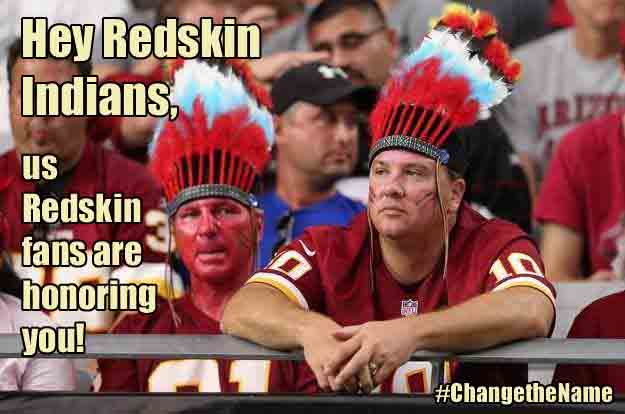
As usual, Redskins fans showed how they "honor" and "respect" Indians:


As one critic put it:My hometown football team sure loves to honor Native Americans. Our fans are so respectful of Native American culture that some of them showed up to the game in Arizona today in traditional red face and headdress. Indigenous people must feel so honored by this display. I am so glad we honor Native Americans like this right before Columbus Day. Native Americans should be thanking us for honoring them like this instead of complaining about REDSKINS.My version of this image:


Comment:  For more on the subject, see Navajo President Sits with Snyder and Natives Protest Redskins in Phoenix.

October 11, 2014

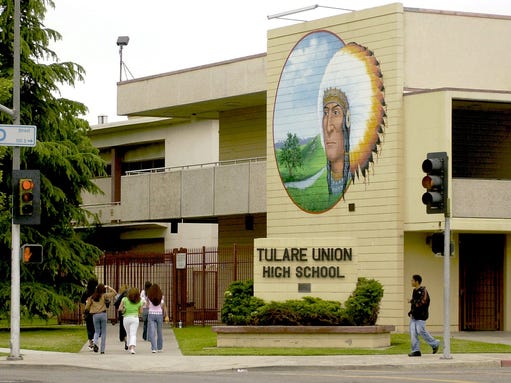
Tulare Union's stereotypical Redskins mascot

Here's the kind of mascot story that has appeared since the Washington Redskins controversy took off:

Tulare Union High School stands by Redskin mascot amid national firestorm

As controversy over Redskin mascot grows stronger than ever, so does Redskin pride at Tulare Union High School

By Dan Kukla
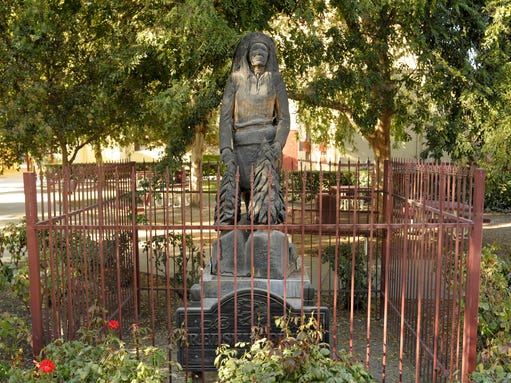
A statue of Chief Seattle, the epitome of Tulare Union High School's depiction of its Redskin mascot, evokes a myriad of reactions depending on the eye of the beholder.

Where some see beauty and dignity, others see ugly racism.

The school views the centerpiece of its campus and Redskin Pride Park as a masterpiece portraying honor and respect.

"This park is where the pride starts," said Mark Hatton, Union's director of student activities. "This is literally the heartbeat of the campus."


ASB president David John Macedo comes from a family rich with Redskin legacy. His grandparents met and fell in love at Union. Now he feels a deep sense of pride in living out that legacy as a Redskin himself.

"It's definitely a lesson to be learned when you're a Redskin," Macedo said. "It's a lesson in stewardship and courage and most of all community."

This profound reverence for the Redskin way of life manifests itself in the school's depiction of the Redskin mascot.

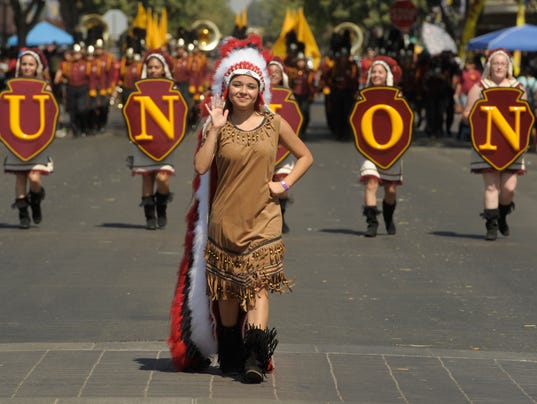
You will not find any animated Indian cartoons on campus or letterman jackets. Over time, Union decided to phase out the use of weapons from its imagery and the word "war" from its vernacular. The physical mascot itself is not a big-headed costume, but rather a human likeness of an Indian Princess that Ingram describes as "beautiful" and "gorgeous."

Indeed, from Chief Seattle to the many murals, signs and displays featured around campus, a walk around school grounds turns up nothing but positive and respectful portrayals of Native Americans.


Comment:  This particular example of mascotry set me off for a couple of reasons:

1) The school uses a real-life individual--Chief Seattle--as its mascot. The only other example of this that I can think of is FSU's "Chief" Osceola.

2) The photos are so obviously stereotypical, yet writer Kukla claims he sees only positive portrayals.

In response to this article, I posted the following comment:"A walk around school grounds turns up nothing but positive and respectful portrayals of Native Americans"...are you serious? Seattle lived in Washington and had nothing to do with California. He did not wear a headdress from the Great Plains or have sexy maidens who did. As Snopes explains, the speech quoted on the statue is a well-known phony from a 1972 film.

Chief Seattle

So every Tulare Union depiction of Seattle is false and stereotypical. That isn't what I'd call "positive and respectful." Falsifying someone's history and appearance is the epitome of disrespect.
I don't know if the girl in the photo is supposed to be "the human likeness of an Indian Princess." Whether it's her or someone else in a costume, Native women don't wear headdresses or dress in sexy buckskin skirts.

Then there's the fact that the school "phase[d] out the use of weapons from its imagery and the word 'war' from its vernacular." Given the remaining stereotypes, this isn't some great achievement.

Moreover, it shows the school's underlying belief: that Indians did nothing but fight wars. That's why it chose the word "redskins": because it embodies the Indians' warlike savagery.

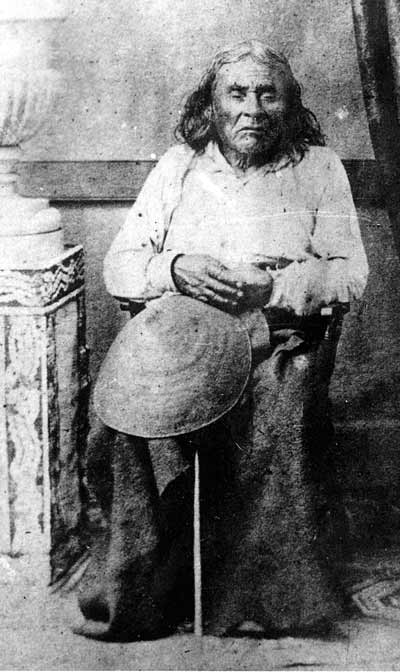
Finally, here's the real Seattle:


Does Seattle look anything like the Plains chief in the logos and statue? No.

Note the woven hat he's holding, which is typical of the Duwamish and other Pacific Northwest tribes. Woven hat, not feather bonnet. Not all Indians come from the Great Plains, silly Tulare Union.

To reiterate, Tulare Union's mascot is false and stereotypical. Worse, the school is arguably racist for ignoring the protests and implying that all Indians fit its Plains chief/Seattle/"Redskin" mold. This is yet another Indian mascot that should bite the dust, and quickly.

October 10, 2014

Renaming Columbus Day angers Italian Americans

On the Columbus Day front this year, Minneapolis and Seattle passed resolutions to change the name:

Inaccurate, controversial history of Columbus leads to alternative celebrations in North Dakota

By Garrett Richie“We don’t necessarily talk about Columbus Day,” Braun said. “We talk about Columbus and the complexity and the history that Columbus in fact did not discover North America. Mostly, we talk about the larger issues of what happened as Europeans settled in North America and the consequences of that.”

As far as the holiday is concerned, it originally came about as a way for Italian Americans to celebrate their heritage during a time when they were still being discriminated against in the U.S. in the late 19th century. However, as Italian Americans began to blend into the general white population in the U.S., the holiday became a more national event, and the focus shifted.

“The irony is that this holiday that started out as a celebration of a significant ethnic heritage against some kind of discrimination has become something that another ethnic group finds oppressive to them,” Braun said.

With this in mind, some towns and groups have tried to find ways to reconsider Columbus by either renaming the holiday or creating a celebration that recognizes Native Americans. This year, the Brainerd, Minn., city council proposed (but eventually tabled) a motion to replace Columbus Day with Chief Red Wing Day, and Minneapolis designated Columbus Day as Indigenous People’s Day.
Later articles addressed this change. In particular, Italian Americans weren't happy about the slight to their hero:

Seattle council faces backlash from Italian-American group

Italian-American activists say they’re forming a political-action committee to oppose local politicians who supported designating Columbus Day as Indigenous Peoples’ Day.

By Daniel Beekman
Some Italian-American activists in Seattle say they’re forming a political-action committee to strike back at members of the City Council who voted unanimously Monday to recognize an Indigenous Peoples’ Day on the same date as Columbus Day.

They say the council members disrespected Seattle’s 25,000 Italian-American residents when they picked Columbus Day rather than another date.

Some Native-American activists, backed by the Seattle Human Rights Commission and more than 30 other organizations, had asked for an Indigenous Peoples’ Day on that date to recall the harm inflicted on their ancestors by Europeans such as Christopher Columbus.

“We empathize with the death and destruction of the Native Americans,” activist Ralph Fascitelli said Thursday during a news conference at Il Terrazzo Carmine, an Italian restaurant in Pioneer Square. “But we think right now this is almost going too far in terms of political correctness.”


They claim the holiday has nothing to with Columbus, but instead celebrates immigration:

Columbus Day changes run aground due to lack of interest, resources; Shared Vision tables issue of honoring American Indians around holiday

By Zach KayserThe idea is spreading beyond Minnesota, too: on Oct. 6, city leaders in Seattle also voted to change the holiday. However, the move drew criticism from Seattle's Italian-American community, news agency Reuters reported.

"Italians are intensely offended," Seattle resident Lisa Marchese told the City Council. "For decades, Italian-Americans celebrated not the man, but the symbol of Columbus Day. That symbol means we honor the legacy of our ancestors who immigrated to Seattle, overcame poverty, a language barrier, and above all, discrimination."

However, the argument for changing the name centers around the link between the holiday and Columbus' legacy. Honoring him as the man who "discovered" America is perceived as paying short shrift to the millions of American Indians who lived here for generations before his arrival. Symbolism aside, there's also a more literal aspect: the acts of aggression on the part of Columbus' expeditions.

Anton Treuer, director of BSU's American Indian Resource Center, said the full extent of atrocities committed by Columbus remains widely unacknowledged.
Alas, the facts don't support their claims:

Redface in America

By Robin Annette LaDueThere have been people of Italian descent who claim that their ethnicity is being disrespected by changing the name from Columbus Day to Indigenous Peoples Day. Their statements are that Columbus Day is really Italian Heritage Day. However, their arguments do not adhere to the facts of the matter. Columbus Day, was, in fact, first put forth under President Harrison. A more likely use of Columbus Day was that:

“During the four hundredth anniversary in 1892, teachers, preachers, poets and politicians used Columbus Day rituals to teach ideals of patriotism. These patriotic rituals were framed around themes such as support for war, citizenship boundaries, the importance of loyalty to the nation, and celebrating social progress.”

Nowhere was it suggested in the process of making Columbus Day a federal holiday that it was in honor of Italian heritage. This does not mean that this holiday is not of great significance to people of Italian descent. It is simply not a reality that changing the name is meant to dishonor people of Italian descent. To frame the long overdue decision to recognize Native people as being disrespectful of Italian people is part of ignoring the reality of the grief so many Native people still deal with on a daily basis due to the loss of land, language, children, culture, and life that began with the landing of Columbus. These are not realities that should be celebrated.

A fact that appears to be lost in this discussion is what the immigration of people of Italian descent and other Europeans meant for Native people of the Americas. For every person who immigrated, another Indigenous person was displaced. The pain of this displacement is almost impossible to express. In effect, when politicians and others tell Native people to go home, it would be to the backyards of such people.


You don't have to dig far to see what Italian Americans are really celebrating. It's the same thing other Americans celebrate: their own "greatness."

Columbus gets his comeuppance: Why his holiday is in deep jeopardy

Mascot for violent European colonialism has been celebrated for years. These major U.S. cities are saying "no more"

By J.P. Lawrence
Some Italian-Americans and others object to the name change, deeming it political correctness. If Columbus Day needs a name change, they say, so does the District of Columbia; Columbus, Ohio; and Columbia University.

Dr. Joseph V. Scelsa, founder and president of the Italian American Museum in New York City’s Little Italy, said Columbus represents the courage shown by immigrants, such as his ancestors, when they came to America.

“If it weren’t for this courageous European who came to these shores, 99% of us would not be here today. He must be seen in the context of his time, not ours,” he said. “What he did was bring Christian civilization to the Western World, and the benefits of that outweigh any disadvantages.”

Scelsa, who holds a doctorate in Sociology and Education from Columbia University, disputed claims Columbus directly killed anyone, while the “Incas practiced blood sacrifice and committed genocide.”

“I believe it is a travesty of justice to dishonor this courageous man who gave so much for this country, and I totally disagree with it,” Scelsa said. “There are many other ways to celebrate Native Americans, and we should, but not at the expense of Columbus.”
Comment:  So apparently it is all about the man and his individual accomplishments after all.

The benefits of "Christian civilization" outweigh any disadvantages? Many American Indians and African Americans would disagree.

And now we're at the crux of the conflict. Italian Americans and other white Americans think they're the center of the universe. They think it's more important to celebrate and honor them than it is to acknowledge the death and destruction of Native cultures. The message is that white peoples' feelings are more important than Native peoples' lives.

It's more than understandable why Natives and their liberal allies don't accept this message. Because it's immoral and un-Christian to celebrate conquest. Killing and enslaving people isn't "civilization," it's barbarism.

The final word is my tweet on the subject:

Mussolini's death toll was 300,000. Columbus's toll was similar. Let's replace Columbus Day with Mussolini Day to honor Italians' heritage.

For more on Columbus, see King Touts "Values Columbus Brought" and Columbus Day Celebrates White Superiority.

Below:  A present-day reminder of what Columbus means to most Americans.

October 09, 2014

Natives in The Swarm

A couple of years ago I read the German sci-fi thriller The Swarm. It has a Native theme at its core and two Native characters. Here's the story:

The Swarm

A review by Georges T. DoddsIn The Swarm, Frank Schatzing postulates a situation where the sea, which we have been abusing for years, strikes back under the direction of an unknown living entity previously content to inhabit the trench depths--the Yrr. Whales begin attacking ships, hordes of jellyfish shut down the beaches of South America, and a strange new marine worm is destabilizing frozen methane in the sea bottom. The scientists are fascinated, the powerful want it stopped at any cost, and the little guy is being overwhelmed by tsunamis and poisoned sea-food. A global ecosystem shift is in the offing and while it's clear humans have a lot to do with it, it isn't clear they're going to survive it.The Swarm (novel)

Comment:  The Native theme is the usual one: that all living things are connected. That we must live in harmony with nature rather than try to control it.

I don't know enough about scientific matters to critique the book technically, but the two Native characters are problematical. Let's look at them.

Leon Anawak

Leon Anawak is a young marine biologist specializing in whales. He ran away from home at age 12 because his father was drunk and abusive and his mother enabled him.

He's so ashamed of his past that he won't even admit being Native. Someone guesses he's Makah because the Makah hunted a whale and he might disapprove, but that isn't it.

For starters, his name sounds Inuit--like anorak--so Inuit would be a good guess. Presumably he looks Inuit also--a look somewhat different from American Indian. But no one makes the connection.

More important, his feelings of shame don't make sense. Why blame the entire culture rather than just his abusive family? Why not say, "I'm Inuit but I hate the place I came from?" It's just weird that he refuses to name his heritage as if that will somehow protect him. What does he think...that his fellow scientists will point and laugh at him because he's a Native from a bad home?

People used to deny that they were Native...but that was 50 or 75 years ago. I haven't heard anyone doing it recently. With all the social movements going on, Natives are reclaiming their traditions these days. As we've seen with the hipsters and other wannabes, it's "cool" to be Native now.

It seems author Schatzing has ignorant or outsider understanding of Native life. He thinks Natives are still downtrodden and any smart Native would repudiate his troubled past. But readers of Newspaper Rock know that just isn't so.

Anawak eventually visits his home in Cape Dorset, Nunavut, and learns it's experiencing a cultural renaissance. To him, this is a big shock. He's amazed that everyone isn't drunk and defeated-looking like they were two decades ago.

But Nunavut is in newspapers and on TV several times a week. You can read about it in blogs or on Facebook pages. Anyone with an Internet connection should know that things are changing among today's Inuit. It's implausible that a man who lives in Canada and uses a computer would be totally oblivious to the developments.

Jack "Greywolf" O'Bannion

Greywolf is half Native but does an Indian schtick for the tourists. He braids his hair, wears fringed outfits, camps out in tipis, and talks portentously about the spirits. Anawak accuses him repeatedly of being a fraud, a white man playacting as an Indian. In other words, a wannabe, though I don't think Anawak uses that word.

You occasionally see or read about people who act this way. They're usually white men who claim to be a tiny bit Cherokee, or European hobbyists who claim they know Native traditions better than modern Indians do.

What they usually aren't is half Native. Someone with that much "Indian blood" would be accepted in every US and Canadian tribe I'm aware of. Greywolf wouldn't have to pretend to be "Indian," he'd be Indian. Everyone except a few traditionalists--extremists who demanded full-blooded purity--would accept him as such.

Again, Schatzing's concept of Natives rings false. He understands how wannabes act--at least stereotypical wannabes who earn all the criticism from Natives. What he doesn't understand is that the wannabe label doesn't apply to people who are half Native.

Unless he was given up for adoption, someone like that grew up with a connection to a Native parent and his or her culture. If he wasn't enrolled automatically, he could easily join the tribe of his Native parent. You'd have to work hard to create a situation where someone half-Native by blood was totally disconnected from his past and acted like a white-man wannabe.

Reviews

The SwarmWhile Schatzing has assembled the tropes of disaster novels in a novel and thought provoking manner, and I learned things I didn't know about deep sea-beds, I had a great deal of difficulty in maintaining interest. It is not that there aren't some suspenseful sequences, but these are far outweighed by the rest.The Swarm by Frank SchätzingThe problem is that this hypothetically punchy little book is weighted down with hundreds of pages of soul-destroying characterisation and unnecessary scientific detail that is instantly undermined by Schätzing's failure to identify the moral centre of environmentalism, meaning that no matter how spectacular its imagery may be, it is still a dull, preachy, and spectacularly wrongheaded joke of a book.The Swarm by Frank SchatzingSchatzing's research here appears impeccable, though his extrapolations are purely fiction. Unfortunately what often happens is that such books become so complicated technically that they lose the common reader along the way, with the scientific process being emphasised at the cost of the characters.Frank Schätzing: The Swarm: A Novel of the Deep

I tend to agree with these reviews. The Swarm is a big, sprawling mess with implausible scenes and unnecessary diversions. It's trying to be a Michael Crichton-style thriller, but Crichton's books were always a taut 300-something pages. The Swarm is anything but taut at almost 900 pages.

If Schatzing had taken the same plot and characters but cut the length by 60-70%, it might've been a great thriller. As it is, it's merely good. Rob's rating: 7.5 of 10.

October 08, 2014

Lucas's prejudices in Star Wars

In 2012 I posted the following article and comment:

George Lucas cut female X-wing pilots out of Return of the Jedi at the last minute

Can we call Lucas a sexist and a racist for his film choices?

This led to the following discussion with Brad:I think the article says it best that we'll probably never know. However, I'll say two things that aren't exactly defenses of Lucas.

One is that if he WERE sexist, it would have been an easy casting decision just not to screen female actors for the parts in the first place. I don't think anyone would have given that a second thought especially back then, although we might have more to talk about now. Lot of male characters had lines cut too, so I'm not seeing an indictment here.

The second is that Lucas has done a lot of squirrely things with these films for a lot of squirrely reasons. Sexism almost seems TOO EASY of an explanation for why he changed something. More likely that it had to do with some inane, esoteric minutia that would never have occurred to anyone but him.
Whatever the reason, there was no excuse for one woman and no minorities among the main characters in Episode IV.

People can always come up with excuses--er, reasons--for their beliefs. Like, "Muslims may be hiding bombs in their robes, or I can't understand what they're saying, or they give off a bad vibe."

What matters is outcomes not, intent. If you're thinking of reasons why a universe doesn't have any significant women or minorities, you're thinking along sexist and racist lines. Whether you realize it or not.In singling out Episode 4, I think you may be placing blame on Lucas that belongs on FOX studios. Star Wars was only Lucas' second major film and he had a tough time selling it to begin with. It's a mistake to think that he had the final say over casting for the film. His only real concession from the studio was permission to use less famous white people. You do remember that this movie was made in the mid-'70s right?

I also think you might be giving Lucas a little too much credit in the creativity department. Much of what Star Wars is was drawn from archetypal medieval literature, Japanese B-movie mysticism, cowboy spaghetti westerns, and WWII combat pictures none of which were particularly big on diversity. If you want to say that Lucas wasn't very enlightened, sure, but I'd say his tropes are more a product of his times than they are bigoted.
Fox cared about the race and gender of minor characters such as X-Wing pilots? Thirteen years after Star Trek pioneered an integrated starship crew? Unlikely.

And why did Lucas dismiss the criticism of the first movie before backtracking and casting some minorities in Episode V? If Fox made the decision, Lucas's response should've been, "I totally agree with your criticism, but the studio had the final say on casting." Unless I'm sadly mistaken, that isn't close to what he said.

Lucas had more power when he made the Indiana Jones movies, but his depictions of South American Indians and Asian Indians were stereotypical and arguably racist. So no, I don't cut him any slack for his alleged lack of clout.

The "product of his times" argument applies to any older person who feels uncomfortable around blacks, gays, Muslims, et al. Hence my posting about Person X and the roomful of strangers. Either Lucas and Person X are both racists, or neither are.

"Discomfort" with strangers

Here's the "Person X" posting I mentioned, with comments from people:

Suppose Person X feels uncomfortable in a room full of one type of person: women, blacks, gays, Muslims, old people, the disabled, children, burn victims, CEOs, prostitutes, movie stars, undertakers, televangelists, drug users, nudists, ex-convicts, etc.

You could say X is prejudiced and needs to get over it, but I wouldn't be too harsh on him. Most likely his discomfort comes from ignorance and will fade as he gets to know the people.

I wouldn't necessarily use words like "racism," sexism," "homophobia," or "bigotry" to describe X. He's not saying these people are bad or inferior, only that he's not used to them.

What do you think?Judy
Will X make an effort to get to know them?

For me, that would be the test. ;-)

Laurel
He's probably a bigot/sexist/racist/homophobe or whatever. I never met anyone who said "I'm not a racist, I just don't feel comfortable around those people" who wasn't a big ol' racist. This is one of those things racists say so I'll shut up about race.

If I go so far with my preferences as to avoid an entire group of people, you can bet I don't see them as individuals and do not have positive thoughts about them.
I agree, Laurel. But my inclusion of nonracial groups shows it can happen whether race is involved or not.

And I agree, Judy. The first time it happened, I'd be charitable toward X and not condemn him as a bigot. But if he continued to avoid them, refused to learn about them, and kept hinting something was wrong with them, I'd move toward condemning him.Laurel:
I can't think of a roomful of ANY type of people I would be that uncomfortable in except one full of armed terrorists or rapists or something, although the "Laurel in a roomful of televangelists" scenario would probably devolve into a bunch of yelling pretty quick.

It is probably usually a good idea to give a person the benefit of the doubt once, though.

Brad
I think Laurel hit on the key issue--the generalizing of people by a characteristic. If "X" is referring to any group of people collectively when making derogatory remarks about them (i.e. "those people"), I think that indicates a ingrained prejudice that goes beyond simple discomfort. People who do that clearly have bias against the characteristic that "those people" who they are whether we're talking about gays, blacks, women, or CPAs. That goes beyond a simple dislike of an individual or singular behavior. I wouldn't hesitate to label that held belief or expression whatever -ism or -phobia that applies.

And to further the point, I don't think even just a willingness to learn about the group in question and potentially change their attitude is enough to make a difference. While it's possible "X" COULD do that, I don't think they get any credit for it until it actually happens.
Comment:  As I said, I'm not sure that we could say Person X is necessarily prejudiced. But yes, prejudice will explain his responses most of the time.

If Person X never met a CPA and has no idea what to expect, I guess you could call his discomfort "prejudice." He's prejudiced against the unknown--thinking a whole class of people will have some harmful or unpleasant trait. But unless the group is murderers or sociopaths or people who never take a bath, that probably won't happen. The group will have the same variety of people as any other group.

Now that Brad made the case that discomfort usually means "ingrained prejudice," go back and apply that to George Lucas and his evident discomfort with casting women and minorities. Lucas's "product of the times" feelings qualify as prejudice.

For more on the subject, see Star Trek vs. Star Wars.
October 07, 2014

Dubious Henry Ford Indian quote

This alleged quote gets posted on Facebook and elsewhere every so often:


In one such posting, it deservedly got ripped with the following comments:This is an insulting stereotype that needs to be stopped. Indians never asked the government to take care of us. And the government has never done so. The entire premise of the US-tribal relations has been that we live in our own lands under our own laws. I hate right-wing propaganda that uses Indian people. I know they would sell us out, steal our lands and likely exterminate us for a few dollars.

What they were supposed to do is pay for what they stole at gun point. There isn't enough money in the world to pay for the land, the lifestyle, the ancestors murdered, the languages lost or the traditions.

Henry Ford never said it.

The "American Indian" was doing JUST FINE before "the Government" came along, thanks VERY much!! Ford didn't give a flip about the American indigenous and would've used his own mother to get his own way. Whatever is the agenda of "Gaining Age But Losing Mind," they should find someone else to speak for them besides a common racist like Henry Ford, the country's most infamous Nazi sympathizer, the ONLY American referred to in Hitler's autobiography, "Mein Kampf," and whose photo was hanging behind Der Fuhrer's desk for years.

Yes, he was anti-Jewish. But, ironically, he was not anti-black and hired many blacks to work in the auto industry. It is one reason why Detroit had one of the first widespread thriving black middle classes in the nation. I always say that the the black middle class in Detroit is the reason that Motown thrived.

I didn't think this meant to say that the U.S. Government was taking care of Indians. I thought it was meant as a warning to anyone who believes that the government can or will take care of them, letting them know they are sadly mistaken if they think that because the Indians got screwed royally--all while the U. S. Government was making promises they had no intention of keeping.

Very good, Bert and Rosi, but no matter Ford's ethnic loyalties, he was making the case that government is inherently a bad thing, and so the REAL irony is that he's using the indigenous to try and demean the case for a strong central government which, at the time, was just about all that was keeping "Indians" from being completely destroyed. Certainly "the states" weren't going to look out for the interests of the indigenous. The old white guys who founded this country effectively nixed Ford's political position when they quickly dumped the Articles of Confederation for the Constitution. Like the powerful robber barons of his age, Henry Ford wanted the government to even further ignore corporate cartels and monopolies, all so that he and the others could amass even more wealth, much of it at everyone else's expense, particularly the "American Indians."
Comment:  Anyone who thinks the government can't take care of people should look at the low-cost Social Security and Veterans Administration, which provide health care more efficiently than private enterprise. Or at "socialized" medicine anywhere in the Western world, with lower costs and healthier people than in the US.

I Googled the alleged Ford quote. While many sites repeat it, no one cites a source for it. The Benson Ford Research Center, which looks to be an authoritative source for Henry Ford quotes, doesn't have it.

So it's dubious at best. Someone may have said it, but it probably wasn't Henry Ford.

For another example of a right-wing Internet meme using Indians, see Phony Pro-Gun Indian Image.

October 06, 2014

Glenn Beck in a headdress

The reason Glenn Beck wore a Native American-style headdress this morning

By Erica RitzThose who watched Glenn Beck’s radio program on TheBlaze TV this morning may have caught Beck wearing a Native American-style headdress early in the broadcast.

“This is actually from the first … resurrection of the Tea Party,” Beck explained. “When the founders went, they dressed to disguise themselves as Native Americans and they dumped the tea away. Around the last century, everybody said, ‘Our country is a little out of control and we should get back to our founding roots.’ This is a headdress from that Tea Party movement that happened in the late 1800s.”

Beck joked: “For anybody who says, oh, geez, they’re dressed as Founding Fathers. It could be worse. We could have all gathered and dressed like this.”

Growing more serious, Beck added: “But it also shows you, this was a very elaborate and national movement. This was a big movement and it’s completely gone. Have you heard of that movement? Did you even know it was going on?”
Glenn Beck Dons Headdress: 'I Think it Works on Me'

By Simon Moya-SmithOnce the video circulated on the web, prominent Native Americans berated Beck’s insensitive behavior.

“The reason that Glenn Beck wore a headdress illustrates the lack of respect that he has not just towards indigenous people, but towards basic human decency,” Johnnie Jae, Jiwere-Nutachi and Chahta and managing partner of Native Max Magazine, told ICTMN. “He has consistently taken controversial stances in the past such as claiming that we should be proud to have a slur towards indigenous people used as a team name,” she said.

Tara Zhaabowekwe Houska, Ojibwe and a tribal rights attorney, criticized Beck’s “jocular behavior” and added “headdresses are earned.”

“I wonder if Mr. Beck would be comfortable casually putting on a Medal of Honor while laughingly stating he ‘feels more important’?” she said.


Facebook comments

Comments from Natives and others on Beck's display:I have no words....

Attention whore? "Hey, everyone else is getting publicity out of doing this, I should, too!"

Turkey feathers like the turkey he is....

Just when you think Glenn Beck couldn't be more sickening...

The icing on the cake is the smug look on his face. He knows exactly what he is doing. Courting controversy so people will pay attention to him. Gross.

We're just props for people like him. Trotted out to make a point and then put away afterwards.

The wind has lost the bellows in his bag of hot air so he bottom feeds like a heckler media-personality -- #noaudience.

He's not complex. He's an opportunist milking whatever issue or angle necessary to boost himself into the central light in order to stay relevant in order to feed his ego.

Douchebaggery!

Ignorant soul!!

I will never run out of reasons to hate Glenn Beck.
Comment:  Needeless to say, Plains Indians and their headdresses had nothing to do with the Boston Tea Party. The colonists didn't know these Indians existed when they staged their protest.

For more on the subject, see Teabaggers = Indians?! and Teabaggers Misuse Indian Imagery.

October 05, 2014

Colonists wanted Indians dead

From the same era as the Expulsion of the Acadians and Lord Amherst's smallpox plans, more genocidal policies and acts:

Official issued proclamation against Penobscot Indians in 1755

By Roxanne Moore Saucier[P]erusing a display out in the hall, I found my “warm fuzzy” wilting. The cause was a copy of a 1755 proclamation by one Spencer Phips, then lieutenant governor of the Commonwealth of Massachusetts.

The document declared the Penobscots “Enemies, Rebels, and Traitors to his Majesty King George the Second.” It “required” his Majesty’s Subjects “to embrace all opportunities of pursuing, captivating, killing and Destroying all and every of the aforesaid Indians.” It further stated that a bounty had been voted by the General Court of the Province, promising 25 pounds for a female Penobscot of any age or a male Penobscot under age 12, and 50 pounds for a Penobscot male over age 12. Scalps of Penobscots under 12 would earn a little less, 20 pounds.

The document may be found on the Abbe Museum website at http://www.abbemuseum.org/phips_bounty.html. The page refers to “Documentary History of Maine,” Baxter Manuscripts, Vol. 24 Page 63, and also the Androscoggin Historical Society at http://www.rootsweb.com/~meandrhs.

So in addition to taking land and spreading disease and paying Native Americans such as Loring to share stereotypes rather than their real culture, we—the white people, the European descendants—sought scalps.
Sullivan/ClintonThe Sullivan-Clinton Campaign was the largest expedition ever before mounted against native North Americans. It targeted the Iroquois Six Nations Confederacy: specifically, the Seneca, Cayuga and Onondaga nations. Indeed, the Fall of Iroquoia is forever entwined with the Birth of the American Republic.

The year was 1779. In the middle of the American Revolution, George Washington ordered two Generals, John Sullivan and James Clinton, and more than 6,200 men--roughly 25% of the entire rebel army--to clear-cut and burn these resisting or then neutral Iroquois nations from one of Earth’s most fertile regions. They should “not merely be overrun," Washington insisted, “but destroyed.” And England, for its part, couldn't and/or wouldn't send forces enough to defend its Indian allies' homelands against the Sullivan-Clinton Campaign.

After five days in April and four weeks in September, almost all of Iroquoia was reduced to shattered hearths and fields of fire. According to Sullivan’s Official Report, the army burned 40 towns and their surrounding fields; consuming at least 160,000 bushels of corn, “with a vast quantity of vegetables of every kind.” A study (1969) by Anthony Wallace concluded that the Campaign destroyed 500 dwellings and nearly 1 million bushels of corn. Drawing on extensive records, a history (1978) by Allan Eckert estimated at least 50 towns and nearly 1,200 houses were burned. All this before the worst winter in recorded memory.

While these figures vary, all show an earth-shaking defeat for America’s native peoples that cannot truly be expressed in numbers; one that still lingers today--often hidden in plain sight or deep in people's souls. Against this background, a hard-won foothold in NY and Rebirth of Iroquoia have been well underway...

October 04, 2014

Lord Amherst's genocidal intent

Historians aren't sure if the British actually gave smallpox-laden blankets to the Indians:

Jeffery Amherst, 1st Baron AmherstPontiac's War was a war that was launched in 1763 by a loose confederation of elements of Native American tribes primarily from the Great Lakes region, the Illinois Country, and Ohio Country who were dissatisfied with British postwar policies in the Great Lakes region after the British victory in the French and Indian War (1754–1763). During these hostilities, General Amherst is often criticized for his conduct. One of the most contentious and debated issues is the question over whether biological warfare was implemented by Colonel Henry Bouquet on orders from General Amherst. The suggestion was first posed by Amherst himself in a letter to Bouquet. Bouquet addressed this suggestion in a postscript and responded to Amherst (in the summer of 1763):

P.S. I will try to inocculate the Indians by means of Blankets that may fall in their hands, taking care however not to get the disease myself. As it is pity to oppose good men against them, I wish we could make use of the Spaniard's Method, and hunt them with English Dogs. Supported by Rangers, and some Light Horse, who would I think effectively extirpate or remove that Vermine.

In response, also in a postscript, Amherst replied:

P.S. You will Do well to try to Innoculate the Indians by means of Blankets, as well as to try Every other method that can serve to Extirpate this Execrable Race. I should be very glad your Scheme for Hunting them Down by Dogs could take Effect, but England is at too great a Distance to think of that at present.

There has been some debate as to whether this plan was actually enacted with no consensus among historians. The argument against the proposition that the plan was implemented on Bouquet's orders includes the fact that Bouquet had never had smallpox himself and was reluctant to enact the plan, as indicated by his postscript. In addition, there exists no communication by Bouquet to Fort Pitt's commander of this plan. However, as historians Elizabeth Fenn and Benedict Kiernan have shown, "Fort Pitt had anticipated these orders. Reporting on parleys with Delaware chiefs on June 24, a trader wrote: '[We] gave them two Blankets and an Handkerchief out of the Small Pox Hospital. I hope it will have the desired effect.' The military hospital records confirm that two blankets and handkerchiefs were 'taken from people in the Hospital to Convey the Smallpox to the Indians.' The fort commander paid for these items, which he certified 'were had for the uses above mentioned.' Historian Elizabeth Fenn has documented 'the eruption of epidemic smallpox' among Delaware and Shawnee Indians nearby, about the time the blankets were distributed."
But whether they did or not, it seems clear they wanted to. In other words, they wanted the Indians dead--exterminated as a people:

Jeffrey Amherst and Smallpox BlanketsThese are the pivotal letters:

  • Colonel Henry Bouquet to General Amherst, dated 13 July 1763, [262k] suggests in a postscript the distribution of blankets to "inocculate the Indians";

  • Amherst to Bouquet, dated 16 July 1763, [128k] approves this plan in a postscript and suggests as well as "to try Every other method that can serve to Extirpate this Execrable Race." (This postcript spans two pages.)

  • These letters also discuss the use of dogs to hunt the Indians, the so-called "Spaniard's Method," which Amherst approves in principle, but says he cannot implement because there are not enough dogs. In a letter dated 26 July 1763, Bouquet acknowledges Amherst's approval [125k] and writes, "all your Directions will be observed."
    And:Several other letters from the summer of 1763 show the smallpox idea was not an anomaly. The letters are filled with comments that indicate a genocidal intent, with phrases such as:

  • "...that Vermine ... have forfeited all claim to the rights of humanity" (Bouquet to Amherst, 25 June) [149k]

  • "I would rather chuse the liberty to kill any Savage...." (Bouquet to Amherst, 25 June) [121k]

  • "...Measures to be taken as would Bring about the Total Extirpation of those Indian Nations" (Amherst to Sir William Johnson, Superintendent of the Northern Indian Department, 9 July) [229k]

  • "...their Total Extirpation is scarce sufficient Attonement...." (Amherst to George Croghan, Deputy Agent for Indian Affairs, 7 August) [145k]

  • "...put a most Effectual Stop to their very Being" (Amherst to Johnson, 27 August [292k]; emphasis in original).

  • Amherst's correspondence during this time includes many letters on routine matters, such as officers who are sick or want to be relieved of duty; accounts of provisions on hand, costs for supplies, number of people garrisoned; negotiations with provincial governors (the army is upset with the Pennsylvania assembly, for example, for refusing to draft men for service); and so on. None of these other letters show a deranged mind or an obsession with cruelty. Amherst's venom was strictly reserved for Indians.
    Comment:  Whether the British carried out their genocidal urges or not, the point is that they had those urges. Whether they were responsible for the epidemics that swept America, they wanted the Indians dead.

    Whether it was relocation, allotment, or termination, US policies must be understood with that in mind. The goal was to eliminate the Indians--by transforming them into non-Indians or by killing them.

    For more on the subject, see The Facts About Blankets with Smallpox.

    October 03, 2014

    Expulsion of the Acadians

    Here's an early and little-known example of warfare against Indians. It may have been the first large-scale forced relocation in America, and a harbinger of things to come.

    Expulsion of the AcadiansThe Expulsion of the Acadians, also known as the Great Upheaval, the Great Expulsion and Le Grand Dérangement, was the forced removal by the British of the Acadian people from the present day Canadian Maritime provinces of Nova Scotia, New Brunswick, Prince Edward Island—an area also known as Acadie. The Expulsion (1755–1764) occurred during the French and Indian War (the North American theatre of the Seven Years' War) and was part of the British military campaign against New France. The British first deported Acadians to the Thirteen Colonies, and after 1758 transported additional Acadians to Britain and France. In all, approximately 11,500 Acadians were deported.

    After the British conquest of Acadia in 1710, the 1713 Treaty of Utrecht allowed the Acadians to keep their lands. Over the next forty-five years, however, the Acadians refused to sign an unconditional oath of allegiance to Britain. During the same period, they also participated in various military operations against the British, and maintained supply lines to the French fortresses of Louisbourg and Fort Beauséjour. As a result, the British sought to eliminate any future military threat posed by the Acadians and to permanently cut the supply lines they provided to Louisbourg by removing them from the area.

    Without making distinctions between the Acadians who had been neutral and those who had resisted the occupation of Acadia, the British governor Charles Lawrence and the Nova Scotia Council ordered them to be expelled. In the first wave of the expulsion, Acadians were deported to other British colonies. During the second wave, they were deported to Britain and France, from where they migrated to Louisiana. Acadians fled initially to Francophone colonies such as Canada, the uncolonized northern part of Acadia, Isle Saint-Jean and Isle Royale. During the second wave of the expulsion, these Acadians were either imprisoned or deported.

    Throughout the expulsion, Acadians and the Wabanaki Confederacy continued a guerrilla war against the British in response to British aggression which had been continuous since 1744 (see King Georges War and Father Le Loutre's War).

    Along with the British achieving their military goals of defeating Louisbourg and weakening the Mi'kmaq and Acadian militias, the result of the Expulsion was the devastation of both a primarily civilian population and the economy of the region. Thousands of Acadians died in the expulsions, mainly from diseases and drowning when ships were lost.
    Attempted genocide of the Acadian and Mi’kmaq Nations

    By Daniel N. PaulMany Acadians went into hiding among the Mi’kmaq and remained with them until the British and French ended their hostilities in 1763. A group of several hundred were hidden by the Mi’kmaq in the area known today as Kejimkujik National Park. The Expulsion order was almost universal. Even individuals who had sworn allegiance to the British Crown and been promised the right to live peacefully in their ancestral homes were included. Professor Jeffery Plank, University of Cincinnati, states:Everyone involved understood the conflict to be a race war…. During the 1750s the politics of Nova Scotia centered on issues of national identity. At various times during the decade, the British engaged in combat with several different peoples who inhabited, or passed through, Nova Scotia: The Micmac, the French… and the Acadians… The British governors of Nova Scotia generally believed that they were surrounded by enemies, that the Acadians, the Micmac and the French would soon find a way to cooperate and overthrow British rule. One of the principle (sic) aims of British policy, therefore, was to keep these people separated, to isolate the Micmac, the Acadians, and the French. To achieve this goal of segregation, the colonial authorities adopted two draconian policies. In 1749 the governor began offering bounties for the scalps of Micmac men, women and children. The aim of this program was to eliminate the Micmac population on the peninsula of Nova Scotia, by death or forced emigration. In 1755 the British adopted a different but related strategy: it deported the Acadians, and relocated them in safer colonies to the west. Viewed in the abstract, these two programs, to pay for the deaths of the Micmac and to relocate and absorb the Acadians, represented very simple thinking. The colonial authorities who endorsed these programs placed the inhabitants of Nova Scotia into two categories, Europeans and savages, and treated them accordingly.In retrospect, I don’t believe that the Mi’kmaq and Acadians could have ever escaped their fate. The paranoia and racism harboured by the British would never have permitted it. Today, the Acadians have in hand a half-hearted apology from the Crown for the horrors committed against their ancestors. However, the Crown stubbornly refuses to apologize for the horrors committed against the Mi’kmaq by Governors Edward Cornwallis and Charles Lawrence. Cornwallis, as the record witnesses, attempted Genocide, yet he is still widely honoured. A blot on this society that no decent human being can ever defend.The Acadian Miracle
    Acts of unbelievable cruelty to Acadians and Indians by the English CH. XXV

    By Dudley LeBlanc
    In the "Letters and Memoires on Cape Breton" (Pichon) we read:

    "Towards the end of July 1749, when the news of the truce between the two Crowns had not yet reached New France, the Indians had taken some English prisoners on the Island of Newfoundland; but these prisoners, having informed them of the truce signed the previous year at Aix-la-Chapelle they believed them on their mere word, treated them as brothers, released them from bonds; but in spite of so much kind treatment, these perfidious guests massacred, during the night, twenty-five Indians, men and women."

    Numerous acts of unbelievable cruelty to the Indians by the English are of record:

    "Towards the end of the month of December 1754," says another document, "Mr. Gorham, commanding a detachment of the English troops found in a lonely place, near Annapolis, two huts of Micmac Indians. In these huts were five women and three children, two of the women being pregnant; but despite the feelings of humanity that such persons were likely to excite, the English not only plundered and burned these huts, but also massacred the five pregnant women and three children. It was even found that the pregnant women had been disembowelled."

    "A certain Captain Lovewell," says Hannay, a pro-British historian, "emulous of Harmon’s fame as taker of scalps, and with the patriotism fired by the large bounty offered for this kind of article, gathered a band of volunteers and commenced scalp-hunting. They killed one Indian for whose scalp the company received 100 pounds. He started next year with forty men, surprised the Indians whose scalps netted 1000 pounds. In a subsequent fight he lost his own scalp, as did thirty-four of his men."
    Comment:  If you ever wondered where Cajuns came from, here's the answer: They were expelled from Acadia.

    I'm not sure if the Expulsion counts as genocide. The English were attacking several groups of people, not just one. And they deported their enemies with no evident thought of exterminating them completely.

    Still, this incident shows the Europeans' desire to crush, kill, or destroy the opposition. They wanted it all for themselves, even though they had no right to the land and its resources.

    Below:  St. John River Campaign: "A View of the Plundering and Burning of the City of Grimross" (1758). Watercolor by Thomas Davies.

    October 02, 2014

    Sinitta in a headdress

    Truly the mane attraction! Sinitta steals attention at Judges' Houses as she teams outrageous 'hair-kini' with giant Native American headdress on X Factor

    By Nola OjomuFans were only just beginning to get over the risqué palm leaves outfit she wore in 2009.

    But Sinitta managed to outdo herself as she left X Factor bosses speechless by turning up to help Simon Cowell at Judges’ Houses as a naked Native American.

    The 50-year-old ensured that all eyes were on her as she maintaining her modesty with a ‘hair-kini’ while she also covered up with nude underwear.

    The singer had no problem showing off her toned figure as she joined Simon at his home in Los Angeles.
    Comment:  If you're wondering who the hell Sinitta is, here's the answer:

    SinittaSinitta (born Sinitta Renay Malone in Seattle, Washington, United States) is an American-born singer who has lived in the United Kingdom for most of her life. She is best known for her hit records in the 1980s including "So Macho'" "Toy Boy," "Cross My Broken Heart," and "Right Back Where We Started From." Altogether Sinitta has 14 international hit singles and 3 albums. She has also acted in a number of West End shows and has been a mentor on The X Factor and appeared as a contestant on the eleventh series of I'm a Celebrity... Get Me Out of Here! and the first series of Channel 4's The Jump, which sees contestants train and then compete in winter Olympic sports.For more on the subject, see Dolls Kill Sells "Battle Headdress" and Kaley Cuoco as Indian Maiden.

    October 01, 2014

    Review of Sixkill

    Sixkill (Spenser)
    By Robert B. Parker (Author)A bad-boy movie star named Jumbo pushes the limits of his reputation when he's accused of rape and murder. When the Boston PD calls on Spencer, he meets Jumbo's young bodyguard, Zebulon Sixkill, and the two form an unlikely alliance. It's a high profile case for Spenser, but the Hollywood secrets he uncovers are sordidly unsavory--and not just those of the accused...

    Thank You, Mr. Parker
    By Tom S. TOP 1000 REVIEWER on May 3, 2011

    The 39th Spenser mystery, SIXKILL, is a good one. Our hero investigates a rape/murder case on a Boston film location, and the suspect is the star of the movie, a monstrously spoiled matinee idol named Jumbo Nelson. Jumbo's outrageous antics always create headlines, not to mention headaches for his employers (sound familiar?). Spenser also gets to know Jumbo's bodyguard, Zeb Sixkill, an interesting young man who soon bonds with our hero. By the time they get to the bottom of the mystery, we've learned a lot about the Hollywood studio system, modern-day celebrity, and our own fascination with all things famous and/or notorious. And we get a lot of wisecracks from Spenser, whose observations are always hilarious.

    Is this the end?
    By Don In Fremont on May 3, 2011

    A lot of stuff happens in Sixkill. It's a fairly action-packed and standard chapter of clearly the greatest series in the history of the genre. And it's also impossible, at this point, to talk about without the context of the author's passing early last year.

    Sixkill is described on the flap as "the last Spenser novel completed by Robert B. Parker." ... Point being, we should take no finality poignance from the events in Sixkill, as it was clearly not meant to provide any. But poignant is exactly what Sixkill becomes. Its point is redemption/renewal and it's made in classic Parker style, going back to Early Autumn in more than one way in telling the story of one Zebulon Sixkill.

    Z, as he comes to be called, is a Cree Indian bodyguard that Spenser puts a beat-down on while commencing the novel's case: the death of a young girl in Z's client's hotel room. Spenser is brought into the case by Capt. Martin Quirk, whom you've met.

    Quirk is pretty sure that one Jumbo Nelson, Hollywood Miscreant/Icon, is being railroaded for murder, so he asks Spens to sniff around and see what stinks. Enter Rita Fiore, who happens to be defending Jumbo, and the stage is set for what Parker did better than just about anyone.

    After Z gets canned by Jumbo for getting whupped, he consults Spenser, who agrees to help train him as a mechanism to among other things, get his help solving the case. Parker inserts episodes from Z's early years as Z and Spenser start training at Henry Cimoli's gym, among other locations. Of course, it's all about Z finding himself. And in Zebulon Sixkill, Parker creates a fascinating character, walled-off like a supermax prison. The fun in watching Spenser, with help from Susan Silverman, of course, re-introduce Z with his real self carries its own thrills.

    There's plenty of regular thrills here as well. Parker stages a couple of great fist-fights and brings in some other new creepy dudes as well. Lots of cameos by the dangerous types who have helped Spens out in the past...except for, well, Hawk. Yeah, he's still in East Somewhere, so folks looking for those two hamming it up will have to look elsewhere. (Try A Catskill Eagle.) The last act moves really fast, with a gut-wrenching final showdown that's among Parker's best.

    With Sixkill, Parker provides another solid chapter in the saga. Better than some, worse than others. No earth-shattering changes, and lots of Spenser/Susan navel-gazing. But it still feels great to read.

    We miss him already.
    Rob's comments

    According to these reviewers, Sixkill supposedly reveals details of the Hollywood studio system, and the "Hollywood secrets." But these aspects of the story are nothing special. Any TV cop show tackling a Hollywood subject will give you the same thing.

    The book is mostly about Spenser training Z and avoiding the hit men sent to quash the investigation. The fistfights, car chases, and gun battles are all standard stuff.

    I wouldn't say Z was "fascinating" either. His story is also pretty standard. He's sent from a broken home to live with his grandfather, where he grows up to be the strong, silent type. He's recruited to play football and enjoys the perks of stardom--girls, drugs--but that ends with an injury. Tough but untrained, he becomes a bouncer and then a bodyguard for Jumbo the idol.

    Parker's style keeps Z from becoming a cliche or stereotype, but he's familiar to readers of Native-themed stories. I'd say he qualifies as two-dimensional, if not three-dimensional. It's a typical case of "could be better, could be worse."

    The one thing that's annoying is that about a quarter of Spencer's and Z's exchanges involve "Indian talk." By that I mean talking about stereotypical Indian concepts in stereotypical ways. Parker's point is to make fun of these stereotypes, but they're so trite and obvious that they come across badly. It's as if Parker really thinks this is the way Indians would talk--which is wrong.

    A made-up example will show you what I mean:

    SPENSER: Maybe you should lay off the firewater.

    Z: Will I get in big heap trouble if I don't?

    SPENSER: You know it, kemosabe.

    Like other writers of Indians, Parker is trying to have it both ways: using the stereotypes to highlight Z's "Indian-ness" while mocking them. A real Indian might tolerate a couple of comments about a "vision quest" or "spirit animal" or "happy hunting grounds," but they'd get old fast. Eventually the Indian would say something like, "Knock off the Indian talk, pal. It's not funny or original, and it makes you sound ignorant. Like someone from a bad '60s TV show who doesn't know anything about Indians."

    Despite this criticism, Sixkill is similar to the other Spenser books I've read. If you like the others, you should like this too. Rob's rating: 7.5 of 10.