You've probably heard of Ishi, who supposedly was the last "wild" Indian. The HBO movie
The Last of His Tribe undoubtedly tells the definitive story of his life.
A somewhat misleading
synopsis from Amazon.com:
In 1800 there were 300000 Native Americans living in California; by 1900 only 20000 remained. Of the thousands who witnessed this slaughter it was thought that none remained wild until the day in 1911 when they called "Ishi" was captured raiding a slaughterhouse. Dr. Kroeber (Jon Voight) and his wife Henriette (Anne Archer) discover that Ishi (Graham Greene) is the last survivor of the Yahi tribe. In his head he carries the secrets of his people how they lived and died. These are secrets no man knows--but Dr. Kroeber makes it his mission to uncover them before the last of the Yahi is gone forever.(It's misleading because the story isn't about uncovering Ishi's secrets before he dies.)
A
positive review (also from Amazon.com):
excellent on many levels, March 18, 2002
By PA reviewer (Warren, PA United States)
This film is a must see for many reasons, primarily because it documents the very end of the ~15,000 year legacy of free Native Americans on this continent: "Ishi," the last Yahi and free ranging Native American is forced by circumstance to enter modern civilization in the early 20th Century in California. The historical significance alone makes it worth seeing.
Beyond that, Graham Greene and Jon Voight give outstanding and moving performances. Greene (who is always excellent--Clearcut, Thunderheart, Dances With Wolves, etc.) as Ishi, and Voight as the genius anthropologist who takes him in.
Voight's character is a pure scientist through and through who finds it difficult to get emotionally involved with much of anything. He prefers to look at the world in terms of evidence and hard data. He is distant as his wife is dying, and Ishi tells him (paraphrasing) "you put me in your book, but not in your heart."A
negative review:
Hook's third feature (actually made for cable) has the same fine intentions as The Kitchen Toto and Lord of the Flies, and the same lack of narrative drive and originality. It stars Greene (from Dances with Wolves) as the 'Wild Indian', 'a free-ranging man of nature', the last of his tribe of Californian Native Americans, found robbing a slaughterhouse for sustenance in 1911. Voight is the San Franciscan museum anthropologist who takes him in, studies, and employs him. 'That man's soul is in your hands, Alfred,' he is told , a message he finally takes to heart, much in the way, presumably, Hook hopes the viewer may do. Unfortunately, the movie is so filled with clichés, so devoid of character development and insight, that it's hard to see anybody sustaining interest long enough to hang in for the film's sincere but bathetic denouement. Never have scenes suggestive of genocide been encased in such a vacuum.Rob's review: For once I'll have to go with the positive review. Voight and Greene did fine jobs. The movie was mostly devoid of clicehés and stereotypes. From what I read, it was pretty true to life.
True,
The Last of His Tribe didn't have a strong narrative drive. Like many biopics, it hopscotches over the events of Ishi's life, never delving too deeply into them. It's a rather gentle and genteel film. Which isn't too surprising since, by all accounts, Ishi led a well-adjusted and even happy life once he was found.
Beggarman, thiefWhen Graham Greene appears as the pitiful Ishi, your first thought is, “No, I don’t think so.” His smooth, intelligent face doesn’t go with the ragged clothes and bad haircut. He doesn’t look emaciated or at the end of his rope.
The problem is simple. It’s hard to imagine Greene, who is generally a clever trickster type on the screen, as a beggar and thief. After all, this is the fellow who played a master chef in
Christmas in the Clouds, a high-school teacher in
Wolf Lake, and Shakespeare’s
Merchant of Venice.
But once Ishi joins the “civilized” world, the casting begins to work. He’s clearly as smart and soulful as anyone in the room. Another actor might’ve played him as a dumb brute—more savage than civilized. With Greene it’s the other way around.
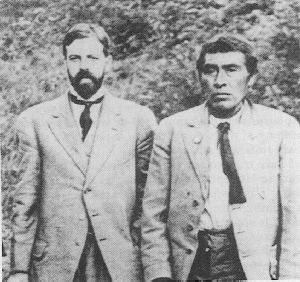
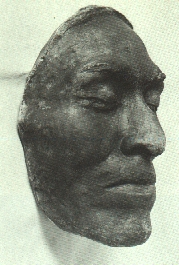
Note: I don’t know if Wes Studi could’ve pulled off the role. I think Greene is probably a better actor. But check out the pictures below. Studi looks more like Ishi than Greene does.
The clash of culturesThe language issue is handled nicely. Ishi can’t communicate with anyone until he meets Kroeber, who speaks his Yana dialect. Even so, Ishi is mostly mute in the first half of the film, with Kroeber occasionally translating phrases. In the second half, Ishi learns enough English to understand people, but still speaks only a few words of broken English.
The inevitable culture clash is handled well too. Ishi doesn’t cry out or cower when he encounters a train or motorcar. He doesn’t react with infantile awe when he sees a museum building or a doctor performing a surgery. He doesn’t do inappropriate things with inappropriate objects.
Similarly, no one treats him like a crude savage. They don’t talk down to him—don’t say anything about how poor and miserable his life must’ve been. Everyone gives him the respect and dignity he deserves.
Note: When the critic above talks about clichés, I wonder if he meant how the white folks treated Ishi like a noble savage, with the emphasis on “noble.” Perhaps he thought the treatment was too polite and genteel—i.e., too “politically correct.” If so, that’s a funny definition of “cliché.” This approach is far better than the usual approach, which would involve accosting Ishi with talk of teepees, chiefs, and squaws. The gentility is about what I’d expect from the leading anthropologists of the time.
The contrived conflictAs I indicated,
The Last of His Tribe is a rather low-key, calm, unhurried look at Ishi’s life. It’s not a movie for fans of action-packed thrillers. There’s really only one dramatic subplot, and from what I can tell, it’s mostly contrived.
Kroeber’s wife is dying and he can’t deal with it. As a man of science, he doesn’t believe in the afterlife. When she dies, Ishi is surprised to learn that Kroeber won’t sing for her. Without a death song, she won’t be able to find the trail to the land of the ancestors.
Later, Ishi discovers doctors performing autopsies on bodies. For the first and only time, he gets angry and abruptly leaves. He spends the night away from the museum, outside. When he returns the next day, he’s coughing with illness, and you know it isn’t going to go well. But in the end Kroeber receives a life-changing lesson from Ishi: He learns how to sing.
Kroeber’s first wife did die while Ishi was there, but I doubt the rest of this scenario happened. The writers probably invented it to give the story meaning. What’s the point of a movie about dying Indians if you don’t get something from it?
I suppose you could argue that this plot is necessary to make
The Last of His Tribe work. Without it, the movie would be more of a documentary than a drama. And then Ishi’s story might not have gotten told.
ConclusionI like the fact that
The Last of His Tribe is what I’d call a genteel film. That makes it eminently watchable if not moving or gripping. Rob’s rating: 8.0 of 10.
For more on the subject, see
The Best Indian Movies.
Below: Ishi, Wes Studi, and Graham Greene.