Showing posts with label James Cameron. Show all posts

October 14, 2011

Amazon worldview influences Avatar 2

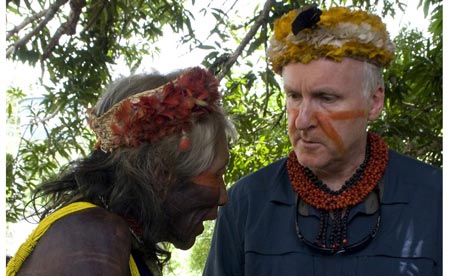
How Amazonian tribes influenced James Cameron’s Avatar 2How have your experiences there influenced Avatar 2?

I've certainly learned from it. I've learned a little bit more about the indigenous community's perspective on our world. The way they think and the way they feel that they are (in a way) tasked by destiny to be the protective spirits of their rainforest, of their world. They are the people who speak for the natural world and we need to listen to them for a number of reasons. First of all, they have the right to exist the way they're used to existing, we don't have the right to change that. Although that doesn't seem to stop us. And secondly, because we need their wisdom. We need to listen to nature a lot more than we do as as civilization. And we're not listening and we're in peril right now.

We also asked Avatar producer Jon Landau (who has also traveled with Amazon Watch and Cameron) how these trips have impacted his film.

How did the Amazon experience impact Avatar 2?

Jon Landau: It gave us an even greater sense of social responsibility, that our films can have a social impact on people around the world and make an impact. And one of the great things I think Jim is able to do in Avatar is, he didn't preach but he exposed things to people and let them come to their own conclusions. So no one went out and said this is wrong and this is right, they took it upon themselves to interpret it however they saw fit. And I think as we go forward—not just as it relates to the movie—but as it relates to what we're doing with the Disney theme parks, whatever we might do in publishing. In the movies, we realize that we have a social responsibility to challenge people to do what Jake did in the movie. Open their eyes. We don't tell them what to do after they open their eyes, because we believe people make the right decisions, we just challenge them to open their eyes.
Comment:  Cameron and Landau don't say how Avatar 2 will be different, but they drop a few hints. More socially responsible, more challenging and provocative...whatever that means. Perhaps a deeper look into the indigenous worldview, since Avatar was so shallow. More of Neytiri's viewpoint and less of Jake's.

On Facebook, Brad responded to this posting by saying, "If that were true he [Cameron] could spare us another three-hour snooze fest and donate the billion-dollar budget to Native tribes." I replied, "No! The world needs another billion-dollar movie to warn us about conserving our resources."

For more on Avatar 2, see Avatar 2 Cast to Meet Indians and Brainstorming Avatar 2 with Indians.

September 20, 2011

Disney plans Avatar attractions

Disney to bring 'Avatar' to theme parksDisney and filmmaker James Cameron announced plans Tuesday to bring the world of the Oscar-winning movie "Avatar" to the entertainment giant's theme parks.

The first "Avatar" land will open at the Walt Disney World in Florida, with construction due to begin by 2013, said Walt Disney Parks and Resorts Worldwide, Cameron and Fox Filmed Entertainment.

"James Cameron is a groundbreaking filmmaker and gifted storyteller who shares our passion for creativity, technological innovation and delivering the best experience possible," said Disney president and chief executive Robert Iger.

Cameron added: "I'm chomping at the bit to start work with Disney's legendary Imagineers to bring our 'Avatar' universe to life.
Comment:  This is a potentially bad idea. Avatar's Na'vi already represent a stereotypical view of indigenous people: primitive, savage, warlike, whooping, scantily clad, in tune with nature, worshiping animals and trees, lacking innovations such as fire or writing, etc. And now Disney is going to simplify and sanitize them for popular consumption?

Will Disney's Indians Na'vi tell epic cycles of stories, plot planetary courses over the centuries, engineer great canals and pyramids, or develop advanced surgical techniques? Because these are all things Indian cultures did. Or will the Na'vi simply run, jump, fight, ride, and hook up with their magical tree? You know, purely physical tasks that don't require any intelligence or planning?

The latter, I'm betting. I'd be amazed if the Avatar attractions made the Na'vi seem less primitive rather than more primitive.

For more on Avatar, see Review of Avatar and Avatar 2 Cast to Meet Indians.

March 29, 2011

Avatar 2 cast to meet Indians

James Cameron to Bring 'Avatar 2' Cast to Meet Brazilian Tribes

By Mike BrackenLast week, sources were saying James Cameron's plans to take a submersible to the deepest part of the Marianas Trench to capture underwater 3D footage for 'Avatar 2' were in jeopardy thanks to the recent earthquake in Japan. The director seems undaunted by that news and has other tricks up his sleeve to bring a sense of realism to the sequel to the highest-grossing film of all time. For example, he plans to take his cast to the rain forests of the Amazon and let them spend time with the indigenous tribes who live there.

The filmmaker, who is currently in Manaus for the second International Forum on Sustainability, feels that the experience will allow his actors to appreciate the setting and people that inspired 'Avatar,' and make the film even better.

"'Avatar' is a film about the rain forest and its indigenous people," Cameron said. "Before I start to shoot the two films, I want to bring my actors here, so I can better tell this story. Actors could learn about the natives and what real life in the jungle is like." Hopefully, this will make it easier for some poor thespian to stand in front of a giant green screen and pretend he's in a lush alien forest.
Comment:  For more on the subject, see Cameron Committed to Indigenous Causes and Brainstorming Avatar 2 with Indians.

October 01, 2010

Cameron criticizes oilsands "curse"

James Cameron lends star power to fight against oil-sands ‘curse’

By Josh WingroveIn a visit rivalling that of a royal dignitary, Canadian director James Cameron emerged as a high-profile voice for first nations groups who call Alberta’s oil sands “a curse,” pitting the Hollywood heavyweight against oil companies and the province that has long supported them.

Mr. Cameron effectively lent his celebrity to the leaders of several Alberta first nations by appearing with them Wednesday, thrusting their long-held complaints to unprecedented prominence.

Mr. Cameron, who recognizes there is apprehension about 'drive-by environmentalism,' urged Alberta to consider the environmental pressures the multibillion-dollar industry is putting on the province, pointing to the polluted Athabasca River in particular: 'I can't imagine being told by mom I can't swim in the river.'

But while many were wary of what Mr. Cameron describes as Hollywood “drive-by environmentalism,” he wielded a keen understanding of the industry and its intricacies, after wrapping up a three-day oil-sands tour. He was praised even by his opponents for listening to industry, government and first nations alike.
Comment:  For more on the subject, see Cameron Tours Oilsands and Cameron to Visit Oilsands?

September 28, 2010

Cameron tours oilsands

Cameron trying to keep open mind about oilsandsCanadian-born filmmaker James Cameron toured Syncrude's oilsands facility near Fort McMurray, Alberta on Tuesday, trying to keep an open mind about an industry that he worries is destroying the environment.

Cameron began Tuesday morning by touring the oilsands area by helicopter. He was then joined by Alberta Environment Minister Rob Renner for a tour of a reclaimed mine, which is now a wetland known as Bill's Lake.
And:Later, the Oscar-winning director travelled to the community of Fort Chipewyan, where he listened to the concerns of those people living downstream from the oilsands, and how the industry has affected their health and the health of the water they fish.

"I want to hear what's on the mind of the people of this community," Cameron said after landing at the community's airstrip. "Find out what concerns them about health issues and fish and wildlife issues, any of the environmental impacts that are associated with the tarsands."
Director to help with oilsands litigationFilm director James Cameron has promised to help people in Fort Chipewyan fund possible litigation against the government over oilsands development in northern Alberta, according to the local chief.

"He didn't express the fact that how much he would be able to contribute, but he did express the fact that he will help in some way," said Allan Adam, chief of the Athabasca Chipewyan First Nation.

Cameron met leaders and community members in the northern Alberta community, located downstream of oilsands development, on Tuesday afternoon as part of his fact-finding mission.

Adam said Cameron will either help raise funds or contribute some of his own money. The chief said the litigation could cost $1 million to $2 million.
Comment:  Glad to see Cameron's commitment to indigenous issues continues.

For more on the subject, see Cameron's and Weaver's Anti-Dam Films and Cameron to Visit Oilsands?

September 06, 2010

Cameron's and Weaver's anti-dam films

In Cameron Helps with Anti-Dam Films, I noted James Cameron's contributions to the battle against the Belo Monte Dam. Now here are the two films in question:

A Message from Pandora

James Cameron produced this special feature about the battle to stop the Belo Monte Dam and defend the Amazon Rainforest.


Sigourney Weaver Narrates New Google Earth Animation on Brazil's Controversial Belo Monte Dam

10-minute Tour in 3-D Highlights the Dam's Harmful Impacts on Xingu River and Greener Alternatives


Comment:  The second film especially is a devastating indictment of the Belo Monte dam. It's hard to believe anyone would support the dam after watching it.

Really, the age of massive engineering projects is or should be over. We need to start living with nature instead of trying to destroy it.

You can see another point that I make frequently: that Amazon Indians are no longer primitive spearchuckers, if they ever were. Sure, these people sometimes dress in traditional costumes, but they also wear shirts and pants, use modern implements, live in villages, speak Portuguese, go to schools, etc.

Like most indigenous people around the world, they live in two worlds. Portraying them as hidebound captives of their old lifestyle is a blatant stereotype.

For more on Cameron's efforts, see Cameron to Film Tribe Opposing Dam. For more on Amazon Indians, see Amazon Indians Weren't Savages and Amazon Indian Students on the Net.

September 05, 2010

Cameron to film tribe opposing dam

Avatar director vows to return for Amazon tribe fightFilm director James Cameron said Sunday he will return to Brazil this year to make a 3D film on indigenous people of the Amazon who oppose construction of a huge dam for fear it could flood tribal lands.

"I want to return to meet some of the leaders of the Xikrin-Kayapo tribe who invited me," the Canadian director said in an interview published in the Folha de Sao Paulo newspaper.

"I want to take a 3D camera to film how they live, their culture," said Cameron, whose blockbuster movie Avatar tells the story of the peaceful Na'Vi people who live in harmony with nature on the planet Pandora and wage a bloody fight against strip-miners from Earth.
Comment:  For more on the subject, see Cameron Helps with Anti-Dam Films and Cameron Suffering "Cause Fatigue."

September 01, 2010

Cameron helps with anti-dam films

Brazil dam project prompts animated response from director Cameron

By Matthew Knight"Defending the Rivers of the Amazon" is a 10-minute interactive presentation created jointly by Amazon Watch and International Rivers and highlights the environmental issues surrounding the building of the Belo Monte dam, in Para state.

Narrated by the actress Sigourney Weaver, the video explains how the dam--scheduled to be built on the Xingu River, a tributary of the Amazon River--will flood 500 square kilometers of agricultural land and rainforest, displacing over 20,000 people who have lived there for generations.

Cameron's help on the project has been invaluable, Amazon Watch's program director, Leila Salazar-Lopez told CNN. The Oscar-winning director helped enlist the services of Weaver and Google Earth.
And:In addition to helping produce the Google Earth Animation, Cameron has also released "A Message from Pandora." The three-minute feature premiered the same time as the recent re-release of his 2009 box office hit, "Avatar."Comment:  Glad to see Cameron is still helping the Amazon Indians despite his "cause fatigue."

For more on the subject, see Okay to Meddle in Brazil? and Dam Suspended with Cameron's Help.

July 15, 2010

Why Cameron supported the Iroquois

James Cameron on His Iroquois Lax Support:  'We All Want to See Them Play'

By Dan DurayWe reached out to Mr. Cameron and it turns out his donation was not out of the blue. Via email, he said he'd met Chief Oren Lyons, honorary chairman of the team, at a meeting of the UN Permanent Forum on Indigenous Issues and discussed some of the "themes and thinking behind Avatar" with him and various other Native American leaders.

From Mr. Cameron's email:

Chief Lyons talked at length about their lacrosse team...how good they were, and what they represented to the Iroquois Nation and other first nation people. I played lacrosse as a boy in Canada (not very well, to be honest), and so have an appreciation of the game, as well as of its cultural origins. Lacrosse was created by indigenous North Americans and later adopted by European colonial cultures. Chief Lyons was proud of the fact that his team would be travelling under their Haudenosaunee indigenous nation passports, which they have been using for 20 years. He contacted me to tell me that they had been held up from in NYC from flying to England, and needed financial assistance to stay there, until it could be resolved with the State Department. I jumped in to buy them a couple of days. State Department apparently came through in time, but of course we are all shocked and deeply disappointed that England then chose to stonewall the team's hopes and dreams. I hope this can get sorted out, as we all want to see them play.
Comment:  For more on the subject, see Iroquois Team Forfeits First Game and Iroquois Kept from Lacrosse Championship.

May 12, 2010

Cameron suffering "cause fatigue"

More on James Cameron's commitment to indigenous causes:

Talking the Amazon with CameronAfter meeting with the Kayapo Indians, “real life Na’vi,” as Cameron put it, the director got inspired and has been campaigning for indigenous peoples. Cameron says the Belo Monte boondoggle dam planned for the Amazon is a “quintessential example of the type of thing we are showing in Avatar—the collision of a technological civilization’s vision for progress at the expense of the natural world and the cultures of the indigenous people that live there.”

On a tear in New York, he spoke before a United Nations committee on aboriginal rights and even launched an environmental scholarship at Brooklyn Tech high school. Not content to stop there, he updated the Avatar website to keep fans informed about environmental issues and sponsored the planting of a million trees around the world as part of Earth Day.
But is Cameron's interest already waning?Having prevailed over the conventional logic and directed a mega hit with an environmental message, the real question now is how Cameron sees his role moving forward. When he made Avatar, Cameron didn’t imagine that people would interpret the movie as a call to action. In fact, he remarked, “I figured I’d be on vacation right now. I figured I’d make my big statement with the movie and let everyone else sort out what to do. Turns out there aren’t that many people figuring out what to do…. I think we’re facing [an environmental] crisis and I’m not going to stand around and leave it to someone else to deal with it.”

Those are energetic words, but when I saw Cameron speak in New York I got the impression that the director was a little overwhelmed by his new role. When one man stood up and asked Cameron if the director would help to save tribes from going culturally extinct in Colombia, the director frankly admitted he was suffering from “cause fatigue.” Later, when Quichua indigenous women got up and offered Cameron a ceremonial scarf, the director looked slightly taken aback.
Comment:  "There aren't that many people figuring out what to do" about the environment? Really? I would've guessed there was no shortage of people concerned about climate change, deforestation, and other environmental issues.

And Cameron's already feeling fatigued? After what...a month or two of challenging Brazil's hydroelectric dam? I've been studying Native issues for 20 years and I'm not much more than a dilettante. What does that make Cameron?

As I wrote in Cameron to Visit Oilsands?, start an organization, dude. Use you money to hire people and your clout to bring in other celebrities, open doors, and arrange meetings.

For more on the subject, see Dam Suspended with Cameron's Help and Cameron's Conversion to Environmentalist.

April 29, 2010

Cameron to visit oilsands?

Avatar director James Cameron wants to see oilsands for himself, former native leader says

By Trish AudetteAvatar director James Cameron may just take the Alberta government up on its invitation to visit the oilsands, a former First Nations leader said Sunday. “He actually suggested that he should be coming up there himself,” said George Poitras, a former chief of the Mikisew Cree. “He’s a Canadian, he knows the tarsands are an international issue. . . . He’s just generally interested.” Poitras was in New York on the weekend to attend the United Nations permanent forum on indigenous issues. He met with Cameron on Saturday morning, then joined him in a panel discussion later in the day. Last week, Cameron—who was born in Canada—made headlines when he said Alberta’s oilsands development is a “black eye” on the country’s environmental record. He suggested more emphasis be placed on the development of alternative energy, such as wind power.Avatar director James Cameron may snag invite to Canada's 'black eye':  the oilsandsThe Alberta government said Wednesday it has not extended an invitation to Oscar-winning director James Cameron to visit the province's oilsands, although if he wants to learn more about the project, that might change.

"I suppose it's possible," said Jason Cobb, a spokesman for Alberta Environment, when asked about an invitation. "We'll have to see how it goes."

Cameron, whose 3-D blockbuster Avatar deals with a fictional planet being destroyed in the mining of "unobtanium," is widely seen as an allegory on the oilsands.

The Canadian-born filmmaker and environmental activist said he hoped to learn more about bitumen operations this weekend when meeting with the Secretariat of the UN Permanent Forum on Indigenous Issues in New York. He called the oilsands a "black eye" for Canada while in Toronto to promote the release of his film on Blue Ray.

Alberta Energy Minister Ron Liepert shrugged off the criticism. Asked if anyone should care about Cameron's comments, the energy minister said, "You might, but I don't."
Comment:  I must've read 100 or more articles on Avatar. I haven't seen one that said it's an allegory for Alberta's oilsands.

A photo caption says the "bleak opening scenes are thought to be inspired by oilsands mining operations." The opening scenes--not the entire movie--is a bit more plausible.

It's great that Cameron is getting so involved in environmental issues. But I have to wonder about his methods. Is visiting places one by one--so he can see them himself--really the best use of his time? Is he saying he won't tackle any problem until he's personally investigated it?

If I were a billionaire celebrity who wanted to tackle environmental problems, I'd probably start a foundation. Or take over an existing one. I'd hire a staff to identify the most critical environmental problems. Then I'd send experts to identify and address the problems along with journalists to cover them. Maybe an actor or a filmmaker or both to leverage Cameron's fame and interest the American media.

Call them "Avatar Response Teams" or something similar, of course. Just like in the movie, they're outside representatives inserted into difficult situations. I can see the headlines already: "Cameron Sends Avatars to Stop Ocean Pollution" (or whatever).

This way, he could handle several of the most pressing environmental problems. The combination of scientific resources and celebrity-driven coverage could help resolve some of them. We're already seeing a hint of how this would work. Wherever Cameron goes, publicity seems to follow. Politicians, environmentalists, and the locale's indigenous population vie for his attention.

That's the way to have an effect. Invest your Avatar money in teams to investigate and publicize issues around the world. Multiply your passion tenfold and things will start happening.

For more on the subject, see Cameron Committed to Indigenous Causes and Canada's Avatar Sands.

Below:  "Avatar director James Cameron has indicated an interest in visiting Alberta's oilsands." (Chris Schwarz, Edmonton Journal)

April 27, 2010

Cameron defends Avatar's white messiah

‘Avatar’ Activism:  James Cameron Joins Indigenous Struggles Worldwide

By Jessica LeeWhile the film was well-received by the largely indigenous audience, Cameron did field some tough questions.

Deer pointed to large Hollywood films, such as Dances with Wolves, Little Big Man, Windtalkers and Avatar, where the hero who saves the indigenous people is always a non-indigenous person. He asked Cameron why he also chose this narrative, and instantly received a large cheer from the audience.

Cameron responded, “That was one of the backlashes against the movie, that the so-called main character was not an indigenous leader himself.” However, he said that the goal in making the film was not to try to “tell indigenous people how bad things are for them,” but rather to “wake up” people who play the roles of economic oppressors or invaders in real-life. “I understand the white messiah argument,” he said, “but in this movie, I am trying to make everybody a white messiah, for everybody to have the sense of responsibility to help with the problem. I think it is such absolutely courageous how you are fighting for your rights … But it is going to take people from the other side meeting you part way and taking responsibility for what has happened in the past and the way we need to live in going forward.”

Cameron continued, “But, if you’ll notice, I tried to go behind the normal Hollywood paradigm and have Jake work within the leadership system of the Na’vi, by not displacing the leader Tsu’Tey who had taken over leadership of the clan when the patriarch, when the father dies, as he stands up with him and ask him to translate for him—so that the message comes from both of them together. I tried to show two cultures meeting halfway to find a solution. And perhaps Hollywood can go further in that regard. Maybe it my own parochial, chauvinistic perspective as a writer. As an artist, it is very important to write from the heart, and Avatar is what came out.”
Comment:  This is one of the more disingenuous rationalizations I've heard recently.

Cameron's excuse is he wants everybody, not just indigenous people, to have a sense of responsibility. For change to happen, he thinks the Western, industrialized side must meet the indigenous side part way. Both sides must work together to find solutions.

Great, but what does that have to do with choose a white-messiah figure to lead the battle? Why couldn't a Na'vi leader be the one who brought the Terran and Pandoran sides together? Why couldn't the Terrans have followed his lead rather than the Pandorans following Jake's lead?

Cameron has admitted being ignorant about indigenous issues, and it shows. If he were following the Native media, he'd know that Natives lead hundreds of conferences, campaigns, and protests every year. They don't sit around waiting for white folks to bridge the gap with them. They take the lead and bridge the gap themselves.

That's what's missing from Avatar--that sense of indigenous people determining their fate with or without outside help. Indians leaders such as Tecumseh, Osceola, and Geronimo resisted the US for years, on their own, without a white man's advice.

Jake Sully...a co-leader?

Cameron's claim that Jake and Tsu'Tey were co-leaders is pure rubbish. Jake is the one who conquered the unconquerable Toruk, proving himself the messiah who could rally tribes from across the planet. Jake is the one who made the big speech, led the troops into battle, and secured the final victory. Even if Tsu'Tey was the Na'vi's nominal leader, his role was inconsequential.

The real reason for making the hero white is that Cameron was working inside his comfort zone. He chose to feature white characters because he's white. Which means he's consciously or unconsciously prejudiced against others.

I guess we'll find out for sure in Avatar 2. Now that he's made a billion dollars and proved the marketability of blue aliens, he can do whatever he wants. He could give Jake Sully a minor role in the sequel, or not use him at all. He could do an entire movie with Pandorans only--no humans in avatar's clothing. If he chooses to make Terrans the heroes again, it'll strongly suggest his bias.

For more on the subject, see The White Messiah Fable and White Guilt in Avatar.

Below:  "James Cameron receives several gifts from indigenous communities after Avatar was screened to some 400 delegates of the U. N. Permanent Forum on Indigenous Issues at the New York Directors Guild Theatre in Midtown Manhattan April 24."


April 26, 2010

Cameron committed to indigenous causes

‘Avatar’ Activism:  James Cameron Joins Indigenous Struggles Worldwide

By Jessica LeeBlockbuster Hollywood director James Cameron said that he is committed to helping indigenous peoples around the world who, like the fictitious Na’vi in his film Avatar, are “caught at the tectonic interface between the expansion of our technical civilization into the few remaining preserves of this planet.”

Several months after the release of Avatar, which quickly became the top grossing film of all time, and two days after the release of the DVD on Earth Day, Cameron was invited to speak at two events on April 24 that were associated with the Ninth Session of the United Nations Permanent Forum on Indigenous Issues taking place in New York City from April 19-30.

“I’d just like to say it is a tremendous honor for me to be here,” Cameron said in his introduction to a special evening screening of Avatar to some 400 people from the indigenous forum at the New York Directors Guild Theatre in Midtown Manhattan. “I applaud what you [at the forum] are doing. It is so critical given how many indigenous cultures are under threat throughout the world.”

Cameron said that he has been astonished by the response to the film and said that many indigenous communities and environmental organizations have contacted him seeking his help and support.

“It has been very, very interesting for me in the last couple of months to see how many people have come to [my wife] Susie and myself asking if there is something we can do in association with Avatar because so many people around the world working with indigenous issues have seen their reality in the film—even though the film is a fantasy that takes place on a mythical world—people are seeing their reality through the lens of this movie.”

While he said that he had never worked with indigenous people before in his life, he says he is now very committed to helping illuminate these struggles worldwide. “I never really dreamed that a Hollywood film could have that significant of an impact,” Cameron said on panel discussion earlier in the afternoon, “Not only is this is an opportunity, it is a duty. I do have a responsibility now to go beyond the film, because it doesn’t teach, and to become an advocate myself and use what media power I have to raise awareness.”
Native Peoples See Themselves in 'Avatar'

Comment:  A few points:

1) It sounds as though Cameron didn't know anything about indigenous issues before making Avatar. Undoubtedly this is reflected in the movie's super-simplistic storyline.

2) People have invoked Avatar in at least three conflicts around the world: Canada, Palestine, and Brazil. Yet people claim movies have no influence in the real world and are just pieces of entertainment? The facts prove this ignorant view wrong.

3) Cameron apparently was inspired by his own movie--researching and writing it--to become involved in environmental and indigenous causes. This shows how powerful the Native narrative can be. If you think about it, it has a timeless story structure: heroes (Natives) face an overwhelming foe, suffer a terrible defeat, but come back to win in the end.

Stories about slackers, hipsters, and yuppies aren't classically American. Stories about underdogs--e.g., minorities and immigrants--pursuing their dreams are. Something like Avatar--good Natives triumph over bad imperialists--should be a no-brainer for Hollywood.

For more on the subject, see Dam Suspended with Cameron's Help and Cameron's Conversion to Environmentalist.

Below:  James Cameron joins the panel discussion, “Real Life ‘Pandoras’ on Earth: Indigenous Peoples Urgent Struggles For Survival,” held at the Paley Center for Media in Midtown Manhattan April 24, 2010.

April 19, 2010

Okay to meddle in Brazil?

Avatar director James Cameron joins Amazon tribe's fight to halt giant dam

By Tom PhillipsNot all Brazilians have taken kindly to Cameron's engagement with the indigenous cause. "This type of intervention strengthens the belief… that the aim of the ecological movement is simply to maintain the status quo of the world economy," one columnist wrote in the Monitor Mercantil newspaper last week, adding that "Cameron's colonialist message" was an attempt to "exterminate the future of Brazil." Brazil's outgoing energy minister, Edison Lobão, told the Record news channel that Cameron understood "nothing about electric energy." "We don't try to get involved in cinema, because we know nothing about it," he said. "I wouldn't try to make Avatar, would I? It would be horrific."

But in many of the Xingu's indigenous villages, the man they call Camerón has been an instant hit. "It's very important that he has come here," said Mokuka Kayapó, a leader from the Moikarako village, after meeting the Canadian director. "Now he must invite us to go where he lives to tell the people our truth, in our language."

Cameron also defends himself from accusations of meddling. "I think one of the biggest questions is: 'What is your standing? What are you gringos doing here? What gives you the right to tell us how to run things within our country? It's our problem, it's not your problem.' I get all that," he said. "But North America is Brazil's future. We can come to Brazil from the future and say: 'Don't do this.'

"If this goes forward then every other hydroelectric project in the Amazon basin gets a blank cheque. It's now a global issue. The Amazon rainforest is so big and so powerful a piece of the overall climate picture that its destruction will affect everyone."
Comment:  It's okay with me if Cameron meddles in Brazil's affairs.

For starters, he isn't just criticizing the government. He's criticizing the government on behalf of the indigenous people whom the government doesn't represent. If they asked him to butt out, it would be a different story, but they clearly want his help.

Also, as Cameron notes, the fate of the Amazon rainforest affects us all. Like the oceans or Antarctica, it really should be an international resource. I wouldn't mind if the United Nations or whoever declared it one.

In short, when Brazil's actions start depriving Indians of their lives and the planet of oxygen, I'd say we have the right to intervene. If Brazil doesn't like it, too bad.

For more on the subject, see Cameron:  Lakota = "Dead-End Society" and Dam Suspended with Cameron's Help.

April 18, 2010

Cameron:  Lakota = "dead-end society"

Avatar director James Cameron joins Amazon tribe's fight to halt giant dam

By Tom PhillipsCameron said witnessing indigenous ceremonies and meetings in the Amazon had made him reflect on the plight of the North American Indians and inspired him to attempt to give the "global consciousness… a heads up."

"I felt like I was 130 years back in time watching what the Lakota Sioux might have been saying at a point when they were being pushed and they were being killed and they were being asked to displace and they were being given some form of compensation," he said. "This was a driving force for me in the writing of Avatar–I couldn't help but think that if they [the Lakota Sioux] had had a time-window and they could see the future… and they could see their kids committing suicide at the highest suicide rates in the nation… because they were hopeless and they were a dead-end society–which is what is happening now–they would have fought a lot harder."
Adrienne Keene of the Native Appropriations blog responds to this quote:Wow, James Cameron. Wow. So, the contemporary Lakota are "hopeless" and a "dead-end society"? And the generations of fighting against colonialism and continued oppression weren't and aren't fighting hard enough? Talk about ignorance. He makes it seem like the Lakota just rolled over and let their land be taken away. Couldn't be further from the truth.

Ugh. So hear that Natives? We should have just fought harder, and the state of our Native nations would be different. Right.
Some comments about this on Facebook:Just pisses me right off...glad I did not see his stupid movie. It was full of stereotypes anyways....JERK.

James Cameron will never get another cent of my money. Sorry SOB. Proud to be Lakota!

I will never see another of his movies. Just don't like him in general. Did not see Avatar.
Comment:  Someone asked if Cameron meant his remarks figuratively and someone else said no, he meant them literally. I don't know about that.

  • Cameron may have meant the kids who commit suicide feel they're in hopeless or dead-end situations. That isn't the same as saying the whole society is hopeless or dead-end.

    On the other hand, many people do think Indian reservations are hopeless, dead-end places. So Cameron may have meant what he said.

  • It's a common figure of speech to say, "If I'd known x, I would've done y." For instance, "If I'd known my blind date was a supermodel, I would've driven twice as fast to meet her." When people say something like this, they don't mean they'd literally do what they didn't do if given another chance.

    Nor do I think anyone has ever accused the Lakota of being soft on resistance. Considering they fought on until they were massacred at Wounded Knee, I don't see how anyone could've expected them to do more.

    On the other hand, maybe Cameron was seduced by his moviemaking. Maybe he really thinks his Na'vi offer a lesson for indigenous people. Something like, "If you're as smart and brave as my fictional warriors were, you too could win against the forces of imperialism."

    Never mind that the Na'vi probably should've lost against the Terran military--even with the help of Jake the white savior. It was a fluke that Jake encountered and was able to tame the giant Toruk, giving him the clout to unite the tribes. That Trudy turned her gunship against Quaritch's ship. And that the Pandoran wildlife joined the battle at just the right moment.

    I think it's obvious what Cameron wanted to say: that the traditional Lakota would be unhappy if they saw their people today. I think he chose his words poorly; he stupidly used a phrase that sounded like blaming the victim. But I don't think he meant what people inferred.

    For more on the subject, see Brainstorming Avatar 2 with Indians and Dam Suspended with Cameron's Help.

    Below:  "James Cameron talks to a Xingu leader in Brazil." (Atossa Soldani/EPA)

  • April 16, 2010

    Brainstorming Avatar 2 with Indians

    James Cameron Meeting With Brazilian Native Tribes To Brainstorm Avatar 2Where are you right now in production with Avatar 2?

    We are nowhere. We have a commitment that we want to make it. We have to work out a deal with Fox to make it. Fox wants us to make it. We've chosen on our own side to keep these people on as our team. We're continually thinking about it. We recently made a trip down to Brazil and learned a lot. Not just about the world and what's going on the issues there, but how it relates to Avatar and the world of Pandora. Jim meeting indigenous tribes down there, we are a culmination of our past experiences. And these experiences like in Brazil and presenting on the 24th, Avatar to the indigenous tribes United Nation here in New York. All of that is going to inform us about Avatar 2.

    What is the green message of Avatar?

    What I think people take away, or what it was intended to be—I think it's all different. What I think has happened, having been around the world with the film....The movie opens with eyes open, and it ends with eyes open. I think there's an awakening of people. It's something that they are more conscious of. I don't think they've necessarily figured it out for themselves.And the movie doesn't intend to preach. There are no facts, no information is being given. It just basically says, "Hey, this is something for you to think about. And for you to make your own choices." Someone said this to me—and I think this is really great—"After I saw Avatar, I noticed for the first time the oak tree that's been in my front yard for 15 years."
    Comment:  For more on the subject, see Dam Suspended with Cameron's Help and Indigenous Values in Avatar.

    April 15, 2010

    Dam suspended with Cameron's help

    Amazon defenders win bid to stall huge dam project

    By Alan ClendenningEnvironmentalists aided by "Avatar" director James Cameron celebrated a big win Thursday after a judge suspended bidding on construction and operation of an Amazon dam that would be the planet's third-largest.

    The ruling also resulted in the suspension of the hydroelectric project's environmental license. It was reminiscent of 1989, when rock star Sting protested the same dam alongside Indians in an event that helped persuade international lenders not to finance it at a time when Brazil was shuddering under a heavy foreign debt.
    Cameron's role:Increasing international condemnation won't reverse Brazilian policy makers' view that the dam is essential to provide a huge injection of renewable energy, said Christopher Garman, director of Latin American analysis at the Eurasia Group in Washington.

    "This dam is going to happen. It's just a matter of when it happens," Garman said.

    Brazil has a fragile energy grid that was hit last year by a blackout that darkened much of the nation. Belo Monte would supply 6 percent of the country's electricity needs by 2014, the same year Brazil will host soccer's World Cup and just two years before Rio de Janeiro holds the 2016 Olympics.

    Soltani disagreed that the construction of the 11,000-megawatt dam is inevitable, saying Cameron's involvement was a major advance and attracted attention that could "create pressure on the (Silva) administration and on the Brazilian public, and hopefully will encourage the Brazilian public to take a stand."
    Comment:  Another excellent example of how complaining, criticizing, and protesting work. If you have a loud enough voice, as Cameron does, people will listen to you.

    Alas, the suspension lasted only a day. According to the NY Times (4/16/10):[B]y Friday, the dam was back on the table. A judge in the capital, Brasília, overturned the ruling and said the auction would take place as scheduled.No doubt the story is far from over. Activists and Indians working together still may achieve their goals.

    For more on the subject, see Cameron's Conversion to Environmentalist and Cameron Criticizes Hydroelectric Dam.

    Below:  "Director James Cameron marches during a protest against a proposed dam in the Amazon in Brasilia Monday." (AP)

    April 10, 2010

    Cameron's conversion to environmentalist

    Tribes of Amazon Find an Ally Out of ‘Avatar’

    By Alexei BarrionuevoIn the 15 years since he wrote the script for “Avatar,” his epic tale of greed versus nature, Mr. Cameron said, he had become an avid environmentalist. But he said that until his trip to the Brazilian Amazon last month, his advocacy was mostly limited to the environmentally responsible way he tried to live his life: solar and wind energy power his Santa Barbara home, he said, and he and his wife drive hybrid vehicles and do their own organic gardening.

    “Avatar”—and its nearly $2.7 billion in global tickets sales—has changed all that, flooding Mr. Cameron with kudos for helping to “emotionalize” environmental issues and pleas to get more involved.

    Now, Mr. Cameron said, he has been spurred to action, to speak out against the looming environmental destruction endangering indigenous groups around the world—a cause that is fueling his inner rage and inspiring his work on an “Avatar” sequel.

    “Any direct experience that I have with indigenous peoples and their plights may feed into the nature of the story I choose to tell,” he said. “In fact, it almost certainly will.” Referring to his Amazon trip, he added, “It just makes me madder.”
    Comment:  For more on the subject, see Cameron Criticizes Hydroelectric Dam and Indigenous Themes in Avatar.

    Below:  "The director James Cameron backs efforts to halt the building of a dam in Brazil." (André Vieira for The New York Times)

    April 03, 2010

    Cameron criticizes hydroelectric dam

    James Cameron, in real life, fights to save indigenous groups from massive dam construction in Brazil

    By Jeremy HanceAfter creating a hugely successful science-fiction film about a mega-corporation destroying the indigenous culture of another planet, James Cameron has become a surprisingly noteworthy voice on environmental issues, especially those dealing with the very non-fantastical situation of indigenous cultures fighting exploitation.

    This week Cameron traveled to Brazil for a three-day visit to the Big Bend (Volta Grande) region of the Xingu River to see the people and rainforests that would be affected by the construction of the Belo Monte Hydroelectric Dam. Long-condemned by environmentalists and indigenous-rights groups, the dam would destroy 500 square kilometers of pristine rainforest and force the relocation of some 12,000 people.

    "For people living on the banks of the river, as they have for thousands of years, the damage done (by the dam) would destroy their way of life," Cameron said in a press conference following his trip, according to Agencia EFE. He asked the Lula Administration of Brazil to reconsider their decision to build the dam.

    "There are always other solutions when good leaders play their part to solve a problem," added Cameron.
    Comment:  So much for the people who complained that Cameron was making billion-dollar movies but not doing anything concrete to help save the environment. Clearly he believes in Avatar's message.

    Upon reading this, conservatives probably would launch into a second round complaints, such as, "Cameron jetted to Brazil, emitting xx,xxx pounds of CO2, just so he sound off? What a hypocrite!"

    True, Cameron could've teleconferenced, taken a commercial plan (who knows? perhaps he did), or combined his trip with other business trips or a vacation. But we can't solve the world's problems by cocooning in our caves and hoping they'll go away. As the saying goes, you have to spend money to make money. Similarly, you have to harm the environment a little to help it.

    How many Avatar fans will learn about the Belo Monte Hydroelectric Dam because of Cameron's involvement? Tens or hundreds of thousands? If he can draw attention to the dam situation, it may lead to worldwide pressure and a policy change. If so, his trip will have been worth it.

    For more on the subject, see Palestinians = Na'vi and Sting and Indians vs. Hydroelectric Dam.