September 17, 2013

The Obama/Oprah myth

Here's a posting for people who are still clueless about the concept of white privilege. Who think that because dark-skinned individuals succeed occasionally, America has no systemic bias for whites and against minorities.

No, Oprah and Barack can’t fix racism: Stop celebrating “how far we’ve come!”

Yes, Black stars break down barriers--but this week showed they don't signal broad systemic changes. Here's why

By Brittney Cooper
Exceptional black people like Barack Obama, Oprah Winfrey and Michael Jordan do break down barriers, but they don’t signal broad systemic changes. The fact that we are only talking about two brave black sorority girls knocking down yet another door, 50 years after the first black people were allowed to become students at the university signals just how incremental the changes are.

Fifty years ago, scores of exceptional black people used our position at the margins to push this nation into a different and more inclusive future. Five decades later, we live in a world where ordinary black citizens are still murdered by police officers. We live in a world where exceptional black people elicit ephemeral waves of white outrage, but the perpetual killing of ordinary black people will largely be met with silence. We live in a world where the police call George Zimmerman “another Sandy Hook waiting to happen,” while other officers of the state have allegedly conspired to let him get away with Trayvon Martin’s murder. We live in a world where black people absolutely cannot trust the police. We live in a post-moral universe where justice is a moving target that manages to curiously and conspicuously evade black people.

We live in a world where brown people are viewed as threatening terrorists, never mere citizens: That is true whether we are speaking of a disoriented, scared 20-something who has just survived a horrendous car wreck or a beautiful Indian American woman who has been crowned Miss America. This was just as true 50 years ago.


Some evidence

To underscore the point, let's look at a typical week-plus in racist America. Here are some news items that appeared from September 9 to September 17 this year:

Limbaugh names Obama’s Syria plan “Operation: Shuck & Jive”

Judge: Abercrombie wrongly fired Muslim for hijab

Racist “patriots” want me dead: I dared criticize “the troops”

You heard me: Rush Limbaugh is “a racist troll”

Ann Coulter’s Psychotic Racism Too Much Even for FOX

How I Called the Cops and Almost Got Shot: the Politics of Being a "Threat"

Florida man accused of ‘walking on wrong side of the road’


O’Reilly and Allen West agree: Trayvon Martin died because ‘he looked a certain way’

Rush Limbaugh Insults His Own Sponsor McDonalds By Calling McNuggets Poor People Food

Obama Derangement Syndrome Explodes: Right Goes Crazy As FLOTUS Suggests We Drink More Water

7 crazy right wing statements from just last week

Fox Nation Reacts To D.C. Navy Yard Shooting With Racist Hate

This Might Make You Sick: 11 Cases of Restaurant Racism

Miss America sparks America's racism

'How Could Anyone Have So Much Hate?' New Kind of Range War in So. Dakota

University of Alabama president admits: ‘Our Greek system remains segregated’ by race

When It Comes To Illegal Drug Use, White America Does The Crime, Black America Gets The Time

Report: Exec overseeing U.S. Open security wanted guard dog for ‘some n*gger eating’

Note that I didn't include items primarily about prejudice toward women or gays. If I had included them, it would've doubled or tripled the number of items.

Any questions about the ongoing racism in America despite--or because of--having a black president?

For more on the subject, see White Privilege = Male Privilege and Whiteness Defines Others as Outsiders.

Students chant "white man, steal our land"

Outrage at UBC renewed as racist chant alleged

By David P. BallAs the University of B.C. is set to reveal its findings Wednesday about the use of an infamous rape chant, new allegations have surfaced that students also shouted a chant that mocked aboriginals during FROSH week activities.

Computer science graduate and orientation squad manager Benjamin Israel said he witnessed a chant of “white man, steal our land” as part of a Commerce Undergraduate Students team called “Pocahontas.”

"While they were doing the chant, they were sitting in a circle and banging on the ground rhythmically,” Israel said. “They were imitating a Native circle with drums ... My entire squad saw this.”

Israel said many people witnessed the chant, but no one intervened.

“The commerce FROSH this year was apparently Disney-themed, and so each group had its own name to go with the theme,” he said.

A third-year UBC student, who did not want her name used due to fears of reprisals, said she also witnessed the chant.

The allegations comes just as the Truth and Reconciliation Commission opens hearings Wednesday into abuse suffered by aboriginals at residential schools.

UBC spokeswoman Lucie McNeill said the unproven allegations emerged during the school's investigation into a commerce student chant proclaiming, “At UBC we like ‘em young, Y is for your sister, O is for oh so tight, U is for underage, N is for no consent, G is for go to jail.”

That controversy led to the resignation of the CUS president and three other leaders, and the cancellation of future FROSH events.
Comment:  So the students called their group "Pocahontas," pretended to be Indians, and chanted "white man, steal our land." I don't know if this was supposed to be mean "the white man stole our land" or "white man, go ahead and steal our land." Either way, it trivializes and mocks what real Indians suffered.

And the students are the same ones who promoted rape against women. Well, at least they're consistent. They're prejudiced against women and they're prejudiced against Indians.

For more on college racism, see Debauched "Indians" on Caesarian Sunday and Students Apologize for University of Denver Party.

September 16, 2013

"Lizard People" of Los Angeles

Who Were the 'Lizard People' of Los Angeles?

A 25,000-year old civilization?

By Terrence Aym
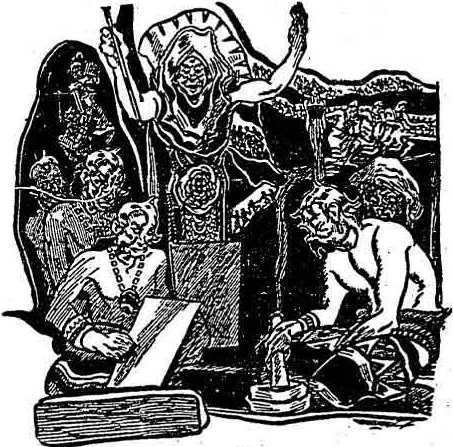
Long before Los Angeles existed…long before the Spaniards built missions along the western coastline…and long before any European set eyes upon the Pacific ocean from the western shores of America, the Lizard People roamed the land—both above and below the earth.

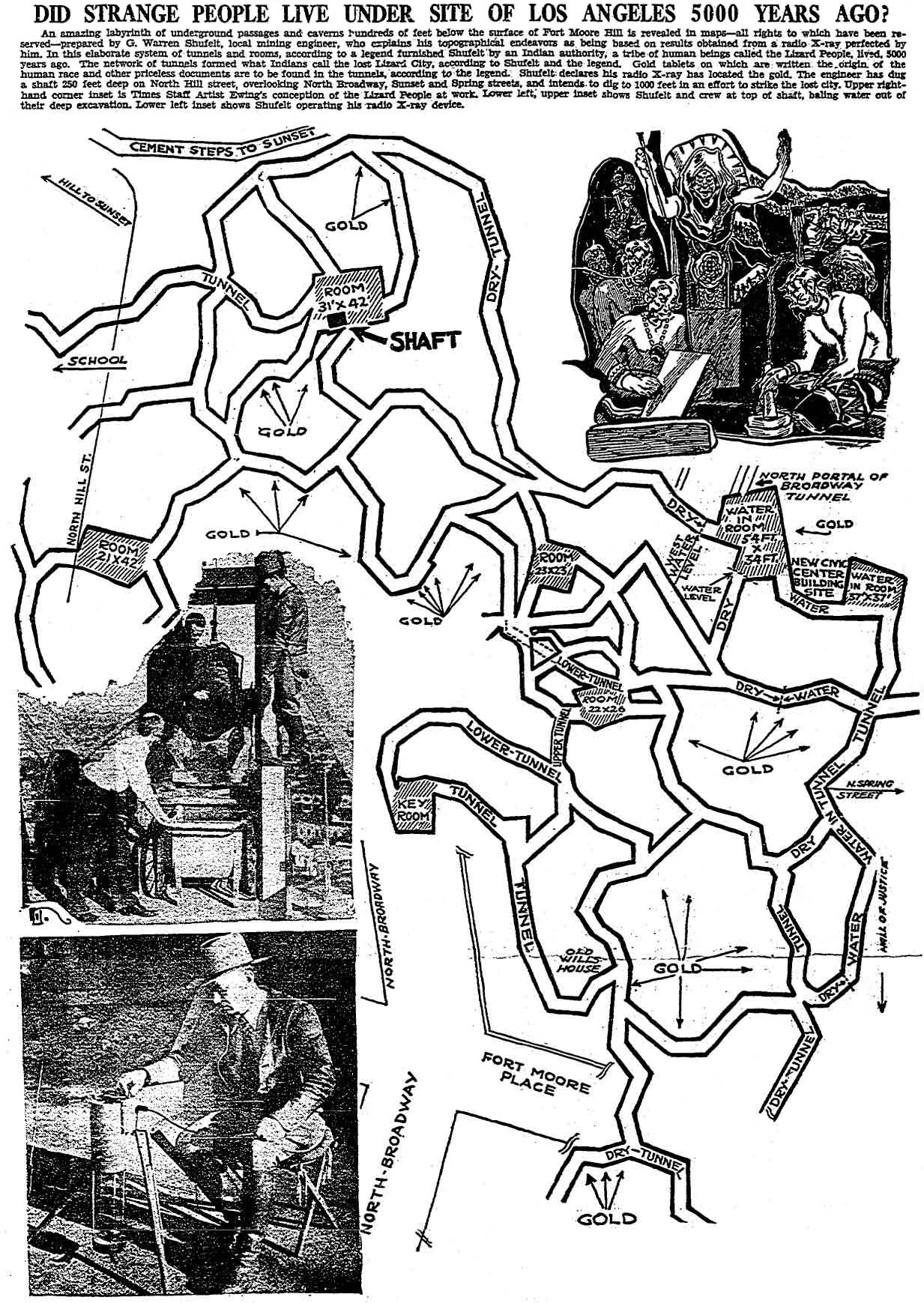
The Lizard People built a maze of intricate tunnels deep underground. Their subterranean passageways lay far beneath the earth for thousands of years until the tunnels were accidentally discovered in 1933 by a California engineer named G. Warren Shufelt.

The engineer had invented an odd device he called a "radio X-ray." While prospecting for precious metals with the instrument he discovered a strange labyrinth of tunnels.

Who were those mysterious people—those Lizard People of the underground realm? The Hopi Indians knew and related legends that provided some clues.

A 25,000-year old civilization?

When Shufelt learned that the Hopi Indians possessed knowledge about the strange tunnels he'd discovered, he traveled to Arizona and met with an elder of the tribe: Little Chief Greenleaf.

Greenleaf (whose Westernized name was L. Macklin) shared an amazing tale with Shufelt.

The chief told Shufelt that the L.A. engineer had stumbled upon one of the three great lost cities built along the Pacific coastline thousands of years in the past.

Presumably,eons before the ancient Sumerian civilization rose 7,000 years ago, the Lizard People were already long settled in North America and had an advanced, flourishing civilization centered around trade between three giant coastal city-states. Greenleaf said that the remnants of the civilization that Shufelt found under the city of Los Angeles had been shelters built to protect the people from meteoric firestorms. Such a storm had destroyed parts of their cities when a huge fire came unexpectedly from the southwest.
Comment:  I mentioned this story a long time ago--on my website, before I had a blog. This 2010 article covers the same subject in more detail.

Paper trail

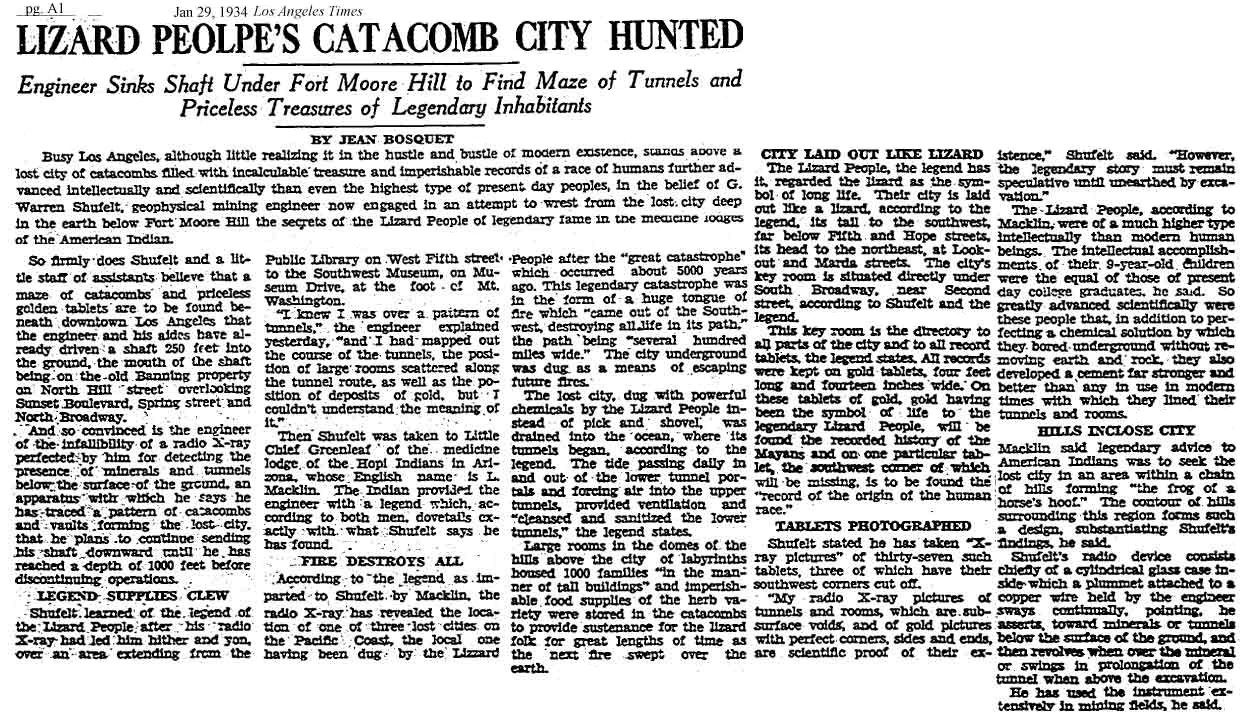
I presume Aym got the story from the LA Times article he mentions--dated January 29, 1934. His article is mostly a rewrite of that article (below).


As you can see, the old article really exists. In fact, the LA Times has articles going back to 1897 about treasure buried beneath the city. In 2009, the paper revisited the subject:

Gold Hunters Dig for Lost Underground Empire of the Lizard People!

By Larry HarnischI thought it would be fun to explore the story of the "Lizard People," which is to say the excavations on Fort Moore Hill in an unsuccessful search for gold. G. Warren Shufelt usually gets the credit for the enterprise, but his partners deserve equal attention. The Times reported that Rex. I. McCreery and Ray Martin provided an ancient parchment map showing the Lizard People's underground empire, which allegedly stretched from the Central Library on 5th Street to the Southwest Museum, which you must admit is a lot of digging.

Earlier Times clips report that Shufelt had been a mining engineer employed by a mine in Kingman, Ariz., so evidently he was legitimate. Unfortunately, The Times' stories about the gold excavation are vague and conflicting about the origin of the map. Most stories say it belonged to McCreery and Martin, who presumably brought in Shufelt as a partner because he was a mining engineer. Our later story says Shufelt got the map from "Little Chief Greenleaf" alias L. Macklin.

Aug. 15, 1897: An early story about gold buried on Fort Moore Hill.

March 3, 1933: Gold hunters are excavating directly over the Broadway tunnel, a long-gone downtown landmark that was just north of the Hall of Justice. Evidently they didn't question why the crews digging the tunnel didn't find anything.

March 4, 1933: Gold hunters consult their ancient map.

March 7, 1933: Onlookers apparently heckled the diggers.

March 9, 1933: They're close!

March 27, 1933: The hunters are secretive about their map, attributing it to the Spanish rather than the Lizard People.

April 10, 1933: The Board of Supervisors allows digging to continue.

Sept. 7, 1933: Shufelt, McCreery and Martin have given up, but Alfred Scott comes forward to carry on the search.
Spaniards or Lizards?

Buried treasure is one thing, but the long article on January 29, 1934, raised the story to a whole new level. I think it's the only one to claim "Lizard People" rather than Spaniards buried a treasure:

Did Ancient Lizard Cult Hide Gold Tablets in Tunnels Under L.A.? Jan. 29, 1934

You also can read it here: Lizard People's Catacomb City Hunted


That wasn't quite the end of the story. Harnisch's roundup of LA Times articles continues:Dec. 22, 1938: Times columnist Ed Ainsworth takes a look at various legends of lost California gold as engineer Roger J. Adams begins digging. According to The Times' clips, a fair amount of dirt from Fort Moore Hill was used as fill during construction of Union Station. The job was done mostly by hand, with men using picks and shovels as a public works project to provide jobs during the Depression.

Sept. 21, 1949: Demolition of the Broadway tunnel failed to reveal any buried gold.
This certainly is a colorful story. But "Little Chief Greenleaf" isn't a Hopi name, so the Native portion of it rings false. No doubt someone concocted the whole "Lizard People" thing.

Shufelt may have invented the so-called Hopi legend himself. Perhaps he felt a need to explain his failures--e.g., "The tides washed out the Lizard People and collapsed the tunnels." Or perhaps people weren't paying enough attention to the and he felt a need to spice it up.

For more on lost civilizations, see Lost Mesa in Fablehaven and Indiana Jones's Criminally Bad Archaeology.

Miss America sparks America's racism

An excellent example of how racist we still are despite--or because of--electing a black president:


Racists Are Being Hella Racist Because Miss America Isn't White

The worst reactions to Nina Davuluri being crowned Miss America

20 Racist Tweets About the New Miss America

Fox News host: new Miss America, Nina Davuluri, doesn’t ‘represent American values’

Miss America brushes off the bigots[W]ith her victory, Davuluri has made an outmoded, quaintly sexist relic somehow relevant–subversive, even. She’s sparked a conversation about what it means to be truly American (Hint: The qualifications don’t include European descent) and exposed the racists in their astonishing ignorance. She showed that while it’s grotesque enough to hate, to hate without any degree of geographic, historic or cultural accuracy takes a person to a super-achiever level of grotesque. And if there were prizes to be handed out for sheer absurdity, a whole lot of people would be wearing tiaras today.Comment:  Apparently white skin is an "American value" now. Which is what conservatives such as Mitt Romney and Sarah Palin mean when they talked about "real Americans": white people.

You rarely see such a pure case of America's racism in action. Davuluri is an American citizen, hasn't done anything wrong, and isn't a Muslim or an Arab. (Not that it would matter if she were a Muslim or an Arab.) So a bunch of bigots are attacking her for nothing except her race.

For more on the subject, see Racists Think "Equality Was Achieved" and "Everybody's Equal" But No Interracial Dating. Or click on the link to see my 600-plus blog entries on racism, most of them dealing only with Native Americans.

September 15, 2013

Satirizing Redskins with Blackskins

This posting is worth quoting in full:

The 'Blackskins' Story: A Strong Image Provokes a Strong ReactionOn Friday, ICTMN published an essay, "Fun Racism Quiz: Would NFL Have a Team Called Washington Blackskins?", and provocative image by Gerard Miller that he had published some time ago, as a college undergraduate. Miller, an African American, said that the piece had convinced some of his fellow students--ones who didn't care about the controversy over the Redskins football team name--that it was an issue they should care about.

The image is a strong one, and it inspired strong reactions from many of our Facebook followers, as well as debate in a comment thread that has now stretched to over 500 entries. There are many insightful comments in the thread—and many that aren't insightful.

Wayde Sid McCloud contributed one of the first responses, and to some extent hit the nail on the head: "When the African American cries racism, America has your back 100%. When Native Americans talk about racism towards them, it's ignored!"

He may be exaggerating with "has your back 100%" but it's safe to say that America has developed pretty good radar when it comes to racist images and words directed at African Americans. The Blackskins image is obviously racist. Nobody could argue that it is a "tribute" to African Americans. Through perseverance, the black community has largely succeeded in educating the rest of America about what images and words are disrespectful and harmful—but, unfortunately, Native Americans haven't gotten to that stage. When Natives call out an image as racist, they are often challenged. Everything from "It's a tribute" to "You're just being politically correct" to "It's a tradition—get over it." Would anyone advance those same arguments to a black person who was (rightfully) offended by the Blackskins image?

Some commenters (and there is no telling, on Facebook, whether the people chiming in have read the article) saw the Blackskins image as a "cheap shot" directed at African Americans, and wondered why American Indians would "attack" another group that also faces discrimination but isn't involved in the Redskins mascot discussions. The Blackskins image was not an attack on African Americans.

Look how far we have come—from a country that allowed slavery 150 years ago to one in which the Blackskins image would not be tolerated for a second. Every thinking American sees that it is racist, and that's laudable progress. And "Blackskins" isn't even a racial slur anyone uses.

Unfortunately, take the same image, substitute a 19th-century conception of a noble Indian and print the word "Redskins—which is a slur according to any dictionary—beneath it, and America goes blind to the racism. So blind that it's considered suitable for t-shirts, bumper stickers, and baby attire. And that's the point. American Indians have seen black Americans make great strides in reclaiming human dignity after brutal historic oppression. Black Americans in the year 2013 have made progress toward that mountaintop, and as a black man, Gerard Miller knows that. He also knows that American Indians would like to catch up.
Comment:  I'd say the "Blackskins" image is rather tame. I would've add bones in the man's hair or nose to make the point clear. Namely, that a primitive African savage is exactly the same as a primitive Indian savage--like the one on the Redskins logo.

For more on the Washington Redskins, see NFL's Goodell Softens on "Redskins" and Satirizing Redskins with Whiteskins.

"Redskins" protest at Packers game

Some football fans not so sure about losing Redskins name

Protesters near Lambeau say it's time for a change

By Patti Zarling
A handful of protestors tucked behind Lambeau Field on Sunday said it’s time for the Washington Redskins to lose what they say is a racist name. The Green Bay Packers hosted the Redskins in their home opener.

Carrying signs saying “Redskins is institutionalized racism,” and “Redskins refer to the scalps of my ancestors,” protesters urged football fans to consider the message behind the name.

“We’d like to see it changed,” protestor Hugh Danforth said. “It’s a racist name. Several TV commentators have said they won’t use the name. Colleges and high schools have changed their team names from Native American names to something else. We need a policy change from the NFL.”
And:Barb Munson of Mosinee, a member of the Oneida Tribe of Indians of Wisconsin and of the Wisconsin Indian Education Association's Mascot and Logo Task Force, said earlier that the task force supports removing all race-based stereotypes.

The Oneida Tribe of Indians of Wisconsin has taken a formal position objecting to the “Redskins” name and logo and will continue to raise that objection, but it had no plans to be part of Sunday’s protest, tribal Business Committee member Brandon Stevens said earlier.

The Oneida tribe is one of the Packers’ major sponsors, with the entry gate on Lambeau Field’s east side named for the Oneida Nation.
Group protests ‘Redskins’ name at Lambeau Field

September 14, 2013

News from TIFF 2013

Some reports from this year's Toronto International Film Festival:

First Nations filmmakers slam ‘Hollywood Indian’ image“Our iconography has been peppered through film since the inception of film so we’ve always associated with film, but have never been truly represented and you’re starting to see a shift in that,” said filmmaker Jeff Barnaby (“The Colony”), who was born and raised on a Mi’gmaq reserve in Canada’s Quebec province.TIFF’s native-Canadian features leave stereotypes in the dust[W]hen one of the world’s foremost film fetes programs three native-themed pictures pretty much back-to-back–a documentary, Hi-Ho Mistahey!, by National Film Board veteran Alanis Obomsawin, and two dramatic features, Jeff Barnaby’s Rhymes for Young Ghouls and Empire of Dirt, directed by Peter Stebbings–there’s a near-automatic tendency among mainstream pundits, regardless of ideology, to try to clump (ghettoize?) them together for purposes of winkling out big meanings, common threads, comparisons and contrasts. Revenge on the Rez: Roseanne Supernault of 'Rhymes for Young Ghouls'Roseanne Supernault is an award-winning Metis Cree actress whose recent work includes the acclaimed series Blackstone--and with Rhymes for Young Girls, she's again featured in a gritty drama set on a First Nations reserve. Yet Rhymes for Young Ghouls, a revenge-fantasy story that tackles the legacy of residential schools and takes place on the fictional Red Crow Mi'kmaq Reserve in 1976, is quite different. On the website of the Toronto International Film Festival, where Rhymes for Young Ghouls had its premiere on September 9, the film is described as "an S.E. Hinton novel ... re-imagined as a righteously furious, surreal thriller."Empire of Dirt: a busy post-TIFF life ahead“It was surreal,” [actress Cara] Gee recalled of the experience, a year after filming the low-budget drama about three generations of Cree women fighting to break free of a cycle of shame, addiction and bad decisions. “I was very, very nervous my first time seeing my dumb face in a giant screen. That’s trippy.”Aboriginal film 'Empire of Dirt' 'not trying to shove issues down throats'"We're not trying to shove any kind of issues down anyone's throat. It's a human story and hopefully that's what comes through," said Cara Gee, who plays a young single mother and former addict trying to save her teenage daughter from making the same mistakes she did.Comment:  For more on TIFF 2013, see Hi-Ho Mistahey! and "Big Year" for Native Films at TIFF.

Below:  Roseanne Supernault.

Native technology in alternate history

Musing about Native SteampunkA functional alternate history that has the kind of tech seen in steampunk can’t have just started one day in the 19th century. If you’re going to alter your universe, why stick with our existent timeline right up to the last second?

What if NDN folks had, say, knowledge of vaccination? Or what if we’d had a greater number of domesticable animals and thus developed a wider profile of immunities to the kinds of communicable diseases common to Europeans? What if we’d developed advanced cross-national communications systems for the sharing of technological breakthroughs before European contact happened?

NDN technologies have historically tended to be green and sustainable - not because NDN folks are ~magically spiritually attached to Mother Earth~ but because NDN cultures tend to value foresight and cycles, considering generational consequences of technological adoption and understanding of systems over flat utilization of resources. There’s an existent, historical emphasis on biotech (do you enjoy potatoes, tomatoes, or corn? (YOU ENJOY CORN, DO NOT LIE.) Thank NDN folks for making these plants exist, because without human intervention you’d have nightshade, nightshade, and teosinte.) I like to imagine technological development of American nations sans European contact or with non-oppressive European contact as following biotech lines and resulting in super-powerful herbal medicines, biomimcry in architecture and materials development, mycoculture and mycoplastics, and use of solar steam power. I explore NDN science extensively because I am sick and tired of the myth that prior to European contact NDNs were a stagnant neolithic monoculture. To quote Elizabeth Lameman (speaking here about her film “The Path Without End”):"We often limit ourselves and discredit our ancestors by thinking they didn’t possibly have the technology to travel when in fact they did have canoes and other forms of ships. To me, this is how we represent ourselves in steampunk, which is otherwise a very colonialist genre that stems from the Victorian mindset. We do and did have technology, but since we use(d) biodegradable materials, and thus “evidence” has faded with nature, we are told by the dominate culture that we were savage with no technology."
Comment:  For more on Native steampunk, see So Long Been Dreaming and Developing Native Steampunk.

September 13, 2013

Racists think "equality was achieved"

Here's how many people who deny racism "think":

First Nations Won't 'Get Over' Your Ignorance

By Chelsea VowelCanadians who do recognise historical injustice seem to understand it in this way:

Bad things happened.

Bad things stopped happening and equality was achieved. (Though I've yet to see someone identify exactly when this happened.)

The low social and political status held by indigenous peoples is now wholly based on the choice to be corrupt, lazy, inefficient, and unsuited to the modern world.

In this view, there is no history of colonialism and systemic racism that informs the modern view of indigenous peoples, because that problem was solved at some point in the past. The real racism is in conflating legitimate dislike for indigenous peoples (based not on race or ethnicity but rather on the bad choices we make) with historic colonialism/racism which is over. In continuing to discuss colonialism and racism as a present-day concern, we are engaging in reverse-racism and oppressing blameless settlers.

The fact is, what we all learn about Canadian history is wrong. Every single one of us, native and non-native alike, have been fed a series of lies, half-truths and fantasies intended to create a cohesive national identity. What is most startling about this, is that a great many people are aware of the errors and omissions present in our system of education and in our public discourse, and yet somehow there has not yet been a national attempt to rectify this.

Integral to colonial narrative is belief in the superiority of European contributions and the absence of any truly important contribution from non-European peoples to Canadian society, except when narrowly defined within examples of successful integration and "up by their bootstraps" stories. After all, if non-European and indigenous contributions were of any real value, wouldn't we see them everywhere? Instead, all that is good and modern originated in Europe!

Idle No More offers environmental narrative

Naomi Klein: Green groups may be more damaging than climate change deniers

The "No Logo" author explains how environmentalists may be more damaging to their cause than climate change deniers

By Jason Mark
You’ve said that progressives’ narratives are insufficient. What would be an alternative narrative to turn this situation around?

Well, I think the narrative that got us into this–that’s part of the reason why you have climate change denialism being such as powerful force in North America and in Australia–is really tied to the frontier mentality. It’s really tied to the idea of there always being more. We live on lands that were supposedly innocent, “discovered” lands where nature was so abundant. You could not imagine depletion ever. These are foundational myths.

And so I’ve taken a huge amount of hope from the emergence of the Idle No More movement, because of what I see as a tremendous generosity of spirit from Indigenous leadership right now to educate us in another narrative. I just did a panel with Idle No More and I was the only non-Native speaker at this event, and the other Native speakers were all saying we want to play this leadership role. It’s actually taken a long time to get to that point. There’s been so much abuse heaped upon these communities, and so much rightful anger at the people who stole their lands. This is the first time that I’ve seen this openness, open willingness that we have something to bring, we want to lead, we want to model another way which relates to the land. So that’s where I am getting a lot of hope right now.

The impacts of Idle No More are really not understood. My husband is making a documentary that goes with this book, and he’s directing it right now in Montana, and we’ve been doing a lot of filming on the northern Cheyenne reservation because there’s a huge, huge coal deposit that they’ve been debating for a lot of years–whether or not to dig out this coal. And it was really looking like they were going to dig it up. It goes against their prophecies, and it’s just very painful. Now there’s just this new generation of young people on that reserve who are determined to leave that coal in the ground, and are training themselves to do solar and wind, and they all talk about Idle No More. I think there’s something very powerful going on. In Canada it’s a very big deal. It’s very big deal in all of North America, because of the huge amount of untapped energy, fossil fuel energy, that is on Indigenous land. That goes for Arctic oil. It certainly goes for the tar sands. It goes for where they want to lay those pipelines. It goes for where the natural gas is. It goes for where the major coal deposits are in the US. I think in Canada we take Indigenous rights more seriously than in the US. I hope that will change.

September 12, 2013

NFL's Goodell softens on "Redskins"

Roger Goodell on Redskins Name: ‘If One Person is Offended, We Have to Listen’

by Chris LingebachNFL Commissioner Roger Goodell has changed his tenor slightly since telling ten members of Congress in June the ‘Redskins’ nickname is a “unifying force that stands for strength, courage, pride and respect.”

In an interview with Lavar Arrington and Chad Dukes on 106.7 The Fan Wednesday, Goodell emphasized the importance of both honoring tradition, as well as listening to fans of differing points of view, with regards to the largely debated team name.

“Well as you guys know, I grew up in Washington, so the Colts were my team early on and then I became a Redskins fan,” Goodell told Lavar and Dukes. “I know the team name is part of their history and tradition, and that’s something that’s important to the Redskins fans.”

“I think what we have to do though is we have to listen,” Goodell said. “If one person is offended, we have to listen.”
Washington Redskins: Time to change the name?

By Tom GeogheganPressure is mounting on the Washington Redskins to change their name because of the offence it causes Native Americans. But will a club steeped in tradition ever buckle?

It's one of the most famous names in American sports, with a logo recognised the world over.

But even fans of the Washington Redskins are facing up to a belief that it might all have to change.

For many years, some people have questioned why the football team has a name that Native Americans find offensive. And now the campaign is building momentum.

Protests have been organised to greet the team at their away game on Sunday in Wisconsin, which will also mark the start of a season-long ad campaign on the local radio airwaves in every city the team will visit.

More and more journalists are refusing to use the name, the most recent refusenik being Christine Brennan at USA Today, who announced the move on Thursday, thereby joining Peter King at Sports Illustrated and Mike Wise at the Washington Post.

Attitudes are also changing at grassroots level. A high school in upstate New York changed its nickname to "Hawkeyes" in April after students complained the longstanding "Redskins" nickname was offensive. A month later, members of Congress formally asked the league to consider a name change.

Players have remained silent but not former players. Washington football great Art Monk said no-one should question why Native Americans feel this way about the name.

The radio ad campaign which begins on Sunday is aimed at educating listeners in every city that hosts the team why the word offends, and is organised by the federally-recognised tribe Oneida Nation.

"It's derogatory, it's dehumanising, it's degrading and it's high time this was addressed and changed because it gives the wrong message to the world," says its leader Ray Halbritter, who says he was called a redskin at school.
Racist Rush

Then there's Rush Limbaugh, whose long history of racism is well-documented:

Rush Limbaugh Denies Anyone Is Offended By 'Redskins' Name (Audio)

By Michael AllenConservative radio host Rush Limbaugh claimed today that the debate over the National Football League's Washington Redskins' name is a "manufactured controversy" so that the "left can get what they want."

According to The Washington Post, NFL commissioner Roger Goodell told WJFK-FM on Tuesday: "If one person's offended, we have to listen. And ultimately, it is Dan [Snyder]'s decision. But it is something that I want all of us to go out and make sure we're listening to our fans, listening to people who have a different view, and making sure that we continue to do what's right to make sure that team represents the strong tradition that it has for so many years."

However, Limbaugh denied that anyone was actually offended by the name "Redskins," noted MediaMatters.org.

"The Redskins sell out every week, NFL TV ratings are sky high, Redskins' paraphernalia sells through the roof, who is bothered by this?" asked Limbaugh (audio below).

"They can cram nearly 100,000 people in that stadium and every time they have a game it is full. Who's offended? This is a manufactured controversy, manufactured by the left. And they want the government to come in or a powerful authority to tell this individual owner what he can or can't do, unwittingly supporting the loss of liberty and freedom," claimed Limbaugh.

The talk show host didn't mention that Native American Indian tribes have been protesting the team name for years.

"The name is one of the last vestiges of racism that is held right out in the open in America," Native American activist Suzan Shown Harjo told NPR this week.

The Oneida Indian Nation has started a radio ad campaign against the name, reported the Mercury News.

According to the Associated Press, ten Congressional members requested a name change back in May.
Comment:  So much stupidity in Rush's brief comments. For instance:

  • If 100,000 fans in the stadium are evidence of approval, then 314,900,000 non-fans (out of a US population of 315 million) not in the stadium are evidence of disapproval.

  • If Limbaugh means the Indians and tribes who have opposed mascots for decades are "leftists," he's right. Indians are generally liberal because of conservatives' well-documented hatred of and opposition to minorities.

  • Actually, everyone would be happy if owner Dan Snyder changed the "Redskins" name on his own. No one's calling for government intervention as the primary or sole solution.

  • Rush is a big fat liar if he thinks we care how the nickname goes away. All we want is it gone.

    And if the "freedom" to use racist slurs is diminished...well, that's no big loss. If bigots like Limbaugh don't like having to curb their bigotry, they can leave.

    Native movies of note--September 2013

    Editorial: Film provides true look into reservation communityPride and Basketball is a documentary that highlights the role that basketball plays for the community of Lame Deer, Mont. located on the Northern Cheyenne Reservation, as told from the perspective of current players, past greats, and community members. Pine Ridge: Venice ReviewThe Bottom Line
    A familiar style of magic-hour ethnography yields some entrancing and unflinching visions of American margins.
    ‘Bury My Heart With Tonawanda’ selected for two film festivalsIt is the story of a young man with Down syndrome who escapes while being transported to a home for the insane in the late 1800s and finds his way into Western New York’s Native American community.

    Update on blogging policy

    Since Facebook and Twitter are now well-established, it's become less important for me to post Native-oriented news here. Especially full stories or long excerpts. So I'm continuing my effort to cut back the amount of material I post here.

    You can find a wealth of stories on sites such as Pechanga.net, Indianz.com, and Indian Country Today. You should visit those sites for your daily dose of Native news.

    I'll continue to post links here, and occasionally longer stories that I think you should read or where I have something to add. Also consider joining these news feeds, where I'll continue to be active:

    Blue Corn Comics on Twitter
    For the Native news and politics I consider important.

    Blue Corn Comics on Facebook
    For Native-themed comic books and related comics news.

    NativeCelebs on Facebook
    For Native entertainment news and analyses.

    September 11, 2013

    Middlebury students uproot 9/11 memorial

    9/11 Memorial Uprooted in Midday Protest

    By Kyle FinckA 2,977 flag memorial was ripped out of the ground in front of Mead Memorial Chapel shortly before 3 p.m. on Wednesday, Sept. 11 by a group of five protestors claiming that the flags were on top of a sacred Abenaki burial site.

    The flags—meant to commemorate each of the 2,977 lives taken in the Sept. 11, 2001 attacks—have been posted in the grass between Mead Chapel and the Davis Family Library annually in a joint effort between the College Republicans and Democrats for nearly 10 years.

    Ben Kinney ’15, president of the College Republicans, spent two hours putting the flags outside of Mead Chapel on Tuesday night, and happened to be walking up the hill towards the chapel when he saw four females and one male stuffing the miniature flags into black trash bags.

    “I got there just as they were taking the very last of them out of the ground and putting them in piles,” he said. “At first, I the group was comprised of College Democrats helping put the flags away before the rain rolled in, but then I realized what they were doing.”

    Kinney said the protestors told him they were “confiscating” the flags in protest of “America’s imperialism.”
    9/11 flag vandalism shocks Middlebury College

    By Zach DespartHarris asked why they were tearing up the flags. When he told the individuals the memorial was commemorating those who died in New York, Washington, D.C., and Shanksville, Pa., during the attacks, he said one of them responded, “You’re commemorating the wrong deaths.”

    The person continued, “This monument stands for American imperialism and we’re confiscating it.”

    Middlebury College senior Julia Madden also witnessed the vandalism and approached the protesters at the same time Harris did.

    “They said it was disrespectful to the Abenaki (native American peoples),” Madden said. “I told them they were being disrespectful to the victims of 9/11.”
    And:A second person also spoke about her involvement in the vandalism through an online post and in an interview with the Independent.

    In an article posted on climate-connections.org, Amanda Lickers stated she was also involved in the vandalism.

    Lickers said she is a member of the Haudenosaunee Confederacy, another name for the Iroquois, a group of tribes in New York state.

    According to her statement, Lickers said when she saw the 9/11 memorial, she made the decision that “the lands where our dead lay must not be desecrated.”
    Native American tribe calls protesters who destroyed 9/11 memorial ‘disgusting’

    By Robby SoaveThe protesters who uprooted a 9/11 memorial display at a liberal arts college in Vermont claimed they were defending Abenaki tribal lands and taking a stand against U.S. imperialism.

    The Abenaki tribe’s response? “Disgusting.”

    Don Stevens, chief of the Nulhegan Abenaki Tribe, said his tribe did not approve of the actions taken by five people–including one student–at Middlebury College last week.

    “We didn’t know anything about this and if we had we certainly wouldn’t have sanctioned it,” he said in a statement to The Addison Independent.

    The 9/11 memorial display consisted of 2,977 flags placed in a field on Middlebury’s campus. The flags represent the nearly 3,000 people who died in the terrorist attacks on September 11, 2001. The College Republicans and Democrats have cooperated to erect the display annually for years.

    But this year, liberal activists uprooted all the flags on the pretext of defending the Abenaki tribe’s rights. The field is tribal land, they claimed, and Native American beliefs prohibit disturbing the earth on hallowed ground.

    But Steven said there’s no evidence that the field is an Abenaki burial site. And even if it was, the flags would be a welcome presence.

    “Our burial sites honor our warriors and their bravery,” said Stevens. “Putting flags in the earth to honor bravery would not be disrespectful.”
    Comment:  I can't tell who muddled the story, but it's not clear what the students are claiming.

    For starters, what land are they referring to? The particular patch of ground with the flags? The entire campus? The whole state or country? Or what?

    And what are they claiming about this ill-defined piece of land? That it's literally a burial ground--with identifiable human remains in it? That it's some sort of "hallowed" land--hallowed by whom? That it belongs to the Abenakis, or to all Indians?

    Not all tribal lands are "hallowed," of course. And not all "hallowed" lands are burial sites. It's a rhetorical flaw to confuse these things.

    If the students are saying the entire country once belonged to the Indians, so no one should ever put an American flag in it--well, I don't think many Indians would agree. They're not that possessive about every square inch of America. They stand by their treaties, in which they ceded some of their land in exchange for peace.

    If the spot was a burial mound or other sacred site, that would be different. One could argue that the college itself shouldn't be located there. But the Abenakis have had decades to make such a claim, and I don't think they've done so. It would be a major story if they had.

    In short, non-Abenakis shouldn't be making claims on the Abenakis' behalf. Especially when the Abenakis disagree. The Abenakis are fully capable of telling us what they consider sacred or hallowed, so let's wait until they protest a flag ceremony.

    For more on Indians and 9/11, see Alcaraz's "Twin Tipis" Cartoon and Native Artists Commemorate 9/11.

    How not to respond to charges of racism

    A posting lists some of the responses activists hear whenever they point out racism. I've noted the best ones below.

    Top 10 list: How not to respond to Indigenous experiences of racism in Canada

    By Michelle Reid2. Don't claim you have more important things to worry about than racism.

    Someone is always eager to point out that there are "real things to worry about," like radiation or Syria or child poverty. This is a really cool way to say, "I don't care about you or your experience, but I'll mask my indifference by pretending I am fully preoccupied by a more important cause." Did you know it's possible for different awful things to be happening, and that there is not a finite amount of consideration for the awfulness of the world? That you caring about Syria does not preclude you acknowledging that racism is a damaging force in the lives of many, and that other people might want to pay attention to that too? It's true!
    And:7. Don't use ignorance as a shield.

    "I don't get why this is racist!" you say, as if your similar ignorance about other topics--astrophysics, post-modern literature--are grounds to refute their existence or validity. It might be possible that as a person who does not belong to the cultural or ethnic group in question, you have never noticed certain incidents of racism or the erasure of identity because they just didn't apply to you. Your reality is not everyone's reality. Your reality is not necessarily the best or the most correct. If your reality involves dismissing or ignoring the suffering and dehumanization of others, well, it's definitely not the best or most correct.
    And:9. Don't refuse to acknowledge that you might be living in a racist society.

    Everyone would prefer to think of themselves as not-racist. "I’m not racist," everyone insists, before detailing their racist position. But generally, insisting that you are not racist while trying to defend ideas that others have identified as racist is a losing battle. The fact is, Canada was founded on racism; it was so racist it was actually a role model to other racist regimes. It’s likely that growing up here has resulted in internalizing some racist beliefs. It happens! If you’re called out for them, don’t trip over yourself to explain how you cannot possibly be racist because in your heart you know your intent was pure. Ask yourself: is it possible that living in a country that treats First Nations like a plague to be eradicated may be why you are so ready to dismiss their voices and claims, to assume that they are exaggerating or flat-out lying about their experiences? Is it possible that you might be wrong?
    Comment:  For more on racism, see Jindal's Stupidity About Racism and "Everybody's Equal" But No Interracial Dating.

    September 10, 2013

    Baby Veronica case violates sovereignty

    UN official issues statement on Veronica

    By Michael OverallDrawing international attention to the ongoing custody battle, a UN official demanded Tuesday that Oklahoma respect Baby Veronica’s “human rights as a child and as member of the Cherokee Nation.”

    State and federal authorities should consider Veronica’s best interest before making a final custody decision, said James Anaya, the United Nations special rapporteur on the rights of indigenous peoples.

    “Veronica’s human rights as a child and as member of the Cherokee Nation, an indigenous people, should be fully and adequately considered in the ongoing judicial and administrative proceedings that will determine her future upbringing,” Anaya said in a statement from Geneva.

    The Oklahoma Supreme Court is considering an appeal from the girl’s biological father, who has been ordered by courts both in Oklahoma and South Carolina to hand the girl over to her adoptive parents.
    Indian Country Needs a Red Line in Sand Against Assaults on Sovereignty

    By Jay DanielsHow sad that the Adoptive Couple may one day have to tell this little Cherokee girl that they challenged her in court. It’s under the guise of their challenging the biological father, but the case name is Baby v. Adoptive Couple. How would you feel to find out that you are one of the most significant Indian court cases in history and the plaintiff was your adoptive parents? The adoptive mother made a statement to a journalist recently “We beat the Cherokee Nation.” Was their intent to beat the Cherokee Nation, or to adopt the baby? That’s the history of Native Americans. It’s not so much that non-Indians believe they are right in their fight, but they love the feeling when they can take something away from us. They enjoy sitting back after it’s over and being able to say “We beat them.” Classic confrontation and it’s still happening today.

    There are assaults on our casinos, smoke shops, water rights, unwanted mining on our trust lands or close proximity to reservations, lack of adequate supervised development of oil fields, taxation issues around the country, etc. We are given a bone here and there while they attempt to backdoor Indian Country by eroding our inherent right and sovereignty. We are forced to focus on winning a battle but sometimes losing the war. It’s one step forward and two steps backwards. Never able to completely move ahead because we are forced to move behind in key issues not only affecting tribes today but potentially drastic implications down the road for all of Indian Country.
    Comment:  For more on Baby Veronica, see Oklahoma Governor Orders Extradition for Brown and Christian Adoption Groups Stereotype Indians.

    Wyandotte company named Manufacturer of the Year

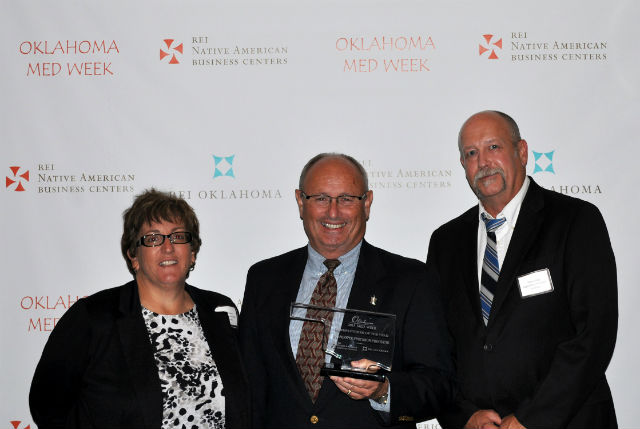
    Wyandotte Nation company named 'Manufacturer of the Year'Wyandotte Precision Products (WPP) was named “Manufacturer of the Year” during Oklahoma Minority Enterprise Development Week. The celebration of success of minority entrepreneurs was coordinated by the REI Native American Business Centers.

    “It is an honor for our team at Wyandotte Precision Products to receive the award from the MED organization and REI of Oklahoma,” said WPP President Ron Brown. “We still have a tremendous amount of work to do to meet our goals, but the award is an unexpected and welcome recognition of our efforts so far. As with all of our WTOK businesses, it is a team effort and a team recognition. We could not do what we do without the support of the Wyandotte Nation and all the departments of WTOK.”

    The company was formed in June 2011, with the acquisition and workforce transition of an existing machine shop by the Wyandotte Tribe of Oklahoma’s Economic Development Department. WPP is a precision machine shop, located at the Joplin, Mo., airport, that produces maintenance and repair parts for manufacturing companies in the food processing, printing, oil and gas, military, explosives and automotive industries.

    Experts in the reverse engineering process, the workforce consists of nine full-time employees, in addition to a contract worker. WPP also utilizes the Wyandotte Nation’s intern program to augment its customer service staff.
    Comment:  For more on Native business honors, see Northrop Wins Warrior Award and Minority Construction Firm of the Year.

    To'hajiilee in Breaking Bad

    'Breaking Bad' Episode 'To'hajiilee': Shootout in Navajo CountrySunday's episode of the AMC drama Breaking Bad has been hailed by some fans as the best in the history of the series, which began in 2008 and is nearing the end of its fifth and final season. The L.A. Times cites a figure of 300,000 tweets about the show, which included a massive shootout scene. Called "To'hajiilee," the episode is partially set on To'hajiilee, a non-contiguous part of the Navajo Nation west of Albuquerque, New Mexico.'Breaking Bad' recap: I Buried My Heart at To'hajiilee

    Jesse's promise to go after Walt where he really lives comes to fruition, but ends with possibly fatal consequences

    By Denise Warner
    To'hajiilee--the name of tonight's episode--is perhaps the most important place in Breaking Bad's mythology. It's where Jesse and Walt first cooked together. It's where Walt hid his money from the world. And it's where Todd, Jack and the rest of the white power Nazis get into a shootout with Hank and Gomez that leaves all of their fates up in the air--at least, until the next episode.Comment:  For more on the Navajo and television, see Navajo Musician in The Voice and Media Covers Mike and Molly "Joke."

    Below:  "Dean Norris and Bryan Cranston in a scene from Sunday night's 'Breaking Bad' episode."

    September 09, 2013

    Elizabeth Kartchner's "Little Indian Party"

    I came across this item on Twitter.

    Elizabeth Kartchner is apparently a young mother who blogs. She describes her effort thusly:This lil’ blog started because Collin was watching a Yankees playoff game on television and I was bored. Ok, really, I wanted to have a place to share creative projects, pictures of my darling munchkins & extraodinary thoughts about our ordinary days.Recently she decided to hold a "Little Indian Party" for her daughter Avery. She posted pictures to show her ignorant views of Indians.

    Birthday Party Pow-wow

    A Birthday party pow-wow came about for one reason. I wanted to make a tee-pee! Avery was thrilled for the idea because one of her favorite movies is Peter Pan and she insisted on being Tiger Lily & she knew there would be cake involved.THE CAKE: was my favorite part! I found a local cake extraordinaire and I told her what I wanted. Chevron stripes, flowers and make even a fox somewhere. It turned out amazing. It’s called Piece of Cake. Do you like the little pokes in the frosting from anxious, drooling indians?

    Comment:  So you let your daughter watch a racist movie? And as a result, you both have stereotypical ideas of what an Indian is? Great.

    Maybe next year you can watch a Stepin Fetchit movie, then have an Uncle Tom and Aunt Jemima party. You can sing happy songs like the ones in Song of the South Wouldn't that be fun?

    For more on Peter Pan, see Stereotypes in Tiger Lily and Boy Sees Racism in Peter Pan.

    Nicholas K's "shamanistic journey"

    Adrienne Keene writes about another fashion show in her Native Appropriations blog:

    A “Shamanistic Journey” Through Nicholas K’s Spring 2014 Collection

    First she quotes an article by David Bologna on NYUNews.com--apparently a blogging site associated with New York University:Picture the urban landscape of pre-Columbus America: quite a paradox but easily captured by Nicholas K in their Spring/Summer 2014 collection at Mercedes Benz Fashion Week. A trance-like track of synth bass was combined with soothing chants to create a modern tribal music that seemed thematically fitting. While still staying true to their bold use of draping, layering, and neutral tones, Nicholas K suggested a new perspective to the term ‘urban chic’ by taking us back a few years.

    Garbed in subtly Native American-inspired headdresses, the models displayed the palettes of sand t-shirts, antler booties, smoke sweaters, and onyx shorts. These earthy colors further accentuated the collection’s oneness with nature captured best by an interpretation of Native American culture. While the use of chunky tribal prints was occasionally seen peeking through a granite hoody or displaying prominently on a cascading jacket, the menswear pattern of oversized plaid did not detracted from the feminine earthiness of the collection.
    Then she dissects it:Ok, I know this is a student publication and all, but can we talk about this language? “A trance-like track of synth bass was combined with soothing chants to create a modern tribal music that seemed thematically fitting”? “These earthy colors further accentuated the collection’s oneness with nature captured best by an interpretation of Native American culture”? That’s the problem with “tribal” themed fashion trends or those “inspired by Native American culture”–it creates this distorted stereotype that Native peoples are a monolith, with one “culture.” This culture apparently is connected to nature and set in contrast to “urban” contexts. That first line kills me. “Picture the urban landscape of pre-Columbus America: quite a paradox…” No. Not a paradox at all. “Pre-Columbus America” was hella urban. Sorry.Comment:  Nicholas K's description of the collection isn't any better, so it's not as if Bologna had to guess the designer's intent. Indeed, Nicholas K's talk of medicine men and a "shamanistic journey" is arguably worse.

    For more on fashion stereotypes, see Victoria's Secret Apologizes for Headdress and No Doubt's Looking Hot Video.