Showing posts with label protests. Show all posts

March 21, 2016

Indigenous Chileans in Madam Secretary

A recent episode of Madam Secretary dealt with

Madam Secretary recap: 'Higher Learning'

An agreement between a U.S. mining company and Chile goes awry.

By Lindsey Kupfer
Madam Secretary
Season 2, Ep. 17 | Aired Mar 20


The show opens in the Andes mountains in Chile. There is a group protesting an American company, Hercutel, for mining gold in their mountains. The protest gets ugly, and someone throws a rock at the American driver. According to Bess’ team, the mining agreement between Hercutel and the Chilean government was completely legal, but now the president of Chile has changed her mind and accused the company of negotiating more than their fair share of profits, sparking the various protests.
Later:Bess talks to the foreign minister, threatening to cripple their economy, and Chile quickly agrees to reopen the mining operation in the morning. Nothing’s that simple, though. A man named Hugo from the Inhawoji people of Chile reveals in an online video that the mountain belongs to the indigenous people and has belonged to them for 6,000 years. That means that the Chilean government had no right to make an agreement with Hercutel. In protest, Hugo says he’s going to climb the mountain to save it or he will die trying—while live-streaming his climb of course. Welcome to 2016.College protester Brian Andrew Lindstrom confronts Bess, then sues her when her bodyguard "invades his personal space." Bess visits the Lindstrom family to talk Brian out of suing, leading to this exchange:Elizabeth McCord: I think the thing getting lost here, Mr. and Mrs. Lindstrom, is your son's passionate commitment to social justice. Young people rising up against the abuse of power has been a force for change many times in this country, and Brian was right. Not about the mining contract. That was legitimate. But about the larger issue. The brutal legacy of colonialism asserting itself once again in Chile. That turned out to be true. And, Brian, without you guys and the Chilean citizens rising up against what you thought was wrong, the Inhawoji people might not have dared raised their voices, too, and found a world ready to listen.

Brian Andrew Lindstrom: Thanks, Mrs. Secretary.

Blake Moran: Madam Secretary.

Elizabeth McCord: Don't stop speaking truth to power. But, maybe the best way to call upon our better selves is for you to show us yours.
Brian's parents yell at him to stop complaining and he agrees to drop the lawsuit.

It's rare to hear a politician talk about colonialism, even if it happened as far as possible from the US but in the same hemisphere. Even a liberal Secretary of State such as John Kerry or Hillary Clinton wouldn't take the side of the people against a democratic ally. That's what makes Madam Secretary such a good show.

Incidentally, I think the Inhawoji are a fictional group. I couldn't find anything about them on the Internet.

January 25, 2016

Whitesboro issue increases awareness

After widespread criticism, the town of Whitesboro has agreed to change its seal. That's good, but the larger story is what Native activists are accomplishing:

Whitesboro drops 'racist' seal: Sign of the times for Native Americans?

A decades-long debate over the Whitesboro, N.Y., seal has led to 'victory' for Native Americans who said it was offensive to their heritage. Are America's first people gaining more recognition?

By Lucy Schouten
African Americans have arguably made more progress than indigenous people in scrubbing the American landscape of hateful or racist symbols and celebrating their heritage. For example, Martin Luther King Jr. Day and Black History Month in February are longstanding holidays that have honored black Americans for years, yet native Americans are only recently finding similar holiday recognition. The latest effort is to change the existing Columbus Day holiday to Indigenous Peoples Day, reported The Christian Science Monitor's Molly Jackson:South Dakota and Berkeley, Calif., were among the first to pay attention, choosing to use the second Monday in October to honor the New World’s first inhabitants instead of its 15th century newcomers. ... Further protests seemed to fall on deaf ears, until a sudden wave of Columbus cancellations in the past two years: 10 more cities have joined the list, from Albuquerque to Seattle to St. Paul. This new wave may represent a broader shift in how Americans view Native American rights, or at least the growing local political influence of indigenous groups.Comment:  Exactly. It's all about increasing awareness. Which leads to improvements in all areas: poverty, crime, health, etc.

Here's one response to people, including Natives, who say we have more important issues to worry about:

With a simple social media protest, we got a torrent of national exposure in the media: NY Times, Washington Post, The Daily Show, Stephen Colbert, etc. What have you done lately that compares to that?

When you raise a poverty, crime, or health issue that gets dozens of pieces of coverage, let us know. Until then, we are at the forefront of raising awareness of Native issues.

Which is not to say we should stop talking about poverty, crime, or health issues. But it's ridiculous to claim that something earning a ton of media coverage is a waste of time. You don't understand how to mobilize people and instigate change if you think one poverty piece is better than dozens of mascot pieces.

#OccupyWallStreet, #IdleNoMore, #BlackLivesMatter, #OscarsSoWhite, and #ChangetheName!

For more on the subject, see Flipping the Whitesboro Script and Comedians Mock Whitesboro Seal.

November 26, 2015

Indian costumes at annual Turkey Trot

Native American Activists Plan to Protest Redface Runners at Long Beach Turkey Trot

By Gabriel San RomanEvery Thanksgiving, runners head to Long Beach's annual Turkey Trot looking to put a dent in the calorie bombs sure to be gobbled up later in the day. They come by the thousands donning silly turkey hats with others wearing spoon and fork costumes. Too cute! Others, sadly, sport feather headdresses, sexy PocaHotties loincloths and war paint in a nauseating display of redface.

Native American activists are planning to protest this year's Turkey Trot, though, to put the brakes on redface runners. "Conquering our image is another form of colonization that began with the theft of our lands," says protest organizer Tahesha K. Christensen. "Redfacing is racist and it is no different than blackface, or making fun of Jews, Asians, or any other cultural group."

Christensen, a Native American of the Omaha Tribe, originally just wanted to find a charitable 5K around town to jog in when she heard about the Turkey Trot. Anna Christensen, Tahesha's mom and a Native activist in her own right, cautioned about the rampant redface she'd see. The would-be Turkey Trotter checked out the event's webpage and was mortified at all the photos of people playing Indian.

"It made me very angry and it really was painful to see all of those people so disrespectful to our Native cultures," she says. Christensen made polite pleas on the Turkey Trot's promotional page only to get blocked from commenting further.


And at the event itself:

Protesters want no Native American costumes at Long Beach Turkey Trot

By Andrew EdwardsA small group of protestors gathered near the beachfront site of the Long Beach Turkey Trot and called for ban against Native American-themed costumes at the event.

The protestors consider the wearing of such costumes disrespectful to Native Americans and their cultures.

“I got to speak with the organizer and I got to ask him if he would kindly ban the costumes, and he said he’s not in a position to do that just yet, but he understands our concerns,” said Gray Wolf, a protester who said he’s active with the American Indian Movement. “I think we made a little headway.”

Such costumes were a rare sight at Thursday’s event. A reporter observed about five people among an estimated 4,000 attendees who donned feathered headware that somewhat resembled ceremonial Native American attire. Many more people wore hats resembling Thanksgiving turkeys.
Comment:  The above image shows what past Turkey Trots were like. In fact, this photo may have inspired activists to launch a protest on Facebook and in person.

October 12, 2015

Native students protest Brown columns

Native students at Brown react to The White Privilege of Cows and Columbian Exchange Day, the two columns that appeared in the student newspaper.

Exchange Columbus: The case for Indigenous People’s Day

By Native Americans at BrownNative Americans at Brown’s demonstration Monday is a fight for visibility and a call for the University to oppose the acts of genocide against Native peoples. By changing the name from Fall Weekend to Indigenous People’s Day, we aim to turn this holiday into a celebration of the cultures and histories of Indigenous living and dead, on campus and beyond.

On Tuesday, Oct. 6, The Herald published the column “Columbian Exchange Day,” which asked Native students on campus to celebrate the so-called benefits of Columbus’ arrival while ignoring the contemporary realities that Indigenous peoples and black people at Brown, the United States and the rest of the Americas face as a result of Columbus’ arrival.

In the days after the publication of the column, Natives at Brown has received an outpouring of support from students and faculty members in the Brown community, and it has been a moving experience for which we are very thankful. But there are still antagonistic structural and social forces on campus that led to the release of this article that neglect the support of students of color on campus and that refused to rename Fall Weekend to Indigenous People’s Day during the first petition in 2009. So we release this statement to provide history, Native student experiences at Brown and a reason for why these opinions columns have the impact that they do. We want to stress upon the student body, administration and faculty the tangible impact that racist ideologies have on Native students at Brown and beyond.
Brown University Students Stage Die-In, Demand Greater Recognition For Native Americans

Activists want the school to observe an annual Indigenous Peoples' Day.

By Tyler Kingkade
Students staged a "die-in" at the Brown University campus Friday as part of a campaign urging the school to do more to honor Native Americans.

The die-in was scheduled to last 52 minutes and 30 seconds "to signify the 523 years of indigenous resistance since Columbus," according to an event description from the student group Native Americans at Brown.

Friday's event was billed as a "pre-demonstration" for a Monday protest, where students urged the university to change the name of its Fall Weekend Holiday--a day off from classes that Brown holds on the Monday when many Americans observe Columbus Day--to "Indigenous Peoples' Day." Seventy-five students had volunteered to be part of the die-in.

The activism at Brown dovetails with a larger, national conversation about renaming Columbus Day to Indigenous Peoples Day--the reasoning being that Columbus didn't actually discover America, and that in fact his arrival ushered in an era of slavery and genocide for Native Americans.

At Brown, however, the protest follows a controversy on campus over two op-eds published last week by The Brown Daily Herald, the student newspaper, that were denounced as racist by many students.
Comment:  For more on Columbus, see Rise of Indigenous Peoples' Day and Renaming Columbus Day Angers Italian Americans.

May 13, 2015

Native filmmakers criticize Netflix boycott

More on Netflix's deal with Adam Sandler the racist:

Netflix giving Adam Sandler creative control is totally backfiring

By Yohana DestaWhen Netflix originally signed the Sandler deal, many film fans were left scratching their heads. But from a purely financial standpoint, it makes sense: In its original announcement, Netflix stated that Sandler films have grossed more than $3 billion globally. And in a rare moment of candor about its viewers' habits, Netflix disclosed that Sandler films are among its top streaming performers.

Sandler is arguably the most financially successful talent the streaming company has pulled into its originals fold, and will reap his piece whether the films perform or not—not that we'll ever know, since Netflix doesn't share viewership numbers—as the company will continue to foot the $40-$80 million budgets to which he's accustomed. And the fact that he co-wrote the Ridiculous Six script makes it clear that he doesn't mind being labeled a bigot.

This is where a traditional Hollywood studio—like Sony, where Sandler still has made most of his pictures and still has a deal—would normally step in. But Netflix isn't a traditional Hollywood studio; they've navigated original TV content, but don't have experience wrangling a movie player of Sandler's power and lightning-rod nature.

The minute Sandler got complete control of a project, it became clear that he needs someone to save him from himself. Without a suite of seasoned, strong-willed executives to have a hand on the reins, Netflix has allowed him to cross the line in a way he never did—or possibly even could—before.

Sandler is using his highly visible platform to degrade and objectify an entire subset of people who have historically been degraded and objectified—a blow to Netflix's creative, high-quality content streak. Maybe Sandler doesn't care about being labeled, but that's a label Netflix doesn't want.
Fueled by Adam Sandler Fiasco, Navajo Woman Protests Script’s Stereotypes

Allie Young says movies like ‘The Ridiculous Six’ can have damaging effects on a community struggling with identity issues.

By Jennifer Swann
It remains to be seen whether the walk-off, a slew of bad press, and a petition backed by nearly 100,000 will have any impact on the release of The Ridiculous Six, which is being produced not by a traditional studio system but by Netflix, a streaming service that relies more on subscribers than on ratings.

The number of actors who stormed off the set was tiny compared with the number of Native Americans who continued working, opting for a paycheck rather than a protest. But Young says the attention to the issue is unprecedented, even if the industry is slow to change. The New York Times weighed in last week with a story about the Hollywood biases faced by Native American actors, including Tantoo Cardinal, a Canadian indigenous actor who appeared in Dances With Wolves.

“Never in history have you heard of a group of Native Americans taking a stand like this,” Young says. “So I’m proud of that. I’m happy to see that there are more actors who do have a voice, like [Native Canadian actor] Adam Beach, who are coming forward in support of the whole controversy.”
Boycott a bad idea?

I haven't heard anything more about a boycott of Netflix beyond the initial proposal. As far as I can tell, no one's participating in it. But some people are still talking about it as if it's a thing.

Anti-Netflix Campaign Is 'Drowning Native Voices' Says Native Director

By Wilhelm MurgFilmmakers Brian Young and Sterlin Harjo have come out against the #WalkOffNetflix campaign because of the Native American films available on the service. Is that your main complaint?

Here’s the thing: nobody has seen Rhymes for Young Ghouls, right? You would have to have had your ear on the ground to have heard about it, and that’s true of a lot of Native directors' films. You have the ability to make films fairly cheaply, and you’re getting a market that is flooded with bullshit, frankly. Professional filmmakers have to battle for that position with amateurs and nobody’s interested in Native-told stories per se. Smoke Signals was 17 years ago, and everybody’s been waiting for that next watershed film that was going to break it all open for Native cinema and it just hasn’t happened yet. It’s because the avenues aren’t there in terms of distribution. At the end of the day Hollywood is about making money, so if you want to be a filmmaker you need to make money. They don’t qualify you by ethnicity, they just want to know if you are making good films, and that was our goal; we wanted to make a good film, but try to sneak in the content; providing a message wrapped up in an entertainment vehicle.

So if you’re rolling back about 100 years of representation in cinema, it’s not going to happen with 1 or 2 films. You’re going to have to get 40 or 50 films before you can start talking about Native Cinema as a genre. The problem with #WalkOffNetflix is that it is inadvertently suppressing those voices with good intentions, but the last I heard, the road to hell was paved with them.

So that was my main beef with it: you’re drowning our ethnic voices because of this idiot.
Barnaby somehow thinks a small protest, rather than Netflix's bottom line, is going to dampen the market for Native films. Sterlin Harjo also criticizes the protest, but rightly places most of the blame on Netflix.

Ridiculous Netflix: Sterlin Harjo Discusses Netflix and Adam Sandler’s Ridiculous Six

By Lauren WissotFilmmaker: As someone not of Native American descent I was pretty appalled by Netflix’s lackluster, “broad satire” defense. I mean, if this was Adam Sandler “satirizing” blacks I’m sure Spike Lee, along with many other African-American filmmakers, would be calling for a boycott of the streaming site. But you’ve personally come out against the recent #WalkOffNetflix campaign that the controversy inspired. Can you explain your reasoning? And if canceling Netflix subscriptions isn’t the best response, what is?

Harjo: We were all appalled by the treatment of Native characters, as well as by Netflix’s response. The problem is deeper than Netflix. I’m sure that the executives in charge of Netflix’s original programming didn’t have Native people in their best interest when they green-lit this project. I knew months before that the film was coming down the pipe because the lead actor of my film Barking Water, Richard Ray Whitman, told me he turned it down. He said it was racist and sexist. He even brought it up to the casting director–but one actor in protest isn’t going to stop the millions of dollars behind a film like this. A few people canceling their Netflix subscription isn’t going to stop it. What is going to stop it is when all of our actors turn down roles like this, as Whitman did. It’s going to stop when more Native filmmakers are supported to create their own visions. Supporting Native filmmakers will help peel back the decades of misrepresentation of Native people. Netflix can’t stop it. Only we can. We have that power, but we need support.

Right now, in America, Native filmmakers are on the outskirts of the outskirts–it’s true independent cinema. Studios won’t touch us. Indians in buckskin and feathers is the only way studios want to see us because it fits their narrative. They don’t want to see the truth. We have to roll up our sleeves and keep creating truth. We have to keep creating films, and seeing our visions to the screen. One of the few screens where we can show our work is on Netflix. There are great Native and indigenous films on Netflix. Filmmakers like Taika Waititi, Sydney Freeland, Jeff Barnaby, Neil Diamond, and Heather Rae have blocked out a small section on Netflix. Our films have reached a lot of people, including non-Indians, because of Netflix. If Native people walk away from the site then we are losing some of our audience. It could have the opposite effect, of making Netflix decide not to acquire films like mine. We have to create our own content–and we need every place that is willing to show that content.
Comment:  For more on Adam Sandler, see Natives to Hollywood: Stop Stereotyping and Ricky Lee Defends Ridiculous 6.

May 02, 2015

Ridiculous 6 adviser speaks out

Why I Quit Adam Sandler's Movie: Ridiculous Six's Apache Consultant Speaks

By Vincent SchillingLast week, a group of Native actors walked off the set of the Adam Sandler comedy The Ridiculous Six to protest the film's content. One of the key dissenters was Bruce Klinekole, Apache, who had been hired as the film's Native American cultural consultant. Klinekole, whose last name translates as "Catch the Horse," objected to the Netflix production's repeated gross misrepresentations of Apache culture, dangerous bow-and-arrow scenes involving inexperienced actors, and being denied the chance to even speak to Adam Sandler.

After his requests for changes were ignored, 65 year old Klinekole spoke with other Native Elder friends, including David Hill (an actor who ended up joining the walk-off), about what to do. When Klinekole saw four eagles circling above the set, he knew it was a sign to walk off the set.

"I wasn't allowed to talk to a producer and they wouldn't allow me to talk to anybody," Klinekole told ICTMN. "They wouldn't let me do anything. Nothing."

“I said, 'Okay, that's all, I'm going," he continued. "I felt bad for my fellow people who were there but there was nothing I could do. I couldn't say anything on behalf of my Native people or on behalf of my Apache people who were depicted so badly.”
Comment:  A brief discussion of the adviser's role:

Klinekole was arguably too naive. I wouldn't walk onto a set with a completed script, props, costumes, etc. and expect them to change everything. If you're not advising from the pre-production stage on, you might as well not bother.I couldn't believe he had to go through a PA--basically a college intern. The lowest rung and she arrogantly denied him access--of course, she had no power to grant him access. I've been a PA and I would have TRIED.The whole adviser role was obviously a joke. Or maybe it was another of Sandler's attempts at "satire."

They never intended to do anything the adviser said. They should've changed his title to "Fig Leaf for Covering Our Asses" or "Excuse for Giving Our Racism a Pass."The role was designed to have someone to blame. They knew it was horrible, they knew Natives would be upset, so they had him set up as the fall guy, expecting it wouldn't hit the fan until AFTER the film came out, and they could blame him and say, "Hey, we had a cultural advisor!"For more on Adam Sandler, see Should Natives Boycott Netflix? #NotYourHollywoodIndian.

May 01, 2015

Should Natives boycott Netflix?

Natives debate whether to boycott Netflix because of The Ridiculous 6, its racist Adam Sandler movie.

Yes, Unsubscribe From Netflix: These Small Steps Matter for Native Self-Esteem

By Gyasi RossWord to the wise: Adam Sandler is not going to magically start making intelligent movies. Promise. He is too rich and arrogant and unspiritual to realize that an organization created by individuals within his culture—the Anti-Defamation League, started by Jewish Americans—was started precisely to combat the kinds of portrayals of Jewish people as his movie made of Natives in The Ridiculous Six. He doesn’t care that he’s a hypocrite and that’s why he hasn’t responded—he’s rich!

Apparently spirituality and conscience goes out the window when one acquires wealth. If that’s the case, I honestly hope I never get rich.

Anyway, that’s not a surprise. What IS surprising is the lame, condescending and tired excuse provided by Netflix—that, essentially, Native people are “in on the joke.” This is more troubling than Sandler’s idiocy—at least he’s staying true to form. Netflix, however, is breaking new ground and flaunting the sad truth that they don’t mind swimming in the water of SO many other patriarchal, arrogant white folks in relation to Native people—they’re talking for us, telling us how we feel. This is an extension of the Justice John Marshall “domestic, dependent nations” logic, that somehow Native people are unqualified to feel for ourselves and tell others how we feel.

We Natives need someone to interpret the way we feel for us. Like a ward needs his guardian.

Let me be honest—I LOVE Netflix. I hope Netflix does the right thing! I have had Netflix for years and dig their distribution model and up until last week’s condescension to Native people, I’ve watched Jack Reacher on Netflix at least once a week for the past year. But life is full of uncomfortable decisions and those brave actresses and actors literally put their careers on the line for the sake of integrity—the least I can do it put Jack Reacher up for a little while. You folks inspired me. And those brave actresses and actors, whether that was their intent or not, said that it is NOT OK for non-Natives to speak for Native people (or even for Native people to speak for other Natives as has happened during other social justice movements). Condoning white people speaking for us is arrogant, it’s ugly and it’s a throwback to a time when Native people simply did not have the access to media that we do today.

Therefore, until Netflix chooses to acknowledge Native voices and meet and confer with members of our community in a public forum, I’m getting off of Netflix. I encourage you folks to do the same—they do not value your opinions and don’t even acknowledge when a group of Native people asks them to consider a reasonable position.”
Young: 'No, I Will Not Deactivate My Netflix Account'

By Brian YoungNetflix is a company. It’s not a person with which can be reasoned. It will not understand a conversation on how degrading and damaging ‘injun’ stereotypes can be (I’ll recommend a movie that addresses that. It’s also on Netflix!). As a company, Netflix understands numbers. Yes, the more people that deactivate their accounts, the louder the message they’ll hear. That’s forcing them to our will, not educating them to our cause. The latter will have a much longer lasting effect. We as a unified movement have that power to either force them or education them. We have to education them. While forcing them to our will might reap short term effects, such as canceling “The Ridiculous Six,” we must think of the long run and what long term effects we can achieve.

Hollywood, and by extension Netflix and Adam Sandler, do not care about the representation of Native Americans. Since its birth, Hollywood and its byproducts have never been about telling our stories. Hollywood is a business that understands ratings, viewing numbers and consumer demand. Adam Sandler, and other big name Hollywood actors, are attached to projects to reduce risk so that investors will have more confidence that their initial investment will reap financial returns once the movie is released. What does that mean for Native films? Hollywood, unfortunately, thinks that Native films do not have a market and thusly are a high-risk, low return financial investment. In other words, Native films are a waste of money.

This is why I am imploring you to not deactivate your account. Instead, watch a film made by a Native person. There are many, many great films that you can watch. As of right now, in the United States Netflix streaming catalog, you can watch Neil Diamond’s “Reel Injun,” a documentary about ‘injun’ stereotypes, Jeff Barnaby’s “Rhymes for Young Ghouls,” (every single millisecond oozes style and captivates); Sterlin Harjo’s latest film, “This May Be The Last Time;” the classic, “Smoke Signals,” and “Jimmy P”–not necessarily a Native film, but a film about a Native, starring Benicio Del Toro.

Several movies in Netflix’s DVD catalog include, “The Lesser Blessed” (watch this!), and the above mentioned “Boy” and “Bran Nue Dae,” and “Incident at Oglala: The Leonard Peltier Story.” There’s even “Longmire,” which have Native actors (yours truly included, again shameless self-promotion). Heck, even “Breaking Bad” has Jeremiah Bitsui, a Navajo actor.
Young even started a petition:

Expand your native films and produce more native content

By Brian YoungDepictions such as those found in “The Ridiculous Six” support the fallacy that Native Americans and Native American women are less than human. Racial stereotyping leads to racial discrimination. Racial discrimination leads to racially charged violence. The overly sexualized depiction of Native American woman, as seen with “Beaver Breath”, “Sits-On-Face” and the phrase “We go someplace and I put my peepee in your teepee” supports the notion that Native American woman are animalistic, inhuman, and promiscuous. The combination of racial stereotyping and the hyper sexualized depiction of Native American women can only create an ideology that leads to the increased violence against this population. These impacts cannot be hidden behind the guise of levity. The jokes in “The Ridiculous Six” are harmful, dangerous, and nowhere near satirical.

To combat the negative stereotyping of Native Americans, we are demanding that you support Native American filmmakers, actors, producers, directors, and films in general. To do so, we ask that you expand your native film selections. As a distribution company, you are constantly seeking to expand your catalog so as to better your customer experience. Native Americans are also a part of your customer base, as evident in the social media campaigns #WalkOffNetflix and #VivaNativeCinema. By expanding your catalog with Native films, you will present an accurate representation of Native Americans and Native American women, thus reducing racial stereotyping to your 30 million subscription base. We would like to suggest some titles that would be an asset to your DVD and streaming catalog: Lee Tamahori’s Once We Were Warriors, Bruce McDonald’s Dance Me Outside, Anne Makepeace’s We Still Live Here, Courtney Hunt’s Frozen River (on stream, already available on DVD), Dee Brown’s Bury My Heart At Wounded Knee (on stream, already available on DVD), Peter Stebbing’s Empire of Dirt, Georgina Lightning’s Older Than America, the Aboriginal t.v. series Mohawk Girls, Andrew Okpeaha MacLean’s On The Ice, Rick Derby’s Rocks With Wings, Steve Barron’s DreamKeeper, Shonie and Andee De La Rosa’s Mile Post 398, Niki Caro’s Whale Rider (on stream, already available on DVD), and Sara McIntyre’s Two Indians Talking. These suggestions serve as only a beginning, as this list is in no way inclusive or final. Native American filmmakers are continuing to create and produce films as we write this petition, and this demographic will only continue to grow.
Comment:  A boycott won't work because Netflix isn't a person? But a petition will? Alas, Young's position is inconsistent.

Boycotts and petitions aren't attempts to reason with a company. Rather, they're attempts to influence a company by bringing market pressures to bear.

In particular, they're attempts to influence the bean-counters in charge of the bottom line. Whether the company has a "conscience" and acts for moral reasons is almost irrelevant.

As long as the company stops its racism, we don't much care about its motivation. Changing the harmful behavior is the first and most necessary step. Educating the company about its mistakes is secondary.

Besides, being forced to publicly admit one's mistakes and change one's policies is inherently educational. When you punish a child or a pet, you don't necessarily have to explain your reasoning. The punishment alone educates the child or pet not to do wrong again.

That said, a boycott or a petition probably won't have much effect. Netflix's streaming service has some 30 million subscribers. I doubt they'd even notice the actions of a few hundred protesters.

For more on Adam Sandler, see #NotYourHollywoodIndian and Native Actors Denounce Sandler.

April 30, 2015

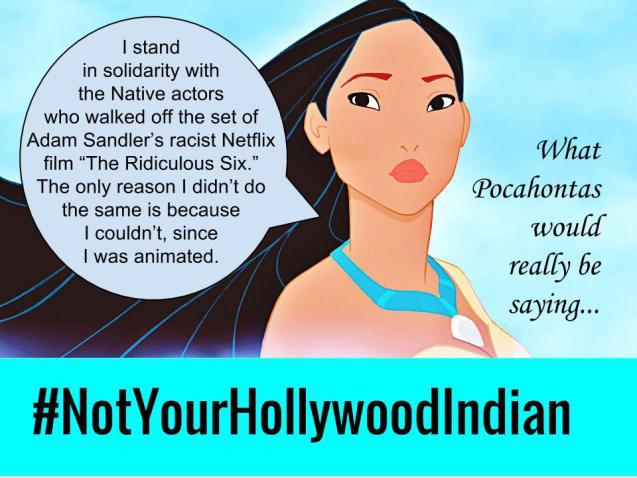
#NotYourHollywoodIndian

Native activists took to Twitter to criticize Adam Sandler and his Ridiculous 6 movie:

Native activists tell Adam Sandler, Netflix they're #NotYourHollywoodIndian

Activists use hashtag #NotYourHollywoodIndian to pressure Netflix to cancel production of The Ridiculous Six

By John Bowman
As news of the walkout spread, Red Shirt-Shaw began posting about it on Twitter under the hashtag #NotYourHollywoodIndian, which was inspired by some of the actors' comments.

"I logged into social media and saw that a ton of people were talking about it, but that the ideas weren't consolidated, so I decided to try to push it out there," she said.

"I'm just moved by how it has grown and seeing the people come out and support it, and seeing news articles reference it," said Red Shirt-Shaw. "I think that we have to stand as a united front."

She also co-founded a petition on Change.org urging Netflix to cancel the production of The Ridiculous Six.

"We're really hoping that we can build up the signatures that are on there and present this to Netflix in a way that will say 'We're not going to support you. People have already cancelled their subscriptions. You guys really need to evaluate whether or not this is a project you want to move forward with in the future,'" she said.

So far, Netflix remains committed to the movie.
Can the recycled bigotry of Adam Sandler's Ridiculous Six do some good?

By Jaynie ParrishThe image of a 21st century American Indian is a twisted reality, especially in Hollywood and sports. Of course that’s been true since the first films were made about American Indians—or the first team names were chosen. That’s the legacy of the old world.

But, like many other marginalized groups, social media gives us a different way to amplify our message.

On Friday California writer Megan Red Shirt-Shaw created a hashtag, #notyourhollywoodIndian: “I applaud the actors who walked off that set,” she wrote. “A comedy directed & acted by Native American comedians would revolutionize comedy.”

Hashtags like these allow people to say what they believe without the filter of the mainstream press–and even to the mainstream press. Being heard gives us the ability to hold people accountable, even big name movie stars.

Hashtags aren’t enough, of course–they’re not our votes. And our outrage should also be directed at critical matters like better health care, safe water and improving the social and economic conditions Native Americans continue to face. A terrible Adam Sandler isn’t the worst of our problems–but if it brings us together and gives us a public platform, perhaps, inadvertently, the bigotry on display in his film will be a starting point for how we do change the world.
'Hey Adam ... Let's Talk': The #NotYourHollywoodIndian Q&A

By Arturo R. GarcíaWhat, if anything, could Sandler and Netflix do to help remedy the situation?

Red-Shirt Shaw: I would be lying if I didn’t say I hope they cancel this film—but I’m also still waiting to hear from the comedian himself. Until then, let’s keep telling him “Hey Adam, we’re #NotYourHollywoodIndian—let’s talk.”What do you think?

What happens next, both for this campaign and Native In America?

Red-Shirt Shaw: I hope that #NotYourHollywoodIndian changes the conversation in the film industry about Indigenous identity and that the movement is productive, that ultimately people are using their positivity and power to educate. I hope that Natives In America takes over the world. Period. On a smaller scale … I hope the entire amazing NIA team knows how much they are surprising and inspiring people with their stories about being Native in the 21st century. Until we break through that glass ceiling of who America thinks we are, we have to keep telling our tales. And we will.
Adam Sandler movie sparks debate over American Indian images

By Russell ContrerasIn recent years, Native Americans have been more outspoken.

For example, in 2013, some Native Americans were critical of Johnny Depp's portrayal on Tonto in the Disney version adaptation of "The Lone Ranger." Depp spoke in broken English, chanted prayers and wore a stuffed crow on his head. However, after a campaign by the movie to improve its image with Native Americans, Depp was eventually embraced on the Navajo Nation and was later adopted into the Comanche Nation.

A year before, the band No Doubt was forced to apologize and pull the music video "Looking Hot" after lead singer Gwen Stefani was criticize for dancing around teepees and wearing a series of American Indian-styled outfits.
Comment:  I believe activists tried to create a Twitterstorm using the #NotYourHollywoodIndian tag. But I saw only a few postings on the subject, and didn't hear anything about it afterward. I don't think it was a big success.

For more on Adam Sandler, see Native Actors Denounce Sandler and Vanilla Ice Defends Ridiculous 6.

April 26, 2015

Natives brave to protest Sandler

An Open Letter to the Native Actors Who Walked Off Adam Sandler’s Set By Apache Writer

By Noel AltahaThere are a few issues I have with this whole film, with that being said, let me state just a few:

The fact that this film was about Apaches yet the actors were Navajo is a problem. So the film crew basically implicitly insinuated that Apaches can’t adequately portray themselves enough to be Apaches in this film. If that isn’t a whole other level of twisted, I don’t know what is. And y’all went along with it. That in itself seemed like a yellow flag to me indicating a warning sign of what’s to come. Like a coyote crossing your path. *sips tea

The fact that Adam Sandler is a man of Jewish heritage, a culture with a history remarkably similar to Indigenous Americans. We are both descendants of a Holocaust. In fact, Hitler was inspired by the American government for its tactics used in the first Holocaust. The one launched against Indigenous people in present day America. Why? Because the American government wanted our land. The American government then hid this “dirty little secret” so well from the history books in American schools and around the world. Maybe someone needs to send Adam and his film crew to have a chat with someone’s Rez grandma, she’ll set him straight.
Altaha's conclusion:Dear Native actors who walked off the scene of Adam Sandler’s film set,

When you walked off the set of the film at the point you realized they started disrespecting Apache women, I thank you.

I thank you for planting seeds in someone’s mind: that respect for women is non-negotiable.

This small act may contribute to the protection of the next several generations of Indigenous women and girl-child. Maybe other men will think differently. Thank you.
The bravery of the Native American actors who walked off Adam Sandler’s movie

By Alyssa RosenbergIt’s one thing to walk away from a production that you think is abusive, a project that has been misrepresented or a situation where your technical expertise is being misused if you have other opportunities. It’s something very different, and altogether braver, to do so when you know that even a degrading opportunity might not come again.

But there’s power in that decision, too. By refusing to play parts they found degrading, actors like Loren Anthony and David Hill are leaving Sandler, his producers and Netflix in a difficult position. Will they try to fill the roles with other Native American actors, trying to convince them to take on work that others have deemed destructive? Or will they be forced to use white actors in racial drag in the roles, making them the butt of jokes that previously would have been directed at people of color?

No matter what decisions Sandler and Netflix make, Anthony and Hill have laid down another marker for all the actors that follow them. Regardless of what mainstream Hollywood might say, some opportunities aren’t worth taking.
Navajo Nation President Ben Shelly Condemns Adam Sandler Film“Our Native American culture and tradition is no joking matter. I applaud these Navajo actors for their courage and conviction to walk off the set in protest,” President Shelly said. “Native people have dealt with negative stereotypes on film for too long.

“Enough is enough,” he added.
Comment:  For more on Adam Sandler, see Sandler's Racist Ridiculous Six "Jokes" and Sandler Crew "Bronzed" Navajo Actress.

April 24, 2015

Sandler crew "bronzed" Navajo actress

Navajo Actress Explains Why She Left Adam Sandler 'Ridiculous 6' Set

"That's not comedy when it comes to Native American stereotypes because we're always portrayed as the 'drunk Indian,' and that's just perpetuating those stereotypes," Allie Young says

By Daniel Kreps
After a dozen Native Americans hired to play extras on Adam Sandler's Netflix-produced western Ridiculous 6 ditched the set, one Navajo actress named Allie Young sat down with MSNBC to discuss the many reasons why they decided to leave the production. In addition to the script that they found offensive and disrespectful, the extras felt that the comedy–a play on The Magnificent Seven–furthered century-old stereotypes about Native Americans, Mediate reports.

"I'm full-blooded Navajo and they bronzed me. I was quite confused," Young said of the makeup department darkening her skin to make her look more stereotypically like a Native American. Young also revealed that the film's cultural consultant was the first person to leave the set. "That says something when the cultural advisor for the film quits because he's offended," she said.

Much has been made of the script giving characters names like "Beaver Breath" and "No Bra," but that was just the tip of how offensively the production viewed Native American women. "There was one instance where one of the Native American women, played by a white actress, is passed out on the ground and the group of white men are throwing liquor on her and she jumps up and starts dancing with everybody else," Young says of her breaking point to leave the film. "That's not comedy when it comes to Native American stereotypes because we're always portrayed as the 'drunk Indian,' and that's just perpetuating those stereotypes."
We Talked to a Native American Actress Who Walked Off Adam Sandler's Movie

By Zach SchonfeldIn a conversation with Newsweek, extra Allie Young, who is full-blooded Navajo, explained why she objected to the film, which has been picked up to premiere on Netflix next year.

"I take this very personally because my little brother committed suicide when he was 17 because of racism," Young said. "In his suicide note, he said, 'It's hard to stay alive when you're brown and gifted.' I want to take a stand for native and indigenous youth. I want them to see their people portrayed as something better."

An aspiring screenwriter and founder of the Survival of the First Voices festival, Young researched Hollywood depictions of Native Americans when she was a student at Dartmouth. She jumped at the chance to be an extra in The Ridiculous Six because she wanted to see how things had changed. She soon realized they hadn't much at all.

"At one point early on I was going in to makeup and being bronzed, and the wardrobe was not Apache traditional wear," Young explained. "I'm full-blooded Navajo. I was a little bit confused as to why I was being bronzed. I'm light-skinned. Maybe they wanted me to look darker."

The script posed more issues, including offensive names for indigenous women, like "Beaver's Breath" and "Wears No Bra." In one scene, a Native American women is passed out on the ground. A group of white men pours liquor on her, and she wakes up and starts dancing. "In Indian country, we're battling that issue right now," Young said. "It's 2.5 times more likely for an indigenous woman to be raped or sexually assaulted. Movies like this perpetuate that and just add to the stereotypes of our native women."
Comment:  A full-blooded Navajo made darker? Subjected to "redface" even though she's already "red"?

How exactly does this contribute to Sandler's "humor"? Answer: It doesn't.

It's clearly an attempt to make the Indians stranger and more exotic. That is, to make them less human and more animal-like. To "other" them.

There's no explanation for this other than racism. Indians look dark, according to the filmmakers, and white people don't. Which is why activists have rightly labeled Adam Sandler and Netflix racist.

For more on Adam Sandler, see Natives Quit Adam Sandler Movie.

April 23, 2015

Natives quit Adam Sandler movie

Native Actors Walk off Set of Adam Sandler Movie After Insults to Women, Elders

By Vincent SchillingApproximately a dozen Native actors and actresses, as well as the Native cultural advisor, left the set of Adam Sandler’s newest film production, The Ridiculous Six, on Wednesday. The actors, who were primarily from the Navajo nation, left the set after the satirical western’s script repeatedly insulted native women and elders and grossly misrepresented Apache culture.

The examples of disrespect included Native women’s names such as Beaver’s Breath and No Bra, an actress portraying an Apache woman squatting and urinating while smoking a peace pipe, and feathers inappropriately positioned on a teepee.

The film, which is said to be a spoof of The Magnificent Seven and was written by Adam Sandler and his frequent collaborator Tim Herlihy, is currently under production by Happy Madison Productions for a Netflix-only release. The movie will star Adam Sandler, Nick Nolte, Steve Buscemi, Dan Aykroyd, Jon Lovitz and Vanilla Ice.

Among the actors who walked off the set were Navajo Nation tribal members Loren Anthony, who is also the lead singer of the metal band Bloodline, and film student Allison Young. Anthony says that though he understands the movie is a comedy, the portrayal of the Apache was severely negligent and the insults to women were more than enough reason to walk off the set.
American Indian actors quit Adam Sandler movie over names

By Russell ContrerasGoldie Tom, another extra who departed the set Wednesday, said producers told the group to leave if they felt offended and that script changes were not up for debate.

"This just shows that Hollywood has not changed at all," Tom said.

She added the production had a number of non-Native American actors portraying American Indians, a long-standing complaint about the movie industry.

The actors said a Native American consultant hired by the production also walked off the set.


Native American Actors Walk Off Adam Sandler Set in Protest

Netflix defends film as "a broad satire of Western movies and the stereotypes they popularized"

By Jon Blistein
Netflix has defended Adam Sandler and his upcoming movie The Ridiculous Six after roughly a dozen Native Americans actors and actresses, as well as the film's Native cultural adviser, walked off the New Mexico set, claiming the script was offensive and disrespectful, Deadline reports.

Per Indian Country Today Media Network, the performers, who were primarily from the Navajo nation, took issue with jokes that insulted native women (characters were given names like Beaver's Breath and No Bra) and misrepresented Apache culture (one shot called for a woman to be simultaneously urinating and smoking a peace pipe). Others also pointed out that everything from the costumes to the positioning of feathers on a teepee was inaccurate, if not inappropriate.

While neither Sandler nor anyone from his production company, Happy Madison, have commented on the incident so far, a spokesperson for Netflix said: "The movie has ridiculous in the title for a reason: because it is ridiculous. It is a broad satire of Western movies and the stereotypes they popularized, featuring a diverse cast that is not only part of—but in on—the joke."

Those that walked off the Ridiculous Six set said they received similar, if not more curt, responses from producers after voicing their concerns. David Hill, a 74-year-old man of Choctaw descent, compared their arguments to those Washington Redskins owner Dan Snyder uses to defend the team's outdated name, while Allison Young, Navajo, told ICTMN: "They just told us, 'If you guys are so sensitive, you should leave.' I was just standing there and got emotional and teary-eyed. I didn’t want to cry but the feeling just came over me. This is supposed to be a comedy that makes you laugh. A film like this should not make someone feel this way."
Native American extras storm off set of new Adam Sandler film over racist jokes that called woman 'Badger Breath' and made fun of their culture

By Chris SpargoMaking matters worse says Anthony is that no one felt like they were being listened to by the production team.

'They just treated us as if we should just be on the side,' said Anthony.

'When we did speak with the main director, he was trying to say the disrespect was not intentional and this was a comedy.'

The cultural adviser meanwhile asked to speak to Sandler according to one extra, but was refused, and when that extra, Goldie Tom, later complained, she was told; 'It's in the script and we are not going to change it.'
Video: Adam Sandler's Producer To Native Actors: 'Sensitive? You Can Leave'

By Vincent SchillingIn an exclusive video obtained by one of the actors on set, Goldie Tom, Native Actors discuss their disappointment on the set of the Adam Sandler movie. During the discussion one of the producers tells the actors, “Here’s the thing, If you are overly sensitive about it… then you should probably leave.”

The actors are visibly frustrated at the remarks.


Adam Sandler film angers some Native American actors

Native American cast leaves Adam Sandler flick: ‘Nothing has changed—we’re still just Hollywood Indians’

April 22, 2015

Native students protest EMU's racism

Native American group holds protest at EMU following racial incident

By Melanie MaxwellNative Americans attending a rally at Eastern Michigan University Wednesday had a message for the dozen or so students involved in a recent racial incident: apologize.

Nathaniel Phillips, the Native American man who reported the harassment to police, was on hand playing a drum and shaking hands of the hundred or so people who gathered to listen to members of the Native American Student Organization speak outside the EMU Student Center.

Amber Morseau, president of NASO, said the response from the university and the EMU students who allegedly heckled and threw a beer can at Phillips while they were wearing headdresses with painted faces has not been satisfactory. The NASO considers the acts "racist" and a "hate crime."

"We as natives and we as human beings will not accept this silence," she said. "It is unacceptable for us, our relatives, our brothers, sisters, fathers and mothers."
EMU takes action

Coincidentally, or perhaps in response to the protest, school officials acted the same day:

EMU investigates report of students dressed as Native Americans during off-campus party

By Ben Baird and Austen Smith"Eastern Michigan University takes these matters very seriously and remains strongly committed to maintaining a respectful, inclusive and safe environment, in which acts that seek to inflict physical, psychological or emotional harm on specific demographic groups will not be tolerated," according to the university's statement.

"The investigation into this matter is ongoing, and will be guided by the university's policies and procedures that govern student conduct."

The university changed its mascot from the Hurons to the Eagles on May 22, 1991. It marked the end of more than 60 years of tradition.

The EMU Board of Regents initiated the mascot name change after an Oct. 1988 Michigan Department of Civil Rights report questioning the use of Native American imagery by school athletics. The report stated use of names, logos and mascots promoted racial stereotypes.
EMU announces chief diversity officer job after racially charged incidents

By Jeremy AllenPresident Susan Martin announced Wednesday that Eastern Michigan University was creating a chief diversity officer.

The announcement came less than a week after the university sent a campus-wide email detailing a confrontation April 11 between several students dressed in native American garb and an Ypsilanti resident of native American descent at an off-campus party.

In her email to campus announcing the position, Martin said that incident was one of several that have raised issues of race, ethnicity, religion, sexual orientation or gender identity.

Days before the altercation at the party, four student protesters were detained at a screening of the movie "American Sniper." They were protesting because they said the movie was insensitive toward Muslims.
"Hurons" name lingers

EMU's Native American student group asks university for more support during rally (PHOTOS)

By Ben BairdNASO members made clear they are not satisfied with the university administration's response so far, both in regards to the students in red face as well as the reappearance of the Hurons logo on campus. The Hurons mascot was eliminated more than 20 years ago after a campus-wide effort was begun by four Native American women who found it disrespectful.

Davi Trusty, who was the president of NASO in 1991 when he attended EMU, said he feels it's a shame Native American students are still fighting the same issues that he fought.

If someone thinks it's okay to tell a Native American to go back to the reservation or to put makeup on their face and pretend to be an "Indian" something is wrong in that person's psyche, he said.

Trusty said they appreciate the love and support members of the community have shown following this incident.

Morseau said Kay McGowan, an adjunct professor at EMU who teaches anthropology and sociology classes, spoke to each of her classes April 15 about racism, disrespect toward women and the culture of erasure--of a dominant culture diminishing another.

McGowan, the only Native American professor on campus, subsequently received an email from someone identifying himself as "John Smith" who told her no harm was intended by what happened April 11 and that the Native American community was overreacting.

"This email alone demonstrates to us that these students involved do not understand what it is they have done and they certainly have yet to see the consequences deserved for what we consider to be a hate crime," Morseau said.
Comment:  No one said it explicitly, but the racist frat party with students in redface is a perfect example of what the NCAA criticized. Namely, how Indian mascots create a "hostile and abusive environment." What could be more hostile than telling an actual to go back to the reservation? Or assaulting him with a beer can?

The students claimed they were "Hurons"--meaning wild savages who could do whatever they wanted. The "Hurons" identity created this problem. It gave them a license to indulge in ugly behavior, and to blame it on the Indians.

That's what Indian mascots do. And that's why they have to go.

For more on the subject, see What "Go Back to the Reservation" Means and EMU Students in Redface Taunt Indian.

April 15, 2015

1911 protest against Hollywood stereotypes

More from The Only Good Indian: The Hollywood Gospel by Ralph and Natasha Friar:

Native protests against racism and stereotyping continued during the 1909-14 "deluge" of movies. For instance:CUT TO
The Capitol Building in Washington, D.C., 1911. There is a demonstration on the steps. We see several Native Americans, in full tribal regalia, angrily talking to government officials and newsmen.

For the first time Native Americans voiced their strong objection to their portrayal in films. To emphasize their case, the Shoshoni, Cheyenne, Arapahoe, and Chippewa took their case to Congress and threatened to go directly to President Taft if no action was taken.
Spoiler alert: Nothing much came of these protests. Maybe some commission tasked to investigate the situation, but that's about it.

But the point isn't the outcome, it's the attempt. Natives recognized and disliked Hollywood's bastardization of their cultures from the beginning.

They didn't stoically accept their fate as they vanished into the mists. They stood on the steps of Congress and demanded action.

March 12, 2015

Ingraham: Natives want "Selma moment"

Laura Ingraham mocks ‘Redskins’ protests: Native Americans think it’s ‘their Selma moment’

By David EdwardsConservative radio host Laura Ingraham suggested on Tuesday that Native Americans and students in New York opposed “Redskins” as a mascot only because they wanted “their Selma moment.”

Last week, two high schools in New York had cancelled games with Lancaster High in Buffalo because the school district had not made a decision on whether or not to change the “Redskins” mascot, a term that many Native Americans find offensive.

“The people who want to keep the name don’t understand the hurt,” Tonawanda Senecas tribe member Al Parker told the school board at a Monday meeting. “It is not an honor. We are not honored by your continuing this mascot.”

On Tuesday, Fox News host Brian Kilmeade asked Ingraham for a reaction to what he called “crazy behavior” by those opposing the mascot.

“Everything is politically correct so I think the students in upstate New York, maybe they think they’re having their Selma moment by acting against this other team,” Ingraham replied. “They can do what they want, they can cancel the game. Everyone is bringing in witnesses to say I’m more offended than the other guy. And then some guy who is part Indian says, ‘I’m not offended.’”
A response:

We are not your mascots: Why Laura Ingraham’s Redskins remarks are so clueless

The radio host didn't just belittle a high school protest--she undermined a centuries-long fight for civil rights

By Jacqueline Keeler
According to Ingraham’s flippant quip, our “Selma” is taking place only now, 50 years after the more serious battles over Civil Rights were fought and won. Apparently, due to genocide and our much ballyhooed “disappearance” it just took us Native Americans a bit longer to get to that bridge.

However, we have already had our “Selmas.” Many of them. They had names like Wounded Knee, Alcatraz, and they are ongoing even today. Native American people are still holding protests on the land against the Keystone XL Pipeline and fighting for the Apache sacred sites in Oak Flat, Arizona. It’s in the news. The Keystone XL pipeline fighters even put up their tipis on the Washington Mall last year and rode their horses through Washington, DC past the White House. Ingraham might want to read the news.

This is not a new issue. The National Congress of American Indians, the nations largest and most representative organization for tribes, began their campaign against mascots in 1968. The radical American Indian Movement who were leaders in many of Native America’s Civil Rights era “Selmas” also joined the fight against mascots in 1968.

The reason for Ingraham’s stunning ignorance of this issue and why Native Americans are still being caricaturized is directly tied to the history of genocide in this country against our people. We are the “disappearing Indians” riding out into the sunset, but really we had to disappear didn’t we? For progress, for Manifest Destiny, for America to even exist. In very real ways, mascotting “disappeared” peoples can be seen as a form of trophy-ism: like the head of a noble beast on the wall.

What is extraordinary is that 50 years after the Civil Rights movement, Native Americans are still being caricaturized in our public schools to a degree unknown by any other ethnic group.
Comment:  Ingraham is right in a sense. Natives want a "Selma" moment on mascots just as they have for half a century. They want a moment when people stand up and march against mascots. They want all Americans to unite and say, "We must stop stereotyping, belittling, and ignoring real Natives. These false and insulting mascots must go."

I guess Ingraham meant "Selma" as a term for a one-time photo op. But the actual meaning is the opposite. The black Selma was a culmination of a century of activism and protest, and a Native Selma would be too.

True, as Keeler notes, Native have already had Selma moments at Alcatraz and Wounded Knee. More recently, they've raised awareness with their Idle No More and Keystone XL protests. But another Selma wouldn't hurt. Every disenfranchised group should have as many Selma moments as necessary until they achieve all their rights.

Note: This entry gets a Stereotype of the Month nomination because Ingraham implied Native activists are insincere and hypocritical, seeking only fame and glory. From what I've seen, nothing could be further from the truth.

For more on the subject, see Obama's Speech at Selma.

December 23, 2014

Locke shooting spurs racial tensions

Sadly and ironically, this happened Dec. 20:

Man attends police brutality rally, gets killed by cop next day

Below:  "Allen Locke, 30, was killed by Rapid City police officer Saturday evening who fired up to five shots."


Here's more on Locke's shooting and the resulting rally:

Native community mourns police shooting victim; South Dakota to investigate

By John Lee McLaughlinThe somber song and pounding of a drum slowly grew louder Sunday as a group descended from a north Rapid City hilltop where they had been mourning the death of Allen Locke.

Comprised of about 30 people, the group finally stopped in front of the home at 541 Paha Sapa Road, where Locke, 30, was fatally shot Saturday night by Rapid City Police after he charged an officer while holding a knife, according to police reports.
The police explanation didn't satisfy Natives:"That's exactly what they did in that press conference is justify everything," she said, while noting that the incident is only part of a longstanding relations issue between local law enforcement and the Native American community. "That's our son. Any mother (here) would say that."

"There is no trust in the police department," Stoneman said, who also called for a task force to address the issue. "In the long run, it's going to have to come from the city: the mayor, the chief of police."
Family of Native Man Shot By Police Pleads For Peace

By Kevin WosterWhatever the details of the Locke incident, the overall issue of race remains a divisive force in Rapid City, Eagle says.

"This all adds to the sentiment that the police aren't here for the Native community, as far as the protection and service goes," she says. "The enforcement and policing of the Native community is what's very evident."

Locke was shot after Meirose had responded to a call from a home in Lakota Community Homes for his removal from that home. The callers requesting his removal were Native Americans, and some in the home were in his family. Family and friends have questioned some of the details in the account offered by the police.

Locke had a history of criminal encounters with law enforcement, including DUI, marijuana possession and simple assault. But whatever his court history, his death is being mourned by those who knew him personally and others in the Native community who did not.
Race Relation tensions on the rise in Rapid City

After Saturday's shootings, tensions escalate downtown

By Adam King
Mayor Kooiker initiated the meeting because he's concerned that some are taking Saturday's lone shooting incident and making it a bigger issue.

"I think to draw a broader conclusion that this negatively impacts race relations in rapid city is wrong," Kooiker said.

Although he does acknowledge that there are some issues that need to be addressed.

"Overall race relations are a continual dialogue and a continual conversation," Kooiker said.

From Eagle's prospective, the mayor and city council are blatantly ignoring the issue.

"At the city level no acknowledgement of the problem even exists. There can be no change unless somebody addresses it. The people in power need to address it," Eagle said.
Tension simmers after Rapid City shooting

Native leaders want more voice in race relations after police shooting of man with a knifeSome Rapid City Native American leaders are upset they were left out of a meeting Monday with Mayor Sam Kooiker over the death of a tribal member who was shot and killed by a Rapid City police. The man charged at the officer with a knife, police said.

Allen Locke, 30, was shot several times by officer Anthony Meirose on Saturday after the officer responded to a call of an unwanted person in the Lakota Community Homes addition. The South Dakota Division of Criminal Investigation is investigating the shooting.

Rapid City mayor Sam Kooiker met Monday with some Native American leaders Monday to discuss race relations and show his support for Meirose and the Rapid City Police Department. Some members of the Native American community are unhappy with Kooiker's message and say more people should have been included in the discussion.
Rapid City Mayor on Police Killing of American Indian: “I Want Our Officers to Know We Have Their Backs”

Open Season on Native Men

By Ann-erika White BirdAs for the people who continue to see us as animals and respond with brutality, let the officials in suits and ties take a stand to stop this behavior. Statements mean nothing without action. Institute body cameras. Consider the statistics provided by the Rialto evaluation. When officers had to wear body cameras, citizen complaints against police officers declined by 88 percent, use of force dropped by 60 percent. Let them discuss death prevention, institute procedures. How can we continue to promote peace when our Native men are being gunned down?

In several statements coming from the white community and the Native community, officials like to use the word “dialogue.” What’s difficult to imagine is how that dialogue is going to stop the open season on Native men, especially if officials are in denial that our people are targeted.
Comment:  For more on the subject, see #NativeLivesMatter in Rapid City and Police Shoot Natives Too.

December 20, 2014

#NativeLivesMatter in Rapid City

The #BlackLivesMatter and #ICantBreathe protests have triggered similar protests in Indian country. For instance:

Police Protest Rally Aimed At Racial Awareness

By Kevin WosterA nationwide protest over police treatment of minorities came to Rapid City today, focusing on alleged racism toward Native Americans and a string of Native American deaths along Rapid Creek.

Demonstrators came from across South Dakota and beyond to protest what they believe is unjust treatment of Native Americans by Rapid City police.

They gathered in Memorial Park adjacent to the Lakota Nation Invitational sports and cultural event at the Rushmore Plaza Civic Center. Demonstrators called out the names of Native Americans found dead along Rapid Creek over more than 15 years, arguing that many of the deaths weren't solved because non-Indian investigators didn't care.

"We're tired of our people being found dead in this creek. No investigations. They're unsolved," Julee Richards of Pine Ridge said.

Police say the string of deaths, including one last week, along the creek were thoroughly investigated. Some appeared to be drownings or other natural causes. In some instances alcohol was involved. But some of the deaths remain a mystery.
Anti-police brutality rally peaceful

By Andrea J. CookShouts of "Native lives matter" and "Hands up don't shoot" echoed along two of Rapid City's busiest streets Friday as nearly 100 men, women and children gathered to call attention to police brutality and the loss of Native American lives along Rapid Creek.

Rapid City Police officers stood discretely in the background while American Indian Movement Grassroots leaders welcomed the gathering that included both Native Americans and non-Natives who braved overcast skies and a sudden cold snap to stand with people around the nation to oppose police brutality

"Discrimination is alive here," Bill Means of Porcupine told the crowd before the group set out for a walk down Fifth Street and along Omaha Street. As participants walked, the names of 25 individuals who died along Rapid Creek were read.

Walkers stopped at the corner of Fifth and Omaha streets to raise their posters and show solidarity before they lined up along Omaha Street raising their hands and shouting "Hands up don't shoot" and "Native lives matter."
Writer Gyasi Ross offers his perspective:

We Are All to Blame for Michael Brown and Eric Garner Not Getting Justice

By Gyasi RossThis shit is not new. Ask Emmett Till. Ask James Byrd Jr. Ask Dred Scott. Ask the Natives massacred at Sand Creek.

But we're still in the same place we've been in for the past 50 years: merely diagnosing the problem. As we used to say in the '80s, "No shit, Sherlock." We're pointing at the racism, pointing at all these agencies and municipalities that we cannot do anything about. The one place where we're not pointing? We're not pointing at ourselves. We let this happen. Black folks. White liberals. Pigeon-toed Natives. Conservatives. All of us. We're all complicit.
Ross's conclusion:Racism is real, and black men get killed in tragically disparate numbers. Absolutely. It's been that way since the first interloper landed on this continent, and now many of us brown- and black-skinned people have even been infected with that racism disease against each other. That's deep. So it's going to take some time to remove that racism sickness out of America's DNA. That's long-term. In the short term we've got a responsibility to use the tools that exist right now. I admit that I have no clue whether the system will actually work; it might be as much of a joke as I was raised to believe it is. But I also cannot honestly say that these tools don't work until we actually try to try them. Failing to register to vote is not playing the game. Thirty-percent voter turnout is not playing the game. Finding creative ways to get out of serving on juries is not playing the game. You don't want to participate in the American justice system? I get it. Yet non-participation has consequences. I mean, there's absolutely a place for marching, sounding off on social media and being outraged and indignant. We should be; that's all positive stuff. Yet we have to use the tools that we have currently; otherwise we'll keep "outsmarting" justice.Comment:  For more on police brutality, see Police Shoot Natives Too and Historical Antecedents of Police Brutality.

November 28, 2014

Black and white rage in Ferguson

Repetitive Motion Disorder: Black Reality and White Denial in America

By Tim WiseI suppose there is no longer much point in debating the facts surrounding the shooting of Michael Brown. First, because Officer Darren Wilson has been cleared by a grand jury, and even the collective brilliance of a thousand bloggers pointing out the glaring inconsistencies in his version of events that August day won’t result in a different outcome. And second, because Wilson's guilt or innocence was always somewhat secondary to the larger issue: namely, the issue of this gigantic national inkblot staring us in the face, and what we see when we look at it--and more to the point, why?

Because it is a kind of racial Rorschach (is it not?) into which each of these cases--not just Brown but all the others, from Trayvon Martin to Sean Bell to Patrick Dorismond to Aswan Watson and beyond--inevitably and without fail morph. That we see such different things when we look upon them must mean something. That so much of white America cannot see the shapes made out so clearly by most of black America cannot be a mere coincidence, nor is it likely an inherent defect in our vision. Rather, it is a socially-constructed astigmatism that blinds so many to the way in which black folks often experience law enforcement.

Not to overdo the medical metaphors, but as with those other cases noted above, so too in this one did a disturbing number of whites manifest something of a repetitive motion disorder--a reflex nearly as automatic as the one that leads so many police (or wanna-be police) to fire their weapons at black men in the first place. It is a reflex to rationalize the event, defend the shooter, trash the dead with blatantly racist rhetoric and imagery, and then deny that the incident or one's own response to it had anything to do with race.
And:Reflex: To deny that there's anything at all racial about the way that even black victims of violence--like Brown, like Trayvon Martin, and dozens of others--are often spoken of more judgmentally than even the most horrific of white perpetrators, the latter of whom are regularly referred to as having been nice, and quiet, and smart, and hardly the type to kill a dozen people, or cut them into little pieces, or eat their flesh after storing it in the freezer for several weeks.

And most of all, the reflex to deny that there is anything racial about the lens through which we typically view law enforcement; to deny that being white has shaped our understanding of policing and their actions in places like Ferguson, even as being white has had everything to do with those matters. Racial identity shapes the way we are treated by cops, and as such, shapes the way we are likely to view them. As a general rule, nothing we do will get us shot by law enforcement: not walking around in a big box store with semi-automatic weapons (though standing in one with an air rifle gets you killed if you're black); not assaulting two officers, even in the St. Louis area, a mere five days after Mike Brown was killed; not pointing a loaded weapon at three officers and demanding that they--the police--"drop their fucking guns;" not committing mass murder in a movie theatre before finally being taken alive; not proceeding in the wake of that event to walk around the same town in which it happened carrying a shotgun; and not killing a cop so as to spark a "revolution," and then leading others on a two month chase through the woods before being arrested with only a few scratches.

To white America, in the main, police are the folks who help get our cats out of the tree, or who take us on ride-arounds to show us how gosh-darned exciting it is to be a cop. We experience police most often as helpful, as protectors of our lives and property. But that is not the black experience by and large; and black people know this, however much we don't. The history of law enforcement in America, with regard to black folks, has been one of unremitting oppression. That is neither hyperbole nor opinion, but incontrovertible fact. From slave patrols to overseers to the Black Codes to lynching, it is a fact. From dozens of white-on-black riots that marked the first half of the twentieth century (in which cops participated actively) to Watts to Rodney King to Abner Louima to Amadou Diallo to the railroading of the Central Park 5, it is a fact. From the New Orleans Police Department's killings of Adolph Archie to Henry Glover to the Danziger Bridge shootings there in the wake of Katrina to stop-and-frisk in places like New York, it's a fact. And the fact that white people don't know this history, have never been required to learn it, and can be considered even remotely informed citizens without knowing it, explains a lot about what's wrong with America. Black people have to learn everything about white people just to stay alive. They especially and quite obviously have to know what scares us, what triggers the reptilian part of our brains and convinces us that they intend to do us harm. Meanwhile, we need know nothing whatsoever about them. We don't have to know their history, their experiences, their hopes and dreams, or their fears. And we can go right on being oblivious to all that without consequence. It won't be on the test, so to speak.

Being Black: The Real Indictment in Ferguson and the USA

By William C. AndersonNow that the grand jury has returned with their decision on the extrajudicial killing of Michael Brown, we should be reminded that even though Darren Wilson was not indicted, Blackness was certainly indicted by the grand jury.

Darren Wilson is free and the police continue to be empowered to kill with impunity. Blackness was found guilty yet again, as witnessed by the many Black slain and their stories. The color some of us carry around can exact a death sentence at a moment's notice. Ever since the formation of the world's greatest empire, Black people have been the eternal scapegoat for all that's been wrong. Our blood waters the roots of war.

There is nothing that can be expressed but grief, anger and frustration at the depraved patterns of this consistently immoral farce that calls itself the "criminal justice system." Kill the Black body and then blame the corpse. This happens repeatedly. Anything is a good excuse to kill a Black person. In Michael Brown's case, stolen cigarillos were worth his death. In 12-year-old Tamir Rice's death this week, it was his unmarked toy gun. And recently, Tanesha Anderson's mental illness made her death worth a violent killing in front of her own family. No matter what, the dead Black body is at fault.

The United States was born out of an incident where a Black man was victim blamed for his murder. It was the Black blood and "mad behavior" of Crispus Attucks that led founding father John Adams to defend the beguiled crown when Attucks was the first American shot down leading up to our nation's birthing revolution. What was his defense of the British patrols overzealous policing? Adams uttered words that would cement our ever-present pattern, stating it was the fault of Attucks "whose very looks was enough to terrify any person." Two hundred and forty-four years after the moment that sparked the fight for independence, we are still dealing with this type of thinking.


Barack Obama, Ferguson, and the Evidence of Things Unsaid

Violence works. Nonviolence does too.

By Ta-Nehisi Coates
In 2008, Barack Obama's task was to capture the presidency of a country which historically has despised the community from which he hails. This was no mean feat. But more importantly, it was not unprecedented. And just as Léon Blum's prime ministership did not lead to a post-anti-Semitic France, Barack Obama's presidency should never have been expected to lead to a post-racist America. As it happens, there is nothing about a congenitally racist country that necessarily prevents an individual leader hailing from the pariah class. The office does not care where the leader originates, so long as the leader ultimately speaks for the state. On Monday night, watching Obama both be black and speak for the state was torturous. One got the sense of a man fatigued by people demanding he say something both eminently profound and only partially true. This must be tiring.

Black people know what cannot be said. What clearly cannot be said is that the events of Ferguson do not begin with Michael Brown lying dead in the street, but with policies set forth by government at every level. What clearly cannot be said is that the people of Ferguson are regularly plundered, as their grandparents were plundered, and generally regarded as a slush-fund for the government that has pledged to protect them. What clearly cannot be said is the idea of superhuman black men who "bulk up" to run through bullets is not an invention of Darren Wilson, but a staple of American racism.

What clearly cannot be said is that American society's affection for nonviolence is notional. What cannot be said is that American society's admiration for Martin Luther King Jr. increases with distance, that the movement he led was bugged, smeared, harassed, and attacked by the same country that now celebrates him. King had the courage to condemn not merely the violence of blacks, nor the violence of the Klan, but the violence of the American state itself.

What clearly cannot be said is that violence and nonviolence are tools, and that violence—like nonviolence—sometimes works. "Property damage and looting impede social progress," Jonathan Chait wrote Tuesday. He delivered this sentence with unearned authority. Taken together, property damage and looting have been the most effective tools of social progress for white people in America. They describe everything from enslavement to Jim Crow laws to lynching to red-lining.


Ferguson isn’t about black rage against cops. It’s white rage against progress.

By Carol AndersonNow, under the guise of protecting the sanctity of the ballot box, conservatives have devised measures—such as photo ID requirements—to block African Americans’ access to the polls. A joint report by the NAACP Legal Defense and Educational Fund and the NAACP emphasized that the ID requirements would adversely affect more than 6 million African American voters. (Twenty-five percent of black Americans lack a government-issued photo ID, the report noted, compared with only 8 percent of white Americans.) The Supreme Court sanctioned this discrimination in Shelby County v. Holder, which gutted the Voting Rights Act and opened the door to 21st-century versions of 19th-century literacy tests and poll taxes.

The economic devastation of the Great Recession also shows African Americans under siege. The foreclosure crisis hit black Americans harder than any other group in the United States. A 2013 report by researchers at Brandeis University calculated that “half the collective wealth of African-American families was stripped away during the Great Recession,” in large part because of the impact on home equity. In the process, the wealth gap between blacks and whites grew: Right before the recession, white Americans had four times more wealth than black Americans, on average; by 2010, the gap had increased to six times. This was a targeted hit. Communities of color were far more likely to have riskier, higher-interest-rate loans than white communities, with good credit scores often making no difference.

Add to this the tea party movement’s assault on so-called Big Government, which despite the sanitized language of fiscal responsibility constitutes an attack on African American jobs. Public-sector employment, where there is less discrimination in hiring and pay, has traditionally been an important venue for creating a black middle class.

So when you think of Ferguson, don’t just think of black resentment at a criminal justice system that allows a white police officer to put six bullets into an unarmed black teen. Consider the economic dislocation of black America. Remember a Florida judge instructing a jury to focus only on the moment when George Zimmerman and Trayvon Martin interacted, thus transforming a 17-year-old, unarmed kid into a big, scary black guy, while the grown man who stalked him through the neighborhood with a loaded gun becomes a victim. Remember the assault on the Voting Rights Act. Look at Connick v. Thompson, a partisan 5-4 Supreme Court decision in 2011 that ruled it was legal for a city prosecutor’s staff to hide evidence that exonerated a black man who was rotting on death row for 14years. And think of a recent study by Stanford University psychology researchers concluding that, when white people were told that black Americans are incarcerated in numbers far beyond their proportion of the population, “they reported being more afraid of crime and more likely to support the kinds of punitive policies that exacerbate the racial disparities,” such as three-strikes or stop-and-frisk laws.

Only then does Ferguson make sense. It’s about white rage.


The Right’s Vile Ferguson Ploy: Why They Really Want to Focus on the Riots

Supporters of Darren Wilson and apologists for Ferguson officials are desperate to change the subject.

By Elias Isquith
[W]hile some of the biggest names out there fell for the trick, focusing on the small number of rioters instead of Wilson’s verdict, most editors understood that the controversy in Ferguson remains what it’s always been: A jarring reminder that the Declaration of Independence’s assertion of universal human equality (the “promissory note,” as Martin Luther King Jr. once called it) remains, for millions of Americans, a debt unpaid.

There’s a lesson here, one that those outraged by what’s happened this year in Ferguson—and happens countless times throughout America, each and every day—should keep in mind as they contribute to our amorphous yet powerful national conversation. We must not allow supporters of the Wilson verdict to distract us by making this a conversation about rioting or poverty or race. That’s not to say we should condone the riots; and it’s not to say we should avoid subjects that involve issues of race and poverty. What it means instead is keeping in mind that riots are nothing new, that the unique struggles of the African-American community can’t be simply attributed to poverty, and that discussions of “race” that aren’t linked with specific policy changes often result in little more than frivolous declarations of privilege.

If we can combat the dual influences of a Ferguson elite that wants national attention to drift elsewhere; and a national media that dislikes policy and favors more watchable, clickable, shareable and fundamentally empty manifestations of the culture war—if we can do that, there’s hope that even though the killing of Michael Brown by Darren Wilson will always be an obscenity, it won’t have been entirely in vain. Let’s ignore those in American society who would rather debate the merits of trashing a bodega than the killing of an unarmed man, and let’s not listen to those who would use this opportunity to relitigate the civil rights movement, the Rodney King riots or the Trayvon Martin case. Let’s honor the wishes of Michael Brown’s parents and decline to “just make noise” in favor of making “a difference.”

How to define that difference—whether through body cameras on police, constraining the power of prosecutors, mandating that police departments reflect the communities they serve, etc.—is the debate we need to have right now. The culture war can wait.
Also:

America’s toxic race rule: Why Ferguson protests revive the ugly “twice as good” myth

Comment:  For more on Ferguson, see Prosecutor's Bias in Ferguson Shooting and Wilson's Testimony in Ferguson Shooting.