Showing posts with label Apache. Show all posts

September 14, 2016

Apache Gold in Wyatt Earp

Another TV Western that occasionally featured Indians:

Apache Gold
Episode aired 7 March 1961The Clanton gang is selling liquor to the Apaches with Ike and Phin hoping their contact will tell the location of hidden gold rumored to be in a cave but it is causing unrest in the tribe. When Phin is captured, Earp must help free him.

June 03, 2015

Review of Killer of Enemies

I recently read this book:

Killer of Enemies (Killer of Enemies Series)

Amazon's summary is too long to repeat. Here's all you need to know: Lozen the Apache girl hunts monsters for the Ones who survived the Cloud apocalypse to ensure the safety of her family.

I'll let some Goodreads reviewers give the book's strengths and weaknesses.

Marg:First off, I definitely don’t think this is a bad book. There were several things about it that I enjoyed & appreciated. Its strongest aspect by far being the main protagonist, Lozen. Let’s be honest here, YA fiction is filled with some incredibly lame-ass heroines. Not only do many of them tend to be lovesick, boy-crazy, whiny damsels in distress, but they also have the annoying tendency to be…well… stupid. Lozen most certainly breaks that mold. She’s brave, tough, knows how to kick ass, and is impressively smart & resourceful. She’s also observant, levelheaded, and completely devoted to her family. Furthermore, I found her to be very likable with a strong, distinct narrative voice.

Unfortunately, now comes the bad news, and I’m really sad to say that the book’s biggest flaw is its world-building. Without question, it had some creative, original ideas but was overall underdeveloped and very muddled to the point of being confusing & distracting. Along the same line, it seemed as though the author could not make up his mind on what genre to focus on. The world, story, and characters were all a mishmash of sci-fi, magical fantasy, dystopian fiction, post-apocalyptic fiction, neotribalism, etc. As interesting as these bits were on their own, they failed to complement each other and come together in a cohesive way.
Daniel:Let me just pause here and note that despite a pretty strange premise--not mention some concerns about the book not really knowing what it wants to be--Joseph Bruchac seems to do a great job telling a story. It starts at a run, and it never really slows down. And that makes it worth the read. It's fast, it paces well, and it's fun to read.

But it doesn't know what it is. There are mutant monsters, vampires, giant eagles, high tech electronics that are genetically integrated with humans (at least until the Cloud arrives and ends anything electronic), psychic powers, Big Foot, and old Apache myths and prophecies...

Yes. The book is all over the place. I couldn't tell if Bruchac has been watching too many horror movies or if he was trying to channel his inner Larry Correia, but aimed at a younger audience than Monster Hunter International. There's really no cohesive mythology or explanation tying it all together, though, and though there is a plausible explanation each time a new creature or plot twist pops in--whether it's vampires (some plague that escaped) or Big Foot (preexisting human civilization) or psychic powers (they had been repressed during the electronic era)--in the sum, it gives me the impression that Bruchac was winging it, pulling little slips of paper out of hat to figure out what was going to be the next "miniboss" or obstacle.
Readknitread:Reasons why I think you should pass on this book:

Numero Uno--the counting! Lozen apparently can't have a thought about anything without making a list and counting in Spanish. And it isn't as if she speaks Spanish. She just prefers to count in it. The constant repetition of counting makes Lozen's character flat and boring. She could have been a great strong female character but having to make a list for every thought that she had makes her seem weak and ditzy.

--The repetition in this book shows that the author had a template and followed it until the bitter end. Lozen is assigned to kill a monster, Lozen boast about how she is better than any other human being in the world, Lozen has a flashback thought about her father and/or uncle, Lozen uses a story from that memory as the baseline for her plan to kill the monster, Lozen wins. Lozen thinks about her plan to escape with her family. And repeat until you run out of chapters. Don't stray from the template. Wouldn't want to hold the interest of the reader or anything weird like that.

--Pick a genre and stick with it. Don't try to please everyone.Don't try to make a supernatural, mythical, sci-fi, fantasy, Native American folklore, historical fiction, adventure/survival, romance, are-we-alone-in-the universe, futuristic book. Pick a genre! Don't just stick vampires in for one chapter for the sake of it being a YA book so of course we should have vampires that add nothing to the plot except to give Lozen a repetition pattern for being able to kill anything.
I wouldn't be quite this negative, but Killer of Enemies does have flaws. For instance, after Bruchac sets up Haven as an inescapable prison a la Alcatraz, Lozen escapes rather easily. "Mr. Hairy Ally" provides a lot of convenient help--getting her out of at least one trap that would've killed her otherwise. And the story ends with a poorly choreographed slugfest against the one-dimensional villains.

I wasn't interested enough to continue with the series. Indeed, I'm not sure whom this book is for. Maybe younger audiences who are curious about Native cultures and looking for something less sophisticated than The Hunger Games.

Because that's what Killer of Enemies offers. It's a fun romp but ultimately lacking in substance. Rob's rating: 7.5 of 10.

May 02, 2015

Ridiculous 6 adviser speaks out

Why I Quit Adam Sandler's Movie: Ridiculous Six's Apache Consultant Speaks

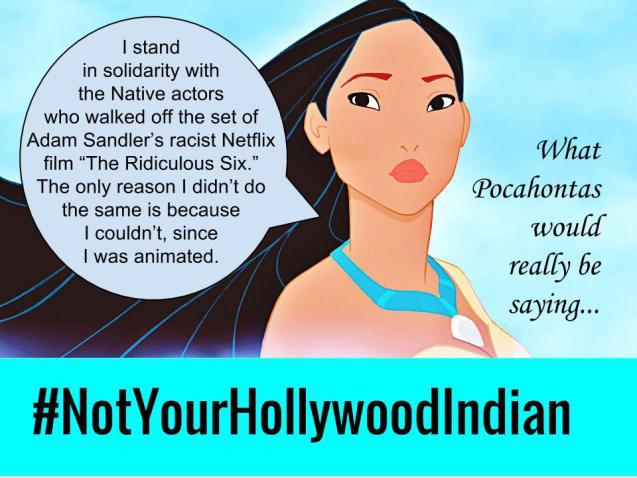
By Vincent SchillingLast week, a group of Native actors walked off the set of the Adam Sandler comedy The Ridiculous Six to protest the film's content. One of the key dissenters was Bruce Klinekole, Apache, who had been hired as the film's Native American cultural consultant. Klinekole, whose last name translates as "Catch the Horse," objected to the Netflix production's repeated gross misrepresentations of Apache culture, dangerous bow-and-arrow scenes involving inexperienced actors, and being denied the chance to even speak to Adam Sandler.

After his requests for changes were ignored, 65 year old Klinekole spoke with other Native Elder friends, including David Hill (an actor who ended up joining the walk-off), about what to do. When Klinekole saw four eagles circling above the set, he knew it was a sign to walk off the set.

"I wasn't allowed to talk to a producer and they wouldn't allow me to talk to anybody," Klinekole told ICTMN. "They wouldn't let me do anything. Nothing."

“I said, 'Okay, that's all, I'm going," he continued. "I felt bad for my fellow people who were there but there was nothing I could do. I couldn't say anything on behalf of my Native people or on behalf of my Apache people who were depicted so badly.”
Comment:  A brief discussion of the adviser's role:

Klinekole was arguably too naive. I wouldn't walk onto a set with a completed script, props, costumes, etc. and expect them to change everything. If you're not advising from the pre-production stage on, you might as well not bother.I couldn't believe he had to go through a PA--basically a college intern. The lowest rung and she arrogantly denied him access--of course, she had no power to grant him access. I've been a PA and I would have TRIED.The whole adviser role was obviously a joke. Or maybe it was another of Sandler's attempts at "satire."

They never intended to do anything the adviser said. They should've changed his title to "Fig Leaf for Covering Our Asses" or "Excuse for Giving Our Racism a Pass."The role was designed to have someone to blame. They knew it was horrible, they knew Natives would be upset, so they had him set up as the fall guy, expecting it wouldn't hit the fan until AFTER the film came out, and they could blame him and say, "Hey, we had a cultural advisor!"For more on Adam Sandler, see Should Natives Boycott Netflix? #NotYourHollywoodIndian.

April 26, 2015

Natives brave to protest Sandler

An Open Letter to the Native Actors Who Walked Off Adam Sandler’s Set By Apache Writer

By Noel AltahaThere are a few issues I have with this whole film, with that being said, let me state just a few:

The fact that this film was about Apaches yet the actors were Navajo is a problem. So the film crew basically implicitly insinuated that Apaches can’t adequately portray themselves enough to be Apaches in this film. If that isn’t a whole other level of twisted, I don’t know what is. And y’all went along with it. That in itself seemed like a yellow flag to me indicating a warning sign of what’s to come. Like a coyote crossing your path. *sips tea

The fact that Adam Sandler is a man of Jewish heritage, a culture with a history remarkably similar to Indigenous Americans. We are both descendants of a Holocaust. In fact, Hitler was inspired by the American government for its tactics used in the first Holocaust. The one launched against Indigenous people in present day America. Why? Because the American government wanted our land. The American government then hid this “dirty little secret” so well from the history books in American schools and around the world. Maybe someone needs to send Adam and his film crew to have a chat with someone’s Rez grandma, she’ll set him straight.
Altaha's conclusion:Dear Native actors who walked off the scene of Adam Sandler’s film set,

When you walked off the set of the film at the point you realized they started disrespecting Apache women, I thank you.

I thank you for planting seeds in someone’s mind: that respect for women is non-negotiable.

This small act may contribute to the protection of the next several generations of Indigenous women and girl-child. Maybe other men will think differently. Thank you.
The bravery of the Native American actors who walked off Adam Sandler’s movie

By Alyssa RosenbergIt’s one thing to walk away from a production that you think is abusive, a project that has been misrepresented or a situation where your technical expertise is being misused if you have other opportunities. It’s something very different, and altogether braver, to do so when you know that even a degrading opportunity might not come again.

But there’s power in that decision, too. By refusing to play parts they found degrading, actors like Loren Anthony and David Hill are leaving Sandler, his producers and Netflix in a difficult position. Will they try to fill the roles with other Native American actors, trying to convince them to take on work that others have deemed destructive? Or will they be forced to use white actors in racial drag in the roles, making them the butt of jokes that previously would have been directed at people of color?

No matter what decisions Sandler and Netflix make, Anthony and Hill have laid down another marker for all the actors that follow them. Regardless of what mainstream Hollywood might say, some opportunities aren’t worth taking.
Navajo Nation President Ben Shelly Condemns Adam Sandler Film“Our Native American culture and tradition is no joking matter. I applaud these Navajo actors for their courage and conviction to walk off the set in protest,” President Shelly said. “Native people have dealt with negative stereotypes on film for too long.

“Enough is enough,” he added.
Comment:  For more on Adam Sandler, see Sandler's Racist Ridiculous Six "Jokes" and Sandler Crew "Bronzed" Navajo Actress.

April 25, 2015

Sandler's racist Ridiculous 6 "jokes"

These Are the Jokes That Caused Actors To Walk Off Adam Sandler's Set

By Jordan SargentThe scenes that caused the Native actors to leave the set appear to happen within the first 15 minutes or so of the film. Extra Loren Anthony, who spoke to Indian Country Today, described a scene involving a character named Beaver’s Breath as being particularly irritating to the extras:Here is the part in which a Native woman squats and pisses while smoking a peace pipe. The extras noted a character named “No Bra” as being a disrespectful parody of Native American names—there is no “No Bra” in the version of the script we have, though it appears as if that character’s original name, “Sits-On-Face,” was even worse.

Read a Page From the Adam Sandler Script That Caused Native Actors to Quit

By Vincent SchillingNative actors who walked off the set of Adam Sandler’s movie The Ridiculous Six managed to snap a quick photograph of one of the pages of the script that shows offensive language and insults to native women. In the scene, characters "Beaver Breath," "Smoking Fox" and "Never Wears Bra" discuss the novelty of toilet paper, and it is revealed that their own approach to hygiene involves keeping their private parts clean with dead animals.

Additionally, the characters speak in broken stereotypical English.

The script reads as follows:

EXT. CREEK OUTSIDE APACHE VILLAGE – LATER

The Creek area is busy. Braves spear-fish while children play in the water.

Smoking Fox is on the banks of the creek, doing laundry with her best friends: a 30-ish chubby woman, BEAVER BREATH, and a younger woman, NEVER WEARS BRA (both Apache).

BEAVER BREATH

I have a big idea for your wedding: we decorate trees with toilet paper!

SMOKING FOX

What is this “toilet paper”?

BEAVER BREATH

Paper used to clean your chi-wat after taking a chungo.

NEVER-WEARS-BRA

That what dead squirrel for!


Another posting explains why Sandler's racist jokes don't qualify as satire:

The 'Ridiculous Six' Script Reveals "Offensive" Jokes That Caused Native American Actors To Walk Out

By Mark NewtonJust so we're all singing from the same hymn sheet, here is the definition of a 'satire':

The use of humor, irony, exaggeration, or ridicule to expose and criticize people's stupidity or vices, particularly in the context of contemporary politics and other topical issues.

So, do the jokes presented above fall under satire? Well, one of the perhaps unwritten rules of satire is that it should ideally satirize the status quo or the mainstream, and satire has frequently been used by comedians to lampoon politicians and the powerful on all sides of the spectrum. Comedy becomes tricky when it appears to be directed at a minority which has historically been oppressed, often because they have little recourses to respond on the same level.

Of course, issues of race are also fair game for satire, especially how race is discussed within the mainstream media. But the important issue here is that the audience must understand any seemingly offensive views expressed by a character are not genuinely held by the actor saying them or the writer who wrote them--but are merely used to satirize views we know are held by some/or exist. Think, for example, Stephen Colbert on The Colbert Report.

The main problem with The Ridiculous Six script is that the ignorant people appear not to be the white characters, but the Native Americans--since they have the silly names and behave in an uncouth fashion. In this sense, the 'stupidity and vices' exposed belong to the Native Americans and not the white characters, suggesting this doesn't really fall under the traditional definition of satire. Of course, maybe Sandler is simply satirizing himself as a white, affluent comedy writer who does not understand the sensitivities of the Native Americans?
Comment:  Let's address the question of whether Ridiculous Six is a legitimate satire. For starters, who's the butt of the jokes: the Indians or someone else? If it's someone else, where is that in the script? Because it isn't evident in the excerpts.

Another way to put this is: How are these "jokes" any different from the ones in a racist movie? Again, if some "context" makes them different, where is it? Because it isn't evident in the excerpts.

True, we lack the entire script. But we have the judgments of the people who were there. They confirm what's evident in the excerpts--that the "jokes" are flat-out racist. Until Sandler and Netflix demonstrate otherwise, that judgment stands.

For more on Adam Sandler, see Natives Quit Adam Sandler Movie.

April 24, 2015

Sandler crew "bronzed" Navajo actress

Navajo Actress Explains Why She Left Adam Sandler 'Ridiculous 6' Set

"That's not comedy when it comes to Native American stereotypes because we're always portrayed as the 'drunk Indian,' and that's just perpetuating those stereotypes," Allie Young says

By Daniel Kreps
After a dozen Native Americans hired to play extras on Adam Sandler's Netflix-produced western Ridiculous 6 ditched the set, one Navajo actress named Allie Young sat down with MSNBC to discuss the many reasons why they decided to leave the production. In addition to the script that they found offensive and disrespectful, the extras felt that the comedy–a play on The Magnificent Seven–furthered century-old stereotypes about Native Americans, Mediate reports.

"I'm full-blooded Navajo and they bronzed me. I was quite confused," Young said of the makeup department darkening her skin to make her look more stereotypically like a Native American. Young also revealed that the film's cultural consultant was the first person to leave the set. "That says something when the cultural advisor for the film quits because he's offended," she said.

Much has been made of the script giving characters names like "Beaver Breath" and "No Bra," but that was just the tip of how offensively the production viewed Native American women. "There was one instance where one of the Native American women, played by a white actress, is passed out on the ground and the group of white men are throwing liquor on her and she jumps up and starts dancing with everybody else," Young says of her breaking point to leave the film. "That's not comedy when it comes to Native American stereotypes because we're always portrayed as the 'drunk Indian,' and that's just perpetuating those stereotypes."
We Talked to a Native American Actress Who Walked Off Adam Sandler's Movie

By Zach SchonfeldIn a conversation with Newsweek, extra Allie Young, who is full-blooded Navajo, explained why she objected to the film, which has been picked up to premiere on Netflix next year.

"I take this very personally because my little brother committed suicide when he was 17 because of racism," Young said. "In his suicide note, he said, 'It's hard to stay alive when you're brown and gifted.' I want to take a stand for native and indigenous youth. I want them to see their people portrayed as something better."

An aspiring screenwriter and founder of the Survival of the First Voices festival, Young researched Hollywood depictions of Native Americans when she was a student at Dartmouth. She jumped at the chance to be an extra in The Ridiculous Six because she wanted to see how things had changed. She soon realized they hadn't much at all.

"At one point early on I was going in to makeup and being bronzed, and the wardrobe was not Apache traditional wear," Young explained. "I'm full-blooded Navajo. I was a little bit confused as to why I was being bronzed. I'm light-skinned. Maybe they wanted me to look darker."

The script posed more issues, including offensive names for indigenous women, like "Beaver's Breath" and "Wears No Bra." In one scene, a Native American women is passed out on the ground. A group of white men pours liquor on her, and she wakes up and starts dancing. "In Indian country, we're battling that issue right now," Young said. "It's 2.5 times more likely for an indigenous woman to be raped or sexually assaulted. Movies like this perpetuate that and just add to the stereotypes of our native women."
Comment:  A full-blooded Navajo made darker? Subjected to "redface" even though she's already "red"?

How exactly does this contribute to Sandler's "humor"? Answer: It doesn't.

It's clearly an attempt to make the Indians stranger and more exotic. That is, to make them less human and more animal-like. To "other" them.

There's no explanation for this other than racism. Indians look dark, according to the filmmakers, and white people don't. Which is why activists have rightly labeled Adam Sandler and Netflix racist.

For more on Adam Sandler, see Natives Quit Adam Sandler Movie.

April 23, 2015

Natives quit Adam Sandler movie

Native Actors Walk off Set of Adam Sandler Movie After Insults to Women, Elders

By Vincent SchillingApproximately a dozen Native actors and actresses, as well as the Native cultural advisor, left the set of Adam Sandler’s newest film production, The Ridiculous Six, on Wednesday. The actors, who were primarily from the Navajo nation, left the set after the satirical western’s script repeatedly insulted native women and elders and grossly misrepresented Apache culture.

The examples of disrespect included Native women’s names such as Beaver’s Breath and No Bra, an actress portraying an Apache woman squatting and urinating while smoking a peace pipe, and feathers inappropriately positioned on a teepee.

The film, which is said to be a spoof of The Magnificent Seven and was written by Adam Sandler and his frequent collaborator Tim Herlihy, is currently under production by Happy Madison Productions for a Netflix-only release. The movie will star Adam Sandler, Nick Nolte, Steve Buscemi, Dan Aykroyd, Jon Lovitz and Vanilla Ice.

Among the actors who walked off the set were Navajo Nation tribal members Loren Anthony, who is also the lead singer of the metal band Bloodline, and film student Allison Young. Anthony says that though he understands the movie is a comedy, the portrayal of the Apache was severely negligent and the insults to women were more than enough reason to walk off the set.
American Indian actors quit Adam Sandler movie over names

By Russell ContrerasGoldie Tom, another extra who departed the set Wednesday, said producers told the group to leave if they felt offended and that script changes were not up for debate.

"This just shows that Hollywood has not changed at all," Tom said.

She added the production had a number of non-Native American actors portraying American Indians, a long-standing complaint about the movie industry.

The actors said a Native American consultant hired by the production also walked off the set.


Native American Actors Walk Off Adam Sandler Set in Protest

Netflix defends film as "a broad satire of Western movies and the stereotypes they popularized"

By Jon Blistein
Netflix has defended Adam Sandler and his upcoming movie The Ridiculous Six after roughly a dozen Native Americans actors and actresses, as well as the film's Native cultural adviser, walked off the New Mexico set, claiming the script was offensive and disrespectful, Deadline reports.

Per Indian Country Today Media Network, the performers, who were primarily from the Navajo nation, took issue with jokes that insulted native women (characters were given names like Beaver's Breath and No Bra) and misrepresented Apache culture (one shot called for a woman to be simultaneously urinating and smoking a peace pipe). Others also pointed out that everything from the costumes to the positioning of feathers on a teepee was inaccurate, if not inappropriate.

While neither Sandler nor anyone from his production company, Happy Madison, have commented on the incident so far, a spokesperson for Netflix said: "The movie has ridiculous in the title for a reason: because it is ridiculous. It is a broad satire of Western movies and the stereotypes they popularized, featuring a diverse cast that is not only part of—but in on—the joke."

Those that walked off the Ridiculous Six set said they received similar, if not more curt, responses from producers after voicing their concerns. David Hill, a 74-year-old man of Choctaw descent, compared their arguments to those Washington Redskins owner Dan Snyder uses to defend the team's outdated name, while Allison Young, Navajo, told ICTMN: "They just told us, 'If you guys are so sensitive, you should leave.' I was just standing there and got emotional and teary-eyed. I didn’t want to cry but the feeling just came over me. This is supposed to be a comedy that makes you laugh. A film like this should not make someone feel this way."
Native American extras storm off set of new Adam Sandler film over racist jokes that called woman 'Badger Breath' and made fun of their culture

By Chris SpargoMaking matters worse says Anthony is that no one felt like they were being listened to by the production team.

'They just treated us as if we should just be on the side,' said Anthony.

'When we did speak with the main director, he was trying to say the disrespect was not intentional and this was a comedy.'

The cultural adviser meanwhile asked to speak to Sandler according to one extra, but was refused, and when that extra, Goldie Tom, later complained, she was told; 'It's in the script and we are not going to change it.'
Video: Adam Sandler's Producer To Native Actors: 'Sensitive? You Can Leave'

By Vincent SchillingIn an exclusive video obtained by one of the actors on set, Goldie Tom, Native Actors discuss their disappointment on the set of the Adam Sandler movie. During the discussion one of the producers tells the actors, “Here’s the thing, If you are overly sensitive about it… then you should probably leave.”

The actors are visibly frustrated at the remarks.


Adam Sandler film angers some Native American actors

Native American cast leaves Adam Sandler flick: ‘Nothing has changed—we’re still just Hollywood Indians’

January 20, 2015

Operation Redwing

Speaking of Natives and nuclear bombs, here's another item on the subject:

Operation RedwingOperation Redwing was a United States series of 17 nuclear test detonations from May to July 1956. They were conducted at Bikini and Enewetak atolls. The entire operation followed Project 56 and preceded Project 57. The primary intention was to test new, second-generation thermonuclear devices. Also tested were fission devices intended to be used as primaries for thermonuclear weapons, and small tactical weapons for air defense. Redwing demonstrated the first US airdrop of a deliverable hydrogen bomb--test Cherokee.

All shots were named after various Native American tribes.
Comment:  This is yet another example of using Native terms to denote toughness, violence, or savagery. For more on the subject, see Indians in the Military.

Below:  Redwing Apache.

September 10, 2014

What Tribe by Douglas Miles

Gathering of the Tribes: Artists Celebrate Indigenous Origins

By Rob SchmidtDouglas Miles, San Carlos Apache, the mastermind behind the company-turned-art-collective known as Apache Skateboards, has another culture-challenging project in the mix: What Tribe. This traveling exhibit features a collection of minority artists who address racism and stereotyping with their work.

The show kicked off at Denver University in Colorado, then appeared in Phoenix, and finally in East Los Angeles, where it was well received. The show at Self Help Graphics in the Boyle Heights neighborhood included a mural on the outside wall of the gallery created by several artists. Miles explains its origin:

“What Tribe kind of came about as an answer to the constant media misrepresentation that I saw.” This came to a head with two egregious examples: the No Doubt video with Gwen Stefani as an Indian temptress, and the Lone Ranger film with Johnny Depp as Tonto.

This cultural misappropriation points to one thing, says Miles: “Institutional racism. Which is a form of racism in America that runs so deep and so constant that people, Native people and non-Native people, almost don’t even know or accept that it exists.

“Institutional racism is very insidious, and it has many forms,” he adds. He sees it in galleries, films, books, museums and the media.
Comment:  The article's original title was:‘What Tribe’ Addresses America’s Institutional RacismAn editor changed it for some reason, perhaps because it was too "challenging." Douglas Miles and I agree the original title was much better.

For more on the subject, see A Decade of Douglas Miles.

September 07, 2014

Racist superhero comics in Cracked

The title of this piece isn't quite accurate. It should be something like "Dozens of Shockingly Racist Scenes in 5 Famous Superhero Series."

Many of the scenes are from the World War II era, when Americans were fighting the Germans and Japanese, so the racism is somewhat understandable. A few are from the ignorant but well-meaning 1960s and 1970s. In a couple of cases I don't agree with the author--such as the X-Men's use of racial slurs to argue against racism.

Racist and stereotypical depictions of Indians make more than their fair share of appearances. Let's take a look:

5 Shockingly Racist Scenes in Famous Superhero Comics

By Seanbaby#5. The Justice League

It's unusual for an elite group of whites to be racist, but the Justice League had some problems with it. For starters, even their space aliens were Aryan. When Hanna Barbera adapted them into a cartoon in the '70s, animators had to invent four ethnic members just so they wouldn't burn through their supply of "flesh" paint in the first season. If you're not familiar, the racial heroes added to the Super Friends were:

1. A Native American named Apache Chief who wasn't either of those things.
Bruce Wayne became a bat to strike fear into the hearts of Gotham criminals, but in China, bats are often considered good luck. So Batman may have decided to murder a few hundred of their people to clear up any confusion. And speaking of confusion, here's the kind of interaction Batman has with Native Americans:There were people on the Justice League with racism that didn't even make sense. Green Lantern is a space policeman. Most of his coworkers and friends are jellyfish or cosmic squirrels, and yet he had no idea what to do when he met a real-life Earth Eskimo.Yes, Hal Jordan had an Eskimo sidekick he called "PIEFACE." And that nickname fucking stuck. Thomas Kalmaku walked around for decades answering to PIEFACE. It was such a bizarrely offensive character that when Filmation created a Green Lantern cartoon in the '60s, they replaced him with a blue (probably) alien boy named Kai Ro. Hal wasn't as aggressively racist towards him, but their relationship was far from appropriate.

Superman handled most racial situations perfectly. He made it through WWII and Korea without calling anyone names and he didn't even ask to touch Black Lois' hair. If he had one cultural kryptonite, it was that he wasn't great with Indians.
In a story called "Superman, Indian Chief!", Superman was called in to settle a property dispute in Metropolis. An evil mogul discovered, through distant Native American ancestry, that he owned all the city's land. He instantly began extorting the citizens of Metropolis and proudly bragged about it right to Superman's face. It was almost suicidally evil, and here's how Superman handled it:Superman had any number of option--everything from diplomacy to super hypnosis to super ventriloquism to punching the evil dick into the sun. He went with: running back in time to screw the Indians out of their land 300 years ago. He didn't even have to think about it. He was already jogging through the 1800s before the guy was done with his threat. Say what you want about Aquaman and Wonder Woman shrieking "Jap!" for the better part of a decade; Superman wove his racism into the very fabric of his universe's chronosphere.

#4. The X-Men

Like the Justice League, most of the X-Men's cultural diversity came in one explosion of poorly thought out ethnic characters. For example, James Proudstar. He's a Native American with the power of being pretty tough and tracking. Almost as if a racist thought, "What super powers would be handy if you had to, like, be an Indian all day?" And sure enough, when we meet him, he's having a wrestling match with a buffalo. A wrestling match with a buffalo.


Actually, the original Thunderbird was John Proudstar. His brother James became Thunderbird after John died.

And yes, a buffalo on the Apache reservation is fairly ridiculous. It's theoretically possible but extremely unlikely.#1. The Marvel Family


Comment:  Seanbaby criticizes other portrayals in the Marvel Family comics, but not the Native portrayals. The Native examples are sidelights, and they're self-explanatory.

Unfortunately, it's still not uncommon to see Native characters wearing headdresses and buckskins, or half-naked, or both. Yes, even in the 2010s. For instance, Grant Morrison re-introduced Chief Man-of-Bats, the Native Batman, a few years ago. (Man-of-Bats may have debuted in the Batman story pictured above.)

April 20, 2014

A decade of Douglas Miles

Another article by me:

An Unquiet Indian: 10 Years of Decks, Guns and Geronimo With Douglas Miles

By Rob SchmidtDouglas Miles, the founder of Apache Skateboards from the San Carlos reservation in Arizona, didn’t set out to be a professional artist. In fact, he started in social work.

“I’ve been making art ever since I can remember,” he says—around 25 years. But professionally, he spent his first 10 or 15 years in the social field.
About his Apache X retrospective:The reactions have been positive, says Miles. The people who supported Apache Skateboards at the beginning continue to support it. Only one criticism has been a constant. “I like the art, they’ll say, but I don’t like the gun imagery. It kind of throws people off.”

He doesn’t apologize for that, and people aren’t saying it as much anymore. They got used to it, he explains, or they see “it’s part of the story.” That is, the story of Apache Skateboards, American history, and the history of the Apache people. “It’s not something that I’m trying to sugar-coat or whitewash.”
Comment:  For more on the subject, see The Artist Who Plays Lozen and Apacheria: The Art of Douglas Miles.

March 05, 2014

Assimilation in 1950s movies

I watched three old 1950s Westerns recently. As usual, they had some authentic elements but were mostly inauthentic.

Together they spun a clear message of assimilation. America's "Indian problem" would go away if only the Indians joined the mainstream and became good white Christians.

The Far HorizonsPlot

An ambitious, historic attempt to explore and document an untamed American frontier unfolds in this rousing adventure drama. In 1803, Meriwether Lewis and William Clark, with President Thomas Jefferson's blessing, embarked on the government-sponsored Lewis & Clark Expedition–an attempt to discover a water route connecting St. Louis, Missouri, with the Pacific Ocean. Their trek takes them through the magnificent, danger-filled territory of the Pacific Northwest, with guidance from the Shoshone maiden Sacagawea.

Reception

In 2011, Time Magazine rated The Far Horizons as one of the top ten most historically misleading films, in part due to its casting of Caucasian Donna Reed as Native American Sacagawea, and the creation of a romantic subplot between her character and William Clark despite the fact that Sacagawea's husband, French-Canadian trader Toussaint Charbonneau, was in real life also a member of the expedition.


The explorers' first encounter with a tribe is reasonably accurate. The white man approach the Indians in full dress uniforms, present them with medals and other trinkets, and declare they're now subjects of the Great Father in Washington. The Indians pretend to go along, but after the white men leave, the chief throws down his medals and declares his opposition. No one can own the land, he says.

So far, so good...but then the angry Indians stalk the explorers and try to kill them. Uh, no. Lewis and Clark encountered several friendly tribes and stayed with them for a couple of winters. No one made a concerted effort to kill them.

The unavoidable message is white men good, Indians bad. The noble explorers are just innocently surveying the land. The evil savages can't stand the idea of sharing the country, so they go into a murderous rage. They don't plan intelligent counteroffensives like Tecumseh's confederation of tribes, which happened only a few years later. They lash out like wild beasts threatened with captivity.

The whole love subplot is ridiculous too. And it contributes to the overall message. Sacagawea journeys to Washington DC with Clark, but she can't fit into white society, so she leaves. Although you could take that as advocating separatism, I didn't. I took it to mean Indians can't be part of the mainstream unless they eliminate what makes them unique and become plain-vanilla Americans.

Walk the Proud LandPlot

This is the true story of Indian agent John Philip Clum (Audie Murphy) as told by Clum's son in the 1936 biography Apache Agent. The film begins in 1874, as Clum, an Eastern government representative, arrives in San Carlos, Arizona. He is sent to try a new approach to peace with Apaches based on respect for autonomy rather than submission to Army. He faces suspicions from the white settlers, the Army and the Indians, especially Geronimo.

Reception

The film was not a success at the box office, something attributed to the fact that Murphy played a pacifist rather than an action hero. This ended Murphy's plans to make his dream project, a biopic of painter Charles Marion Russell.


I saw only the final half of this, but I think I got the idea.

Clum plays the usual role of the white savior who knows what's best for the Indians. His "new approach" is to tell them to stop fighting and settle down as farmers. Many of the Apache agree, but Geronimo (Jay Silverheels!) and his renegades say they'll never give up their independence.

Needless to say, this isn't exactly a pro-Indian message. It's "pacifist" only in the sense that Clum isn't the one hold a gun to the Apaches' heads. But an implied threat is there. If the Indians don't do it Clum's way, the Army will enforce it their way.

Clum manages to trick Geronimo into submission. He approaches Geronimo with a small number of men and puts them in Geronimo's hands. But other men in the hills fire their guns, and the echoes make it seem as if Geronimo is outnumbered and surrounded. He finally surrenders.

So it's not Clum's pacifist message that carries the day. It's more of the white man's deception. The "bad" Indians are forced to accept the white man's way as the best and only possible existence.

ApacheApache was based on Paul I. Wellman's novel Broncho Apache, which in turn was inspired by a true story. Burt Lancaster plays Massai, a lieutenant of the great Apache warrior Geronimo (here depicted as an old man, played by Monte Blue). Though his tribe has signed surrender terms with the conquering whites, Massai refuses to do so. He escapes from a prison train and conducts a one-man war against the white intruders-and against some of his own people. Along the way, he claims Nalinle (Jean Peters), whom he previously regarded as a traitor to his cause, as his wife.

John McIntire plays famed Indian scout Al Sieber, who-in this film, if not in real life-is sympathetic to the Indians' plight and Massai's single-purposed cause. The real-life counterpart to Massai was killed by Sieber's minions after agreeing to call off the hostilities; United Artists objected to this, forcing producer/star Burt Lancaster to shoot an unconvincingly happy ending. --Hal Erickson, Rovi


Lancaster looks silly as an Indian, and initially sounds silly too. I guess he eventually grows into the role. But that's neither here nor there.

Apache shows what happened to Geronimo and his men when they surrendered to "pacifist" white men. They were sent to a prison camp in Florida and never saw their homeland again. So much for peace and reconciliation.

Massai escapes and, on the way home, meets a Cherokee farmer who touts the value of settling down and growing corn. Massai is scornful, but the man insists he hasn't given up his Cherokee identity. Massai takes some corn with him when he leaves.

When he reaches his own people, the weak-willed appeaser of a chief turns him in to the white men. He escapes and begins his one-man battle to remain free. Nalinle tries to help him and eventually they hole up in a remote cabin, where he angrily tosses the corn away.

The next spring, he's surprised to find a corn crop growing near the cabin. The white men track him down, and he and Sieber play a silly cat-and-mouse game in the corn patch while the others surround it. The white men have scorned the idea that wild savages could become tame farmers, but Sieber sees the corn patch as proof that they can. Amazingly, he lets Massai return to his cabin and live as a newly minted man of the soil.

Conclusion

So the implied assimilationist message of The Far Horizons becomes explicit in Apache. Become a farmer or go to prison and die. Even the boldest and most independent warrior must bend to this inevitable outcome. There's no place for Indians in America unless they give up their old ways and become good Christian workers.

True, these movies didn't come out in this order. But in different ways, white filmmakers were trying to present the same message. They each came up with pieces of the puzzle.

Put them together and you can see the whole assimilationist narrative. Indians were wild and savage. Americans just wanted to live with them in peace. Eventually the Indians agreed and gave up their uncivilized ways.

For more on the subject, see The Best Indian Movies.

December 25, 2013

Long Shadow in Justice League Unlimited

Someone told me about the cartoon character Long Shadow a while ago. Last year, I saw the three episodes of Justice League Unlimited in which Long Shadow appeared. Here's the story on him:

Long ShadowLong Shadow was a former member of the Ultimen. As with the rest of the team, he was genetically engineered by the U.S. Government to be a powerful team of superheroes obedient to them, unlike the Justice League.

Background information

Like the other members of the Ultimen, Long Shadow was based on an original character from the old SuperFriends show. In that respect, Long Shadow was a reference/update to Apache Chief, another giant-sized superhero of Native American origin. However, as an artificial human, Long Shadow has no genuine Native American background beyond his implanted memories. Also unlike his SuperFriends counterpart, he requires no phrases to activate his powers. (Apache Chief would shout the magic phrase "Inukchuk" to activate his power and grow to fifty feet tall.)

History

Notably unlike his teammates, Long Shadow was more cool-headed, humble and didn't let superhero fame go to his head. He still retained his admiration of the heroes of the Justice League, considered them as his role models and continued to desire an alliance with them.

Long Shadow wanted his team to join the Justice League, but the other Ultimen, despite some of whom originally also admired the League, were against it. Unlike the rest of the group, who had been enjoying their newfound fame, wealth, and popularity, Long Shadow earnestly wanted to join the Justice League to help more people and be a better hero. Long Shadow's efforts were constantly rebuffed and mocked by his teammates.

After helping the League, Long Shadow developed somewhat of a crush on Wonder Woman. While the attitudes of the rest of the Ultimen and the Justice League were at odds with each other, Long Shadow's humility and admiration earned a good friendship with Wonder Woman, who became a sort of mentor figure to him.
Comment:  There's a lot to like about Long Shadow. For instance, his name evokes the natural world without using a cliché such as "Big Bear." His costume is futuristic but still Native-style in color and design.

As the "History" section indicates, the best part is his refreshing personality. He wasn't the stoic or savage member of the Ultimen. In fact, he was the opposite: friendly, helpful, and open about his desire to be a hero.

That doesn't seem like much, but it's surprising how often a Native character is some variation of stoic and savage. It's the 21st century, people. Indians are extroverts and peace lovers like everyone else.

For more on the subject, see Ty Longshadow = Apache Chief? and Apache Chief.

November 14, 2013

Burroughs's The War Chief

Because of the John Carter movie, there's been a renewed interest in the work of Edgar Rice Burroughs. In recent years, I've posted a few links about him and his ideas about race. For instance:

Burroughs the conservative racist
Review of Warlord of Mars #1

But while talking about Martians as analogues of Indians, I neglected a more direct link. Burroughs wrote a whole novel about the Apache:

The War Chief

SynopsisTHE WAR CHIEF is a realistic historical novel about life and death on an Apache reservation during the final years of the Apache wars until the death of Cochise and the surrender of Geronimo. The story focuses on Andy MacDuff, an infant kidnapped by the Apaches in a raid, adopted by Geronimo and renamed Shoz-Dijiji, or Black Bear. He is given a proper Apache upbringing, including initiation into all the rites and responsibilities of Indian Manhood. He excels at the crucial skills of hunting and warfare, shows himself to be strong and courageous, and soon is made a highly prized war chief. During his apprenticeship, Shoz-Dijiji falls in love with Ish-Kay-Nay, an Apache maiden, who, unfortunately is coveted by another Apache chief, Juh, who hates Shoz-Dijiji for being Geronimo’s favorite. Burroughs’ great respect for the West and compassion for the exploitative treatment of the Indians the hands of the treacherous pin-dah-lickoyee (“white eyes”) is manifested throughout this honest, vivid, and sympathetic portrait of the West that does credit to both the Indians and Edgar Rice Burroughs.Project Gutenberg has posted the whole story online if you want to read it:

Title: The War Chief

Author: Edgar Rice Burroughs
* A Project Gutenberg of Australia eBook *
CHAPTER 1

GO-YAT-THLAY

NAKED but for a G-string, rough sandals, a bit of hide and a buffalo headress, a savage warrior leaped and danced to the beating of drums. Encircling fires, woman-tended, sent up curling tongues of flame, lighting, fitfully, sweat-glistening shoulders, naked arms and legs.

Distorted shadows, grotesque, mimicking, danced with the savage and his fellows. Above them, dark and mysterious and weirdly exaggerated by the night, loomed the Grampian Hills.

Rude bows and arrows, stone-shod spears, gaudy feathers, the waving tails of animals accentuated the barbaric atmosphere that was as yet uncontaminated by the fetid breath of civilization--pardon me!--that was as yet ignorant of the refining influences of imperial conquest, trained mercenaries and abhorrent disease.
But wait...it's a trick! These are the Scottish ancestors of the white men who will soon invade the land of Go-yat-thlay (Geronimo). How they came to have a buffalo headdress, I don't know, but the point is that they reek of savagery.

A few paragraphs later we meet Geronimo as he spies on a covered wagon:Go-yat-thlay had never before seen this wagon, but he had seen its dust from a great distance; he noted its volume and its rate of progress, and he had known that it was a wagon drawn by two mules, for there was less dust than an ox-drawn vehicle would have raised, since oxen do not lift their feet as high as horses or mules, and, too, its rate of progress eliminated oxen as a possible means of locomotion. That the wagon was drawn by mules rather than horses was but a shrewd guess based upon observation. The Apache knew that few horses survived thus far the long trek from the white man's country.

In the mind of Go-yat-thlay burned a recollection of the wrongs that had been heaped upon his people by the white man. In the legends of his fathers had come down the story of the conquests of the Spaniards, through Coronado and the priests, three-hundred years before. In those days the Apache had fought only to preserve the integrity of his domain from the domination of an alien race. In his heart there was not the bitter hatred that the cruelty and injustice and treachery of the more recent American invaders engendered.
So Burroughs treats the Indians decently. He makes a point of saying white men are just as savage as Indians.

But the story centers on a white man raised as an Apache. Needless to say, he becomes a great chief and woos a beautiful "princess." No doubt he's a classic "white Indian" who acts as savior of the savages.

War Chief comic strip

I was reminded of The War Chief when I saw the following images on Facebook:


Apparently, Edgar Rice Burroughs Inc. is producing "All New Weekly Comic Strips" of Tarzan, Pellucidar, Carson of Venus, and other Burroughs properties. With all the talent involved, I imagine they're pretty good.

July 22, 2013

Superheroes in Native American Encyclopedia

A website called Native American Encyclopedia posted a series on Native comic-book and related superheroes. Many are familiar to fans of Native characters, but some are obscure--even to me.

Below are links to the ones I saw. The text is taken from Wikipedia:

Super-Chief ~ Iroquois
Owlwoman ~ Kiowa
Black Crow ~ Navajo
American Eagle ~ Navajo
Forge ~ Cheyenne
Elisa Maza ~ Hopi/African American
Redstone ~ Apache
Red Wolf ~ Cheyenne
Sharon Friedlander ~ Cheyenne
Tom Corsi ~ Cheyenne
Thunderbird ~ Apache
Patoruzú ~ Tehuelche
Michelle Chang ~ Native American/Chinese
Warpath ~ Apache
Talisman ~ Sarcee
Ringo Kid ~ Comanche or Cheyenne
Risque ~ Seminole
Snowbird ~ half Sarcee
Puma ~ Arizona
Apache Chief ~ Apache

Comment:  Pretty good list, but it left out some important characters. The biggest omissions include Wyatt Wingfoot, Dani Moonstar, Shaman, Tom Kalmaku, Rainmaker, and Powwow Smith. And the classic Turok and Tonto, of course. If the Ringo Kid is a superhero, so are they.

A note on Sharon Friedlander and Tom Corsi. They're not really superheroes by any definition. And they're not really a Native, since they were white people transformed by magic. Indeed, I wonder how magic made them Cheyenne, a cultural rather than physical trait. Cheyennes don't have "Cheyenne DNA"; they may not even have much Native DNA.

For more on Native superheroes, see Warpath in New X-Men Movie and Burgas Reviews Demon Bear Saga.

July 08, 2013

Geronimo = Hollywood's favorite Native

Geronimo: Hollywood's Favorite Native for Over 100 Years

By William A. ClementsHis compelling story, his enduring reputation and even his physical appearance make Geronimo ideal for film treatment. As a wire service item that was making the rounds in 1939 with the showing of the film Geronimo! noted, “There certainly was never a more appalling one [figure from the Southwest] than Geronimo, arch fiend and war lord of the Apache Indian tribe which fought the United States to the death for the arid wasteland they know as home.”

Geronimo’s first cinematic appearance occurred only three years after his death in 1909. Now lost to the disintegrating effects of time, Geronimo’s Last Raid came out in 1912. But Geronimo has enjoyed considerable subsequent screen exposure, usually in secondary roles. He has also been a character in episodes of several television series, especially those broadcast during the heyday of the Western in the late 1950s and early 1960s. He even inspired a cartoon character, Geronimoo, in an ABC-TV offering, The C.O.W.-Boys of Moo Mesa. In fact, Geronimo has probably appeared in more “Hollywood oaters,” as one historian calls Westerns, than any other American Indian, including Crazy Horse and Sitting Bull.

Early in his cinematic career, Geronimo took the role of what Michael T. Marsden and Jack Nachbar call the “Savage Reactionary,” a stereotypical villain. Of the two dimensions the “Hollywood Indian” was capable of representing—“the old bloodthirsty savage and his alter ego, the noble savage”—Geronimo usually assumed the role of the former. For example, he is the principal menace threatening the passengers in John Ford’s classic Stagecoach (1939).

Victor Daniels (using the performance name Chief Thundercloud) took the title role in Geronimo!, the film that reintroduced the figure to American popular culture and is generally credited with inspiring World War II military paratroopers to yell “Geronimo!” as they leaped from airborne troop carriers, along with the many children who continue to yell his name as they jump from lesser heights. Daniels was born in 1899 in Muskogee, Oklahoma, and may have been a member of the Cherokee Nation. His looks guaranteed him roles among the extras in many western films during the 1930s. He also originated the role of Tonto in the first Lone Ranger films.
Comment:  This book excerpt goes on to discuss movie and TV portrayals of Geronimo at length. Check it out if you're interested.

For more on Geronimo, see Code Name: Geronimo to Be Released and Beyond Geronimo at the Heard.

Below:  "This excerpt was taken from Imagining Geronimo: An Apache Icon in Popular Culture, by William A. Clements, 2013."

June 06, 2013

Rainmaker in The Movement #2

The Movement Brings Back A Familiar Face (SPOILERS)

By Rich JohnstonThis is one of those rare occasions when I run the final page of a comic book on the day of its release. I’m not going to alter it, I’m not going to hide it, I’m just going to spoil it. So, you know, big spoilers. If you were planning to read The Movement #2 by Gail Simone and Freddie Williams II, today then run away, run away, run away. And come back later to join in the discussion.And who is it?Sarah Rainmaker was an Apache Native American member of Gen 13 with a line in making a stand and being part of organised protests. A perfect character to pick up for a book like The Movement.Comment:  For more on Sarah Rainmaker, see Who Should Play Rainmaker? and Megan Fox as Sarah Rainmaker?!


May 24, 2013

Bad Kids Go to Hell

Here's an independent comic-book series I just learned about:

Exclusive: The Pull List Reviews Antarctic Press’ ‘Bad Kids Go to Hell #2′

By John CarleWhat would happen to the Breakfast Club if instead of just dealing with teenage angst and a hard-nosed disciplinarian they had to worry about a curse caused by all of their parents building a library over a sacred Apache Indian burial ground? Bad Kids Go to Hell explores this scenario as four members of a pretentious high school’s elite class find themselves in detention with a kid from the wrong side of the tracks trying to avoid heading back to juvenile hall and a cynical Goth girl in tune with the occult.

Each of the elitists, the overachieving daughter of a lawyer, the injured jock son of a councilman, the homecoming queen cutter and the pressured son of an Afghani immigrant, all try to examine how they got themselves in to the trouble that landed them in detention. The odd thing is that none of them can explain why they did what they did other than saying the idea just came over them and they didn’t feel like they were in control of themselves at the time.

The issue begins with the kids beginning their punishment, researching and writing a speech for the library’s dedication. What they find backs up the rumors they had begun discussing last issue that the school had been built on sacred Apache land. Upon further examination, they unearth some information about the last guardian of the tribe who had been forced from the land by eminent domain, committed to an asylum and took his only life after feeling he failed to protect the sacred land. And of course, before he died he made sure to place a curse on the land. Like any Goth girl, Veronica offers up the idea to have a séance to find out if there really is a curse on the school. Reluctantly, the others agree and the circle sets themselves up around a table.

When things begin to get a little too heavy for some of the participants, Megan, the overachiever who landed herself in detention for stripping in class and making out with another female student has an asthma attack and runs off, breaking the circle. And then, like any classic horror movie tale, people start dying. Locked in the library together with no one to get them out after Veronica tainted the coffee of their teacher with eye medicine, the five remaining students try to find their way out and quickly begin to turn on each other in typical horror movie fashion.
It was made into an equally independent movie:

Bad Kids Go to Hell

By Leah ChurnerThe real mystery of BKGTH isn’t who’s doing the killing, but where the passion went in this independently produced screenplay-turned-comic-book-turned-movie by Dallas filmmakers and co-writers, Matthew Spradlin and Barry Wernick. Did they outgrow the project in the six years it took to complete? Certainly they were stymied by limited funds. Comic-book adaptations call for dozens of set-pieces, and this movie only has the budget for three or four–hence the copious slo-mo shots, a seeming effort to re-create the book’s still images.

If a high school English teacher were grading BKGTH, he or she would have to give writers points for using the thesaurus. The phrase “dead Indian” is eventually replaced with “Native-American wraith,” for instance, and the headmaster (The Breakfast Club’s Judd Nelson hiding behind a huge beard and glasses) is totally quotable: “Never before have I seen a greater blight on organized education. Like a massive gravity sinkhole, he deforms every positive thought he encounters before sucking it into a vortex from hell.” The operative word is sinkhole.
Comment:  I'm not totally opposed to the idea of Indian spirits haunting the land. I used that idea in the first PEACE PARTY story I wrote. But I like to think I gave it an original twist. This sounds like a completely clichéd version of the idea.

And using the Apache as the culprits? Ho-hum. Name a violent, war-like tribe. Oh, yeah, the Apache.

I think someone said that one student is descended from the "last Apache." This student is probably the one killing the others to avenge his ancestors. Oops, I hope that didn't spoil the comic book and movie. I'm just guessing, so don't mind me.

For more on Indians and the supernatural, see Tonto vs. Wendigo and Cannibal Indians in My Ghost Story.

February 23, 2013

Heliographs helped capture Geronimo

Trail Dust: Army used 'talking mirrors' to help track Geronimo

By Marc SimmonsDuring the last campaign against Geronimo in 1886, the U.S. Army introduced a heliograph system for the rapid transmission of messages across the Southwestern deserts.

The heliograph was a small, round mirror mounted on a movable bracket and a tripod. By catching the sun, it could flash coded signals great distances.

The British had pioneered military use of heliographs in India during the 1860s. When Gen. Nelson A. Miles was chasing Montana Indians in 1878, he had six of the devices and found them very effective. Upon his transfer to Arizona, he decided to use them there.

By the time Geronimo and his handful of warriors made their final raid, the telegraph had been strung from Tucson to El Paso.

The trouble was, the Apaches had learned to cut the wire and then false-splice it with rawhide, so that repair crews could not see the break from the ground.

The heliograph, which flashed from mountaintop to mountaintop, was far more reliable. In a short time, Miles saw to the establishing of a series of signal stations from Robledo Peak above Fort Fillmore in the Mesilla Valley, westward to the main forts of Arizona.
And:Scholars have long argued over just how important the heliograph was in bringing about Geronimo’s final surrender in September of 1886.

Gen. Miles was convinced that it played a key role, and he stated that on more than one occasion. He may also have started a story saying that when the wily Geronimo came to understand how the white men were communicating his movements by the talking mirrors, he realized that his cause was hopeless and sent orders to his scattered warriors to give up.

Said one historian: “The heliograph was a decisive factor. Flashing all day from mountain summits, the mirrors kept the soldiers fully informed of Indian movements. The Apaches had not a moment’s rest.”

But other, skeptical writers declare that the case on behalf of the heliograph has been badly overstated. Geronimo, they say, grasped the nature of the signals right away—for after all, it was not unlike his own smoke signaling.
Comment:  A couple of points worth noting:

1) Cutting the telegraph wires and then false-splicing them with rawhide is a nice sabotage technique. I'm not sure I heard about the fake-wire twist before.

Regardless, it shows how clever and adaptable the Apache were. They weren't just circling the wagons and whooping--as every old Western showed them doing. They were using modern guerrilla warfare tactics.

2) The US Army relied on communications similar to the Indians' smoke signals. What about all the cartoons showing "primitive" Indians using smoke signals while "civilized" white men used the telegraph or, well, nothing?

In reality, the white man was hardly more advanced than the Indian. Take away his telegraph and he had few advantages other than numbers.

So much for the stereotypical cartoons that lampoon Indians as savages.

For more on Geronimo, see Code Name: Geronimo to Be Released and Beyond Geronimo at the Heard.

October 04, 2012

Code Name: Geronimo to be released

‘Code Name: Geronimo’ movie to be released in theaters

By Roscoe PondAn exact replica of Osama Bin Laden's compound in Pakistan was built at the New Mexico state prison just south of Santa Fe. It served as a location shoot for the new action movie, “Code Name: Geronimo.” Filming wrapped production last February 2012. The movie follows a team of 6 Navy ‘Seals’ as they trained for the mission to assassinate Osama Bin Laden. The film is tentatively scheduled for U.S. release October 2012.

This new film is the second to tackle the controversial subject of Bin Laden. ‘Oscar’ winning director Katherine Bigelow (The Hurt Locker) helmed, “Zero Dark Thirty” which will open in U.S. theaters Dec. 19, 2012. John Stockwell directed, “Code Name: Geronimo” which was bought by the Weinstein company at the ‘Cannes’ film festival last May. It premiered in theaters at the country of Brazil on Sept. 28.

The killing of Osama Bin Laden in 2011 was considered a victory for the U.S. Native Americans were insulted that the ‘Navy Seals’ used the operation code name of ‘Geronimo’ to kill Bin Laden.
Comment:  For more on the subject, see Code Name: Geronimo the Movie and Bin Laden Codenamed "Geronimo."