September 09, 2012

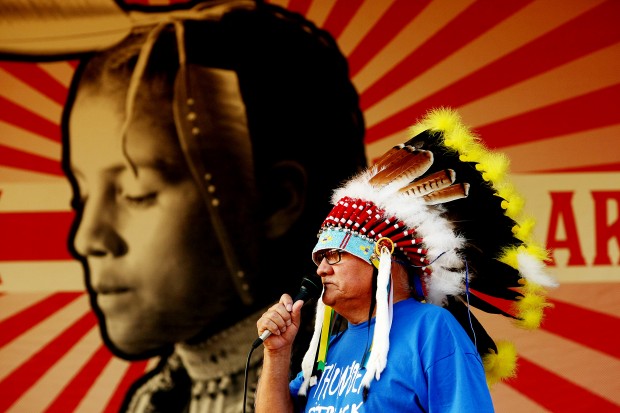
EMU revives Hurons logo

Former EMU logo featuring Native American mascot will briefly reappear on band uniforms

By Christina HallEastern Michigan University’s old Hurons logo is making a re-appearance more than 20 years after it was dropped over concerns that it was offensive to Native Americans and others.

The Hurons logo, used from 1929 to 1991, and another former block M logo that honors the Normalites—when the university was known as Michigan State Normal School—are embroidered inside new band uniforms that will be worn at Saturday’s football home opener.

The logos are inside the green and white jackets near the wearer’s heart and aren’t visible on the outside.

“It’s important to note, our mascot is not changing. We’ve been the Eagles for the last 20 years and we will remain the Eagles,” said Walter Kraft, EMU’s vice president for communications. “We really looked at this as a way to embrace our history and embrace our past and alumni from different eras.”

Kraft said the 163-year-old school has more than 148,000 alumni nationwide—most in Michigan—who attended EMU during its various eras. He said the logos aren’t set to appear on any other formal university items beyond the band uniforms.
Indian Country Today is rightly scornful of this move:

Eastern Michigan University Brings Back Divisive Indian Logo to “Honor its History, Pride”Despite having changed their mascot some twenty years ago from the Hurons to the Eagles, the president and some alumni at Eastern Michigan University (EMU) have seen fit to reclaim the old logo for the football team’s home opener. Despite the fact that the Michigan Civil Rights Commission recommended all schools avoid the use of American Indian mascots, EMU’s marching band will be wearing the old logo, the Detroit News reports.

The News reports that many of the school’s alumni have long derided the team’s name, logo and mascot change, and have refused to support the school financially because of the decision.

“Once a Huron, always a Huron,” appears to be the mantra of some EMU alumni, the Detroit News reports.

“An effort to heal that wound will be made on Saturday at the football team’s home opener against Illinois State at Rynearson Stadium,” AnnArbor.com reports. The News goes on to write that “The EMU Marching Band will sport the logo on its new uniforms Saturday…although the uniform’s Huron logo won’t be easily visible, the move is part of several university efforts to unite EMU alumni—especially those who are still vocal about the dropped mascot and won’t financially support the university.”

The ruffled feathers of alumni, and the withholding of financial support, apparently trumps the 1991 decision by the Michigan Civil Rights Commission and the feelings of Michigan’s many tribal members.

“Reinstating the Hurons is just one of several ways the university is starting to nod to and celebrate its past,” EMU President Susan Martin told the News. “She came up with the idea with alumni to include the Huron mascot on the 275 new band uniforms,” the News reports.

“I don’t like native people being used as mascots in any situation,” said American Indian Services Director Fay Givens to the News, who was a outspoken supporter of changing the Huron mascot in 1991.
Comment:  This is a typical example of white privilege in action. The white majority declares that their feelings are important than the feelings of Indians. The implicit message is: "We own this country. We're the deciders. What we say, goes."

It remains pathetic that mascot lovers need a stereotypical sports logo to validate their existence. Grow up, you whiny babies. Most people give up their teddy bears and security blankets, and you can too.

For more on Indian mascots, see Syracuse Mascot in The Express and Even Sioux Voted Against "Fighting Sioux."

Studi films diabetes prevention commercial

Cherokee Actor Wes Studi, CDC shoot National Diabetes Prevention commercial at Cherokee NationThe Cherokee Nation hosted U.S. Centers for Disease Control and Prevention officials and notable Cherokee actor and citizen, Wes Studi, in Tahlequah for three days to shoot a diabetes prevention commercial in August.

It urges Cherokees and all of Indian Country to look to its roots for a healthier lifestyle since the diabetes diagnosis rate increased 68 percent for Native American teens aged 15-19 between 1994 and 2004.

“Hopefully we can be the solution to preventing Type II diabetes which runs at a high rate in our tribe by promoting eating more traditional foods and playing our traditional games,” said Studi, known for his movie roles in “Dances with Wolves,” and “The Last of the Mohicans.”
And:The commercial features traditional Cherokee and other tribal stickball players in action on the field set in both past and modern time at the Cherokee Nation’s Male Seminary recreation facility which was bought by the tribe four years ago for citizens to workout.

Studi is prominently featured and narrates the message.

“We used to be more active, but some Cherokees today are more into television and video games,” said Sequoyah High School Senior Mahli McNac, who plays stickball and in the commercial. “It’s cool to be part of this message.”
Comment:  For more on Wes Studi, see "Fashion Heat" at Indian Market and Studi and Bedard at Williamsburg.

September 08, 2012

Geico ad features Columbus in speedboat

Geico Commercial Depicts Christopher Columbus with Speed BoatsGeico, the insurance company famous for running multiple catchy advertising campaigns at once, has added a new one that may ruffle a few feathers in Indian country.

Geico is responsible for the Cavemen advertisements, the Taste Test series, and spots featuring the Geico Gecko. The latest series of advertisements shows people having fun, and proclaims that Geico insurance will make you happier than _____.

The first one we saw proclaimed Geico customers would be happier than a bodybuilder directing traffic. The one below Geico customers will be happier than “Columbus with speedboats.”

The advertisement was posted to Geico’s Facebook page, and commenters are outraged—but only some of them because of Columbus’ genocidal legacy. The majority are reacting to a Fox News story (via TMZ) about R. Lee Erney claiming he was let go by Geico for criticizing President Obama.


Geico's own explanation of the ad from ouTube):It took Christopher Columbus way too long to find America with the Nina, the Pinta and Santa Maria. Here's a better idea: speedboats. It sure would make him happy. I guess the rough water could make his first mate a little sea-sick. Or maybe he's just sick of Christopher Columbus laughing all the time. Really though. My question is: where did they get the gas to go from Spain to Hispaniola?

All that really matters is that switching to GEICO could make you happier than Christopher Columbus with speedboats. That's happy.
Reactions on Facebook

Here are some comments from the Facebook posting in question:HEY...Columbus was responsible for wiping out thousands of native Americans when he introduced SMALL POX to them....You need to FIRE HIM TOO you simpletons.

Anyone who likes this despite columbus is portrayed is a ($%*@($%@5 hole. You may like cheering on a mass murderer...thats because you have no ($@%)@#$852 soul. Justice for you war criminals is coming...so party like its 1999...your day is coming...monsters.

The commercial should have ended with the Native Americans standing on shore with machine guns firing rapidly....The those two losers could have said "Happier than machine gun toting Natives when Columbus showed up!"

I'm a liberal and I am also Native American....Geico is known for being rather idiotic at times, but on what planet is glorifying a man who initiated the genocide of MILLIONS of Native peoples a good business move? Your company perpetuates the ignorant and FALSE idea of this man as a hero. What next? A "funny" commercial about Hitler on World Holocaust Day?

Hi Geico folks, I've had insurance with you for years, but if you keep being dorks it won't be for much longer. Christopher Columbus in a speed boat is not funny and actually offensive. Columbus was a genocidal thug whose real idea of a good time was slaughtering indigenous peoples. Please take this ad down. And BTW, canning an actor because of his politics is really quite un-American. Shame on you.
Comment:  The ad doesn't mention Indians at all. So the question is whether we should ever mention Columbus in any context.

Recall that Columbus didn't commit genocide himself. He certainly didn't bring smallpox to the Indians--at least not intentionally. But he did enslave Indians and order them mutilated or killed when they didn't obey him. He indeed may have been personally responsible for thousands of Native deaths.

Of course, that applies to George Washington and Andrew Jackson too. And Thomas Jefferson and Theodore Roosevelt had genocidal or at least anti-Indian philosophies.
And they're everywhere: in monuments, on currency, as place names, etc. We'll never scrub them from America's popular culture despite their crimes against Indians.

An alternative ad

The ad doesn't make Columbus a hero. The way he cackles, he seems a bit mad. But the ad does "normalize" him. By not mentioning his faults, it suggests they don't exist or aren't important.

I dunno. Rather than using this ad unchanged or banning Columbus from ads altogether, I'd suggest a middle approach. Something along the lines of the machine-gun-toting Indians suggested by one commenter.

No violence, of course, but perhaps two Indians on shore could say, "We're happy because we just punched holes in Columbus's ships." Or, "We're happy because we gave Columbus a map with the wrong directions on it." Then the Geico guys could finish with "Geico makes you happier than Indians without Columbus."

Geico would never do that, of course. It would be too controversial. By the same token, though, the present Columbus ad should be controversial too. We shouldn't accept the mainstreaming of Columbus without debate and criticism.

For more on Columbus, see Saving Columbus in Infinity Ring and Hopkins on Conan's Syphilis Skit.

Why Alexie is voting for Obama

90 Days, 90 Reasons

Let's restart the fire. Let's give President Obama four more years. Here are 90 reasons why.


Reason 30: Because the Liberal Messiah Doesn't Exist.More than a few Indians, Republicans and Democrats, said, "He hasn't done anything for Indians, so I'm not voting for him."

That made me wonder how many folks vote for a president primarily based on their own needs and wants. Or vote against a president based on one's other wants and needs.

And, yeah, I'm also one of the liberals who think Obama has often been a too-moderate wimp steamrolled by hateful Republicans. And, yeah, I dream of some third-party progressive messiah who can save us from Paul Ryan, Mitt Romney, the Ghost of Ayn Rand, and all of these current Democrats who are getting their asses handed to them by the Ghost of Ayn Rand.

But that liberal Messiah doesn't exist. Will never exist. Or rather, can only exist in the organic, free range brains of utopia-believing left-wingers.

Of course, I never actually believed that Obama was going to change the country. When he was elected, I didn't rush into the streets and sing "Don't Stop Believin'" with ten thousand other liberals. I'd already been fooled by Bill Clinton into singing "Don't Stop Thinking About Tomorrow."

Yeah, I'm cynical. Yeah, I'm bitter. Yeah, I'm disappointed and hurt by Obama.

But you know what? To love him, I only need to believe in 51% of what he does. And, hey, I'd guess I believe in 63% of what he does. So he hasn't done anything for Indians. You know what? I don't care nearly as much about that as I care about what he has not done to Indians. And has not done to poor people. And has not done to gays and lesbians. And has not done to the environment.

And, most important, I care about what he doesn't plan to do to the country. He's not going to end capital gains taxes or estate taxes. He's not going to gut public education. And, this is the big one, he's not going to put right-wing freaks on the Supreme Court.
Comment:  For more on Sherman Alexie, see True Diary on Most-Challenged List and Alexie on Tucson Book Ban.

Fire totals Wounded Knee Museum

Fire totals Wounded Knee Museum in Wall

By Ryan LengerichAn electrical fire has destroyed the 10-year-old Wounded Knee Museum in Wall, dedicated to the 1890 massacre on the Pine Ridge Indian Reservation.

The building is 80 percent wiped out, and the 30 exhibits inside the 2,600-square-foot structure are a total loss after the fire Sunday night.

"It's like a parent losing a child, that is how we are feeling right now," Steve Wyant, the museum co-founder, said Thursday.

Wyant couldn't put an estimate on the building and museum's cost. He expects a full report from fire officials to detail the cause more specifically.
Comment:  This would be a great opportunity to rebuild the museum on or near the Pine Ridge Reservation. You know, not too far from Wounded Knee itself?

It kind of belongs there, and it would draw tourists to Pine Ridge. If the owner cares about the Lakota, he should promote them, not their ancestors.

For more on the subject, see Pine Ridge Needs Tourism and The Wounded Knee Museum.

September 07, 2012

Native issues at the 2012 Democratic convention

Native Americans speak out at DNC

By Cronkite NewsKyle Blackhorse, a 16-year-old from Phoenix, has enjoyed politics for a long time. He likes meetings, he likes thinking about the issues.

Blackhorse, a member of the Navajo, Tlingit and Yurok tribes, doesn't like to just talk. He wants to do something about the major issues facing the Native American community.

Blackhorse, his mother Lisa and about 100 other people, many of them Native American leaders from across the country, packed into a small room Wednesday at the Democratic National Convention for the Native American Council meeting.

They heard tribal leaders, U.S. representatives and a U.S. senator talk about the problems facing Native Americans across the country.
Elections 2012: American Indian Issues are Prominent at DNC

By Mark TrahantAmerican Indian issues are prominent at the Democratic National Convention. Tonight Denise Juneau, a Mandan and Hidatsa, who grew up on the Blackfeet Reservation, will speak. She’s the superintendent of public instruction and the first American Indian woman elected to a statewide office.

She’s speaking at 7 p.m. Est, so it’s not quite prime time. But people can tune in via the Democratic National Convention’s live stream, on some cable outlets, and on C-SPAN.

Even though it’s not on network television, it’s a big deal because it highlights American Indian issues, in this case, education, for delegates at the convention. It’s a step toward prime time when some future American Indian or Alaska Native politician will be hailed for their keynote speech (such as San Antonio Mayor Julián Castro’s talk last night.)

There is a significantly greater presence of American Indian delegates–some 150 representatives–and issues at the Democratic National Convention than was present in Tampa at the Republican National Convention.
Elections 2012: I am the President: A Defense of Government

By Mark TrahantCandidate Obama had the luxury of campaigning on the Crow Reservation and clearly sending that Indian country matters. President Obama has continued that signal in ways large and small ranging from the White House Tribal Nations Conference to raising money from the Native American community.

Obama’s Thursday night acceptance speech was not a direct pitch to Indian country voters. Yet the policies he talked about directly impact life for Native people living on reservations, villages or cities.

“We don’t think the government can solve all of our problems, but we don’t think the government is the source of all of our problems,” Obama said. “Any more than our welfare recipients or corporations or unions or immigrants or gays or any other group we’re told to blame for our troubles, because, because America, we understand that this democracy is ours.”

This single idea matters because the role of government is critical to Indian country. Tribal enterprises, whether a gas station, convenience store, or a casino, are government-run businesses.

It’s the same in Detroit. Obama’s investment in General Motors made it–briefly–a tribal enterprise of sorts. And now? “We are making things again,” Obama said. “I’ve met workers in Detroit and Toledo who feared they’d never build another American car. And today they can’t build them fast enough because we reinvented a dying auto industry that’s back on the top of the world.”

So this is the choice, the role of government. “Over and over, we’ve been told by our opponents that bigger tax cuts and fewer regulations are the only way, that since government can’t do everything, it should do almost nothing.” he said.

In Indian country governments do create jobs. Most of the jobs, in fact, the contrast, the choice in this election, at least for Indian country, might come down to this one idea.

Republicans have been attacking government for generations. Ronald Reagan summed it up succinctly when he said: “Government is not the solution to our problem; government is the problem.”
Comment:  For more on the Democratic convention, see Juneau Addresses Democratic Convention and Indians at the 2012 Democratic Convention.

Below:  "Lorna Wilbur (Left), and Denise Juneau are advocates for both President Barack Obama and American Indians."

Rally for Pe' Sla purchase

Unity rally draws support for Pe Sla purchase

By Kristina BarkerOn Wednesday, nearly 250 activists—Native Americans of all ages, with a smattering of non-Natives—marched from the Memorial Park band shell to Omaha Street, stepping to the beat of a drum and holding aloft posters reading "The Black Hills Are Not For Sale." At Omaha Street, they lined up along the street for several minutes before heading back to the band shell.

The poster was designed by Shepard Fairey, the same artist who created the iconic red and blue "Hope" poster for the 2008 campaign of then-presidential candidate Barack Obama.

Several speakers at the rally called on supporters to bind together as one and spread the word of the land sale.

"We are one people with one mind and mother, and that's the Earth, and we have to protect it," said Tom Poor Bear, vice president of the Oglala Sioux Tribe.
RC Rally Celebrates Acquisition Of Pe' Sla

By Derek OlsonEarlier this week an agreement was reached between area tribes and a family selling a tract of sacred land in the Black Hills known as Pe' Sla.

On Wednesday night, people gathered at Rapid City's Memorial Park to give thanks for Pe' Sla, which was nearly sold at auction nearly two weeks ago.

"People believe in the Bible, Adam and Eve, and how God created them. We believe in Pe' Sla," Cheyenne River Sioux Council Representative Robin LeBeau said.

"My heart beats very good that the Reynolds family is supportive on how we feel towards our sacred Black Hills and how much it means to us," Oglala Sioux Tribal Vice President Tom Poor Bear said.
As the headline above ("Celebrates Acquisition") indicates, people are talking as if this is a done deal. Not really, as another article explains:

Pe’ Sla Purchase: Not Out of the Woods Yet

By Vincent SchillingAccording to Debra White Plume, a resident of Pine Ridge, information stating Pe’ Sla has been saved is not entirely correct.

“Somehow the word is being put out there that we won and that Pe’ Sla has been saved. That message is wrong,” said White Plume.

According to her, the initial process in that the Oglala Sioux Tribe asked a federal agency to intervene and the Black Hills were taken off public auction, was correct, however, after working with Last Real Indians (LRI) the tribes only made a down payment.

In previous releases, stated amounts collected to help with the purchase of the sacred site included $1.3 million put up by the Rosebud Sioux Tribe and LastRealIndians.com, headed by attorney Chase Iron Eyes, which has raised more than $326,000. The funds were combined for the earnest offer made to the Reynolds family.

The down payment, according to White Plume, has not yet sealed the deal.

“The remainder of the purchase price still has to be paid to the Reynolds family, which is in about 21 days or so,” said White Plume. “So LRI is still raising funds to pitch in with the tribes. Until that final amount of money is paid in full, the land has not been returned to the Lakota people.
Comment:  This article also suggests an answer to the previous question: Why did the Reynolds family halt the auction? Because the Oglala Sioux Tribe called or threatened to call a federal agency. Presumably to inform it of a treaty or legal violation of Native rights.

For more on the subject, see Tribes May Buy Pe' Sla and Pe' Sla Auction Canceled.

Below:  "Chief Black Spotted Horse speaks to the crowd gathered Wednesday evening at the Memorial Park band shell." (Kristina Barker/Rapid City Journal)

Aniston to film in pueblos

Comedy starring Jennifer Aniston to film in NMAn action comedy starring Jennifer Aniston and Jason Sudeikis will begin filming in New Mexico later this month.

The state Film Office says principal photography for "We're the Millers" is currently under way in North Carolina. Shooting will move to New Mexico during the last two weeks of September.

The work will be done in and around Albuquerque, Santa Fe, Santo Domingo Pueblo and Zia Pueblo.
Comment:  For more on Native-themed movies, see My Interview with Steven Lewis Simpson and Gary Farmer in Evergreen.

September 06, 2012

Juneau addresses Democratic convention

Elections 2012: Denise Juneau: It Looks Great to Be up Here

By Mark TrahantDenise Juneau’s speech was not long. It wasn’t the kind of keynote talk where commentators on Fox News jump in and complain. Or those on MSNBC who proclaim the talk as the best ever. Juneau even joked about it on her Facebook page. “I speak Wednesday evening … Don’t blink, you may miss me.”

But those 10 minutes were significant, especially across Indian country. This was the first time an American Indian woman was given the opportunity to tell a story as important as any keynote.

“It looks great to be up here,” she said with a smile. “All the way from Big Sky Country. I am proud to be here as a Montanan. As an educator. As a Democrat. And as a member of the Mandan and Hidatsa Tribes.”

She also said she’s proud to be the first American Indian woman in history to win a statewide election.
The conclusion to Juneau's remarks:

Transcript of Denise Juneau remarks as prepared for delivery, Democratic National ConventionPresident Obama knows that education is the best investment an individual can make in themselves, that a family can make in its children, and that a nation can make in its people. That's why he has made historic investments in higher education, making college more affordable—from community colleges to Pell Grant scholarships and student loans.

President Obama knows that the value of education is not just in the equations our students memorize or the books they read. For some students, school is the only place where they get a hot meal and a warm hug. Teachers are sometimes the only ones who tell our children they can go from an Indian reservation to the Ivy League, from the home of a struggling single mom to the White House.

Our schools are where we pass down our stories and our history. And in my family, that American history goes back centuries—back to the first residents: Native Americans. President Obama understands that the Native American story includes both painful chapters and hopeful ones. He knows that the Native American story is part of America's story and that we deserve to be part of the American dream. That is why he welcomed the tribal nations to the White House and joined them at the table. He signed the Cobell Settlement to correct a long-standing injustice that the late Elouise Cobell—a warrior woman—spent 15 long years fighting for. He's made investments to prevent violence against women in Native communities and to increase opportunities for our youth and veterans. And when he brought health care to all Americans, he helped build hospitals, train nurses, and ensure healthy moms and healthy babies in tribal communities.

It was a proud day in Montana when President Obama visited the Crow Nation and became an adopted Crow tribal member. In fact, I think there are a few of his Crow relatives here tonight. He was given a Crow name that day—it translates to "one who helps people throughout the land." That is more than an adopted name; that is at the core of who he is. It is his mission. And that's why, this November, we will re-elect President Barack Obama!
Comment:  Other than the pseudo-Native Elizabeth Warren, I believe Juneau is the only Indian to address either convention.

For more on the subject, see Elizabeth Warren Ducks Native Delegates and Indians at the 2012 Democratic Convention.

No Holocaust museum for Indians

The U.S. Has a Holocaust Museum, But Why no American Indian Holocaust Museum?

By Peter d'ErricoIt is strange that there is a Holocaust Museum in Washington, D.C., to commemorate what the Nazis did in WWII, but no museum to acknowledge what a long series of United States governments did in the anti-Indian wars that are inextricable from American history. There is no American Indian Holocaust Museum, even though there are documented incidents in which mass killings, not just mass arrests, occurred across the continent over decades.

Exactly what is the “duty of memory”? Do we have a duty to remember anything? We know the adage from George Santayana, that “Those who cannot remember the past are condemned to repeat it.” But what if we want to repeat the past? What if the past is celebrated, not mourned and commemorated?

There’s an awful lot of American flag-waving at Indian Powwows, despite the bloody, anti-Indian history associated with that flag. Does this mean Indians have no memories? Does it mean they celebrate their Holocaust? This is a phenomenon discovered by some who have worked with colonialism: Frantz Fanon, for example, studying Africa, noted that colonized people strive to emulate the culture and ideas of their oppressors.

It seems that the first “duty of memory” is to remember. And how do we remember? By searching out the past, looking for evidence, facing facts, poking through facades, ignoring excuses, refusing lies.

Last year, President Obama ordered the creation of an “Atrocity Prevention Board,” saying, “Preventing mass atrocities and genocide is a core national security interest and a core moral responsibility of the United States.” He also said, “America’s reputation suffers, and our ability to bring about change is constrained, when we are perceived as idle in the face of mass atrocities and genocide.” He added, “history has taught us that our pursuit of a world where states do not systematically slaughter civilians will not come to fruition without concerted and coordinated effort.”

One wonders whether America might do better to start with cleaning its own house, starting with its memory of its history. The U.S. cannot claim clean hands on the issue of mass atrocities and genocide. It cannot claim immunity from the charge of systematic slaughter. In Fanon’s words, these historical events leave behind “germs of rot which we must clinically detect and remove from our land [and] from our minds….”

Only when we have removed the rot of historical denial and replaced it with the fresh air of historical memory are we able to say we have carried out the “duty of memory.” Only then may we say we are ready to prevent atrocity and genocide.
Comment:  I wouldn't bet on seeing an American Indian Holocaust Museum anytime soon. It probably won't happen until the rabid right releases its hold on American politics. Because these people believe America hasn't done and can't do wrong. They think God wrote our history and the Founding Fathers were his disciples.

For more on the subject, see Why Do Indians "Live in Past"? and Colorado Rejects "Genocide" Label.

Intervention helps kids build character

A long posting about what ails our education system has a bit about character at the end. It's relevant to my recent postings about conservative welfare-bashing.

Teachers aren’t the problem

Our schools and politicians are failing poor kids for many reasons--and the current debate ignores them all

By Paul Tough
Finally, there is the fact that the new science of adversity, in all its complexity, presents a real challenge to some deeply held political beliefs on both the left and the right. To liberals, the science is saying that conservatives are correct on one very important point: character matters. There is no antipoverty tool we can provide for disadvantaged children that will be more valuable than the character strengths that many of the young people I profile in “How Children Succeed” possess in such impressive quantities: conscientiousness, grit, resilience, perseverance, and optimism.

Where the typical conservative argument on poverty falls short is that it often stops right there: Character matters … and that’s it. There’s not much society can do until poor people shape up and somehow develop better character. In the meantime, the rest of us are off the hook. We can lecture poor people, and we can punish them if they don’t behave the way we tell them to, but that’s where our responsibility ends.

But in fact, this science suggests a very different reality. It says that the character strengths that matter so much to young people’s success are not innate; they don’t appear in us magically, as a result of good luck or good genes. And they are not simply a choice. They are rooted in brain chemistry, and they are molded, in measurable and predictable ways, by the environment in which children grow up. That means the rest of us—society as a whole—can do an enormous amount to influence their development in children. We now know a great deal about what kind of interventions will help children develop those strengths and skills, starting at birth and going all the way through college. Parents are an excellent vehicle for those interventions, but they are not the only vehicle. Transformative help also comes regularly from social workers, teachers, clergy members, pediatricians and neighbors. We can argue about whether those interventions should be provided by the government or nonprofit organizations or religious institutions or a combination of the three. But what we can’t argue anymore is that there’s nothing we can do.
Comment:  This point also applies to more general arguments about why reservations are impoverished, crime-ridden, etc. Conservatives say or imply that it's because Indians have weak characters. They sit around eating bonbons, watching Oprah, and collecting checks rather than working like white real Americans.

Tough agrees that character matters, but argues that it's not something you change by yourself. It's not like the incredibly trite and overused metaphor of pulling yourself up by your bootstraps. Rather, it's like the almost-as-overused metaphor of "It takes a village." We need to intervene and shape these kids' environments before they become hard-wired to fail.

For more on the subject, see Indians Suffer Toxic Stress and Poverty Makes People Sick.

Native designer joins Baby Phat

Designer Bethany Yellowtail: On the Fashion Fast Track

By Jessica R. MetcalfeThe fashion industry. It is a fast-paced world with complex inner workings that few of us get to witness, and even fewer of us get to shape it. Who decides the latest trends? Who creates the garments that show up on clothing racks in malls and department stores? Who are the faces behind the labels?

Whoever these “taste-makers” may be, one thing is certain: Few Native Americans have played a major role in the international fashion industry, especially considering the recent Tribal Trend that places tacky American Indian stereotypes at its core (and next to zero profits go back to Native artists or communities who supposedly “inspire” the trend).

But one young Native fashion designer hopes to change all that.

Bethany Yellowtail is a proud member of the Crow and Northern Cheyenne Tribes, and she recently accepted a new position at a major fashion company, Kellwood, whose clothing fills the racks at department stores such as Nordstrom, Bloomingdales, Dillards, and Macy’s. Yellowtail was hired as the first patternmaker with the Baby Phat division on the design team. Most of us are familiar with this urban-inspired women’s fashion line that uses a sleek cat as the brand logo—and now they’ve got a young, hip, hardworking, creative Native to add to their team.
Comment:  For more on Native fashion, see "Fashion Heat" at Indian Market and National Aboriginal Fashion Week.

Below:  "Bethany Yellowtail with Mariah Watchman, Umatilla, who competed on America's Next Top Model. Photo taken by Thosh Collins at the Jason Ward for Congress event in Billings, Montana."

September 05, 2012

Traditional vs. contemporary Native art

A lengthy article discusses the conflict between traditional Native art (considered a lesser art form but popular with buyers) and contemporary Native art (critically favored but not what the public wants):

Native Talent

Santa Fe’s Native artists are breaking from tradition, but is their work truly contemporary?

Matthew Irwin
Among other young and innovative Native artists in Santa Fe, the 33-year-old is one of the more outspoken about the limitations of what Southwestern Association for Indian Arts’ outgoing executive director Bruce Bernstein refers to as the “Native box,” or the tendency to group all Native artists together under a set of formal and cultural obligations­—from the materials and methods used to make art to the corresponding themes and narratives.

Though Cannupahanska strongly identifies with his Native heritage, he also believes it doesn’t tell the whole story. And, as he describes the limitations set for Native art, it becomes apparent he’s also talking about the space Natives themselves hold.

“The whole notion of Native art was not developed to create a dialogue of existence within this world, but to talk about existence that was before,” Cannupahanska says.

He wants to change the dialogue to one about where Natives are now—as individuals, as a people, as a nation, as Americans.

“We are dealing with the same trials and tribulations as your average Americans,” he says. “Our reservations are rough. They’re like third-world rough—a ghetto would be nice. But we’re still alive, we’re still thriving.”

The discussion on what constitutes Native art, and what constitutes contemporary Native art, seems to be getting its steam from Cannupahanska’s peers and mentors, but curators, academics and staff at SWAIA are also talking about a palpable rise in contemporary Native art interested in critical dialogue more than commercialism. That they’re talking at all is evidence that a larger dialogue is taking place, though a divide still separates Native artists, with few exceptions, from the international art world.

Some blame the enduring influence of tradition—one that has made artists and critics sheepish, for fear of offending—while others say that any artist, Native or not, simply has to produce work worthy of a world stage and its prejudices. Still others say that “contemporary” is merely a matter of perspective, and that a space on the wall in an international museum or gallery may not be the goal. The irony is that while Santa Fe remains fixated on Abstract Expressionism and Southwestern landscapes and, as a result, has suffered a drought of fresh ideas and talent—evidenced, perhaps, by the number of contemporary galleries that have closed in the last year—its Native talent has begun a vigorous debate on contemporary art.

The question about where the boundary lies between commercial art and critical contemporary art is universal. But for Natives like Cannupahanska and Frank Buffalo Hyde, the stakes are nothing less than their entire cultures. Events like SWAIA’s Santa Fe Indian Market provide a living for many Native communities by creating a space for artists to sell their work, they say, but allotting that space isn’t any different from allotting a reservation. Native Americans—and Native artists, as a form of spokespeople—want to be part of the American narrative.

“In the end, [Native art] is marginalized,” Cannupahanska says. “It’s set aside for…which is totally different from [the] international art world, where you are judged by your work…and, how well you schmooze it up. But you’re not being marginalized.”
Comment:  I'm not sure the article provides any answers. Native artists still have to struggle with these perennial questions. If it's "Native" art, can it be contemporary? If it's contemporary art, can it still be Native? Others may disagree, but I'd say yes and yes.

For more on the subject, see N.D.N.: Native Diaspora Now and Contemporary Expression in Beat Nation.

Below:  "Cannupahanska is among a generation of Native American artists exploring the definition of contemporary Native art and the extent to which identity and heritage figure into it."

Primitive Indian in gas-tax cartoon

Tribal Gas Stations Get a Sweetheart Deal in Washington

Gov. Chris Gregoire says she was forced to give tribes a break on taxes, but some lawyers say that doesn't pass the smell test.

Comment:  What's interesting here is the Dan Carino cartoon used to illustrate this article.


That's Gregoire on the right. The issue is the state's gas-tax compact, which the article calls a "sweetheart deal." Gregoire's gas can is labeled "gas tax compact," and she's obviously pouring gas on the flames.

Unfortunately, nothing else is clear. Pouring gas on a fire is a metaphor for encouraging a bad result. And the bad result in this case is...smoke signals? How does a puff of smoke suggest that Indians are profiting from an allegedly unfair deal?

Conceptually, the cartoon is a failure. But the real problem, of course, is the stereotypical Indian. He's got a buckskin dress-shirt, a feather in a headband, and a big hooked nose. More subtly, he's got pointed ears and a 5 o'clock shadow, which make him look faintly disreputable.

This Indian is making smoke signals because any technology from a handwritten letter to the telegraph to telephones and the Internet is beyond his reach. He's clearly out of date by a couple of centuries. Moreover, he looks more like an Eastern Woodlands Indian (like Jay Silverheels the Mohawk Tonto) than an Indian from Washington state.

In short, the image is badly stereotypical. Yet he's paired with a 21st-century white woman in a modern business suit. Conclusion: Indians are primitive; white people aren't.

This depiction is so typical and "normal" that most people won't think about it. It shows us how the mainstream's view of Indians is stuck in the 19th century. We're civilized and they're savage--the message we've seen and heard a million times

For more on the subject, see Indian Chief Bust at White Faux Taxidermy and Race in Revealing Eden.

Angry Patriots and Pinheads

Elections 2012: The Election Played as a Video Game

By Mark TrahantThe birther movement–the far-fetched idea that President Barack Obama is not a natural born American–has moved to a new platform, the video game, Angry Patriots and Pinheads. According to the company’s website, the game uses “a Revolutionary War cannon to launch patriotic characters or the “Angry Patriots” at socialist politicians, actors, musicians, other mainstream pinheads as well as a variety of ‘jack asses’ stationed throughout the board.”

One such character is Elizabeth Warren. The promotional video shows Warren wearing feathers. She is asked by a Kenyan-flag-waving Obama, “Liz, So are you Cherokee?” The tag line says she proclaimed her 1/32 Cherokee Heritage (a story debunked here by Indian Country Today Media Network).
Comment:  Just be clear, the "angry patriots" aren't the same people as the "pinheads," as you'd expect. These angry patriots are fighting the people they consider pinheads.

Apparently the game uses stereotypes to make its racist points. Warren is a pretend Indian and Obama is a Kenyan. No doubt women are shrill, gays are effeminate, and Muslims are terrorists.

If the game-makers think they're being clever or funny, they're mistaken. Dressing up as Indians started before the Boston Tea Party 239 years ago. I believe cartoonists have been sticking white men in leathers and feathers ever since. To reiterate a centuries-old "joke" is pathetic, not original or insightful.

For more on Elizabeth Warren, see Elizabeth Warren Ducks Native Delegates and Warren:  Conservatives Back Cherokee Protesters.

September 04, 2012

Elizabeth Warren ducks Native delegates

Indian delegates seek sit-down with Elizabeth Warren

Tribal activist: ‘Shame on her’

By Hillary Chabot and Joe Battenfeld
Elizabeth Warren can’t escape her Cherokee heritage controversy even at this gathering of loyal Democrats, as a contingent of skeptical American Indian delegates—including the great-grandson of Geronimo—are inviting Warren to a meeting tomorrow to explain her ancestry claims.

“I think she owes us that, she owes the Native American community here at least that,” said Stephen Lewis, a member of the Gila River Indian community. “That would go a long way in dispelling that question.”

The Truth Squad paid a visit to a gathering of American Indian delegates to ask their feelings about the Massachusetts Democratic U.S. Senate challenger, and many of them expressed anger that Warren listed herself as an American Indian minority in law school directories without any proof.

“If you are native, there is no doubt, and if one has to research to try and ascertain if they are Native American, I would have great concerns with that and I think naturally I would just wonder if that was a vehicle she would want to use to her benefit,” said Frank LeMere, an American Indian activist of the Nebraska Winnebago Tribe. “If that is the case, shame on her.”

The delegates extended an invitation to Warren to appear at their caucus meeting tomorrow, just before she is slated to give a prime-time address on the convention stage.

“If you’re going to claim that you are American Indian and a descendant of some Native nation then you have to represent,” said Sharon Stewart-Peregoy, a Montana state senator and member of the Crow Nation. “You have to step up and bring those (American Indian) issues forward. That’s what it’s all about.”

Harlyn Geronimo, the great-grandson of the legendary Apache warrior, said he didn’t know the details of Warren’s claims but wanted to make sure she didn’t try to “take advantage” of her Cherokee claims. Warren has offered no proof of her ancestry but says she is relying on “stories” relayed to her by her family.

“I wouldn’t vote for anybody that is being dishonest, and it’s unfair to our people,” he said.
Warren at DNC, ignores Native American questions

By Hillary ChabotElizabeth Warren, scrambling to shift focus from her ongoing Cherokee scandal, dismissed demands from Native Americans who want her to explain her heritage claims in her first appearance at the Democratic National Convention this morning.

“I’ve answered those questions, what I’m here to talk about (is) what’s happening to America’s working class families,” said Warren, who had just completed brief appearances on the “Today Show” before the prime-time speech tomorrow.
Cherokees use GOP video to target Elizabeth Warren claims

By Hillary ChabotMassachusetts Republicans looking to overshadow Elizabeth Warren’s turn in the national spotlight are releasing a video with Cherokees at a nearby reservation saying her heritage claims are “slapping Native Americans in the face.”

“That’s not right at all. She is lying to the American public by running for public office and claiming to be of a race that she is not. If she is claiming that she is Native American, prove it,” says John Grant, a resident of Cherokee, N.C., in a GOP video.

The nearly two-minute Web video was filmed in Cherokee long before the Herald interviewed American Indian delegates Monday who also expressed outrage about Warren’s claims to Indian heritage. The Harvard Law School professor dismissed the delegates’ request that she meet with them and discuss her background.
Elizabeth Warren campaign says Native American Council has not sought meeting to discuss heritage claim

By Callum Borchers and Noah BiermanSenate candidate Elizabeth Warren’s campaign said Tuesday that the Democratic National Convention’s Native American Council has not asked her to appear at a meeting to answer questions about her claim to Cherokee heritage.

The Boston Herald reported earlier Tuesday that Native American convention delegates invited Warren to Wednesday’s council meeting, after the paper asked them about Warren’s unsubstantiated assertion that she has Cherokee ancestry.
Comment:  I gather the Native American Council is a step below a caucus. Kind of an informal caucus, because Indians haven't had enough delegates to form an official caucus...so far.

Anyway, it sounds as though Warren is parsing the "invitation" like a typical lawyer/politician. Did the individual delegates invite her but not the Council as a whole? Is she waiting until it's an official caucus, which may not happen until 2016? Is she insisting on an engraved invitation?

Whatever the nature of the invitation, she should meet with the Indians. You claimed you were Native, Liz--now explain yourself.

Warren's mantra that she's "answered those questions" is rubbish, of course. Indians have asked a lot of questions she hasn't answered. Starting with what gives her the right to call herself Native.

Warren is sinking her chances of holding higher office. Her brand is plain-speaking, but she's acting like Mitt Romney hiding his tax returns.
Few people trust a politician who won't answer questions openly and honestly.

For more on Elizabeth Warren, see Warren:  Conservatives Back Cherokee Protesters and Warren Benefited from White Privilege.

Below:  Harlyn Geronimo in a stereotypical Plains headdress. (Christopher Evans)

Indians at the 2012 Democratic convention

Native American voices speak loud and clear at the DNCNative Americans make up a large part of our state's population but at the Democratic National Convention they want a little more of a voice.

Alvin Warren believes the president has done more for Native Americans than any other president ever has.

"There were significant issues the president addressed in his first term, "said Warren of the Santa Clara Pueblo.

Tracy Goodluck agreed and said Native Americans have had a strong voice in the White House.

"I think President Obama has been very responsive to the tribal nations and tribal people both on and off reservations Indians," said Goodluck of the Oneida Nations.
Cherokee Nation chief calls President Obama best president ever for American Indians

By Chris CasteelCherokee Nation Principal Chief Bill John Baker is here to help nominate President Barack Obama for a second term, and he doesn't hold anything back in his praise for the president.

Obama, Baker said here Tuesday, “is the best president for Indian Country in the history of the United States.”

Through the years, Indian tribal chiefs have met a lot of U.S. presidents, but the meetings with Obama have been more than just superficial photo opportunities, Baker said.

“This president has made promises to Indian Country, and he's kept them,” Baker said. “He is a promise keeper. And that needs to be recognized and rewarded.”

Baker, who was elected principal chief last year to the largest Indian tribe in the nation, is a delegate to the Democratic National Convention this week.

It could not be determined Tuesday whether the chiefs of other Indian tribes had ever served as delegates to national party conventions, but it is, at the least, extraordinary.
Denise Juneau to Speak About Indian Education at Democratic National Convention

By Adrian JawortDenise Juneau, Mandan and Hidatsa, grew up in Browning, Montana, located on the Blackfeet Reservation. In 2008 she was elected as the superintendent of Public Instruction, the first American Indian woman to be elected to a statewide executive office in Montana.

She was recently invited by President Barack Obama to speak at the Democratic National Convention being held in Charlotte, North Carolina September 4-6.

Juneau told the Billings Gazette she wasn’t sure exactly what she’d be speaking about but she assumes it will be centered on education in Montana.
Comment:  One could argue that Nixon has been the best president for Indians, not Obama. But Obama is certainly up there near the top.

For more on the Republican convention, see Republicans:  White People Own America.

Below:  Denise Juneau.

Selling the sacred Pe' Sla site

Indian Comics Irregular #211:  Selling the Sacred Pe' Sla Site

September 03, 2012

Conservative admits welfare-bashing is racial

A Kick in the Gut(feld): Racism, Welfare Dependence, and FOX’s Clown Prince of Prejudice

By Tim WiseWhile fawning over black conservative Mia Love, a congressional candidate from Utah, Gutfeld argued that Love was the best chance to “remind America that Abraham Lincoln was a Republican” (as if modern political parties resemble in the least their mid-1800s equivalents), and that “all the policies from the Democrats have done nothing but infantilize an entire race and made them addicted to crappy programs.”

First, let us on the one hand thank Greg Gutfeld for brutally eviscerating the veil of disingenuous denial placed over the welfare discussion heretofore by the Republican Party and conservatives of all stripes in this election cycle. Up to now, whenever those of us on the left would point out the inherent racial subtext of their welfare-bashing, folks like Gutfeld would scream and bellow that we were playing the race card, and that welfare had nothing to do with race. We were, according to them, hearing things.

But now Gutfeld has said it quite plainly. In a discussion of black conservatives, contrasted with blacks generally, he talks specifically about “infantilizing an entire race” and making them addicted to crappy programs, by which it is doubtful he means Democratic programs like the GI Bill, or FHA loans, or Social Security, but rather, so-called welfare programs, and those that are generally derided as being of the “handout” variety. Memo to Greg Gutfeld: when speaking in code about black people, it really helps if you don’t actually mention black people. But ya know, thanks.

Why Yes, That Is a Racist Argument Actually: Following the Anti-Black Logic of Gutfeld’s Thinking

However, not only does Gutfeld’s statement prove that the right is indeed thinking about black people when they bash welfare programs and recipients, it is actually far more pernicious than that. It does more than simply suggest an implicit, dog-whistle kind of appeal to racial resentment. The argument he is making here is actually entirely racist in and of itself, because it casts negative and judgmental aspersions upon African Americans as a group, and it does this in multiple ways.

First, to believe that black folk are so weak that they can be infantilized by a political party or various programs supported (sometimes) by members of that party, is to think precious little of those same black persons. It is to suggest that a people who are strong enough to survive the Middle Passage (go ahead Greg, look it up, it’s OK), enslavement, debt peonage, convict-leasing, Jim Crow and lynching, can somehow be brought to their knees, and turned into dysfunctional children, by virtue of an EBT card or a health insurance policy that happens to cover their kids’ pre-existing asthma. To think black people so weak as to be rendered virtually inoperative as functioning adults by various social programs, while white folks in European nations who receive much larger safety net benefits of all kinds seem to have no similar problems, is to believe black people somehow less resilient, even inferior to those Europeans. If safety nets trap blacks in a so-called “hammock” of dependency as the right is fond of saying, and contribute to so many of the social problems that conservatives would like to lay at the feet of that dependency, why haven’t the much more generous safety nets of every other industrialized nation on the planet with which we like to compare ourselves, absolutely wrecked their people? How are Scandinavians still able to remember how to bathe themselves, let alone get up and go to work? Why do social programs cripple black people but not Nordic types? I wait with baited breath for an answer to this question that won’t be by definition racist. So, ya know, good luck with that Greg. Be sure to let us know what you come up with. And try and make it more than 140 characters of snark.

Gutfeld’s argument is also racist in that it relies on a belief that black people are too stupid to realize the harm that liberals and Democrats and so-called welfare are doing to them. It presumes that black people are so sheeplike they’ll vote for anyone with a (D) in front of their name, just to get that couple-hundred dollars a month in food stamp (or what are called SNAP) benefits, even though such things are so clearly and obviously turning them into children, or even, as some would have it, slaves. But to believe that black people as a group are that unintelligent, that craven, that easily manipulated, is to cleave to an intrinsically racist assumption about them. Whether you believe—as they did in the old days, and as some modern conservatives like John Derbyshire still do—that black people are biologically less intelligent, or whether you reject that argument (as Gutfeld surely would), and think merely that there is something about them culturally that causes them to be collectively stupid, the outcome is the same: you believe African Americans lack the basic intelligence necessary to realize when they are being destroyed. And if you believe that, you are a racist. End of story.
Wise continues by lambasting the claim that white Americans "built it" with no help. He provides several historical examples of whites relying on others:Who’s Dependent? The Irony of White Conservative Stereotypes

But putting the current political context and the actual data aside for a minute, what’s perhaps most infuriating about the dependence argument offered endlessly by the right in regard to black people and so-called welfare, is what an utter inversion of racial reality it truly represents. After all, no group has been more dependent on others in this nation’s history than we white folks.

We depended on the forced labor of black people to produce the wealth that financed the American revolution, and without which labor the nation could never have been built.

We depended on the stolen land of indigenous peoples and the theft of half of Mexico in a war of aggression that we started on false pretense, to then grow the nation beyond its initial geographic area and add even further to the national wealth.

Indeed, the high school from which Greg Gutfeld graduated is named for a European Friar, Junipero Serra of Spain, who depended on the forced labor of Native Californians to support the spread of Catholic missions throughout the territory, and who viewed them as children in need of harsh fatherly discipline and forced conversion from their presumably heathen faiths.

And whites depended on forced Chinese labor to build the transcontinental railroads without which the growth of the industrial economy would have been stifled.

We depended on segregation to elevate us as white people beyond the level of wealth and power that we would have otherwise obtained, by protecting us from competition with millions of persons of color.
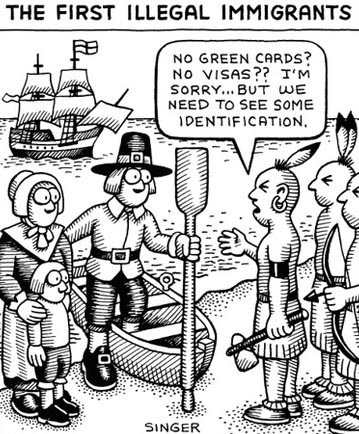
Comment:  Ignoring the fact that the Spanish came first, let's talk about our Anglo-American ancestors. In addition to being illegal immigrants, they were among the first welfare moochers. The colonists at Jamestown and Plymouth wouldn't have survived without the Indians' help. Only after receiving free handouts did the feeble Euro-babies manage to stand on their own feet.

We can sum up this conservative race-mongering and welfare-bashing pretty simply. The GOP's fundamental racial message in this year's election is: white male Christians built it, others tear it down. White male Christians are hard-working and self-reliant. Others are needy and greedy.

If you agree, vote for Romney, who's practically the epitome of Western civilization and its so-called Manifest Destiny to dominate and rule. You know, the basic belief that white = might = right. If you disagree, vote for Obama.

For more on conservative racism, see:

Republicans:  White people own America
Racists deny playing race card
White Americans fear a black president
Conservatives lie about welfare
Women and Indians as "welfare queens"
Republicans want to "Keep America America"

Tribes may buy Pe' Sla

Indians declare victory in their effort to buy the sacred Pe' Sla site:

Sioux Leaders of Pe’ Sla Land Movement in S.D. Announce Deal Between Tribes and Land Owner and Call for Unity Among Reservations; Celebration Rally Planned for Rapid CityLast Saturday, at a press conference in Eagle Butte, South Dakota, Lakota leaders of the movement to secure the Lakota pilgrimage site Pe’ Sla for the Sioux Nation announced that the tribes will purchase the 2000 acres of sacred land in the Black Hills. After several weeks of intense fundraising, the nine tribes raised enough to make a deal with the current owners of Pe’ Sla, Leonard and Margaret Reynolds—though details of the arrangement are still being negotiated. The fundraising effort on the part of the Sioux tribes was begun by Attorney Chase Iron Eyes, and the negotiations were carried out in part by Cheyenne River Tribal Councilwoman Robin Lebeau. Both leaders spoke on Saturday. Saturday’s action was organized by Last Real Indians and the Lakota People’s Law Project, two organizations operating in South Dakota that support the return of the Black Hills to the Sioux.Sioux are victorious in effort to restore Black Hills land to the tribes. Fund-raising continues

But a later article suggests the announcement may be premature:

Tribe pays on Black Hills land

But money doesn't necessarily mean sale, Rosebud Sioux say

By Steve Young
The Rosebud Sioux Tribe is making an earnest payment on land it considers sacred in the Black Hills, though tribal officials say that doesn’t mean a deal to buy it is imminent.

Alfred Walking Bull, a communications specialist for the tribe, said Tuesday that Rosebud has met the financial threshold to make an earnest payment on some or all of the 1,940 acres for sale two miles north of Deerfield Lake.

“A lot of people have taken this as a sign that the tribe is going to be able to buy the land,” Walking Bull said. “We don’t know that yet. It’s really too early to declare victory. We have met the conditions to be at the negotiating table. It would be premature to say the land is going to be ours.”

The owners of the ranchland known as Reynolds Prairie had planned to auction the property in five separate tracts Aug. 25 in Rapid City, but canceled the sale before it happened with no explanation. Leonard and Margaret Reynolds of Hill City would not comment about news of an earnest payment by Rosebud.
Comment:  For more on the subject, see Pe' Sla Auction Canceled.

Osoyoos Band's Nk'Mip Winery

Osoyoos Indian Band’s Nk’Mip Winery Rakes in Awards, Pulls in Busloads of Visitors

By Jack McNeelThe verdant, grapevine-swathed hills roll off into the distance, drawing the eye to a backdrop of purple mountains. The table is set under a sun-filled, cloudless blue sky, and the award-winning wine swishes into the glass. You might think you’re in Italy, or at the very least, California.

Improbably, it is in a region that does not leap to mind when one thinks of wine country, and the venue is even more of a surprise: You are on traditional First Nations territory, that of the Osoyoos Indian Band, to be exact, in what is today known as British Columbia, Canada.

Visitors—from canoodling couples to busloads carrying 60 or 70 people at a time—descend daily upon this, the first aboriginal-owned winery in Canada, daily. Tourists arrive in droves, and on a summer day 400–600 people may come wine tasting. They sip, they tour, they shop—the tasting room sells related items as well as wine—and they learn about the culture from the First Nations décor, photos and captions describing the history of the Osoyoos people as well as the Nk’Mip Cellars.

The winery will be one of the stops in the upcoming Fall Okanagan Wine Festival, from September 28 through October 7, and the band’s Nk’Mip Conference Centre will host a formal, “Hollywood style” dinner during the O! Osoyoos Celebrates! Festival from September 14 through 16.
Comment:  For more on Native wine-making, see Yocha Dehe Wine and Olive Oil.

September 02, 2012

Republicans:  White people own America

A roundup of postings about the Republican convention shows it's all about keeping white male Christians in power.

Republicans want to build a time machine

But don't be fooled: Republicans aren't just nostalgic for 1950s-style social barriers. They want to rebuild them

By Rebecca Traister
Republicans are panting for a tricked-out DeLorean that can take them back! Back in time! To a period when the power structure was fixed and comfortable, when there were no black first ladies or black camerawomen, when loud Jewish ladies were not in charge of national political parties, back to a time when only a select few—the white, the male, the straight, the Protestant—could reasonably expect to exert political or financial or social or sexual power.

The desire to chronologically reverse our nation’s history has been the undercurrent of the 2012 election cycle and its primary debates; it’s barely been disguised in the agenda of John Boehner’s House or in state legislatures around the country.

The mission to drastically curtail women’s reproductive rights, taking aim not just at abortion but at birth control; the blocking of the Paycheck Fairness Act; objections to expanding the Violence Against Women Act; crazed locutions about rape and sluts: In word and deed, conservatives have been telegraphing their hope to return us to a moment not just before Roe, but before the birth-control pill, before the sexual revolution, before second-wave feminism hammered pesky terms like “harassment” and “equal pay” into our lexicon, to a moment when women’s bodies and sexuality and identities were men’s to define, patrol and violate at will.

The state-by-state assault on voting rights, a dizzying array of propositions designed to keep brown and black people, poor people and young people from the polls? This too is an attempt to turn back time, to return the country to a moment before the Voting Rights Act of 1965 helped ensure safe enfranchisement for African-Americans.

For many months, we have been watching a lengthy, multi-tentacled attempt to shut tight doors that were opened by the social movements of the mid-20th century, to push back those who have apparently gotten their hands on a little too much power, by aiming back toward a time when men were white, women were long-suffering vessels, and black men were definitely not president.

But if time travel has been an understated drumbeat of the past two years of Republican machination, in Tampa, it was conveyed with all the subtlety of an AC/DC riff from Paul Ryan’s iPod.

First there was the swooning over the Greatest Generation, the fetishistic shout-outs to hard-laboring forebears, Welsh coal-mining grandfathers and Breyer’s Plant employee dads. Speakers were presenting us with visions of men who lived in an earlier America and the women who sacrificed their own passions (as Mitt Romney recalled of his mother, who gave up Hollywood) to marry them, move to Detroit and raise their babies while the men embraced success and made money.

None of the stories of ye olde American achievement actually jibed with the convention’s “We Built It” theme. The tales were of white men whose class mobility and moon-walks were boosted by G.I. Bills, state-school educations, government-funded space programs and unions. These guys and their unconditionally loving wives were part of a white American middle class that was able to expand thanks to the kinds of post-Depression financial regulations and government-goosed infrastructure and housing programs that modern Republicans are keen to obliterate.

But the incoherence of message didn’t matter, because what all these stories were really flicking at wasn’t the size of the government, but the whiteness and the maleness of those who were helped along with their businesses and wealth and broods of straight-parented families. Just listen to Romney’s assertions about this “nation of immigrants” who came here seeking freedom, a sentiment that is both disingenuous from someone who wants this nation’s current immigrant population to self-deport, and that does not even bother to acknowledge those Americans whose forebears were brought here against their will in an exercise of freedom’s opposite. Romney didn’t include those people because they don’t exist—in a meaningful, threatening way—in the America Romney and his party are trying to bring back.

The keening desire to be back there, to be back then, was responsible for the presence of Clint Eastwood, an actor who came to prominence as a star of the cowboy show “Rawhide,” which aired from 1959 to 1965. People may disagree about whether Eastwood’s vertiginously awful appearance at the RNC on Thursday was intentionally aggressive or just loopy, but there’s no question that his creepy intonation of the phrase “We own this country” came off like a segregationist-era, George Wallace-inspired catchphrase—one the crowd went wild for.
Stop talking about your grandpa!

Republicans like to talk about their "humble roots" in order to disguise their true upper-class ideology

By Andrew Burstein and Nancy Isenberg
Republicans hype the “Greatest Generation” when doing so fits their narrative that anyone who tries hard enough can make it in America. New Jersey Gov. Chris Christie, whose blowhard manner has made him the idol of the party, bellowed before the Tampa crowd that his father was part of the World War II generation, and that he is the beneficiary of his old man’s positive values. “He grew up in poverty,” Christie intoned. Paul Ryan and Rick Santorum similarly tout their humble connections in assuring voters that they come by their conservative values honestly.

This is the new Republican playbook. They are running away, as fast as they can, from the upper-class ideology to which they really subscribe. Romney “loves” his Costco shirts; and, his wife says, they began married life in a basement apartment with a “fold-down ironing board for a dining room table.” We are now supposed to believe that theirs is not the party of wealthy businessmen on one end of the scale, and on the other, angry, spellcheck-resistant Tea Party sign wavers who hate the deadbeats that are bilking the government out of hard-earned tax dollars. No, the new Republican Party is the party of self-made men with loving wives and mothers, “real Americans” who embrace educational opportunity and the American dream for all.

The “new” Republicans owe more than they will acknowledge to a federal government that dispensed a long list of subsidies from World War II forward. The GI Bill made higher education possible for millions, just as New Deal legislation before that helped secure federally backed loans for businesses and homeownership for the first time in our history. The growth of suburbia was financed by big government. Businessmen did not accomplish this change in class structure on their own. Not nearly. The federal government created the middle class of the 1950s. Surely, the Republicans can admit this much. But doing so is risky; it might lead them down the slippery slope from “Greed is good” to “Government is good.”
And:Labor Day should make us think more about class distinctions. Romney is a good husband, but it doesn’t diminish his life of privilege. Ann Romney is not a typical housewife either; her hobby is dressage, not knitting. Contrary to the Republicans’ wished-for America, it is not just the hardworking, honest American who gets ahead: so do mobsters and Hollywood blondes without talent, Enron executives, corporate raiders and members of the patrician class who never worked a day in their lives.

Let’s talk about labor in honest terms. Thomas Jefferson may have designed Monticello, but his slaves mixed the lime and baked the brick and erected the mansion. Slaves built much of early America, long-despised Irishmen dug the Erie Canal, and Chinese peasants were conscripted to lay railroad tracks all the livelong day. Businessmen need a vast array of workers to build any corporate enterprise; employers need employees. White-collar workers, manual laborers, electricians and carpenters make businesses run. Why must Republicans these days take such joy and displaced pride in suggesting that business leaders do it all, building the country brick by brick, by themselves, our precious job creators? A football team needs blockers as well as a quarterback.

Casablanca’s Rick is saying that the pursuit of wealth often gets in the way of virtue as well as justice. If you listen to Chris Christie, public school teachers aren’t accountable enough, and unions are a selfish perk for a coddled generation. Why does the same accountability not extend to big businessmen? No prosecutions on Wall Street? This is where the Republicans’ moralizing platform sinks in quicksand. One standard for ordinary folks, and another for the rich and powerful?

Mitt Romney doesn’t think he should be subject to the same accountability as others. He won’t provide tax returns so that citizens can judge the man and be certain that he puts his country before personal gain. Before the unpropertied were allowed to vote, Jefferson held that those who served in the militia and paid their taxes should be granted that right. It was the Dream Act prequel. The tough stand on undocumented workers taken by Romney and the Republicans reflects the “American value” that Spanish-speaking people can’t be trusted to … love America? Work hard? Pay their taxes? Whose American dream are we focused on?
The implications for Indians

Why don't Republicans say anything about the Indians killed and the Africans enslaved so their white ancestors could prosper? Because that would contradict their misleading message of self-reliance. A Native columnist hits the message home:

Deconstructing Chris Christie’s Speech at the GOP Convention

By Laura Waterman WittstockIndian viewers who tuned in and listened to New Jersey Governor Chris Christie give his keynote speech on August 28 at the 2012 Republican National Convention in Tampa, Florida, would have heard him tell stories of his immigrant family.

As he talked, it became clear this was a man who knew nothing about the country his family came to. To him, this was the land of the free where people of any class could walk out of their muddy fields and onto a boat and onto land they could take from others without recrimination. They simply took and closed the door behind them. And not all could come. Europeans kept out the Africans, the Asians, and Hispanics. These people were only accepted as slaves, servants, and laborers. In Christie’s generation, all he knew was that hard work brought reward.

The people in Christie’s family that inform his memories today knew only of Indians from what they might have read somewhere. Indians were distant, fading curiosities. There was never a tinge, a pinprick, a nudge, to tell them they had landed on what had been someone else’s land. It was after all “the land of the free.” All of the conspiratorial tales and songs and banners worked to erase the immigrant’s memories of the blood on their hands.

Christie said, “We are the great grandchildren of men and women who broke their backs in the name of American ingenuity; the grandchildren of the Greatest Generation; the sons and daughters of immigrants…” Christie said his parents were poor but worked hard. “….the brothers and sisters of everyday heroes; the neighbors of entrepreneurs and firefighters, teachers and farmers, veterans and factory workers and everyone in-between who shows up not just on the big days or the good days, but on the bad days and on the hard days.” This is an ideal population—free of crime, health needs, and old age that other communities encounter—the proverbial world where everyone is “above average.”
And:Christie should know about American Indian history and the land on which he lives. New Jersey has a Commission on American Indian Affairs. ... So why is Christie so ignorant of history and of the Indians who live in his own state? The answer seems to lie in the unwillingness of the Republican Party to pay the country’s debts to the Indian people. The Bureau of Indian Affairs, the Indian Health Service, and the specifics of categories of aid due to Indian people are not just niceties. They are part of agreements and understanding—land for services, set down in treaties.Wittstock's conclusion:A national Indian policy, if there is one to be stated under a Romney/Ryan administration, will cut into Indian funds as deeply as possible, no question about it.Comment:  Chris Christie said, "We are the great grandchildren of men and women who broke their backs in the name of American ingenuity; the grandchildren of the Greatest Generation; the sons and daughters of immigrants…." Note how he excludes the Indians, Latinos, and blacks who have been here much longer than our great-grandparents' generation. This is a dog-whistle to whites who think they've done most of the work while lazy minorities were lollygagging.

Clint Eastwood said, "We own this country." Whom do you think he was talking about? Who is this "we" who owns the country? And who are the ones who don't own the country? The answer to that question is obvious: the women, minorities, gays, and non-Christians who make up the Democratic Party.

Together, their message is that Americans are white. And the GOP is the party of white people. White Americans like them deserve to rule the country.

The Republican appeal to white Americans doesn't get much more blatant than this. Why else would Romney and Christie fail to mention blacks, Latinos, Asians, or Indians? Republicans don't consider minorities "real Americans" like them and their ancestors. Brown people merely reside in America; white people own it.

For more on conservative racism, see Racists Deny Playing Race Card and White Americans Fear a Black President.

Native culture prevents drug abuse

Following American Indian Culture Is Top Predictor of Anti-Drug BehaviorA new research paper gives credence to the many rehabilitation and mental health centers throughout Indian country that incorporate traditional culture as a means of reducing teenage drug and alcohol abuse or dependency.

Following traditional culture is the strongest predictor of anti-drug behavior among American Indian teens, according to social scientists at the Arizona State University School of Social and Family Dynamics who presented at the 107th Annual Meeting of the American Sociological Association (ASA), August 17-20 in Denver, Colorado, reported the ASA.

Engaging spirituality and religion is associated with lower levels of substance use, scientists observed in their study, “Spirituality and Religion: Intertwined Protective Factors for Substance Use Among Urban American Indian Youth,” which was recently published in The American Journal of Drug and Alcohol Abuse. For the study, scientists analyzed data from American Indian students enrolled in five urban middle schools all located within a large southwestern city in 2009. The average age of the 123 respondents was 12.6 years old.

“Most American Indians now live in cities rather than tribal communities. Our study is one of the few to address the role of spirituality and religion among urban Native youth, recognizing the unique histories of cultural integration that characterize today’s urban American Indian communities and the complex belief systems and practices that sustain them in the urban landscape,” said Stephen Kulis, the study’s principal investigator and ASU professor.
Comment:  For more on the subject, see "I Strengthen My Nation" Campaign and Racism Linked to Addictive Behavior.

September 01, 2012

Aaron on ending SCALPED

Jason Aaron on the End of Scalped, Comics’ Answer to Deadwood and The Wire

By Spencer AckermanWired: What made you want to tell the story of a Native American reservation—and particularly a Lakota Sioux reservation?

Aaron: It may have been that the Lakota were the tribe I knew the most about coming into the thing. I’ve always been fascinated with the history of the Plains Indians and the history of the American Indian Movement in the ’70s. Those were things I read about before I even had the idea of doing something like Scalped. The imagery of it, the history of it, it all seemed perfect for everything I wanted to do and it all clicked into place.

Wired: What was the research process for creating Prairie Rose?

Aaron: Just a lot of reading and talking to people. I’ve never been to Pine Ridge or Rosebud in South Dakota, which are obviously the reservations that inspired Prairie Rose. I have connections to people who do live on reservations. Like I said, it was something I had been fascinated by for a while. It wasn’t something I had to come to fresh and start reading about.

Once I had the idea for Scalped and continued reading and researching it, there were things that came out about it that I had no idea about before. The Shunka story [an account of Red Crow's underboss], where we find out he’s gay, part of that was the history of Two Spirits, this long history of gender and sex roles in Native American tribes, which was something I had no idea about before I started researching Scalped. I didn’t know that about Shunka when I started. That story, in another form, had been around for a long time and I almost did that story earlier in the run, but if I had done it then it would have been an entirely different story.

Wired: What feedback do you typically hear from Native Americans?

Aaron: I try not to let that influence my stories. That’s a dangerous rabbit hole to start going down—changing what you do in response to what you read on the internet. But the response has been overwhelmingly positive. Not everybody is a fan of the book, it’s not going to be to everybody’s taste—it’s a crime series where characters are morally ambiguous. I’ve never shied away from some things that are stereotypical, like having Indians who drink too much; the book has one of those. Certainly there are characters that are extremely violent. But I don’t think you can look at Scalped and say it’s a book that portrays Native Americans as savages.

Wired: Have you always known how the series would end?

Aaron: I didn’t know exactly when it would end, what issue we would end at. I knew pretty much exactly where the midpoint would be. Around issue No. 33, No. 34, we were halfway there. I had a huge document sketching out those first 30-something issues from the get-go. I put that together as I was working on the second arc.

Beyond that, yes, I knew what the ending point was, and how we would get there, although I didn’t always know how to get from No. 35 to No. 60. I knew where all the characters were heading. Now some of that changed a little bit. There are a couple of characters I realized I either didn’t want to die or wanted to die. A couple characters went in different directions than what I had envisioned. Certainly Red Crow’s ending changed. [His daughter] Carol gets an ending that people may be expecting now but back in that first trade paperback people probably didn’t expect. Dash’s ending has been the same the entire time, Dino’s ending has been the same the entire time, Catcher’s too. The main thrust of the ending has been clear before I put pen to paper on Issue 1.
Comment:  Glad to see Aaron finally admitted his book is stereotypical:I’ve never shied away from some things that are stereotypical, like having Indians who drink too much; the book has one of those. Certainly there are characters that are extremely violent. But I don’t think you can look at Scalped and say it’s a book that portrays Native Americans as savages.
Can't I? When the majority of characters are criminals, thugs, and lowlifes? Those are the modern-day equivalent of savages, so that's exactly what I say.

For more on SCALPED, see Aaron Looks Back at SCALPED and SCALPED to End in 2012.

Below:  Nice to see SCALPED ends with a cover that isn't as a stereotypical as the first cover was.

San Manuel builds Serrano village

BIG BEAR: Dedication for recreated Serrano village setIt takes a village to build a village and after a full weekend of work that began Aug. 25, members of the San Manuel Band of Mission Indians will join San Manuel Tribal Unity and Cultural Coordinator James Ramos and board members of the Big Bear Valley Historical Society to formally dedicate two new structures into a recreated Serrano Indian village set on the grounds of the Big Bear Museum in Big Bear.

The ramada, a cedar framed and willow thatched shade structure, and an acorn granary, weaved from the branches of the willow tree, join a previously constructed traditional Serrano Indian domed shaped home (kiiè) which has become an annual activity of the Yuhaaviatam Cultural Camp organized through the tribe’s Tribal Unity and Cultural Awareness Program.
Comment:  For more on San Manuel, see San Manuel Partners with Local Ballclub and San Manuel Buys Sacred Spring.

Below:  "Members of the San Manuel, Santa Rosa and Pechanga reservations build a cedar ramada. A ramada and an acorn granary are set to be dedicated at the Big Bear Museum on Sept. 3, 2012."