Showing posts with label intellectual property. Show all posts

September 19, 2012

Kilcher arrested at trade agreement protest

Actress Q’orianka Kilcher Arrested at Trade Agreement ProtestQ’orianka Kilcher, Quechua, famous for playing Pocahontas in The New World, was arrested on Thursday in Virginia for participating an a protest against the Trans Pacific Partnership.

Negotiations over the controversial trade agreement were taking place at a golf resort in Leesburg, Virginia; Kilcher was filming a protest occurring outside the hotel when she was handcuffed. Before her arrest, Kilcher made the following statement, according to a Rainforest Action Network release:

The Trans Pacific Partnership would be devastating for people around the world and it is being negotiated in complete secrecy to hide the content, because these agreements would never see the light of day if US citizens and congress were allowed to see what is being proposed in our names. While hundreds of corporate advisors have access to the information contained within these documents, the American public, the media and even members of congress do not. This sort of secrecy is highly undemocratic and is a complete disregard of all the systems of checks and balances established by the U.S. Constitution to avoid exactly this sort of thing.

The Trans Pacific Partnership has been criticized on a number of grounds; for one, the negotiations strike opponents are unusually secretive, as Kilcher’s statement indicates. The draft proposals are said to include excessive provisions for international enforcement of copyright and intellectual property law that would overrule established intellectual property practices. It has been suggested that this could have wide-ranging effects, including restricting the distribution of medicine and criminalizing such common pop-cultural practices as parody and cosplay. A group called StopTheTrap warns that fines and punishments could follow from internet use deemed illegal under the terms of the TPP.
Comment:  For more on Q'orianka Kilcher, see Charges Against Kilcher Dropped and Shouting Secrets Trailer.

November 04, 2011

Forever 21 continues "Navajo" products

Forever 21 Didn’t Get The Navajo Memo

By Jenna Sauers[F]ellow mass-market retailer Forever 21 doesn't seem to share Urban Outfitters' concern. While a search for "Navajo" on its website turns up no results, a little digging reveals at least a half-dozen items that have the Navajo trademark in the title. That includes the "Navajo & Lace Hipster"—that's right, not one but two international chains sold "Navajo" underwear for fall—the "Navajo Tunic" and the "Navajo Handbag" in the U.S. online store. (The tunic, along with a pair of "Navajo Drop Earrings," is currently out of stock, but you can see a Google cached page for now.)And:Although two of these items—the panties and the handbag—have product descriptions that call them "Navajo-inspired," they all have "Navajo" and not "Navajo-Inspired" in their names, and the rest of the descriptions use yet more specific language that arguably misuses the Navajo Nation's trademark. The necklace is said to be "Navajo beaded," and the tunic and the socks are said to have a "Navajo print." You'd obviously have to be fairly naïve—and unfamiliar with the retailer's reliance on California and foreign sweatshop labor—to believe that anything sold at Forever 21 was in fact made by Navajo people. And you'd have to be similarly naïve—and unfamiliar with the company's apparent distaste for paying licensing fees—to believe any of these "Navajo" products were authorized by the Navajo Nation under license to Forever 21. But the language used in the company's online catalogue is, at the very least, misleading. You can't call something "Navajo" when it's, well, just not. It's a trademark. And for Forever 21, that's a problem.Comment:  For more on the subject, see Forever 21's Stereotypical Necklaces and Forever 21's Columbus Day Sale.

October 19, 2011

Urban Outfitters renames "Navajo" products

So-Called Navajo Products Vanish from Urban Outfitters WebsiteBy Friday, the clamor seemed to have peaked, leaving us wondering “What’s Next for the Urban Outfitters Navajo Case?”

Nothing, it seemed. But today, a search on the Urban Outfitters site for “Navajo” returns no results.
And:The “Navajo Print Fabric Wrapped Flask” is now the “Printed Fabric Wrapped Flask.” The “Navajo Sock” is now the “Printed Sock.”

Same products, different names. For the Navajo, Sasha Houston Brown, and others who made their feelings known, the simple Printed Hipster Panty might also be called the Righteous Undergarment of Cultural Victory.

The war isn’t over (indeed, Sasha objected to the products themselves, not just their names), but a battle has been won.


Urban Outfitters pulls ‘Navajo’ name from products on website in wake of criticismUrban Outfitters last week told The Associated Press it had no plans to alter its products. The online name changes were first reported by Indian Country Today.

The Navajo Nation Department of Justice said Wednesday the changes were “positive” and “more consistent with the corporation’s responsibilities than previously demonstrated.”

“If the company has also ceased using the Navajo name in conjunction with its merchandise in its retail stores and print-media advertising, these are encouraging steps by the company towards amicably resolving this matter,” the department said in a release.

The tribe holds at least 10 trademarks on the Navajo name that cover clothing, footwear, online retail sales, household products and textiles, and said it was intent on protecting those trademarks.


But the war's not over yet:

Urban Outfitters still selling ‘Navajo’ clothing despite criticismCLOTHING CHAIN URBAN Outfitters is still selling ‘Navajo’ branded clothing in Europe, despite coming under fire from the Native American group over its use of their name.

Critics have said the line of Navajo clothing and accessories were disrespectful and offensive–and that Urban Outfitters are profiting inappropriately from the name of the tribe.

A Navajo-branded hip flask has been a particular target for anger, as the reservation has a serious problem with alcoholism. A line of women’s knickers has also been criticised as inappropriate for a Navajo culture which preaches modesty.

Urban Outfitters has removed the Navajo name from its US website, with the items in question now simply marked as “printed”. However, the name is still in use on its UK online store, which also services Ireland.
Comment:  Despite the UK website, this is an awesome victory. Once again, people power kicks the butt of a corporate giant.

For more on Urban Outfitters, see Jezebel Surveys "Navajo" Fashions and Why Protest Urban Outfitters?

October 17, 2011

Jezebel surveys "Navajo" fashions

Following on the heels of the Urban Outfitters controversy, the Jezebel blog looks at The Most WTF Navajo-Inspired Clothing And Accessories:Urban Outfitters may have been the recipient of a cease-and-desist letter from the Navajo Nation, which, as the holder of several trademarks on the word "Navajo," is seeking to stop the company from using "Navajo" in its product names and descriptions, but the current vogue for "Navajo"-inspired (and Native American-inspired in general) clothing, jewelry and accessories is hardly limited to one company. From the beautiful to the tacky to the downright disturbing, here's a survey of fashion's latest problematic ethnic "trend."Comment:  These are more like typical Navajo-inspired fashions than the worst.

For more on the subject, see Why Protest Urban Outfitters? and Media Covers Urban Outfitters Controversy.

October 14, 2011

Why protest Urban Outfitters?

In What’s Next for the Urban Outfitters Navajo Case? Adrienne Keene notes some defenders of the privileged status quo:Most of the media outlets covering the back-and-forth between the Navajo Nation and Urban Outfitters wonder if Navajo even has a case, and plenty of commenters dismiss the tribe and the concerns completely:

saeda: “I don’t think anyone assumes real natives made those panties.”

night crone: “Don’t you think bringing all the media attention to this, will only draw more people to Urban and sell more? Urban doesn’t care if anyone is offended, they just want to make money, and you’ve given them lots of free advertising.”

Merthyr Bong: “As a person of Scots ancestry I am offended by Scotch tape! How dare they! Using plaid even! Where can I get my money and 15 minutes of fame for being offended?”

Lynnie123: “What—no one else in the world could come up with those patterns? They’re probably angry because the Native Americans aren’t making money on the deal.”
Then she answers these critics:Jezebel posted a fabulous piece yesterday detailing the ins and outs of intellectual property law and fashion, tying in the Indian Arts and Crafts Act and other measures in place to protect Native artisans. They quote Susan Scadafi, a professor at Fordham Law, who says, of tribal trademark cases:

“It’s an issue when you have indigenous peoples…who have been subject to actual genocide, and then you come back around with what some people characterize as cultural genocide. The pillaging of land, the pillaging of personal property, followed by the pillaging of what could be considered intellectual property. It’s something that occurs against a background of a lot of other offensive actions.”

That, to me, is the root of it all. This goes far beyond an issue of trademarks or truth in advertising. This is also an issue of representation, and an issue of power. I, personally, don’t care about a pair of socks called “Navajo,” but I do care about what they represent. They represent the appropriation of Native American cultures and lifeways, and the continued stereotyping of Indigenous Peoples. Most consumers look at that sock and can’t imagine that it holds any meaning beyond its $4.99 price tag. But I, and other Native people, look at that sock and see that the painful history that has allowed the vast majority of Americans to ignore our continued existence.

These “Navajo” products, and the thousands like them found at shops all over the world, relegate Native peoples to a stereotype. We are nothing more than a one-dimensional fictitious “Native American culture” represented by southwestern designs, fringe, feathers, and buckskin; when in reality we are a diverse, vibrant population of over 565 tribes and communities, each with our own traditions, languages and cultures.
Comment:  You could apply these comments to almost any stereotype controversy. No one is claiming that any particular mascot or stereotype is going to kill anyone. But each instance is part of a 500-year pattern of destruction and demonization. They represent the Indians' loss of power, wealth, and status, as Americans continue to neglect and marginalize them.

If Indians could restore their power, wealth, and status with a magic wand, they would. Then they wouldn't have to fight individual cases of cultural theft and misrepresentation. Since they can't do that, what do you expect them to do? Sit back and enjoy being raped and exploited?

Until we eradicate racism and stereotyping with the equivalent of a nuclear bomb, all they can do is chip away at the problems one piece at a time. That's what they're doing with these cultural battles. Not trying to eliminate "Navajo" panties and sox--at least not primarily--because these items aren't that important. Rather, reminding people that they're still here and their beliefs and wishes matter. That the destruction and demonization must stop now, because Indians aren't going to let them continue.

For more on the subject, see Media Covers Urban Outfitters Controversy and Open Letter to Urban Outfitters.

October 12, 2011

Media covers Urban Outfitters controversy

With Sasha Houston Brown's open letter getting reposted widely, the Urban Outfitters controversy is taking off in the mainstream media. Here's a report on Time.com:

Urban Outfitters Taken to Task for Faux 'Navajo' Products

By Allison BerryThis season, tribal prints have been a major trend, showing up in numerous fall runway shows, such as Isabel Marant and Proenza Schouler. Naturally, the trend has trickled down to the fast-fashion chains as well. But the ready-to-wear designers who have jumped on the Native American bandwagon have, for the most part, tried to avoid specifically labeling their clothing or marketing their collections as “Navajo.”

A key issue is whether Urban Outfitters is describing the style of the product, or suggesting that it was actually made by Navajo artisans. Currently there are 23 products labeled as “Navajo” on the company's website, as well as 13 described as the more generic “tribal.” And the trend is not limited to Urban Outfitters: Forever 21 also has 6 “Navajo” products, and a whopping 113 that are “tribal.”

Urban Outfitters has not yet issued a public response to Brown's letter.
On ABC News:

Urban Outfitters Under Fire for 'Navajo' Collection

By Christina NgIn a statement to ABCNews.com, Urban Outfitters public relations director Ed Looram wrote: "The Native American-inspired trend and specifically the term 'Navajo' have been cycling thru fashion, fine art and design for the last few years. We currently have no plans to modify or discontinue any of these products."

Looram added that the company is dedicated to inspiring customers and interpreting trends.

Brown said that not only were the company's items offensive, but they may also be illegal.
video platformvideo managementvideo solutionsvideo player

On the popular Jezebel blog:

Urban Outfitters And The Navajo Nation:  What Does The Law Say?

By Jenna Sauers"The story with the Indian Arts And Crafts Act, though, is that it only protects, as you would expect from the title, 'arts' and 'crafts,'" says Scafidi. "So while there is general language [in the Act] about putting the term 'Indian' or 'Native American' or the name of a particular nation on any goods in a misleading fashion, that generalized language about 'any good' is narrowed by the description of 'arts and crafts' items in particular. Which is why things like the Jeep Grand Cherokee are not barred by the Indian Arts and Crafts Act, even though Cherokee is obviously a nation as well." A car isn't a piece of art, or a craft product.

And neither is a piece of clothing. Fashion is not considered an "art" (nor is a clothing design, under current law, copyrightable in the U.S.). And mass-produced items such as those Urban Outfitters sells are not really "crafts" either. In Scafidi's view, the fact that the Navajo Nation took the step of trademarking the name "Navajo" offers the tribe a much higher level of protection. That puts "Navajo" on the same footing as trademarks like "Chanel" or "Burberry." And the Navajo Nation has already warned Urban Outfitters to cease an desist from using the tribe's trademarks on its goods.

"There is a trademark on 'Navajo' for clothing," says Scafidi. "It mentions specifically jeans, and tops, and shirts, and sweatshirts," along with more general categories like "sportswear." Not all of the products that Urban Outfitters is selling under the name "Navajo" are enumerated in the trademark, "but you could imagine that other similar items could fall into the 'confusingly similar' category," meaning that they would also be protected from infringement. Of course, in court, "Urban Outfitters could come back and say, 'Well, if you wanted that trademark to cover panties, then you should have listed panties.'" It would be up to a judge to decide.
Plus some cultural context:

Urban Outfitters’ “Navajo Hipster Panty” Is Just the Tip of the Racial Iceberg

By Jim EdwardsFashion retailers have, historically, fumbled the ball when it comes to race, with companies frequently offending their own customers by presenting stereotypes and outright racism as if they were merely styles. It was only last year that Victoria’s Secret relegated its black models to a “tribal” skit complete with animal prints and a jungle motif.

And who could forget American Apparel’s (APP) “conical Asian hat”—i.e. a rice paddy coolie hat—which was withdrawn from sale following an outcry earlier this summer?
And:Back in 2003, Abercrombie & Fitch (ANF) published a catalog that featured 67 white models and not a single non-white model. It also sold T-shirts that said “Wong Brothers Laundry Service: Two Wongs Can Make It White,” and CEO Mike Jeffries told Wall Street analysts he was “delighted” to “exclude people” from his stores. An employee discrimination lawsuit followed and A&F ended up settling it for $40 million.Comment:  Once again we see the awesome power of protest. Adrienne Keene's initial posting and Sasha Brown's open letter have compelled the mainstream media to cover the issue. It's only a matter of time until Urban Outfitters caves in.

For more on the subject, see Forever 21's Columbus Day Sale and Neo-Navajo Fashion Trend.

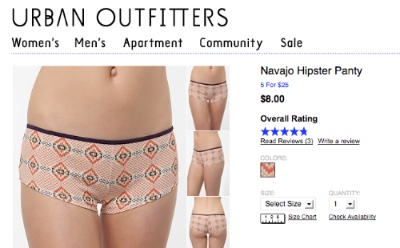
Below:  Images from Urban Outfitters.

October 10, 2011

Open letter to Urban Outfitters

We've read a lot about fashion companies (mis)appropriating Native designs recently. For instance, in Neo-Navajo Fashion Trend and Urban Outfitters' "Native" Products. But with this open letter, the issue may be ready to explode:

An Open Letter to Urban Outfitters on Columbus Day

By Sasha Houston BrownDear Glen T. Senk, CEO Urban Outfitters Inc.

This past weekend, I had the unfortunate experience of visiting a local Urban Outfitters store in Minneapolis. It appeared as though the recording “artist” Ke$ha had violently exploded in the store, leaving behind a cheap, vulgar and culturally offensive retail collection. Plastic dreamcatchers wrapped in pleather hung next to an indistinguishable mass of artificial feather jewelry and hyper sexualized clothing featuring an abundance of suede, fringe and inauthentic tribal patterns.

In all seriousness, as a Native American woman, I am deeply distressed by your company’s mass marketed collection of distasteful and racially demeaning apparel and décor. I take personal offense to the blatant racism and perverted cultural appropriation your store features this season as “fashion.”

All too often industries, sports teams and ignorant individuals legitimize racism under the guise of cultural “appreciation.” There is nothing honorable or historically appreciative in selling items such as the Navajo Print Fabric Wrapped Flask, Peace Treaty Feather Necklace, Staring at Stars Skull Native Headdress T-shirt or the Navajo Hipster Panty. These and the dozens of other tacky products you are currently selling referencing Native America make a mockery of our identity and unique cultures.

Your corporate website claims to “offer a lifestyle-specific shopping experience for the educated, urban-minded individual.” If this is the case, then clearly you have missed the mark on your target demographic. There is simply nothing educated about your collection, which on the contrary professes extreme ignorance and bigotry.

My primary concern with your company is the level on which you are engaging in cultural and religious appropriation. None of your products are actually made by Indigenous nations, nor were any Native peoples involved in the production or design process. On the contrary, you have created cheap knock-off trinkets made in factories overseas. Selling imported plastic and nylon dreamcatchers disrespects our history and undermines our sovereignty as Tribal Nations.

Did I mention that marketing inauthentic products using Native American tribal names is also illegal? The company’s actions violate the Federal Indian Arts and Crafts act of 1990 and the Federal Trade Commission Act. According to the Department of the Interior:

“The Indian Arts and Crafts Act of 1990 (P.L. 101-644) is a truth-in-advertising law that prohibits misrepresentation in marketing of Indian arts and crafts products within the United States. It is illegal to offer or display for sale, or sell any art or craft product in a manner that falsely suggests it is Indian produced, an Indian product, or the product of a particular Indian or Indian Tribe or Indian arts and crafts organization, resident within the United States. If a business violates the Act, it can face civil penalties or can be prosecuted and fined up to $1,000,000.”

I doubt that you consulted the Navajo Nation about using their tribal name on sophisticated items such as the “Navajo Hipster Panty.” In fact, I recently became aware that the Navajo Nation Attorney General sent your company a cease and desist letter regarding this very issue. I stand in solidarity with the Navajo Nation and ask that you not only cease and desist selling products falsely using the Navajo name, but that you also stop selling faux Indian apparel that objectifies all tribes.

Urban Outfitters Inc. has taken Indigenous life ways and artistic expressions and trivialized and sexualized them for the sake of corporate profit. It is this kind of behavior that perpetuates the stereotype of the white man’s Indian and allows for the ongoing commodification of an entire ethnic group. Just as our traditional homelands were stolen and expropriated without regard, so too has our very cultural identity. On this day that America still celebrates as Columbus Day, I ask that do what is morally right and apologize to Indigenous peoples of North America and withdraw this offensive line from retail stores.

Sincerely,

Sasha Houston Brown, Dakota
Santee Sioux Nation
Comment:  For more on the subject, see "Navajo Wolves" Spirit Hoods and "Cherokee Chic" = Generic Hippie Look.

September 25, 2011

Neo-Navajo fashion trend

Another article takes up the subject introduced by Adrienne Keene in Urban Outfitters' "Native" Products:

Neo-Navajo fashion:  Trend or tradition?

By Jaimee RoseAt Neiman Marcus, just racks away from Mary-Kate and Ashley Olsen's latest leather offering, there's a kicky cashmere shift dress--all geometry in deep red, black and cream--that looks exactly like the Navajo blanket on display in the Heard Museum (hand-loomed in 1880, just so you know).

At Forever 21 in Scottsdale, mannequins wear $8 feather necklaces while posed in positions not unlike a ceremonial dance--and the sign in the window says "Into the Wild." (Made in China, and you don't want to know.)

Diane von Furstenberg is on a $365 "Native Hound" print parade. September style magazines trumpet the look with multipage shopping guides headlined "Hail to the Chief." Teenagers are buying woolly shawls. Shawls!

From the omnivorous minds of fashion designers, who want us in soldier chic one minute and Bollywood brilliance the next, a communal word emerged as the Gospel of Fall: "neo-Navajo!" they declared, flinging Navajo iconography all across the mall.
Since Rose refers to the same Navajo Hipster Panties that caught my eye, I'm guessing she read Keene's blog entry.

"Navajo" represents all Indians?

Rose notes some problems with labeling everything "Navajo":We wonder what the people who write product descriptions for Intermix were thinking when they penned "The new Navajo: ethnic Aztec inspiration" (different country, different tribe).

We are not sure it was in the best taste for Urban Outfitters to offer a Navajo-inspired flask, because there's a history there. It's complicated.

And we are dying to hear from the Navajo people themselves--who would be well within their rights to have their Navajo hipster panties in a twist, considering the Telegraph newspaper in London told its readers to "channel your inner Pocahontas."

Pocahontas wasn't Navajo. She was from Virginia.
And:We did, however, receive an offer to publicize trendy labels with the following pitch from a fashion house in New York:

"Pay homage to our past while looking marvelously modern with Navajo-inspired styles from Chelsea Flower, Love Sam, DL1961 Premium Denim & Cult of Individuality . . . On-trend and simply chic--minus the Headdress. Pack the teepee (or the closet) with (items) that will be sure to become closet staples."

Teepee? Headdress?

Hail to the grief.
Comment:  I think Keene and Rose have the basic problem right. This "neo-Navajo trend" is an example of hipster racism. The thinking goes something like this:

"Let's steal appropriate Native designs and label them 'Navajo' or 'Cherokee' because those tribes are well-known. Let's market them as pan-Indian tribalism because that's less 'commercial' and more 'natural' and 'authentic.' There are no real Indians left and they were primitive savages anyway, so no one will object."

For more on "tribal" trendiness, see Luxury Tipis in Great Britain and TeePee Games Responds to Criticism.

Below:  "Navajo Print Fabric Wrapped Flask." So you can feel like an Indian when you get drunk.

September 24, 2011

Urban Outfitters' "Native" products

Adrienne Keene reviews the Urban Outfitters website in her Native Appropriations blog. She notes the plethora of products with "Navajo" names.

Urban Outfitters is Obsessed with NavajosSo what's inherently wrong with using Navajo in product names? And what can tribal nations do about it?

First of all, these products represent a stereotype of "southwest" Native cultures. The designs are loosely based on Navajo rug designs (maybe?) or Pendleton designs, but aren't representations that are chosen by the tribe or truly representative of Navajo culture. Associating a sovereign Nation of hundreds of thousands of people witl a flask or women's underwear isn't exactly honoring.

Additionally, it's more than likely that Urban chose "Navajo" for the international recognition--to most of the world Navajo (and Cherokee)= American Indian (my Jamaican friend didn't even know there were other tribes in the US until she met me). This conflation of Navajo with "generic Indian" contributes to the further erasure of the distinct tribes and cultures in the US and solidifies the idea that there is only one "Native" culture, represented by plains feathers and southwest designs.
And:A few months ago, they Navajo Nation Attorney General actually sent a cease and desist letter to Urban Outfitters, and there are some great quotes from the letter (I'll try and post it in full in another post):Your corporation’s use of Navajo will cause confusion in the market and society concerning the source or origin of your corporation’s products. Consumers will incorrectly believe that the Nation has licensed, approved, or authorized your corporation’s use of the Navajo name and trademarks for its products—when the Nation has not—or that your corporation’s use of Navajo is an extension of the Nation’s family of trademarks—which it is not. This is bound to cause confusion, mistake, or deception with respect to the source or origin of your goods. This undermines the character and uniqueness of the Nation’s long-standing distinctive Navajo name and trademarks, which—because of its false connection with the Nation—dilutes and tarnishes the name and trademarks. Accordingly, please immediately cease and desist using the Navajo name and trademark with your products.Comment:  The stereotype here is that some silly fashion products accurately represent the Navajo or any other Native culture. They don't.

For more on fashion appropriations, see "Native Wolves" Spirit Hoods and "Cherokee Chic" = Generic Hippie Look.

Below:  Navajo Hipster Panty.

July 22, 2011

Tulalip tribe protests Microsoft codename

More on the story begun in Microsoft Leaks "Tulalip" Search Tool:

Wash. tribe unhappy with Microsoft project nameWashington's Tulalip (too-LAY'-lihp) Tribes are unhappy that Microsoft has decided to use their name as the internal label for a new social media project.

Tribal officials are discussing the issue with company officials, and Microsoft Corp. said the name was never intended to leak outside the Redmond software company.

"Tulalip is an internal project code name for the online site Socl.com, which is an internal design project from one of Microsoft's research teams that was mistakenly published to the Web," a Microsoft spokesman said in an email to The Daily Herald. "We have no more information at this time."

Democratic state Rep. John McCoy, a Tulalip tribal member, heard that some Microsoft employees involved in the project live on or near the Tulalip reservation.

"By all accounts, it's an internal project at Microsoft and not a public thing. But in reality they should not have named it Tulalip," McCoy said. "I have no idea what our tribal officials plan to do, but technically these Microsoft employees infringed on the Tulalip name."
Commenters react

Some comments on this article show what the public thinks about Indians:The Velvet Glove

Oh please. Give me a break.

Grow some skin, Tulalip Indians.

What is with everybody walking around with huge chips on their shoulders these days?

Goforride

Is "Tulalip" copyrighted?

I suppose as a "sovereign nation" they wouldn't stoop to ask the US government for a copyright, which would imply the US is a higher power.

If these Microsofties called it "France," I guarantee the French ambassador would be giving interviews, saying how proud he was that Microsofties associated that name with the company's Next Big Thing.

Phil07

The Tulalip Tribes are profit orientated. If they get a small percentage and name rights fee they are happy.

Just open a Microsoft store on their retail land and use it for free.

hopemcp

Really? Really?!

Someone, anyone anywhere is spending any brain power to complain about this?

It's not going to be the product's consumer name, for pete's sake, so how about using the grey matter to worry about homelessness or some such thing.

And why in the world did this become a news story?
Rob replies

To answer some of these questions:

The tribe obviously reacted to the initial story, when it wasn't clear whether "Tulalip" was the proposed name for the service. Duh. When the situation became clear, the tribe reacted appropriately.

Most tribal names aren't copyrighted or trademarked, I think. But the Tulalip tribe says it has trademarked its name. That should've been enough to silence the critics.

The real issue is the principle of the thing. It would be wrong to call the service "Barack Obama" without permission whether his name is trademarked or not. Same thing with a tribe's name.

I wouldn't bet a nickel that France wouldn't protest the use of its name. Much less "guarantee" it. On the other hand, if Microsoft had named the service "IBM" or "Disney," I'd guarantee that these businesses would object. As a general rule, no one wants their name applied to products and services without permission.

You gotta love the whiff of racism in these comments. Indians are ignorant: They don't understand internal codenames. Indians are crybabies: The few minutes the spent addressing this issue was a waste of time. Indians are hypocrites: They'd love the codename if they were paid for it.

Corporations protest naming appropriations like this all the time. For instance, when a casino company opens a hotel or nightclub whose name is already used elsewhere. Will these commenters also speak up the next time one of these incidents occur?

No, because they're not supporting the right of businesses to appropriate names. They're supporting the right of anyone to appropriate Indian names. In other words, they're objecting to Indians alone trying to control their intellectual property. They're objecting because they're racists.

End of the story

Microsoft Appeases Tribe Over 'Tulalip' Code Name

By Peggy WattIf it's not enough that Microsoft had to scramble when a reference to its apparently semi-secret social networking project, Tulalip, slipped out, the software giant then had to deal with trademark concerns by the neighboring Tulalip tribe.

The 22,000-acre Tulalip (Tuh’-lay-lup) reservation is north of Microsoft's Redmond headquarters. The Tulalip Tribes operate a casino and resort, amphitheater, and outlets shopping center adjacent to Interstate 5. Apparently its name--and perhaps its success?--inspired the members of the Microsoft team who needed a code designation for their project.

The tribal council was not amused when Microsoft's project name leaked, and pointed out that the tribe's name is trademarked. Microsoft hastily contacted tribal officials, apparently convincing them that the term was intended for internal use only.

A statement by the Tulalip tribe's board of directors sent to local newspaper The Herald acknowledged the communication, stating, "We accept Microsoft's explanation that this was an internal code name that was never intended to be used publicly. We appreciate Microsoft's swift corrective action, and we consider this matter resolved. We have a good relationship with Microsoft and expect that relationship to continue."
Comment:  I'd love to hear what the commenters would say if Tulalip decided to name a nightclub "Microsoft." If Microsoft objected, would they dismiss its objections as a whining waste of time?

I'm guessing not. In fact, I bet they'd blame the tribe for being greedy and insensitive. The common denominator would be "Indians bad"--in other words, racism.

For more on Native intellectual property, see Are Native-Inspired Fashions Okay? and Sweat Lodge Trial Begins.
July 15, 2011

Microsoft leaks "Tulalip" search tool

Microsoft planning social search tool called Tulalip?

By Laura O'BrienMicrosoft accidentally published a website called Tulalip online, suggesting it may be planning a social search service.

Fusible found out that Microsoft owned the domain socl.com, which revealed an non-operational landing page describing what appeared to be a social search tool.

“With Tulalip you can Find what you need and Share what you know easier than ever”, read the homepage. The name Tulalip derives from a Native American tribe located near where Microsoft is headquartered.


Microsoft briefly leaks social search tool Tulalip on Socl.comMicrosoft published prototype designs of a new social search engine called Tulalip to the URL Socl.com Thursday, but then quickly took down the website, putting an apology in its place.

"Thanks for stopping by," the replacement message at Socl.com said on Friday. "Socl.com is an internal design project from a team in Microsoft Research which was mistakenly published to the web. We didn't mean to, honest."

The brief posting of Tulalip on Thursday was found by a blogger identified only as J.B., who wrote about it on the website domain news site Fusible.com.
Comment:  This probably won't stand, but if it did...wow. This could be one of the biggest cases of cultural (mis)appropriation ever.

Did Microsoft ask the tribe's permission to use its name? Was it planning to pay royalties? I'm guessing no and no.

I can just imagine the white arrogance and privilege at work here. The thinking may have gone something like this:

EXEC #1:  Hey, let's name the search engine after the Tulalip Tribe. It'll be an honor for them.

EXEC #2:  What if they object?

EXEC #1:  I don't think there are any of them left. If there are, they're too busy drinking firewater and fleecing palefaces at their casino.

EXEC #2:  You're probably right. Besides, they'll never notice.

EXEC #1:  Exactly. Indians don't use computers. [Folds arms across chest to imitate chief.] "Me no like'um talking box. Me afraid it will steal'um soul."

For more on Tulalip, see Teenage Tulalip Filmmaker Wins Award and Tulalip Reads for Unity.

March 18, 2011

Are Native-inspired fashions okay?

Culture Clash:  Native-made vs. Native-inspired

By Lisa CharleyboyThere’s a buzz in the air these days about cultural appropriation, especially given the recent fashion trend toward all things Navajo. I think we’re seeing the strongest mainstream trend toward Native-inspired fashion since the ‘70s, when hippies embraced turquoise, headbands and (of course) Navajo patterns. Then, as now, it’s hard to know exactly what non-Natives are getting out of these fashions. Do they desire authentic spiritual engagement—or do they just think feathers and leather look cool?

I hear from many people in our community who don’t believe that anyone should be inspired by Native American culture for the purposes of fashion, but I disagree. First, I don’t think we ought to be militant about what is, after all, merely clothing. (If we’re talking about misuse of sacred symbols and artifacts, that’s different.) The beauty of our rich cultures cannot be expressed in just one way. Additionally, I think that the great interest in all things Native provides significant opportunities for our artists to appeal to a broader audience, which can ultimately lead to economic profitability and sustainability.
Comment:  I think most of the complaints are about 1) misuse of sacred symbols and artifacts, which Charlyboy admits is wrong. 2) stereotypical elements such as beads and fringe, especially when designers lump all Native cultures into one. And perhaps 3) profiting from Native people without acknowledging the source. I don't think many Natives are complaining about cultural appropriation if it's not sacred, not stereotypical, and not a ripoff.

For more on the subject, see Ashton Kutcher Goes Native, Fashion Line with a Native Touch, and Pendleton Spreads Native Designs.

Below:  "The Geometric Shield Ring by Fortune Favors the Brave is Native-inspired; the Sunburst ring by Maria Samora is Native-made. Can't we all just get along?"

March 02, 2011

Sweat lodge trial begins

New Age guru James Ray was in the news from October 2009 to February 2010 for the deaths he caused in a Sedona sweat lodge. Now his manslaughter trial for those deaths has begun.

The trial doesn't exactly qualify as Native news, but Indians are still upset over Ray's appropriation of their culture. Some tidbits from a major article summarizing the situation:

Sweat lodge trial fuels Native American frustrations

By Jessica RavitzProsecutors say the deaths resulted from Ray's recklessness, an overheated lodge and because he encouraged people to stay inside when they weren't feeling well. His defense team denies those allegations, and attorney Luis Li has called what transpired "a terrible accident, not a crime."

Accidents, in fact, have happened even in ceremonies overseen by tribes. The Seattle Times reported a year ago the death of a 29-year-old Puyallup tribe member in a Swinomish smokehouse ceremony on a reservation near La Conner, Washington. The cause of death, overheating, was ruled accidental by a county medical examiner, the paper reported. And no criminal charges were filed in that case because it was an accident, says Alix Foster, an attorney for the Swinomish Indian Tribal Community.

The Ray case highlights an outrage that's long existed for many Native Americans. They are tired of their traditions being co-opted by others and exploited for capital gain. They resent that a ceremony they view as sacred is now being tied to terms like "death trap." They don't want their ancient ways to be deemed fashionable or inspire impersonators.
And:After the disaster and criminal charges, representatives of various tribal nations stepped into the legal fray, filing a federal lawsuit last March against Ray and those who run the Angel Valley Retreat Center, where he had leased land for his program.

The plaintiffs, on behalf of their tribes, sought to end the "abuse and misuse" of their ceremonies and hoped to convince the court that their rituals were their property and should be protected under the federal Indian Arts and Crafts Act. Just as a merchant can't claim earrings were made by Native Americans if they weren't, their ceremonies shouldn't be falsely advertised either, they argued.

That suit was dismissed in October. The court held that "the operation of a sweat lodge is plainly not art, craftwork or a handcraft." Services can't be protected like goods, the court ruled.

Amayra Hamilton, along with her husband, Michael, owns the Angel Valley Retreat Center, where the lodge was located. Their business has suffered greatly since the sweat lodge incident. The couple, in fact, has filed a business claim tort suit against Ray for running his retreat, on their property, in what their attorney Kelley Ruda calls "a ridiculous manner."
I knew the Lakota lawsuit wouldn't go anywhere. And for facilitating Ray's nonsense, the Hamiltons deserve what they got.

More thoughtsAutumn Two Bulls, 29, also lives on Pine Ridge, and just thinking about the dream catchers that hang in trendy gift shops, the non-Native Americans who make money off her people's artifacts, makes her cry "rape."

"Haven't native people been through enough?" says Two Bulls, a writer who created Reservation H.E.L.P. (Helping Every Lakota Person), an organization to help impoverished families.

"It's a fad to be Indian today. … They envision us like a fantasy culture," but the harsh reality is one they helped create and won't face, she suggests.

She says this from her reservation, where there's 80 percent unemployment, suicide rates are reportedly 300 percent higher than the national average and alcoholism ravages her community. Two Bulls says she was 18 when her mother died in her arms from cirrhosis.
Journalist Valerie Taliman offered her thoughts:Ray is a symbol, the latest and most horrifying example of what this trend purports, she says by phone. And the double standard in how he's been treated is glaring, she says.

"If an Indian man, a traditional person, killed people in a sweat lodge, he'd be in jail," she says, not free on bond. "And if I went out, and I impersonated a Catholic priest, and charged people to attend ceremonies, they'd arrest me."
Surprisingly, a Native built Ray's sweat lodge:Singing Bear is a 60-year-old Eastern Band Cherokee who calls himself a wisdom keeper, ceremonial leader and healer. He says he spent 20 years learning from tribal elders on reservations across North America.

So when he was asked to design a sweat lodge outside Sedona, where he lives, it mattered to him that it was done right. He says he selected the blankets and canvas covering that would breathe and offered the space traditional blessings and prayers, at no charge. And he says he worried when he heard how large they said Ray wanted it to be.

He says he told higher-ups at Angel Valley that what Ray wanted was too big and that only trained facilitators should lead ceremonies.
Comment:  Singing Bear could've said no to completing the sweat lodge if he thought it was dangerous. But I guess it's hard to turn down a job over a hypothetical outcome.

Incidentally, Autumn Two Bulls is one of the Indians Dominique Vantell Lonehunt attacked. I'd say she's doing a lot more to help Indians than he is.

For more on the subject, see New Book on Sweat Lodge Killer and Sweat Lodge Deaths on Dateline.

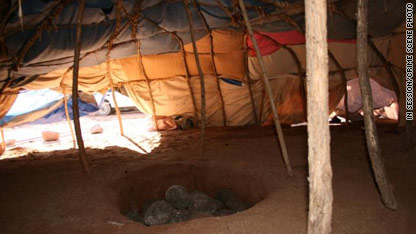
Below:  "James Arthur Ray’s sweat lodge ceremony in this structure left three dead and became a crime scene."

February 15, 2011

Miley Cyrus loves dreamcatchers

Adrienne Keene writes about Miley Cyrus in her Native Appropriations blog:

Miley Cyrus Enjoys Dream Catchers, Apparently

Miss Miley Cyrus was recently inked with her fifth tattoo, a dream catcher along her ribcage. It's supposedly to protect her four siblings, or something like that. Honestly, dream catchers are probably one of the most appropriated and exploited Native images--you see them everywhere. So I'm not supremely bothered by the tattoo, but it is annoying. However, everyone's favorite Disney starlet recently turned 18, and her 18th birthday was a "bohemian theme." Apparently, "bohemian"=dream catchers and feathers.The problem is, in many Ojibwe communities, dream catchers are still a sacred, and their creation involves specific ceremonies and prayers. The plastic commercial keychains sold in rest stops are making a mockery of a sacred object. When people buy the dream catchers because they're "pretty" or to ward off bad dreams, and aren't aware of the power and history behind the objects, it dilutes them to a commercial object disconnected from their origins and community.Commenters disagree

The blog's commenters disagree about whether Cyrus's actions are okay:I think its a cool idea and I'm glad Ms Cyrus celebrated her life with the dream catcher theme. I've seen it at weddings and casinos so what's the difference? Seems like she has an understanding of it and promoted the idea. The cake is awesome too.And:People who aren't native aren't going to understand the implications and hurt that goes along with this. The cake is stupid, her outfit is stupid and her tattoo is stupid. She doesn't know what any of it means, because if she did she'd never have done it. It's not okay, it's never okay. It's like me tattooing a naked picture of your grandmother who died of cancer on my breast and then taking her dead skin and putting it on a cake. Yes. It's that extreme. It doesn't matter if non-natives think its okay, it's not their culture and not their place to okay it. Deal with it.And:Not to defend Miss Cyrus, but a lot of people are proud to be part Native, and don't know how to appropriately express that. I totally understand that it can be offensive at times, but I think that people don't mean to be disrespectful and are actually trying to honor that heritage in a misguided way.Meanwhile, here's a guide to truly awful dreamcatchers:

The "Awful" Field Guide to Dreamcatchers


Comment:  Miley Cyrus has a whole wannabe thing going on. As you may recall, she also loves Pocahontas.

As usual, I tend to agree with Adrienne. It's too late to stop the exploitation of dreamcatchers. But if you have to have a dreamcatcher, get a genuine one from a Native and understand what it means. Don't just use it as a cake decoration or a tattoo because you think it's pretty.

For more on dreamcatchers, see Dreamcatchers Loser Cultural Significance and Dreamcatcher = Healing at Stanford.

February 14, 2011

Fashion line with a Native touch

A look at a fashion line by designer Adam Lippes:

ADAM Fall 2011:  Native American Inspired

By Natalie Matthews[H]is inspiration was a recent trip to the National Museum of the American Indian. But sticking to the recipe, Lippes added just the right dash of native, not a dousing.

Heaviest references came in the outerwear (wool ponchos and anoraks) and skirts (striped in alternating bands of fur and feathers). But when coupled with his easily sellable separates (hand knit sweaters, wide leg pants, and of-the-moment chambray shirts), these pieces weaved a thread of Native American through the collection without snagging it on a creative vision too niche for his laid back, real girl customer. In that way, Lippes managed to pay homage to the Native American culture–while still remaining true to his tribe of customers.
Comment:  These clothes have subtle Native references, all right. If writer Matthews hadn't pointed them out, I probably wouldn't have noticed them.

This is the kind of cultural appropriation most people don't have a problem with. It's clearly more of an homage than a direct steal.

But Lippes and Matthews still contribute to the stereotypical notion that there's only one Native culture. Ponchos and anoraks? From two unrelated cultures (Inca and Inuit) some 15,000 miles apart?

That would be like combining Iceland and India. After all, they both speak an Indo-European language and have Aryan roots. That means they're basically the same thing, right?

For more on the subject, see Pendleton Spreads Native Designs.

February 03, 2011

Pendleton spreads Native designs

Adrienne Keene talks about the cultural appropriation of Pendleton blankets in her Native Appropriations blog:

Let's Talk About Pendleton[R]ecently, Pendleton prints and fabrics have started popping up everywhere. It started with Opening Ceremony's Pendleton line in 2010, and now Urban Outfitters has started carrying a Pendelton line, celebrities are wearing Pendleton coats, and Native-themed home decor is apparently all the rage. Now Pendleton has announced their newest collaboration, The Portland Collection, which fashion blogs are proclaiming will be the big thing for 2011.She has mixed feelings about this trend, noting Pendleton's long association with Natives:It's almost a symbiotic relationship--they saw a market in Native communities, and Native communities stepped up and bought, traded, and sold the blankets, incorporating them into "traditional" cultural activities. Pendleton has also maintained close ties with Native communities and causes, making commemorative blankets for organizations like the National Museum of the American Indian and the National Indian Education Association. They work with Native artists to design the special edition blankets, and even donate some of the proceeds to the causes.

But then, on the other hand, they go off and do things like design a $5000 blanket with White Buffalo hair, which many tribes consider extremely sacred and definitely off-limits to commercial sale.

I do appreciate Pendleton's relationship with Native communities. I love my blankets, and love even more what they represent.

However, seeing hipsters march down the street in Pendleton clothes, seeing these bloggers ooh and ahh over how "cute" these designs are, and seeing non-Native models all wrapped up in Pendleton blankets makes me upset. It's a complicated feeling, because I feel ownership over these designs as a Native person, but on a rational level I realize that they aren't necessarily ours to claim.
Comment:  Given the key facts:

1) Pendleton's designs are based on Native colors and patterns. I don't think they've appropriated any special symbols or designs. (Only the white-buffalo blankets seem questionable.)

2) Pendleton has been making blankets for a century with the wholehearted support of Indians. I don't think anyone has seriously argued that these blankets are cultural theft.

I'd say the Pendleton blankets and the hipster fashions are okay. They fall into an acceptable category of cultural appropriation--same as my "Fighting Terrorism Since 1492" t-shirt.

For more on Pendleton, see Premo Designs Commemorative Blanket and A Century of Pendleton Blankets.

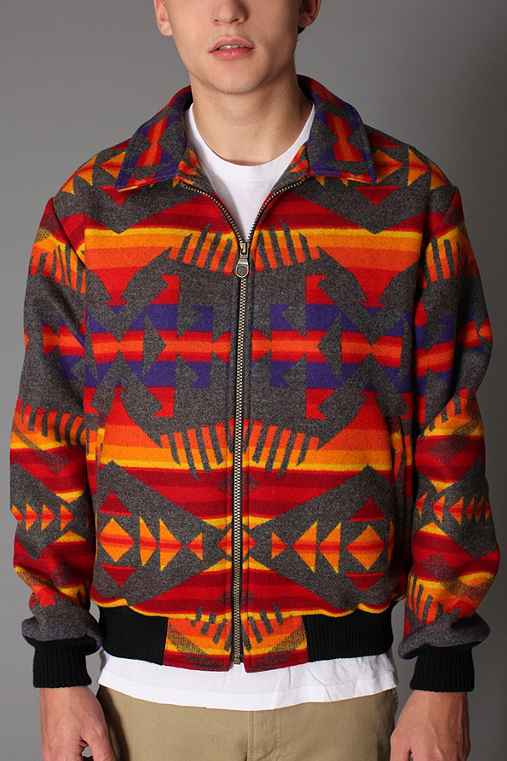
Below:  A Pendleton Santa Fe Jacket from Urban Outfitters.

December 16, 2010

Maori tribe wants Haka back

Is the All Blacks’ Haka Dance On Its Way Out?

By Lucy CraymerSince 1905, the All Blacks, New Zealand’s rugby team, has performed a tribal war dance before the start of every international match. But their chanting days may be numbered.

The ancestors of the ancient Maori tribe that created the specific dance the team uses—the Ka Mate Haka, or “Tis Death, Tis Death”—want it back.

In the rousing dance, the entire team of 15 players line up on the pitch opposite their rivals and act out a ritual that was once used by fierce Maori tribesmen to celebrate their survival in battle. Other New Zealand sports teams, including the Olympic swimmers, have been known to perform a tribal dance as well (when someone wins a gold medal).

The Ngati Toa tribe, which hails from the southern tip of New Zealand’s North Island, is locked in talks with the New Zealand Rugby Union, the sport’s governing body. The tribe is trying to trademark phrases that form part of the song that the rugby players chant when performing the dance, known as the Haka. If the tribe is successful, the Haka as it is known today could disappear from the warm-up of New Zealand’s famous rugby team for the first time in more than a century.
Comment:  As I said before, this is good example of stereotyping indigenous people as savage warriors.

For more on the subject, see Savage Maori in The Wives of Henry Oades and Maori War Chant in Invictus.

December 08, 2010

Saginaw Chippewa to patent logo?

Tribe begins process to protect logo

By Patricia EckerThe Saginaw Chippewa Indian Tribe took steps to protect their Tribal logo as early as 1982, but it has recently become a priority for sitting Tribal Council to move toward "protection" of the Tribal symbol.

The process has begun to patent the Tribal logo and the tag line, "Working Together For Our Future."

"Tribal Council asked PR (public relations) to work with the administration to build a policy of appropriateness (for use of the Tribal logo)," said Frank Cloutier, public relations director for the Tribe. "Two council's ago, a graphic standard of appropriateness was created (for the Tribal logo).
Comment:  I didn't know you could patent a logo. I would've thought a trademark was the right protection.

For more on the subject, see (Mis)Using the Zia Symbol and Who Owns Native Culture?

August 27, 2010

FSU Seminoles blast high-school Seminoles

FSU should lighten up over Southeast logo useHow does any high school “cease and desist” on a cherished tradition? For generations, the Southeast High School Seminoles have charged the gridiron, stalked the basketball court and cheered the sidelines under proud banners displaying a distinctive spear and Indian head.

But now Florida State University accuses Southeast of breaking trademark law and demands the high school quit using the Seminole name, logos, slogans and mascot. How does Southeast diminish FSU’s identity over those marks, as the university’s representative claims?
And:Legendary FSU football coach Bobby Bowden has visited the Southeast campus numerous times recruiting such players as the great Peter Warrick. Other university officials have known about Southeast’s logo for decades, too. Doesn’t that long-standing knowledge constitute tacit approval?

And what does the Seminole Tribe think about all this? The Indian nation played a major role in the development of FSU’s logos, and should have some influence in this legal controversy.

The Collegiate Licensing Company represents FSU in this, led by associate general counsel Jim Aronowitz. In his letter to Southeast demanding the school cleanse all logos and marks from stationary, uniforms, scoreboards and the gym floor, Aronowitz claims the high school is interfering with the university’s “ability to effectively market and license the use” of those logos.

This is all about money. Shameful.
Comment:  So one group of fake Seminoles is protesting another group of fake Seminoles? Nice.

It's one thing to to use exact duplicates of FSU's logos, slogans, and mascots. That sounds like a trademark violation, all right. The Southeast High School Seminoles should come up with their own logos, slogans, and mascots.

The name seems like a different matter to me. I don't think a non-Indian institution should be able to trademark "Seminoles" any more than it could trademark "Americans." The various Seminole tribes should have control over their own name.

If a non-Indian institution can trademark a tribe's name, then what? If the Seminole Tribe opened a "Seminole" restaurant and FSU already had one, could FSU challenge the tribe's use of its own name? Could FSU sell or license its Seminoles name to a biker club, a porn shop, or an anti-casino group? If these things are legal, they shouldn't be.

Obviously, I'd prefer it if the local Seminole tribe decided who could or couldn't use its name. If it wanted to grant the right to the high school, I'd say tough tootsies to FSU. Either accept the high school's name, which won't harm your business, or find yourself another name.

For more on the subject, see Seminole Jerseys Honor Nike and Why FSU's Seminoles Aren't Okay.

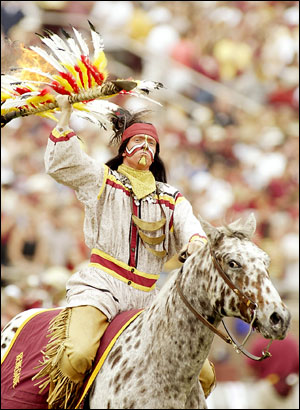
Below:  "Chief Osceola" mascot imitates a "savage" Plains Indian with horse, spear, and warpaint. Yeah, we wouldn't a high school imitating this mascot. That would perpetuate some stupid stereotypes. Those are FSU's stupid stereotypes, not the high school's!