October 25, 2012

Wolf Pack sequel to Twilight?

‘Twilight’ Could Live On, in Wolfpack-Focused SequelsOn November 16, The Twilight Saga: Breaking Dawn—Part 2 will hit theaters, and with it the final chapter in the Twilight series of movies will unfold.

Right?

Maybe not. According to a report at MovieHole.net, Lionsgate and Summit Entertainment, Twilight‘s production companies, are looking to extend the Twilight story beyond the original four books written by Stephenie Meyer.

MovieHole’s Clint Morris cited an unidentified source who said that the studio was looking at a variety of options: a “TV show or film spin-off, merely set in the same world as the one in the movies but not featuring the main trio, is being seriously considered.” The source added that the werewolves of the Quileute Tribe, known as “the Wolfpack,” are “one area of interest.”

Aside from the fact that the upcoming Twilight Saga: Breaking Dawn—Part 2 will complete the story as told in the books, there would be another, more-relevant challenge to continuing the main Twilight storyline: Getting all the film’s big stars together again. So zooming in on just one part of the story makes sense. Whether a Wolfpack-focused movie or TV show would include Taylor Lautner among the Wolfpack of the Quileute rez (played on screen by Native actors Chaske Spencer, Kiowa Gordon, Alex Meraz and Bronson Pelletier) would remain to be seen.
Comment:  If they do a WolfPack movie or TV show, how much do you wanna bet that they recast the parts with hot young non-Native actors?

For more on Twilight, see Beach Calls Out Wannabe Actors and No Indians in Breaking Dawn Posters.

October 24, 2012

Research proves mascots are harmful

The University of North Dakota's Fighting Sioux mascot is almost dead and gone. But in a two-part posting, Adrienne Keene offers a good summary of the arguments against Indian mascots. Note that these arguments apply not only to mascots but to Halloween costumes, hipsters in headdresses, and related stereotypes:

The Fighting Sioux are back: My passionate plea against Indian mascotsBut mascots are HONORING the bravery and fierceness of Indians!
No. They're not. Honoring someone does not consist of taking their culture, reducing it to a one-dimensional racist stereotype, and representing them however you see fit. It's about power and who has the right to represent whom. Also, this cartoon helps. I don't consider a dude in warpaint and feathers making a mockery of my culture honoring. At all. Also, not all Indians are "fierce" and "brave," just like not all white (or Black or Latino) people are "<insert stereotype here>".
I'm Irish (Norwegian, Catholic) and don't get offended by the Fighting Irish (Vikings, Padres)!
That's because there is not an active system of colonialism and oppression marginalizing the Irish, "Vikings," or Catholics in our country. Native peoples are still living under colonial rule--take a look at stats from any area of society, and you'll see Native people at the bottom. I'm sorry if you feel "oppressed" as a catholic or a viking--but you still have a helluva lot of white privilege that kinda negates it. Sorry.

What's next, animal rights activists telling us we can't use ANIMALS as mascots?! Where does it end?!
Yeah, cause Native people (PEOPLE) are on the same level as animals? Thanks buddy. Thanks a lot.

What about the Wizards? Pirates? Cowboys?
Um, mythical beings or occupations are not the same as an entire race of people.
Fighting Sioux Part 2: The ScienceCollege students were shown images of Chief Wahoo ("bad image"), Chief Illiniwek, and the Haskell Indian Nations University Indian ("good" images), as well as an image from AIGC's campaign (an actual good image), and then asked to generate "possible selves"--looking forward to the future and how they see themselves. Those primed with the mascot images (even the good ones), generated far less achievement-related possible selves than those with the control or AIGC image. Basically, looking at a mascot limits the way Native students see themselves succeeding.

...and a horrible follow-up, Fryburg did another study that compared white students, and in all the areas where Native students' self esteem, community worth, and possible selves went down, white students went up. No active oppression in American society, right? White students directly benefit from racism against Native students.

In sum: Scientific research shows that mascots and Indian stereotypes, regardless of if they are "good" images (Pocahontas, The Fighting Sioux) or "bad" images (Chief Wahoo), they cause depressed self esteem, decreased community worth, and decreased possible selves--even when students say the images don't bother them. And images are worse than words.

So still want to tell me how the Fighting Sioux are no big deal and I should get over it?
More arguments against mascots

The Native American Mascot: Tribute or Stereotype?

By Sam SommersIn follow-up studies, the same researchers again presented high school respondents with various passages and images related to Native Americans. After reading about mascots (and seeing Chief Wahoo), Native American respondents scored lower on an individual self-esteem questionnaire, as well as a measure of their sense of community worth (i.e., feelings of respect and a sense of value towards Native Americans). In fact, scores for self- and community-worth were even lower among students who had seen Chief Wahoo than they were among those who read about the common depiction of Native American communities as suffering from high rates of alcoholism, suicide, and teen pregnancy.

Perhaps most problematically, in a final study a variety of Native American mascots were shown to different groups of college student respondents. Afterward, students were asked to write about what their life would be like in one year. Those Native American students exposed to mascots were significantly less likely to use achievement-related language in anticipating their future than were students in a control condition. That is, having seen and read about mascots, Native Americans became less likely to make achievement-related predictions for themselves regarding good grades, graduating, finding a job, etc.

The data from these studies are consistent with the idea that these mascots are often viewed positively, even by members of Native American communities. At the same time, they are also consistent with the conclusion that there are negative psychological consequences to such mascots, even if those who experience these consequences can't or won't articulate them when asked.

(And, of course, there are yet other questions to be asked about the effects of such mascots. For example, to what extent do they attenuate versus exaggerate racial stereotypes held by White people? In a separate investigation published in 2011, a different set of researchers concluded that Native American mascots activated negative, but not positive, stereotypes among Whites.)

In the end, these data pose a problem for claims that these mascots are honorific and likely to enhance the self-esteem of Native Americans. Even when that is (or has recently become) the motivation behind a team name, such good intent is not sufficient to bring about good outcomes. As the authors of the paper described above explain, "American Indian mascots do not have negative consequences because their content or meaning is inherently negative. Rather... [the mascots] remind American Indians of the limited ways in which others see them."
Marketing the Native American Stereotype

By Rhonda LeValdoThe sole argument proponents have is that these mascots honor us by keeping our history alive. We cannot have such low standards for educating our youth. Right now, could any student name five tribes? Name the President that killed the most Native Americans in the largest mass hanging in this country’s history? Or name one boarding school? Native mascots don’t teach that history, so let’s stop using that argument. If there is such a burning desire to honorably keep Native history alive, invite a Native into your classroom to share that history.And:There are some people who do not find mascots and other Native stereotypes in media interesting or important, but Native American children have been increasingly learning about themselves from outside their own families and clans. Well over half of the enrolled tribal population lives in cities, away from reservation homelands. These children, all our children, grow up having to deal with the stereotypes thrown at them--not simply from commercial sources, but social ones. We cannot expect a Native child to deal with questions, taunts, insults, and slurs, not just from educated adults, but their own peers. Yet this is the situation our children are faced with. For generations, Native children have stood alone, with no one to fend them, and nothing for them to use in defense- both on the playground and in the classroom. Of course we cannot forget there are some people in their own families who have deemed these problems--mascots and other stereotyped Native media– uninteresting, unimportant, and not worth our attention. Think about who it is hurting and how it will have an impact on the future.Comment:  For more on the Fighting Sioux, see Even Sioux Voted Against "Fighting Sioux" and North Dakotans Vote to Retire "Fighting Sioux."

Indiana Jones's criminally bad archaeology

Long-time readers know I criticized Indiana Jones and the Kingdom of the Crystal Skull when it came out in 2008. Indeed, I criticized all the Indiana Jones movies for their portrayal of indigenous people and the archaeologist's relationship to them.

This posting makes some of the same points in a humorous way:

Back from Yet Another Globetrotting Adventure, Indiana Jones Checks His Mail and Discovers That His Bid for Tenure Has Been Denied.

By Andy BryanJanuary 22, 1939

Assistant Professor Henry “Indiana” Jones Jr.
Department of Anthropology
Chapman Hall 227B
Marshall College

Dr. Jones:

As chairman of the Committee on Promotion and Tenure, I regret to inform you that your recent application for tenure has been denied by a vote of 6 to 1. Following past policies and procedures, proceedings from the committee’s deliberations that were pertinent to our decision have been summarized below according to the assessment criteria.

Demonstrates suitable experience and expertise in chosen field:

The committee concurred that Dr. Jones does seem to possess a nearly superhuman breadth of linguistic knowledge and an uncanny familiarity with the history and material culture of the occult. However, his understanding and practice of archaeology gave the committee the greatest cause for alarm. Criticisms of Dr. Jones ranged from “possessing a perceptible methodological deficiency” to “practicing archaeology with a complete lack of, disregard for, and colossal ignorance of current methodology, theory, and ethics” to “unabashed grave-robbing.” Given such appraisals, perhaps it isn’t surprising to learn that several Central and South American countries recently assembled to enact legislation aimed at permanently prohibiting his entry.

Moreover, no one on the committee can identify who or what instilled Dr. Jones with the belief that an archaeologist’s tool kit should consist solely of a bullwhip and a revolver.

Nationally recognized for an effectual program of scholarship or research supported by publications of high quality:

Though Dr. Jones conducts “field research” far more often than anyone else in the department, he has consistently failed to report the results of his excavations, provide any credible evidence of attending the archaeological conferences he claims to attend, or produce a single published article in any peer-reviewed journal. Someone might tell Dr. Jones that in academia “publish or perish” is the rule. Shockingly, there is little evidence to date that Dr. Jones has successfully excavated even one object since he arrived at Marshall College. Marcus Brody, curator of our natural-history museum, assured me this was not so and graciously pointed out several pieces in the collection that he claimed were procured through Dr. Jones’s efforts, but, quite frankly, we have not one shred of documentation that can demonstrate the provenance or legal ownership of these objects.

Meets professional standards of conduct in research and professional activities of the discipline:

The committee was particularly generous (and vociferous) in offering their opinions regarding this criterion. Permit me to list just a few of the more troubling accounts I was privy to during the committee’s meeting. Far more times than I would care to mention, the name “Indiana Jones” (the adopted title Dr. Jones insists on being called) has appeared in governmental reports linking him to the Nazi Party, black-market antiquities dealers, underground cults, human sacrifice, Indian child slave labor, and the Chinese mafia. There are a plethora of international criminal charges against Dr. Jones, which include but are not limited to: bringing unregistered weapons into and out of the country; property damage; desecration of national and historical landmarks; impersonating officials; arson; grand theft (automobiles, motorcycles, aircraft, and watercraft in just a one week span last year); excavating without a permit; countless antiquities violations; public endangerment; voluntary and involuntary manslaughter; and, allegedly, murder.
Comment:  Academic standards were laxer in 1939. These days, Jones wouldn't just be denied tenure. He'd be kicked out of the school and academia as a whole if he committed one-tenth of these offenses.

For more on the subject, see Indiana Jones and the Stereotypes of Doom.

October 23, 2012

"Stupid Indians" Craigslist posting

This posting from Rapid City's Craigslist generated a flurry of outrage:STUPID INDIANS: We DID NOT take your land!!! (RC)

I am so tired of your whining, your complaining and your bitching how we “WHITES” took your land. Seriously?!?! SHUT UP already, that was the past and you miserable excuses for human beings really make the rest of the Indian population look bad. Let me make it perfectly clear, you SIOUX INDIANS are the worst of your kind. You’re a bunch of drunks, moochers and you have ruined Rapid City in the worst possible way. Yet, you have the nerve to bitch to “WHITE” folks how we took your land. I think you all have a few screws loose in your heads, because i do not remember that we ever took your land, you are all clearly mistaken. Besides, who cares as that was over a hundred years ago and you are still talking about it as if it was today?

You are pathetic, so why don’t you take your TPs and move back to Alaska with the rest of your kind. You are a bunch of INDIAN SAVAGES. You can’t even keep your own people out of the creek, so how many more are going to die before you all clean up your act. It would be a lot better if Hitler erradicated the Indians instead of the Jews. The jews never did anything wrong, and here we have a bunch of mooching , low life, drunk and pathetic Indians running around causing more crime that we don’t need. You also cause more accidents in Rapid City, then you speed off and wonder why we all hate you. STUPID INDIANS, you’re a bunch of cowards and if there was a law like taking control of the deer population , only taking care of the INDIAN population, i would gladly gun you all down.

Thank You very much, and yes we are damn proud we stole your land!!!


Here's a typical response:

“STUPID INDIANS” Craigslist Posting Should not be Tolerated

By Dana Lone Hill“That’s South Dakota for you!”

That is the common response to the word most people in this state like to make about the R-word.

Racism.

It is almost as if it is a way to blow it off, dust it off your shoulder, let it go. Just excuse the pure, ignorant and blatant racism in this state and in the Dakotas as “Oh yeah, it’s like that there.” As if it is ok.

Instead of, as this Craigslist ad states, we Indians like to “whine, complain, and bitch” around about our land that they have no idea how it was “stolen” but hey, if you read your history and the Supreme Court ruling, your America owes us BILLIONS of dollars for the “illegal seizure” of our Black Hills, our Sacred Hesapa.

The very point and heart of where we come from. The very spot where you probably sit on your ass and write this terroristic, hateful, ignorant hate crime from, anonymously.
Comment:  It's pretty easy to ridicule this Craigslist posting. For instance:

Dumbass #1: "We DID NOT take your land!!!" Meet Dumbass #2: "Yes we are damn proud we stole your land." You're the same person, dumbasses!

And how about his belief that all Indians come from Alaska? Is that a garbled version of the Bering Strait theory, or does this idiot really think Indians originated in Alaska?

Posting reveals hidden bigotry

The interesting thing is what this tells us about our society. Someone felt free enough to express this nakedly hostility toward Indians in public. Not only that, but to advocate gunning them down--to committing genocide just as Hitler did. It doesn't get much more hateful than that.

And for every person who's this open about his hatred, how many have hidden, even unconscious prejudices? Perhaps somewhere in the vicinity of 50%. That's roughly the portion of people prejudiced against blacks and Hispanics, and there's no reason to think they're more tolerant of Indians.

Seething with anger at real or imagined slights, these people walk among us. No doubt many of them worship Republican Jesus, toe the Tea Party line, and shoot guns to prove their manhood. Racists who hate and kill are one of America's biggest problems, because they're rather shut down the government than help brown-skinned people.

For more on the subject, see GOP America:  Strivers vs. Parasites and Prairie Niggers!" in SDSU Bathroom.

"Too sensitive" about Del Rey's headdress?

Here's a comment on my Lana Del Rey in a Headdress posting. Anonymous wrote:it seems you, the writer of this blog are way too sensitive. i know she didn't mean it as an attack on your culture. the enslavement and murder our ancestors, since i am hispanic, faced, while unjust, is just about irrelevant in the year 2012. as for 'ride', it's just fashion and a sweet song.So many ways to demolish your argument, Anonymous--such as it is.

For starters, it isn't my culture, since I'm not Native. I care about racism toward others because it's the morally correct thing to do.

I'd say roughly 100% of the Natives I know would say their ancestors' deaths still matter today. Who are you to say differently?

Indeed, Natives are dying today, before their alloted lifespan, because of the broken treaties of the past. Because of the poverty, crime, and disease caused by generations of trauma.

Do you celebrate Cinco de Mayo, Memorial Day, or the Fourth of July? I'd say those long-dead people--immigrants, soldiers, Founding Fathers--are just about irrelevant in 2012. Why are you wasting time on them?

You haven't forgotten your history, so why do you expect Natives to forget theirs? You're wallowing in the past just like you think they're doing. When you stop it, we can talk about Natives stopping it too.

And who cares what Del Rey meant? As I've written many times, it's the results that matter, not the intent. Her actions harm people whether she intended it or not.

If she's ignorant, then that's the problem--not my alleged sensitivity. Are you really in favor of ignorance? If you're not, stop apologizing for her and start criticizing her.

Would you accept her performance if she dressed up in blackface and an Afro wig? No? Then why do you accept this? It's the same thing, bright boy: portraying a minority using grotesque stereotypes.

I could go on, but I trust you get the point. For more on the subject, see 1491s on Redface and Blackface and Paul Frank's Racist Powwow.

October 22, 2012

Kateri = symbol of colonization

1st Native American saint stirs pride, skepticism

By Mary EschSister Jennifer Votraw is director of communications for the Ogdensburg Diocese in northern New York, where the Mohawk reservation is located. While the diocese doesn't provide direct pastoral care to the Mohawks, Votraw belongs to the order the Sisters of St. Joseph, nuns who regularly aid the priests who minister to the tribe. She said years of successful interactions between the church and the tribe demonstrate a mutual respect for each other.

Still, she knows there are traditional Mohawks who will never be swayed in their view of the church and may resent Kateri's canonization as a ploy to improve the church's image among Native Americans.

"They believe very firmly in their religion, which is Mohawk," she said. "You just have to respect that."

Orenda Boucher, a Mohawk humanities professor at Kiana Institution, a Native American college near Montreal, said there are "mixed feelings" and no easy answer to the question of what Kateri represents to Mohawks or the rest of the world.

"A lot of my friends who are traditionalists see Kateri as tied into the story of colonization that has deeply affected Kahnawake, and to the atrocities of the church," she said.

Boucher said to understand the complexities of Kateri's life, it's important for people to look beyond the biographies written by clergymen who focus on what they consider her Christian virtues.

George-Kanentiio said traditional Iroquois worry that Kateri's sainthood could be used as way to encourage Native Americans to eschew their ancestral values for Catholic dogma.

"It should never obscure the best elements of our aboriginal spirituality, nor should Kateri's personal behaviors, given their extremities, be endorsed as a model for women anywhere," he said, referring to her self-mutilation with whips, thorns and hot coals.

"Women in particular need not kneel in supplication to any man or any god but to rise to dance and sing in true joy," he said. "We can never accept any institution which actively suppresses women or qualifies their potential."
'It's the same great spirit'

Canonization of Kateri is a big step toward true reconciliation, but the embrace could go further

By Wab Kinew
Yet even as indigenous North Americans are celebrated by the church, there are signs the embrace could go further. During his remarks, the Pope noted that although Saint Kateri "worked, faithful to the traditions of her people," she "renounc[ed] their religious convictions."

The church views indigenous cultures as merely a host for the Catholic religion. This approach is called "acculturation" by Catholic missionaries. As one priest explains in the new film In Her Footsteps: The Story of Kateri Tekakwitha, acculturation is the process where the local culture becomes like a "prism" through which the "truth" of the gospel is revealed.

Talking to many of the indigenous people at the canonization ceremony, many of them residential school survivors, I don't think this is what they have in mind. They speak of embracing Catholicism, but also of practising their traditional spirituality. It is precisely this pluralistic approach that made the inclusion of smudging and indigenous language so important to them. It is that same reason that motivated so many of them to wear their traditional clothing to Vatican City.

As Chief Littlechild says: "We can have both spiritual beliefs, although it's the same great spirit and the same Creator."

There was much talk from church officials this week about how Kateri's sainthood opens the doors for new forms of evangelism. Pope Benedict himself called for a "renewal of faith in the First Nations." This misses an opportunity.

The truth about reconciliation is this: It is not a second chance at assimilation. It should not be a kinder, gentler evangelism, free from the horrors of the residential school era. Rather, true reconciliation is a second chance at building a mutually respectful relationship.

While the Vatican may not yet treat it as such, many of the Aboriginal delegates in Rome this week do. They speak about new beginnings, healing and moving on. In a quiet courtyard in Vatican City at a post-canonization reception, Littlechild says, "I've forgiven, even more now, I think. For myself, the experiences that I've had, but also for my family."
Comment:  The basic question here is whether the Church has embraced the idea of respect and partnership with Native cultures. Or whether the Church thinks the good little Indians should give up their pagan practices and join a "real" religion.

The evidence suggests the latter more than the former. For instance:


For more on the subject, see The Best Indian Movies.

Below:  Chief Littlechild. (Wab Kinew)

Obama vs. Romney on Manifest Destiny

Elections 2012: Manifest Destiny is a Topic for Monday Debate

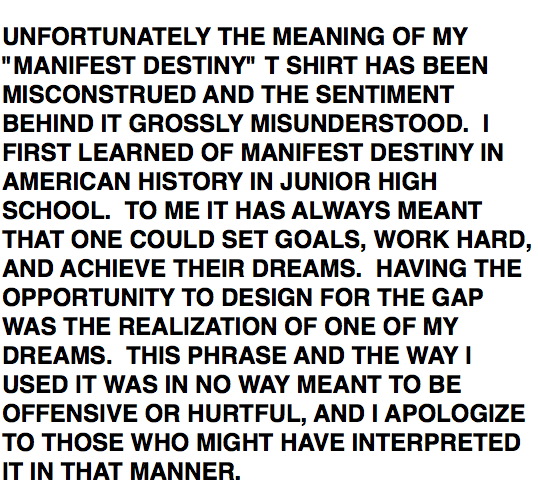
By Mark TrahantA T-shirt with the words “Manifest Destiny” became an instant cause in Indian country recently and especially on Social Media. Thousands of people told The Gap that the shirt was outrageous and should be pulled from the shelves. The campaign was successful, the clothing company responded, the designer apologized, and the shirt is no longer sold.

But Manifest Destiny is still the centerpiece in American thinking about the world. It’s topic one in tonight’s debate between President Barack Obama and Republican challenger Mitt Romney.
And:The idea of conquest was present long before the phrase “Manifest Destiny.” Thomas Jefferson had the same basic thought when he described America’s role as an “Empire of Liberty.”

No politician today would dare call for “Manifest Destiny.” But that same idea will surface tonight cloaked in the politically correct version, “American Exceptionalism.” (Although that phrase actually predates “Manifest Destiny.”)

One of the planned topic areas, probably the first one, is how the two candidates see America’s place in the world.

There will be two different answers both in terms of style and substance.

Critics of President Obama say that, at his core, he does not believe in this premise. The evidence is a 2010 speech where the president said: “I believe in American Exceptionalism, just as I suspect that the Brits believe in British exceptionalism and the Greeks believe in Greek exceptionalism.”

But Obama also said in that same speech, “I’m enormously proud of my country and its role and history in the world.” And, he continued, “I see no contradiction between believing that America has a continued extraordinary role in leading the world towards peace and prosperity and recognizing that that leadership is incumbent, depends on, our ability to create partnerships because we create partnerships because we can’t solve these problems alone.”

But that version of American Exceptionalism doesn’t fit Romney’s definition. “I think it’s fair to ask, you know, what is it that explains the absence of any discernable foreign policy from the president of the United States? And I believe that it flows from his fundamental disbelief in American exceptionalism,” Romney said on a talk show last year. “In the President’s world, all nations have common interests, the lines between good and evil are blurred, America’s history merits apology. And without a compass to guide him in our increasingly turbulent world, he’s tentative, indecisive, timid and nuanced.”

The very idea of nuances are opposite Manifest Destiny. The idea that God has ordained a particular kind of American power. Or as it was called during the pre-war build up to an invasion of Iraq, American Hegemony.

American Hegemony justified the Iraq war and the threats that Romney makes to Iran. One of the questions tonight: Is Romney even open to talking with Iran in order to prevent war.

At the Citadel military college in September, Romney used language that would have matched any 19th century Manifest Destiny speech.

“This century must be an American Century … America has the strongest economy and the strongest military in the world. In an American Century, America leads the free world and the free world leads the entire world,” he said. “God did not create this country to be a nation of followers. America is not destined to be one of several equally balanced global powers. America must lead the world, or someone else will. Without American leadership, without clarity of American purpose and resolve, the world becomes a far more dangerous place, and liberty and prosperity would surely be among the first casualties.”

Obama’s view is quite different. He outlined this in a 2010 National Security Strategy. “The burdens of a young century cannot fall on American shoulders alone. Indeed, our adversaries would like to see America sap our strength by overextending our power,” the president said. The power of the country comes not from its military strength but from its people. “Our long-term security will not come from our ability to instill fear in other peoples, but our capacity to speak to their hopes.” That idea, Obama argued, still requires American leadership.

So as you watch, listen, or tweet about tonight’s debate consider what the two candidates are saying–spoken words or not–about Manifest Destiny, American Exceptionalism or the American Century.
Comment:  For more on Manifest Destiny, see Hitler Loved Manifest Destiny and Bono Mack:  Pro-Indian = Anti-American.

Russell Means dies

Russell Means, Indian activist, actor, dies at 72

Means died early Monday at his ranch in in Porcupine, S.D., Oglala Sioux Tribe spokeswoman Donna Solomon said.Russell Means, a former American Indian Movement activist who helped lead the 1973 uprising at Wounded Knee, reveled in stirring up attention and appeared in several Hollywood films, has died. He was 72.

Means died early Monday at his ranch in in Porcupine, S.D., Oglala Sioux Tribe spokeswoman Donna Solomon said.

Means, a Wanblee native who grew up in the San Francisco area, announced in August 2011 that he had developed inoperable throat cancer. He told The Associated Press he was forgoing mainstream medical treatments in favor of traditional American Indian remedies and alternative treatments away from his home on the Pine Ridge Indian Reservation.

Means was an early leader of AIM and led its armed occupation of the South Dakota town of Wounded Knee, a 71-day siege that included several gunbattles with federal officers. He was often embroiled in controversy, partly because of AIM's alleged involvement in the 1975 slaying of Annie Mae Aquash. But Means was also known for his role in the movie “The Last of the Mohicans” and had run unsuccessfully for the Libertarian nomination for president in 1988.
Russell Means, Who Clashed With Law as He Fought for Indians, Is Dead at 72

By Robert D. McFaddenStrapping, and ruggedly handsome in buckskins, with a scarred face, piercing dark eyes and raven braids that dangled to the waist, Mr. Means was, by his own account, a magnet for trouble — addicted to drugs and alcohol in his early years and later arrested repeatedly in violent clashes with rivals and the law. He was tried for abetting a murder, shot several times, stabbed once and imprisoned for a year for rioting.

He styled himself a throwback to ancestors who resisted the westward expansion of the American frontier. With theatrical protests that brought national attention to poverty and discrimination suffered by his people, he became arguably the nation’s best-known Indian since Sitting Bull and Crazy Horse.

But critics, including many Indians, called him a tireless self-promoter who capitalized on his angry-rebel notoriety by running quixotic races for the presidency and the governorship of New Mexico, by acting in dozens of movies — notably in a principal role in “The Last of the Mohicans” (1992) — and by writing and recording music commercially with Indian warrior and heritage themes.

He rose to national attention as a leader of the American Indian Movement in 1970 by directing a band of Indian protesters who seized the Mayflower II ship replica at Plymouth, Mass., on Thanksgiving Day. The boisterous confrontation between Indians and costumed “Pilgrims” attracted network television coverage and made Mr. Means an overnight hero to dissident Indians and sympathetic whites.

Later, he orchestrated an Indian prayer vigil atop the federal monument of sculptured presidential heads at Mount Rushmore, S.D., to dramatize Lakota claims to Black Hills land. In 1972, he organized cross-country caravans converging on Washington to protest a century of broken treaties, and led an occupation of the Bureau of Indian Affairs. He also attacked the “Chief Wahoo” mascot of the Cleveland Indians baseball team, a toothy Indian caricature that he called racist and demeaning. It is still used.

And in a 1973 protest covered by the national news media for months, he led hundreds of Indians and white sympathizers in an occupation of Wounded Knee, S.D., site of the 1890 massacre of some 350 Lakota men, women and children in the last major conflict of the American Indian wars. The protesters demanded strict federal adherence to old Indian treaties, and an end to what they called corrupt tribal governments.
Comment:  For more on Russell Means, see Means Has Cancer Again and Means Releases New Book Online.

October 21, 2012

Dr. Phil's horror show

Natives were mostly outraged by the Baby Veronica case on Dr. Phil. Some of their responses:

Dr. Phil’s Hollywood-ized Adoption Propaganda

By Trace A. DeMeyerWatching clips of today’s episode (10-18-12) of Dr. Phil, watching those teary adoptive parents show their anger, outrage and despair over losing their babies because of some (ridiculous) (unjust) Indian Child Welfare Act, I knew right away this was going to be a one-sided show touting the benefits of adoption, even if they had a few Indian experts on the show, too.

Dr. Phil was obviously not allowing enough time to teach about ICWA and the wholesale removal of Indian Children in Canada and America, ethnic cleansing via non-Indian adoptions, or explaining why Indian children are called Stolen Generations.

Until I wrote my memoir, I couldn’t find much information in one place and had to dig pretty deep. That’s another reason why I wrote two books hoping it will counter such ignorance and this Hollywood-ized adoption propaganda that still dominates TV.

As I watched, it was obvious how young adoptees being Indian citizens didn’t really matter to the non-Indians parents who adopted them. All they really cared about is keeping them.

If these Americans had any knowledge of the Indian Child Welfare Act, the testimony of Indian leaders in 1976, or the history of America’s neglect of Indians (poverty, starvation and concentration camps called Indian reservations), and the legal theft of thousands of children, maybe then we’d stand a chance going on TV or entering the public courts. Maybe then America might catch a glimpse what 100+ years of theft of tribal children looks like.

Facing down teary adoptive parents who expect praise, not condemnation, we Indians are very familiar with their race-based judgments. Indians went direct to the Senate to get ICWA. Indians won’t win any debates on public TV in three-minute segments. Our history on this topic alone could fill several library collections.
Dr. Phil’s Horror Show

By Donna LoringDr. Phil aired a horror show on October 17 featuring couples who had adopted Indian children or who were in the process of doing so. The show zeroed in on the Indian Child Welfare Act and blamed it for interfering with their adoptions and costing them custody of the Indian child they had adopted or were in the process of adopting. One couple they showed was in hiding with the Indian child they had taken. They hired security, like the tribe was the monster!

Did you watch that show? I am sad and dismayed to say that I watched it, yes the whole show! It was a one sided narrowly focused show. It was the scariest thing I have ever watched unfold. It was about Native children being taken. On the show they justified the taking and even featured two Native brothers who had been taken and totally immersed in the non-native culture. They had no idea of their tribal values or history.

It was a show filled with total ignorance of our genocide and one that perpetuates genocide by promoting the continued taking of our children. Without our children we disappear as a culture and a people. It presented the white cultures view only and it was some very dangerous perspectives to be feeding a national audience. Oops, did I say white culture? Yes I did, and there is one, believe it or not, and it does not have the survival of Indian people or Indian governments in mind. It never has. The historical taking of our children by those who wanted to “Kill the Indian and safe the man” tells the story of our cultural genocide in this country. This was accomplished in the form of Indian residential schools. It now is in the form of the adoption, foster care and Welfare systems.

If Dr. Phil or any of his production staff had taken the time to educate themselves on the history and background of this federal law they would have learned why it was necessary.

I watched in shock at the ignorance of Dr. Phil, the non-Native guests and the non-Native audience! The Native experts that were on his show were totally ignored or talked over and the audience made their feelings known which caused a chilling effect on these two Native advocates.
Viewers Respond to Dr. Phil Episode About Baby Veronica Custody Battle: Boycott the Anti-Native American Dr. Phil ShowIn response to yesterday’s episode of the Dr. Phil Show that attacked the Indian Child Welfare Act (ICWA) and undermined the significance of Native children remaining in their tribe and being immersed in their culture, a grassroots campaign to “Boycott the Anti-Native American Dr. Phil Show” was started on Facebook.

The mission of the Facebook campaign is to hold “Dr. Phil McGraw accountable by boycotting until he agrees to have a show where QUALIFIED experts discuss ICWA’s importance.”
For more on child welfare, see When Indians Make Bad Decisions and Why the Indian Child Welfare Act Exists.

Nun wears headdress at canonization

Getting even more publicity than Kateri Tekakwitha's canonization was this photograph taken at the scene:


"Nuns held images of Kateri Tekakwitha, the first Native American to achieve sainthood, as they waited for the start of a canonization ceremony celebrated by Pope Benedict XVI, in St. Peter's Square on Sunday." (Andrew Medichini/Associated Press)

Most of the Natives I know were incredulous about this. Some comments from the F.A.I.R. MEDIA (For Accurate Indigenous Representation) page on Facebook:First they make an idol of our ancestor then this multi coloured eagle feather bonnet...sheesh.

While i'm sure she thought she was paying tribute it just shows what kind of stereotypes still exist in our world.

Talk about cultural insensitivity...and ignorance....

WTH! Does the Church really think dressing up a nun like she's entering a Brazilian parade is the correct protocol for celebrating a Mohawk woman??? Geeeezh!

The Catholic Church has demonstrated again and again that their interest in Indigenous cultures extends only to finding ways to convert--with a view to accessing Indigenous lands and resources.

The Catholic Church again...so offensive....Soon their day will come..down with religion and separatism...up with humanity and respect for the down-pressed people of the world....

It also shows their arrogance. How untouchable they are that they can do whatever they feel under "God's OK."

WOW this hurts.

Sick bastards...this is what I have been saying about the Church. See how sensitive they are to other cultures. Waiting for the black face paint next. I wonder if she realized that she forgot the war paint? What an ass.

There are so many things wrong here. Why. Just why.

This has just given millions of Catholics licence to engage in garish cultural appropriation. This will make the struggle against "Dressing up as Indians" at Halloween--all the more harder. This is a huge set back.

Wow. Just wow. Lots of work to be done in educating an unbelievably ignorant world.
Comment:  Activists often call for boycotts in situations like this. Can we boycott the Pope?

Ironically, the nun is holding an illustration of Kateri. This illustration may not be accurate, but clearly it looks nothing like the nun in her get-up. The nun would have to be an idiot to be oblivious to the stereotyping she's doing.

In related news, Indians say they'll dress up as a priest and pretend to molest altar boys the next time a Catholic official visits them. Because the nun's blatant Native stereotyping deserves a response in kind.

Someone should write a letter to the Associated Press and ask them to pull this photo. The AP is a primary source of photos for thousands of newspapers and websites. This photo will be the "face" of the canonization while it's in the news, and whenever it's retrieved from the archives.

For more on Kateri Tekakwitha, see Playing Indian to Celebrate Kateri and Indians Attend Vatican Canonization Ceremony.

Playing Indian to celebrate Kateri

Celebrate Blessed Kateri’s Canonization with Kids!

By LacyThe date of Blessed Kateri Tekakwitha’s canonization is going to be October 21, 2012! (Yay!) The cool thing about soon-to-be-Saint Kateri is that she was Native American. This opens up all kinds of crafting possibilities! Blessed Kateri Tekakwitha’s feast day is July 14. We made some fun, Native American dress up crafts to celebrate St. Kateri’s canonization with my kids!

We were inspired by some crafts over on Catholic Inspired. Jennifer has directions on how to make this Native American vest, Christian symbols headband (with free download), and this Cross and Beads necklace. Aren’t they cute?! We also made an Indian vest from paper grocery bags, and a Native American headband to match.
Debbie Reese's response in her American Indians in Children's Literature blog:The Catholics-playing-Indian activities are well-intentioned, but ignorant and ought to be set aside. As a society, we need not do these sorts of activities. We see it a lot in the context of "Indian" mascots for sports teams. There's a lot more awareness of stereotyping in that context, and a lot of schools have abandoned those stereotypical mascots. That same awareness--apparently--needs to be developed amongst Catholics who dress their kids up in stereotypical attire to be "Saint Kateri."Comment:  Reese is more polite than I'd be. This activity is stupid and ignorant.

As Lacy should know, playing dress up is wrong when adults do it and it's wrong when kids do it. The actual Kateri didn't look like this, so the costume is stereotypical and insulting to Indians.

For more on Indian wannabes, see Sumter Native American Family Tribe and British "Apache" Is an Embarrassment.

Pope canonizes Kateri Tekakwitha

Pope names first Native American saint

Kateri Tekakwitha among seven new saints celebrated by crowd of 80,000 in St Peter's SquareEighty thousand pilgrims, many in flowered lei, feathered headdresses and other traditional attire, gathered in St Peter's Square on Sunday as the pope added seven more saints to the Catholic roster in an attempt to reinvigorate the faith in parts of the world where it is lagging. One of the seven, Kateri Tekakwitha, will be the first Native American saint to be canonised.

In his homily, Benedict praised each of the seven as heroic and courageous examples for the church, calling Kateri an inspiration to indigenous faithful across North America. "May the witness of these new saints … speak today to the whole church, and may their intercession strengthen and sustain her in her mission to proclaim the gospel to the whole world," he said.

The celebrations began at dawn, with Native Americans in beaded and feathered headdresses and leather-fringed tunics singing songs to the beat of drums. Later, the crowds cheered as the pope read out the names of each of the new saints in Latin and declared that they were worthy of veneration by the entire church. Prayers were read out in Mohawk and Cebuano, the dialect of another saint, Pedro Calungsod, a 17th-century Filipino teenage martyr, and in English by a nun wearing a lei.

"It's so nice to see God showing all the flavours of the world," said Gene Caldwell, a Native American member of the Menominee reservation in Neopit, Wisconsin, who attended with his wife, Linda. "The Native Americans are enthralled" to have Kateri canonised, he said.
Pope names first Native American saint

Pope Canonizes 7 Saints, Including 2 Women With New York Ties

Comment:  For more on Kateri Tekakwitha, see Indians Attend Vatican Canonization and Americans, Canadians Spar Over Kateri.

October 20, 2012

Hitler loved Manifest Destiny

I've seen claims that Hitler based his "final solution" on his knowledge of the American genocide of Indians. But I hadn't seen any hard evidence of it. This passage comes closer to explaining the connection than anything I've seen so far.

The Ugly Roots Of The GAP’s Manifest Destiny

By Leon DonnellyThe German Friedrich Ratzel in his book “Lebensraum,” 1901, wrote of an impersonal, Darwinist ‘survival of the fittest’ struggle for existence among human beings. In considering the near extinction of Native American Indigenous peoples by Euro-American conquerors he saw in this a model for German racial expansion, conquest and extermination in the eastern lands of Europe. Ratzel wanted Germany to emulate the American model of aggressive conquest of all indigenous peoples that stood in Germany’s path of acquiring ‘living space’ in the East for her ever expanding ‘pure white Germanic race’, and so recommended aggressive war of acquisition and conquest which “quickly and completely displace the inhabitants, for which North America, Southern Brazil, Tasmania, and New Zealand provide the best examples.” Then, following these models, settler colonies could quickly be founded with a German yeomanry farmer class protected by forts and military units. It was upon this basis that Adolf Hitler formed Germany’s policy of aggressive acquisition & conquest in the East of Europe & Russia. In Nazi propaganda film and newspaper photographs of the Nazi colonisation of Eastern Europe German wagons rolling East were shown in conscious echo of images derived from Hollywood Western films celebrating Manifest Destiny and the conquest of the American West.

Ratzel was praising of American historian Frederick Jackson Turner who formulated his “Frontier Thesis” of American History in his essay “The Significance of the Frontier in American History” (1893), which celebrated the irresistible march of white Anglo-Saxon civilisation across the North American continent as an evolutionary process, and highlighted Turner’s contrast of the “dynamic borders of American Westward expansion” with the static borders of densely populated Europe. I quote from Wikipedia on Turner: “He believed the spirit and success of the United States was directly tied to the country’s westward expansion. Turner expounded an evolutionary model; he had been influenced by work with geologists at Wisconsin. The West, not the East, was where distinctively American characteristics emerged. The forging of the unique and rugged American identity occurred at the juncture between the civilization of settlement and the savagery of wilderness. This produced a new type of citizen–one with the power to tame the wild and one upon whom the wild had conferred strength and individuality…As each generation of pioneers moved 50 to 100 miles west, they abandoned useless European practices, institutions and ideas, and instead found new solutions to new problems created by their new environment. Over multiple generations, the frontier produced characteristics of informality, violence, crudeness, democracy and initiative that the world recognized as “American.” According to Wikipedia by the time Turner died in 1932 60% of the leading History departments in the US were teaching American History courses in Frontier History along Turnerian lines.

Adolf Hitler himself saw in the American conquest of the West a model for Germany’s conquest of the East to achieve her divine right of “Lebensraum” there. In “Mein Kampf” Hitler sees the American expansion into the West as an expression of white Anglo-Saxon Germanic racial superiority. Hitler commends these American settlers for keeping their Germanic blood pure by not intermarrying with Native peoples, and drew from it his own version of Manifest Destiny where German blood has the divine right to conquer land inhabited by “untermensch,” who are not to be considered human beings by the Germanic conqueror but are to be mercilessly starved, slaughtered and for all intents and purposes made extinct for the purposes of “Lebensraum” for the “pure white race” of the Greater German Reich.

American National Socialists know what “Manifest Destiny” means. The Klu Klux Klan will know. And the Native Americans know what it means. Genocide. Genocide of the Native American people. In the year in which UN Special Reporteur on Indigenous Human Rights, James Anaya, has alerted the world to widespread Human Rights abuses against the Native Americans, presently & historically, the need to return to them stolen lands and to redress the traumatic historical effects of Manifest Destiny, this seems a curious & perverse slogan for Gap to offer the world.
Comment:  For more on Manifest Destiny, see Bono Mack:  Pro-Indian = Anti-American and McNairy Apologizes for "Manifest Destiny" T-Shirt.

Is Seahawks logo stereotypical?

Native American Mascot Controversy Takes Center Stage at the Smithsonian's National Museum of the American Indian

By The Smithsonian's National Museum of the American IndianThe Smithsonian's National Museum of the American Indian presents "Racist Stereotypes and Cultural Appropriation in American Sports," a symposium and community conversation Thursday, Nov. 1, from 10 a.m. to 5:45 p.m. in the museum's Rasmuson Theater in Washington, D.C.

"What better place to address this issue than the Smithsonian's National Museum of the American Indian on the National Mall," said Kevin Gover (Pawnee), director of the museum. "The Smithsonian Institution is the ideal forum to bring people together to ask tough questions."

The series of panel discussions will feature scholars, commentators, authors and representatives from Indian nations and the NCAA. Panelists will explore the mythology and psychology of stereotypes in sports, the history of ethnic "identity theft" and recent efforts to retire and revive "Native American" sports references at the University of Oklahoma, Stanford University, Dartmouth College and Syracuse University. The symposium advances a movement endorsed by the U.S. Commission on Civil Rights in 2001 and addressed last year by the U.S. Senate Committee on Indian Affairs.
To prepare for this event, Kevin Gover asked me the following:A thought. None of us seem to be offended by the Seattle Seahawks logo. Clearly it is based in northwest Native design. Does this mean that the respectful, non-stereotypical use of Native imagery is inoffensive? If so, suppose Washington renamed its football team the "Americans" and used some Native symbol (say, an eagle feather) as its logo. Would that be ok? I'm just trying to find some markers we can use when talking about this subject.My response:

The feather example actually did come up in William & Mary's case. Nickname: The Tribe; logo: a feather. The NCAA ruled it had to change its name and logo.

To me that's the least significant case of Native stereotyping in a sports mascot. Yes, you could say the feather evokes the feathered warriors of the past. But it's also used in many cultural and religious contexts today. If it were up to me, I'd say it isn't worth a protest. We do have more important things to do than fight this battle.

On to your question. Is the respectful, non-stereotypical use of Native imagery inoffensive? I'd say yes. In the Seahawks' case, the logo isn't a chief, a deity, or a sacred animal. It's a non-sacred animal done in a Pacific Northwest style. Assuming someone has done due diligence, it should be okay.

(Due diligence means making sure no one holds the seahawk sacred, and the art is done according to tradition.)

In your hypothetical "Americans" example, I think it could be done. But I'm not sure what the nonstereotypical logo would be. Chief, warrior, teepee, tomahawk, arrow, dreamcatcher, feather...they all evoke stereotypes. Things that haven't been used before aren't likely to be appealing.

I think a valid Native logo would have to be something like the Seahawks logo: an original design, not an appropriation of something existing. A couple of examples:

Alternative logo for Blackhawks

Musqueam design on Team Canada jerseys

If your team name was the Thunderbirds or the Coyotes, I could see using a generic or original design in a Native style. To me that would be akin to genuine honor or respect. It wouldn't promote any stereotypical beliefs about Indians, and would promote their continued existence and relevance.

For more on Indian mascots, see 1491s on Redface and Blackface and Stanford Indian Makes a Comeback.

October 19, 2012

Bono Mack:  Pro-Indian = anti-American

A political campaign here in California has veered into racist territory:

ELECTIONS: Bono Mack gets heat from Indian Country, Ruiz from law enforcement community

By Ben GoadInland Rep. Mary Bono Mack is facing criticism from tribal groups following her campaign’s attacks against Democratic congressional candidate Raul Ruiz for participating in Thanksgiving Day protests in the 1990s.

Meanwhile, a pair of former law enforcement officials are taking Ruiz to task for his brush with the law in the same era, during which he spoke out in support of convicted killer Leonard Peltier.

Bono Mack, R-Palm Springs, and her campaign have made an issue of Ruiz’ involvement in the protests and other activities during his time in medical school, painting him as ultra-liberal and un-American.

On Friday, Oct. 19, the Tribal Alliance of Sovereign Indian Nations sent Bono Mack a letter condemning her for attacking Ruiz “on the basis that he stood with tribal people to protest the deplorable historic treatment of American Indians…”

The complete letter can be seen here. Here’s an excerpt:

“We certainly understand the rough and tumble nature of political campaigns, and we know that sometimes candidates say things that they later regret. As an agent of the federal government, however, you should be working to overcome the wounds of past wrongs done to Indian people, not deepen them. Vilifying someone who nobly stood with Indians and protected an Indian elder is at best gratuitous and opportunistic. At worst, it is a betrayal of a friendship, an attack against tribal peoples and others who have stood with us to protect the inherent rights we have left. Indeed, without these inherent rights more than 6,000 constituents in your district would not be employed by tribal government gaming. We know you know better.”

The letter comes a day after the Palm Springs-based Agua Caliente Band of Cahuilla Indians issued a statement calling the Bono Mack criticism outrageous.
Both that tribe and TASIN said stressed that they had a positive working relationship with Bono Mack in the past.
Mary Bono Mack comments denounced by Tribal Alliance of Sovereign Indian Nations

Bono Mack Says Native American-Supporting Opponent is Anti-American

By Rob CapricciosoU.S. Rep. Mary Bono Mack, R-California, currently in a dead heat in her race for re-election with Democratic challenger Raul Ruiz, has recently put out a series of ads, statements, a press release, and campaign tweets indicating that Ruiz is anti-American for his past support of causes identified with American Indians.

In 1997, Ruiz was arrested as a college student during a protest of the Thanksgiving holiday in Plymouth, Massachusetts that was intended to highlight Native American roles in American history and misrepresentations of Indians in contemporary American society. The event got out of hand, police pepper sprayed him and others, and charges were eventually dropped. City leaders ended up paying $100,000 toward a Native American scholarship fund, and they erected a plaque commemorating the event and Indian heritage.

In Bono Mack’s new ads, a serious-sounding narrator, accompanied by ominous music, asserts that Ruiz is “attacking Thanksgiving and our American values.” In a recent debate, the congresswoman sharpened the attack, saying, “He led protests against the celebration of Thanksgiving , no joke … because he opposes what Thanksgiving stands for and what it represents.”

Bono Mack’s campaign has also claimed that Ruiz read a letter aloud at the protest expressing support for a pardon of Leonard Peltier, an American Indian Movement activist who was convicted of shooting two FBI agents on the Pine Ridge Indian Reservation in 1975.

The Ruiz campaign says the candidate doesn’t remember expressing support for Peltier and that he didn’t support Peltier then or now. That’s in contrast to some Native Americans who believe Peltier was wrongfully convicted, and who call for his pardon to this day.

Still, Bono Mack campaign strategists, John Pezzullo and Marc Troast, have re-tweeted messages on Twitter indicating that Ruiz is a “radical liberal” for his participation in the Native-focused event, and they have re-tweeted messages claiming he supported Peltier. Their campaign also has released audio, which they say is Ruiz reading a statement in support of Peltier. The Ruiz campaign has not denied the authenticity of the audio, and says if Ruiz did read it, he was caught up in the moment and did not believe what he was reading.

The Agua Caliente Band of Cahuilla Indians is part of a growing chorus of Indians who are concerned with the Bono Mack political strategy. The tribe has put out a statement calling her ads “an outrageous and unacceptable insult to all Native Americans.”

“We are not endorsing either candidate at this time,” said Tribal Council Chairman Jeff L. Grubbe. “However, we call on Rep. Bono Mack to unequivocally repudiate this attempt to portray standing up for Native Americans as somehow un-American.”
Raul Ruiz 'regrets' reading Leonard Peltier support letter

Comment:  Bono Mack's comments are consistent with everything I've said about today's conservatives. They hate minorities in general and Indians in particular for reminding us of America's flaws.

The continued existence of people who suffer from past and present injustices is a stake through the heart of America's founding myth. You know, the belief that America is the land of opportunity where the playing field is level and everyone has an equal chance.

America was really founded on the Euro-Christian belief in the superiority of white civilization. This is embodied in the concepts of Manifest Destiny and American exceptionalism, which tell us Americans are meant to dominate the world.

Standing up for Indians, as Ruiz did, is "un-American" because it challenges the basis of white power and privilege. If the people who rule do so because they cheated, stole, and killed, they've forfeited the moral high ground. There's no reason to listen to liars and hypocrites, or keep them in power.

This conflict comes up again and again in our culture and in this blog. For more on the subject, see:

Gap removes "Manifest Destiny" t-shirt
Republicans:  White people own America
Custer-loving Republican resigns
Ethnic studies "undermine sovereignty"?
Fischer worships "God" of racism

"In your face" approach doesn't work?

After reviewing the Urban Outfitters and Paul Frank controversies, an article suggests how to battle the ongoing prejudice:

Navajo Hipster Panties Gone Awry

By Arielle ZiontsScoggins suggests the best way to counter disrespectful appropriation of Native American fashion and culture is to educate people about Native American history and explain to non-Natives why this trend is disrespectful.

“Some people don’t know that that’s offensive…you are desensitized to it,” said Scoggins.

McGowan agrees that education on the topic should be promoted, but warns that people should not be approached forcefully about the issue.

“You just don’t go up to them and say ‘hey, don’t do this’ because then you aren’t a good ambassador…because [by doing so] you are putting on an aggressive face yourself,” said McGowan.

Anthes hopes that the movement towards the acceptance of the LGBT community can be used as a model to approach this trend.

“Twenty years ago… it was acceptable societally to make homophobic jokes, to just assume that these people were not going to hear you say these hateful things… that population has become a lot more visible so we understand and have empathy,” said Anthes. “Most people [can] go through their life without ever having to look an Indian person in the eye and say… ‘it’s fine if I’m joking about it.’”

Arguably, the best way to combat the problem of cultural misunderstanding is through fostering intercultural connections. Native Americans are a minority of the American population, and can easily be marginalized. Efforts such as Adrienne K’s Native Appropriations blog and social media campaigns are where indigenous Americans can have their voices heard.
Comment:  I'm not up on my LGBT history, but it seems to me they were "in your face" as much as anyone. With gay pride parades, anti-AIDS activism, and more. Professor Anthes doesn't address how the movement worked, but I doubt it was through education only.

McGowan, who's "a senior at Claremont High School and a member of the Iowa tribe of Kansas and Nebraska," doesn't like the "in your face" approach. But we have only his opinion that it doesn't work. There's nothing resembling a fact to support his claim.

In any case, Adrienne Keene's blog often takes an "in your face" approach. As does my blog, of course. Many of the Native activists I know also take this approach.

And we have proof that this approach works: the Civil Rights movement of the '60s. Nothing was going to change until the National Guard integrated the schools, blacks occupied buses and lunch counters, and people marched in the streets. Same with Indians: Alcatraz, the Trail of Broken Treaties, and Wounded Knee II.

As someone said recently, smiles, prayers, and dances for unity aren't enough. If you want to change something, you often have to get angry and make yourself heard. America started acknowledging minority rights only when minorities thrust themselves in America's face.

For some recent protests, see McNairy Apologizes for "Manifest Destiny" T-Shirt and Winning the War on Columbus? For a discussion of protests in general, see Stereotypes Disappear "Organically"? and Do Protests Work?

October 18, 2012

Baby Veronica case on Dr. Phil

Dr. Phil Show To Feature Perspective of Adoptive Parents in ‘Battle Over Baby Veronica’Today, the DR. PHIL Show will tell the story of Matt and Melanie Capobianco, the non-native adoptive parents of 3-year-old Veronica (Cherokee), who was removed from her home in South Carolina at the age of 2 this past New Year’s Eve to live with her biological father, Dusten Brown, in Bartlesville, Oklahoma, a neighboring city of the Tahlequah-based Cherokee Nation.

The widely publicized and controversial custody case, which has been going on since 2009 when Veronica was four months old, has been heralded by some as a victory for the Indian Child Welfare Act (ICWA), the Cherokee Nation, and for Veronica, who will remain with her family who have “a deeply embedded relationship” with their heritage, as the South Carolina Supreme Court ruling states.

But others have criticized the decision as destructive to the toddler and an injustice to the adoptive parents.

In a taped interview, the Capobiancos sat down with TV talk-show host Dr. Phil McGraw to share their anger and frustrations at losing Veronica and at the ICWA of 1978, which gives placement preference of adopted American Indian children first to family members, second to members of the same tribe and third to members of another tribe.

“The Child Welfare Act is destroying families,” Matt told Dr. Phil. “Veronica’s our daughter.” The couple was present in the delivery room for Veronica’s birth, and Matt cut the umbilical cord. “I just can’t put it into words how incredible it felt to have a little girl.”
And:The ICWA was designed to preserve the relationship a child has with its relatives and its tribe, Craig Dorsay, a Portland, Oregon-based attorney who has worked on thousands of ICWA-related cases, explained to Indian Country Today Media Network. “In the South Carolina case, the tribe is painted as the villain,” Dorsay said. “But you have to remember the tribe is interested in the health and welfare of the child.”

Although non-native adoptive families can promise to expose children to ceremonies and culture, there is no substitute for immersion. “In the Indian community, grandparents, aunts and uncles, they all share equal responsibility for the child, and the child’s life is enriched by this,” Dorsay said.

Terry Cross, executive director of the National Indian Child Welfare Association, agrees that the ruling ensures Baby Veronica grows up surrounded by her culture and people and the rights and responsibilities that come with it. “I can’t say enough about the importance of a child’s rights throughout their lives,” Cross said. “These are things as simple as voting in tribal elections, running for office, taking advantage of tribal scholarships and benefits, participating in customary and ceremony rights, plus their relationships with extended families. It’s about a notion of a sense of belonging. Indian children are as tied to their extended families as they are to their parents. There’s a rich network of culture there, and that’s what we rely on for wellbeing.”

But tonight’s episode of the DR. PHIL Show paints the decision to remove Baby Veronica from the home of her adoptive parents as a heart-breaking “nightmare,” severing a young girl’s ties with the only caretakers she has ever known.

While Nimmo defends the purpose of the ICWA, she is repeatedly countered by Troy Dunn, host of the TV show The Locator, a non-native brother to an adopted American Indian man, and the person who pitched Dr. Phil to feature the story of Baby Veronica on the DR. PHIL Show.

While Nimmo is explaining the purpose of the ICWA, Dunn interrupts and alleges Veronica’s background is barely Indian.

“Have you told Dr. Phil how much of this child’s blood is actually Indian? Because I think we’re leading people to believe this is an Indian thing,” Dunn said.

“She is an Indian baby,” Nimmo replied.

“This child is more Hispanic than Indian, more white than Indian, more Asian almost than Indian,” Dunn charges. “There is like a drop of Indian blood in this child….” he said. “…[I]t’s a massive warning to any parent in America right now who’s considering adopting a child, because if there’s a drop of Indian blood in this child, this is a possibility, this event could happen to somebody else,” Dunn said. “Somebody from the tribe—not a birth parent—a tribal member can step up a make a claim, which is what drives some families into hiding.”

Nimmo clarified that the law applies to tribal citizens, not to native heritage. “It’s not about a drop of blood; this father is a citizen of the government. It’s not just if you have Indian in your background.”
Show is biased

That sounds like a reasonably balanced presentation of the issues. But Dr. Phil's own site presents a different picture:

Adoption Controversy: Battle over Baby Veronica

If you go by the space allotted, the Capobiancos get 8-9 paragraphs and the Cherokees get one. Then there's this assertion from Johnston, another non-Indian parent:I think it’s an unjust law. I think it’s a racist law, because we were white, and the kids were considered Indian ... If the tribe cared so much about my children, they would have prevented them from being homeless in the first place. They would have rescued them from off the streets. They wouldn’t have allowed them to be sleeping in somebody’s backyard or left with strangers in an abandoned apartment. But they only became involved in their lives once they were in a home and thriving.The "racist" assertion ignores the fact, stated above, that the law is based on tribal citizenship, not blood quantum. A full-blooded person might not be a tribal member while a person only 1/16 Indian by blood might be a member in good standing.

Saying tribal governments don't care about their children is similar to saying they're savage and uncivilized. In other words, the claim is close to being racist itself. Does Johnston seriously think a government can prevent every citizen from going homeless? How many non-Indian US governments have accomplished that...none?

For more on child welfare, see When Indians Make Bad Decisions and Why the Indian Child Welfare Act Exists.

Indians attend Vatican canonization ceremony

Canonization of Kateri Tekakwitha Draws at Least 2,000 Mohawks to Vatican Ceremony

By Gale Courey ToensingWhat is likely to be the largest delegation of Mohawk Indians ever to assemble in Rome will take place this weekend, October 20–21, for the canonization of Kateri Tekakwitha, a 17th-century Mohawk woman.

Almost 2,000 people from Akwesasne and Kahnawake will flock to the Vatican for the ceremony that will grant sainthood to Kateri Tekakwitha, the first indigenous woman of Turtle Island to be canonized by the Catholic Church. The canonization will take place on Sunday.

About 150 people—three busloads—left for the airport a week ago, and others, like Alma and Orlo Ransom and three members of their family, were leaving on Thursday, October 18, for the ancient city.

“The Vatican is topping off what we feel by making her a saint,” Alma Ransom told Indian Country Today Media Network. She has played a critical role in the canonization effort over the years.
Turtle Island Indigenous Flock to Vatican to Witness Kateri Tekakwitha’s CanonizationFrom Nova Scotia to British Columbia, and from Mohawk communities in the Northeast to the Yakama in Washington state, First Nations citizens and American Indians streamed to the Vatican in Rome this week to witness the canonization of one of their own.

Sunday October 21 is the day that Kateri Tekakwitha, Mohawk and Algonquin, is being granted sainthood. Though Tekakwitha’s canonization has highlighted ambivalence toward the church throughout Turtle Island, this recognition of Catholicism and Native devotion resonated among Indians and brought a few thousand of North America’s Indigenous Peoples to Rome to see for themselves the culmination of 300 years of prayers. Nearly 2,000 of them are Mohawks from both sides of the U.S.–Canadian border.

“I’m already emotional about it, just talking about being in the presence of the Pope, and [hearing him] say in his own words that Kateri is canonized, is the greatest thrill,” Grace Esquega, director of the aboriginal-focused Kitchitwa Kateri Church in Thunder Bay, Ontario, told CBC News last week. She added that she had carefully chosen her regalia and was carrying an eagle feather to the Vatican.

“Kateri’s canonization is a very significant event, not only for the Mohawk faithful, but for Native people throughout North America…and beyond,” said Kahnawake Grand Chief Delisle Jr. in a statement. “We know that there will be millions of people sharing in the celebrations of this day. The fact that a quiet and unassuming woman of peace who died so long ago will be acknowledged and remembered at this level is something we can all be proud of.”
Comment:  For more on Kateri Tekakwitha, see Americans, Canadians Spar Over Kateri and Kateri Tekakwitha to Become Saint.

Below:  "Archibishop Lopez Quintano, the Apostolic Nuncio to Canada, holds a basket made by Mohawk basketmaker Sheila Ransom that will be presented to Pope Benedict XVI by the Mohawk delegation to the canonization of Kateri Takakwith. To his right in the photo are Alma and Orlo Ransom; to his left are tribal police Detective Matt Rourke and former St. Regis Mohawk Tribe Chief Wally Oaks." (Gale Courey Toensing)

October 17, 2012

Childhood stress causes adult problems

The Psych Approach

By David BrooksIn Paul Tough’s essential book, “How Children Succeed,” he describes what’s going on. Childhood stress can have long lasting neural effects, making it harder to exercise self-control, focus attention, delay gratification and do many of the other things that contribute to a happy life.

Tough interviewed a young lady named Monisha, who was pulled out of class by a social worker, taken to a strange foster home and forbidden from seeing her father for months. “I remember the first day like it was yesterday. Every detail. I still have dreams about it. I feel like I’m going to be damaged forever.”

Monisha’s anxiety sensors are still going full blast. “If a plane flies over me, I think they’re going to drop a bomb. I think about my dad dying,” she told Tough. “When I get scared, I start shaking. My heart starts beating. I start sweating. You know how people say ‘I was scared to death’? I get scared that that’s really going to happen to me one day.”

Tough’s book is part of what you might call the psychologizing of domestic policy. In the past several decades, policy makers have focused on the material and bureaucratic things that correlate to school failure, like poor neighborhoods, bad nutrition, schools that are too big or too small. But, more recently, attention has shifted to the psychological reactions that impede learning—the ones that flow from insecure relationships, constant movement and economic anxiety.
Cuddle Your Kid!

By Nicholas D. KristofOne University of Minnesota study that began in the 1970s followed 267 children of first-time low-income mothers for nearly four decades. It found that whether a child received supportive parenting in the first few years of life was at least as good a predictor as I.Q. of whether he or she would graduate from high school.

This may illuminate one way that poverty replicates itself from generation to generation. Children in poor households grow up under constant stress, disproportionately raised by young, single mothers also under tremendous stress, and the result may be brain architecture that makes it harder for the children to thrive at school or succeed in the work force.

Yet the cycle can be broken, and the implication is that the most cost-effective way to address poverty isn’t necessarily housing vouchers or welfare initiatives or prison-building. Rather, it may be early childhood education and parenting programs.

Scholars like James Heckman of the University of Chicago and Dr. Jack Shonkoff of Harvard have pioneered this field, and decades of fascinating research is now wonderfully assembled in Paul Tough’s important new book, “How Children Succeed.” Long may this book dwell on the best-seller lists!

As Tough suggests, the evidence is mounting that conservatives are right about some fundamental issues relating to poverty. For starters, we can’t talk just about welfare or tax policy but must also consider culture and character.

“There is no antipoverty tool we can provide for disadvantaged young people that will be more valuable,” Tough writes, than grit, resilience, perseverance and optimism.

Yet conservatives sometimes mistakenly see that as the end of the conversation.

“This science suggests a very different reality,” Tough writes. “It says that the character strengths that matter so much to young people’s success are not innate; they don’t appear in us magically, as a result of good luck or good genes. And they are not simply a choice. They are rooted in brain chemistry, and they are molded, in measurable and predictable ways, by the environment in which kids grow up. That means the rest of us—society as a whole—can do an enormous amount to influence their development.”
The following study provides evidence for this position:

New Version of Classic Marshmallow Experiment Upends Original Conclusions

In it, a marshmallow was placed before young children, who were told to wait for it. The original experiment concluded that those who waited longer succeeded later in life. In shorthand:

Character => success

But in the revised experiment, the researchers withheld art supplies from one group of children before testing them with the marshmallow. Those who had been frustrated this way were much quicker to take the marshmallow. In shorthand:

Environment => character => stress

Conclusion

The implications of this study are obvious. As in Tough's book, kids in an unstable or unpredictable environment are more likely to avoid stress and seek comfort. That means dropping out of school or a job and pursuing sex, drugs, or gang affiliation. Which leads to a criminal record, a disease, or an unwanted pregnancy. The kids aren't "weak" because of their race or culture. They simply lack the mental maturity most of us take for granted. Any person raised in that environment would come out roughly the same.

This must be the 10th or 20th item I've posted on the subject of why poverty happens. Again, it's not because people are lazy and don't work hard enough. It's because environmental factors rob people of their ability to focus, learn, and apply themselves.

These people are victims of circumstance, which is why we denounce those who blame the victim. They often can't overcome their handicaps by themselves, but they can with our help. As Kristof says, we can and should do whatever we can to influence their development.

For more on the subject, see:

GOP America:  strivers vs. parasites
Social factors affect intelligence
Romney:  47% are moochers
America's "bootstrap theology"
Conservatives admit welfare-bashing is racial

McNairy apologizes for "Manifest Destiny" t-shirt

Gap Pulls "Manifest Destiny" T-Shirt, Gets History Lesson from Outraged Consumers

By Lylah M. AlphonseAdding fuel to the fire, the shirt's designer, Mark McNairy, tweeted "MANIFEST DESTINY. SURVIVAL OF THE FITTEST" last Friday in response to customer complaints. He quickly deleted his tweet, but not before a screengrab of it was widely circulated, and then he followed up—three days later—with an all-caps semi-apology.

"Unfortunately, the meaning of my 'Manifest Destiny' T shirt has been misconstrued and the sentiment behind it grossly misunderstood," McNairy posted on Twitter on Tuesday, blatantly disregarding his "survival of the fittest" quip. "I first learned of Manifest Destiny in American History in Junior High School. To me it has always meant that one could set goals, work hard, and achieve their dreams. Having the opportunity to design for the Gap was the realization of one of my dreams. This phrase and they way I used it was in no way meant to be offensive or hurtful, and I apologize to those who might have interpreted it in that manner."

Dear Mark McNairy: The term "Manifest Destiny" does not mean what you think it means. (Also? Your junior high school history teacher is weeping right now.)

While it might be nice to think that it's some sort of inspirational mantra, maybe based on The Law of Attraction—Create your own life path! Manifest your destiny!—as McNairy and the PR department of Gap, Inc., have learned, "Manifest Destiny" actually refers to the mid-19th century mindset that white Americans had a divine obligation to claim as much of the continent as possible for themselves, slaughtering and oppressing native people in the process.
So McNairy "apologized" to those who, unlike him, didn't sleep through school and actually know what the words mean. Thanks for nothing, pal.

Some tweets responded to McNairy's semi-apology:@mmcnairy Considering that you are the one who misconstrued the meaning of the phrase, this is a pretty half-assed apology.

Hey @mmcnairy, since you didn't bother to Google "Manifest Destiny" I did it for you. Read before you speak again. http://en.m.wikipedia.org/wiki/Manifest_destiny #Gap

Is it just me, or did @mmcnairy just pull a "I'm sorry you're angry"? NOT an apology man...#Gap
My snarky addition to the pile-on was this:Breaking Gap news: McNairy's junior high school just checked his record. Turns out he flunked 7th-grade history and will have to repeat it.

Among other problems, he thought the Civil War was fought over stripes vs. solids, and the First Amendment says, "Do whatever feels good."
For more on the subject, see Gap Removes "Manifest Destiny" T-Shirt and McNairy "Hurt" by T-Shirt Criticism.