October 08, 2013

"Redskins" change is coming

Regarding Washington Redskins name change, ‘never’ may be sooner than anyone thought

By Mike WiseThe question is how long before Roger Goodell or any of the NFL commissioner’s brightest lawyers deem that a prolonged public assault against the name becomes financially hazardous to the league’s future. Just when is the tipping point?

The answer, we found out Monday, is now.

League officials have reached out to the Oneida Nation, which sponsored Monday’s symposium and suddenly has been passed the name-change baton from Suzan Shown Harjo after more than two decades.

The NFL, through Adolphus Birch, its senior vice president of labor policy and government affairs, has asked that a meeting originally scheduled for Nov. 22 be moved up—and, if needed, to the Oneida reservation in Verona, N.Y.

Think about that: The NFL, which has spent tens of thousands of dollars defending the team from American Indian plaintiffs seeking to strip its trademark in court for the better part of two decades, has offered to go to the res to talk.

Tiring of the sustained momentum the issue has gained since the beginning of the year, including a national radio ad campaign denouncing the team’s name in each city it plays—tired of the widespread publicity, which runs the gamut from the Indian Country Today media network to NBC’s “Meet the Press”—Goodell has sent an emissary to act on his behalf.

The commissioner and others also may be tired of team owner Daniel Snyder’s cold brazenness toward the offended. They simply can’t take his tone-deafness on the issue anymore; it’s bad business.

If the NFL is as boxed in as it appears and Birch and others from the league office aren’t going on a patronizing P.R. mission, this is the first step in the matter being taken out of Snyder’s hands—the first clear indication that the name is eventually going down.

I thought this past winter it might happen within 10 years. My guess now is five years or less, maybe three—and that’s just to accommodate the time it will take to reach a settlement with the team, find a new name and license, market and promote it.
The Redskins are going to change their name someday, so deal with it

And we think we know what the new name will be.

By Chris Chase
The Redskins name will change sooner than you think — two or three years, tops. The franchise and the NFL have to realize they’ve lost control of the story and aren’t getting it back. That opportunity has long passed.

Just think, if Daniel Snyder had been willing to deal with the issue rather than with indignant defiance, he could have avoided this mess. The Redskins owner should have hosted Native American leaders on both sides of the issue and listened to their concerns. Even if there was still opposition, there could have been compromise. Maybe the Redskins would have agreed to donate money to Native American charities or fund football programs at high schools. Or Snyder could have changed the team’s logo, replacing the Native American caricature with an “R,” like the helmets from 1970. That change wouldn’t have affected the name, but it would have shown Snyder to be sensitive and understanding, thus delaying a debate about the name. If the Redskins had Native American support, the story would have died.

Instead, he and the Redskins played it wrong at every turn. They’re going to pay for that short-sightedness.

But neither Snyder nor the NFL will be strong-armed into changing the name. There are too many egos involved for that. Snyder isn’t going to let Mike Wise run his franchise and the NFL won’t want to change league policy because of public pressure. So, for now, they’ll both weather the storm. Then, when the uproar has quieted down, the team will make a surprise announcement about a name change.

It’s a strategy used effectively by Augusta National Golf Club when there was a controversy over its membership policies. A national campaign led by Martha Burk tried to force Augusta to admit women. The membership held firm, rode out the rough patch, then changed its policy years later. Burk won, but Augusta National was able to save face.

The Redskins won’t have the same luxuries as Augusta, because this story is capable of quickly going off the rails. Right now, the debate is mostly toothless. It’s being played out in newspapers and televisions with little interest from fans or sponsors. But if the Redskins make the Super Bowl in the next few years, the story will becomes worldwide news. It will be two weeks of talk about the name rather than a celebration of football. Or what happens if one sponsor comes out against the name? Others may quickly get in line. Once money is involved, a change may have to be made. The key for the Redskins and the NFL will be to act before they have no other choice.
NY Times joins in

More pressure from the "newspaper of record"--specifically, from Maureen Dowd, a major NY Times columnist:

Call an Audible, DanAll you have to do is watch a Western. The term “redskin” is never a compliment.The Times also ran a retrospective on Suzan Shown Harjo's campaign against the nickname:

Redskins’ Name Change Remains Activist’s Unfinished Business“She has led this fight early,” said Ray Halbritter, a representative of the Oneida Indian Nation, which has paid for advertisements calling on the Redskins to abandon their name. “We stand on her shoulders.”

Reasons to change "Redskins"

The rationales for changing the "Redskins" name keep coming. Here's a philosophical one:

“It is a shameful enterprise to root for a team called the Redskins”

The name controversy's gone national (even the president's weighed in), and some fans are calling for a change

By Daniel D'Addario
Whether or not fans of opposing teams are actually depicting native peoples as dead in their hopes to get a win over the Illini, the Braves or the Redskins, they’re still framing them as something less than human. The Redskins play against the Bears, the Lions, the Eagles, the Panthers, the Falcons …

As Chadwick Allen, a professor of English specializing in comparative indigenous literary studies at Ohio State University, noted: “You have native people relegated to the past and made unreal as contemporary citizens. When people hear these names they think of the deeper past, not contemporary people. Other sports teams are named things like the Spartans or animals associated with being aggressive or strong.” Naming football teams after Native Americans in the first place is a way to put them safely where they belong, under the control of white management as surreal figures of fun and fantasy, the exact counterbalance to the Paul Revere-like New England Patriots (and this leaves entirely aside the issue of just how offensive “Redskins” is compared to, say, “Illini”).

“In the imagination of mainstream Americans, they’re still fighting the Indian wars,” said Howe. “They only happen to be on the gridiron.”

Joanna Hearne, professor of English specializing in Native American and indigenous film and media at the University of Missouri, noted that use as team mascots was specific to Native Americans in sports: “No one would do that with an image of Sambo. Over time with protests from Native American communities, and shifts in education and increasing Native access to media and representation, there is consciousness that this is pageantry of colonialization.” In other words, to portray a Native American as a mascot representing athletic talent and, as in the case of the Redskins’ unofficial mascot Chief Zee, comic bonhomie, is a process of erasing the humanity of Native Americans and a specific story of their actual slaughter—per Hearne, “legitimizing title occupation and ownership of land.”
Still fighting the Indian Wars, relegating Indians to the past, putting them under white management, erasing their history and humanity...yes to all this article's arguments. I've said similar things many times. Indian mascots are a symbolic way of keep Indians poor and humble under the white man's thumb.

Polls ask wrong questions

Here's an explanation of why "Redskins" polls are bogus:

Think no one cares about the Redskins' team name? Visit a reservation

Yes, Native Americans feel there are bigger issues in the US than a bad NFL mascot, but that doesn't mean it's not offensive

By Dana Lone Hill
Frankly, that's how many Native Americans feel–that the US has greater problems, especially considering we're currently in the midst of a government shutdown. At one time that was my stance, too. But here's the thing: while many of us don't think it's anywhere near the biggest problem in America today, we would all be offended if anyone ever referred to us as redskins.

If you want to read a thoughtful opinion on the Washington Redskins mascot debate, I recommend Joe Flood's piece on Buzzfeed: "How The Redskins Debate Goes Over On An Actual Indian Reservation." At least he bothered to see what people living on reservations really think of the term (Flood himself lives on my homeland, the Pine Ridge Reservation). He asked many people if the term was offensive and a majority agreed, we have other things to worry about in Indian Country. But when he turned the question around and asked if they would allow someone to call them a redskin, every single one answered no, because it was offensive.

I did my own informal survey and got a variety of answers. Yes. No. It doesn't matter, and the ever so popular "We have more important things to worry about." Yet, when I asked the same question Flood did: "What would you do if someone called you a redskin?" The answer was the same. Everyone thought it was offensive. That's why this mascot debate matters.
Bingo! Someone finally asked the right question. It's not whether the team name bothers Indians in the abstract. Or whether they'd waste time changing the name. It's whether "redskins" is an insult or not on a personal level. And the answer is a unanimous yes, it is.

As I tweeted:#Redskins polls are based on confusion between should they change name, would you change name, does name offend you, & does slur offend you?These are four different questions, if not more. Yet polls treat them as if they're the same and blur the answers.

Let's see what happens when polls ask, "Would you call an Indian a 'redskin' to his or her face?" Until then, they're dodging the issue of whether the name is an ethnic slur.

"Navajo girl" in Saturday Night Live

The season premiere of Saturday Night Live (airdate: 9/28/13) featured this skit:Used car ads tend to be all kinds of weird, but surely the idea had to come from somewhere, right? It turns out Saturday Night Live got their hands on a copy of the very first used car commercial, and since it stars Tina Fey and newcomer Mike O'Brien, it is, of course, absolutely hilarious.

If you can't see the video, the couple looks like farmers from the Dust Bowl era. They're selling Model Ts. The following dialogue ensues:RICK: Daisy! Tell 'em again how crazy these prices are!

DAISY: I smashed a mirror 'cuz I saw a woman in there that's crazy!

RICK: All right. Don't make me put you back up in the attic please.

DAISY: Don't put me up there!

RICK: Dammit, Daisy! I wish I had a more legitimate treatment option other than the attic, but that's just where medicine is at.

DAISY: I think I killed that Navajo girl.

RICK: What?! Why is this the first I'm hearing about this?

DAISY: No one will know she's in our root cellar.
Comment:  Huh? Killed that Navajo girl?!

Sure, it's a throwaway line in a throwaway skit. Nobody will think twice about it. And Daisy the speaker is crazy, so we can't take anything she says seriously.

But really, why use "Navajo girl" as a punchline? How is that funny? Why would a writer even think of that as a possible punchline?

In its infinitesimal way, this line contributes to the idea that Native people are inconsequential. That they're nothing but the butt of stereotypical humor. That we can laugh at their (imaginary) deaths because they're just, well, Indians.

Who's a famous murdered white girl? JonBenét Ramsey? Okay, suppose the line was "I think I killed that beauty-pageant girl in Boulder, Colorado"? Would that be equally funny? Or would it seem tasteless and cruel?

Navajo girls get killed all the time, so it's really not a joking matter. But SNL seems oblivious to this bit of prejudice. That's not surprising given all the times it's spoofed Indians in the past. Like many other TV shows, it's tone-deaf when it comes to Native people, culture, and history.

October 07, 2013

Mohawk shaman in Sleepy Hollow

The third episode of Sleepy Hollow, titled For the Triumph of Evil (airdate: 9/30/13), had a Native theme. Here's a recap with my comments:

‘Sleepy Hollow’ season 1, episode 3 recap: ‘For the Triumph of Evil’

By Tasha Meares

The episode begins with a dream demon (aka the Sandman) driving people to madness and suicide. In their basement office, Ichabod Crane and Abbie Mills research dream mythology.

She explains to him that dream spirits have been around for centuries, but most of them were harmless. She continues to explain that there are those out there that are less friendly; dream demons.

She shows him a picture and asks him if he knows him. Ichabod asks her if the creature that she saw in her dream and big hollow eye sockets, of which he did.

He begins to tell her of the first time he heard of this myth that has become all too real. He explains that he heard of this while fighting alongside the Mohawks during the Revolutionary War. The symbol that they would draw on the ground would be the same symbol that appeared in the old manuscript Abbie had shown him.
On the bad side, Abbie's symbol is an hour-glass shape bisected by an arrow. It looks like some medieval rune; it doesn't look remotely Native

On the good side, Ichabod names the demon Ro'kenhrontyes. At least that sounds like a Mohawk word. Alas, the legend is apparently made up:

Was Ro’kenhrontyes a real part of Mohawk folklore?No and it is frustrating when Hollywood writes fiction and then attributes it to a real living culture. Most people don't bother to ask if something is real as you have done. They simply assume it is and then it gets repeated so often it becomes truth in the minds of the general population. I can't tell you how many times I (a traditional Mohawk) have been "corrected" by a non-Native on my own culture because they saw it in a movie or they read a book.The Mohawk camp

Back to Meares's review:The Mohawk spoke of the dream demon killing his father because he had turned a blind eye on his neighbor’s plight. Hmm…does that sound familiar?

She asks Ichabod what she should do.
Good: In a brief flashback, the Mohawks and their camp look reasonable. There are no tipis or chiefs in feather bonnets--nothing too stereotypical.


Bad: The Mohawks look underdressed for a cool New England night. I'm guessing they wore shirts most of the time.He tells her that they need to visit a Mohawk Shaman. She tells him how after the new government took hold a lot of the new government and the Native Americans fought, and a lot of their land was taken away. She told him that there were not a lot of their people left around. Ichabod is shocked, claiming that those people were his friends.Ichabod claims more than that. He claims their "nation" (singular) stretched across the continent. Not quite, since there wasn't one Indian nation.

He claims the Indians' system of governance formed the basis of the laws of the 13 colonies. One, I'm not sure how he could say that before the writing of the Constitution. Two, this is an unproven theory that he almost certainly wouldn't have been familiar with.

He also says the Mohawks fought with him against the British. Maybe a few did, but most of the Iroquois tribes sided with the British against the Americans. The Oneida were the only tribe who fought on the American side. But I guess "Mohawk" is more familiar than "Oneida" so they went with that.

So Ichabod reaction is superficially good, though it hews to a liberal line unheard of for an 18th-century man. But it's laced with problems.

GeronimotorsWith that, they take off to Geronimotors to the sweet tune of Mister Sandman. I am not even going to discuss the cheesy irony in all of this.

The owner introduces himself and proceeds to try to sell them something. Stereotypical used car salesman type. They tell him that they are the police, and immediately, he jumps a little matter of toxic waste that he has in the back. After she tells him that this is not what they are there for, he softens up a little. They tell him that they need his help in combat the dream spirit.
Good: The owner's name is Seamus Duncan. No stereotypical John Black Wolf or Joe White Eagle here.

He's dressed in a suit and bolo tie and talks like a regular guy with a snarky attitude. In other words, he doesn't look or act like a stereotypical Indian.

Bad: He's played by Michael Teh, an actor from Australia. He look and his name suggest he's Asian--perhaps Chinese. That they couldn't find a Native actor to play the role is lame.


Ambivalent: The Geronimotors car lot with its chopping tomahawk sign.

I think Duncan the Mohawk owner and the show's creators are trying to have it both ways. One the one hand, Duncan and they are mocking the average American' ignorance. They presumably know better, and Duncan seems like the kind of shrewd businessman who would exploit his Native heritage.

On the other hand, the difference between using stereotypes to mock ignorance and using them, period, is subtle. I inferred the creators' intent, but not that many Americans will make the effort. They may well believe that Mohawks, shamans, Geronimo, and tomahawks are part of one big Native culture.

What if a white man owned this used-car dealership? Then the sign clearly would be offensive because of the stereotypes. Having a Native owner may change a few viewers' perceptions, but it doesn't change the equation significantly. Most people will read the stereotypes superficially, so the show probably should've omitted them.

The lot also has one or two wooden Indian as decorations. This is taking the gag a little far, I'd say. Even if Duncan thinks he's mocking his customers, at some point he's contributing to the stereotypes just like an ignorant non-Native.

Duncan the shamanAt first, he rebels against them as if they are mocking him. They assure him that they are not kidding. Ichabod follows him as he walks away. He tells him that he saw the look in his eyes when he mentioned the dream spirit. He said that he saw the same look in his ancestors’ eyes when he mentioned the name to them as well.

Ichabod tells him that the dream spirit is coming for his friend, and asks him what he will do when the spirit comes for him. Suddenly, he stops.

After some intense persuasion he agrees to help them.
Duncan tries to disabuse them of any stereotypes they may have. He doesn't live in a teepee or dance in powwow. Ichabod says that's too bad, because he rather liked powwows.

Uh, what we now call powwows didn't occur till a century after Ichabod's time. From Powwows.com:The first legitimate intertribal powwow in Oklahoma was the Ponca Powwow. It began in northern Indian Territory around 1879.Sure, there might have been other tribal gatherings, but they probably weren't for festive dancing, and they probably weren't called "powwows." Duncan is referring to the modern powwow concept concept and Ichabod is referring to something else. But the episode again suggests that there's one Indian nation that has celebrated the same way for centuries.He asks them to get in his truck, and he takes them for a long drive out to the middle of nowhere to a building that looks much more befitting of a Native American Shaman.

Bad: Most Native cultures, including the Mohawk, don't have shamans. A shaman is a particular kind of spiritual practitioner, not any indigenous person who does magic.

Bad: The lodge is dim and smoky and hung with furs, blankets, and oil lamps. It conveys the idea that the "shaman" is engaged in something dark and unnatural, like black magic.

Scorpion magicHe tells them that this is no run of the mill demon. This one will drive you to a pain so unimaginable that you will take your own life. He explains that some souls go to heaven, some souls go to hell. Those souls who are not claimed go straight to hell with the demon.

He tells her that there is nothing she can do while on this plain. He explains that if she drinks the tea he has placed in front of her, she will travel into his dream world. Then the real fight begins.

She raises her glass before drinking the whole thing. He explains to her that once she enters the dream world, the demo will pick what challenge she has to face. She is a living soul in the valley of death. He explains that if she dies in the dream world, she dies in reality as well.

Almost immediately, Crane takes a sip of the same tea. He tells her that he is coming with her.

The Shaman explains to them that the tea will put them to sleep while the venom will allow them to control their actions while they are asleep.

Whose venom, you may ask? He shows them the scorpion caged in the glass jar.

The Shaman straps both Crane and Mills to tables. He says it is for their own protection. He stresses how much the scorpion’s sting hurts.

He informs them that once they enter the dream world, the tea will keep them connected. Only they will know what they have to do.

The shamans open the jars and place them on Ichabod and Abbie’s stomachs.

Almost simultaneously, the scorpions sting, and they are off to the dream world.
Bad: It wasn't enough to send them into the dream state with drugged tea? It required a scorpion's sting to give them "control"? That seems unnecessarily dark. It implies that Native religion is unhealthy if not dangerous--not "safe and sane" like Western religions.


Even if the show is supposed to be scary, the creators could've done something else. Like give them "magic mushrooms" and send them on a "bad acid trip." There's no reason a trip to the dream world should require deadly venom. The tea alone could've sent them and given them control.

Conclusion

Rebecca Pahle of TheMarySue.com sums up the episode's Native bits:Is it just me, or did Sleepy Hollow handle Native Americans with a liiiiiittle less cultural sensitivity than it did when it refused to make Ichabod a special snowflake for disapproving of slavery back in the day. Granted, Seamus did say to cut it out with the stereotype schtick, because he doesn’t live in a teepee or a participate in pow-wows, thank you very much. And that was cool. But the way the Native American of course believes in the dream demon and of course knows how to defeat it using “ancient Mohawk knowledge” had me wincing big-time.

But on the positive side: Seamus’ car lot is called Geronimotors, and he asks Ichabod and Abbie whether they’re into time travel, because he has a mint-condition DeLorean he can sell them. *deep breath* I love the smell of bad puns and “I see what you did there” in-jokes in the morning.
My thought: If you're gonna have a Mohawk demon, it makes sense to have a Mohawk involved in its defeat. But that means having a medicine man or the equivalent doing supernatural stuff, which is generally stereotypical.

I'm not sure there's a good solution to this problem. You could have several Mohawks, some of whom don't believe in the demon. You could make the demon non-Native and use the Mohawks in another story.

Overall, I'd say the Native bits are another mixed bag, like those of the recent Modern Family and The Crazy Ones. Bringing Indians into Sleepy Hollow's world, and having a young Native business owner with a modern attitude, are great. But the ignorance about Mohawk lore, the Geronimotors car lot, the non-Native actor, and the whole supernatural scene cancel that out. One step forward, two steps back.

P.S. In the next episode, Sleepy Hollow briefly dramatized the Boston Tea Party. Kudos to it for not showing stereotypical Indian "braves," even though some were present. They weren't necessary for the story, so it was smart to avoid potential problems and leave them out.

For more on Sleepy Hollow, see "Shaman" Filmed for Sleepy Hollow.

Oneida symposium challenges "Redskins"

Redskins Name-Change Symposium: Where Were Snyder and Goodell?

By Rob CapricciosoAn emotion-laden symposium sponsored October 7 by the Oneida Indian Nation in Washington, D.C. highlighted the voices of many people aggrieved by the Washington NFL team’s racist Redskins name and mascot.

“No matter what the history of something is, if it is offending people, then it’s time to change it,” said Ray Halbritter, Oneida Indian Nation representative and CEO of Nation Enterprises, parent company of Indian Country Today Media Network, in his introductory remarks. “It’s a dictionary-defined offensive term.”

Held at the Ritz Carlton in Georgetown, the event featured many more American Indian leaders and citizens explaining that the term is a racial slur that does not honor anyone. There was also a psychologist detailing the harmful emotional social and psychological effects of such mascots on both Indian and non-Indian children (backed up by recent scientific studies); there was a Smithsonian director discussing the negative historical and contemporary roots of the word; there were high school youth who had taken on similarly offensive school names in their school districts and gotten them removed; and there were congressional legislators, Rep. Eleanor Holmes Norton (D-Washington, D.C.) and Betty McCollum (D-Minnesota), working their political pathways to drive change.

But there was no Daniel Snyder, owner of the Redskins since 1999 who made news in May when he said he would “never” change the team’s name, despite the growing criticism of it. And there was no Roger Goodell, commissioner of the National Football League, who spotlighted Snyder’s position when he said on a radio program in September, “[I]f we are offending one person, we need to be listening and making sure that we’re doing the right things to try to address that.”

Halbritter said at the event that he was disappointed that no NFL representatives chose to attend. He said they had been invited, and the symposium was held in D.C. to coincide with the NFL’s fall meeting in the city specifically to make it easier for NFL representatives to be there. He also noted that his tribe has been a sponsor of the Buffalo Bills, and it supports the football league financially as a business partner.

“We made it as convenient as possible for them to attend, but no one is attending,” said Halbritter, whose tribal nation is currently carrying out a large publicity campaign, called "Change the Mascot,” which is featuring radio ads in D.C. and other NFL cities that explain why the name offends so many Native Americans.
Oneida Nation takes battle against 'racial epithet' to Washington Redskins' turf

By Mark WeinerOn Monday, more than 150 reporters and others crowded into a conference room to hear the panel discussion. More than a dozen TV cameras lined a riser, and news trucks with satellites crowded the streets in front of the hotel.

One man in the audience wore a T-shirt with a message printed on the back, "I'm a Cherokee, not a Redskin." A backdrop behind the panelists displayed images of the Washington Redskins logo with the international "no" signed stamped across the front.

U.S. Rep. Betty McCollum, D-Minn., co-chair of the Congressional Native American Caucus, was among those at the symposium who said that the use of the Washington Redskins nickname should no longer be debatable.

"Native Americans are not mascots or caricatures to be exploited for profit," McCollum said. "There is no dignity or respect for exploitation."

McCollum and others who spoke at the symposium refuted polls cited by the Redskins that show the public and Native Americans are not offended by the nickname.

"The hired PR folks who are now defending Mr. Snyder's football team are citing outdated polls and data," she said.
Indian tribe pushes for Washington Redskins name change as NFL owners gather

By Theresa Vargas and Mark MaskeIts conference, held at the Ritz-Carlton in Georgetown, featured a panel of speakers that included the head of the Smithsonian’s National Museum of the American Indian , a psychologist who spoke about the public health consequences of the word, student activists and politicians—Rep. Betty McCollum (D-Minn.) and Del. Eleanor Holmes Norton (D-D.C.).

“I can think of no argument for retaining a name that directly insults Americans and especially our first Americans,” said Holmes Norton, speaking as a third-generation Washingtonian.

She said NFL Commissioner Roger Goodell showed leadership last month when he stepped back from his earlier defense of the team’s name and said, “If one person’s offended, we have to listen.”

Nevertheless, no formal discussion of the Washington Redskins’ name is expected among NFL owners who are gathering at another Ritz-Carlton in Washington for a one-day meeting Tuesday, according to two people familiar with the situation, who spoke on the condition of anonymity because of the sensitivity of the topic.

They said they sense little or no sentiment within the league to urge Redskins owner Daniel Snyder to make a change.

NFL officials were invited to the Native American symposium, but none attended the event, Halbritter said. But he said he was encouraged that Goodell had instructed Adolpho Birch, the NFL’s senior vice president for labor policy and government affairs, to schedule a meeting. The sit-down is scheduled for Nov. 22 at the league’s offices, but two sources said it could be held sooner.
Meeting face to face

The November-or-sooner meeting between NFL officials and the Oneida is the real news coming out of the symposium. Is it a real sign of the NFL's shifting position, or a gimmick to placate protesters by pretending to take them seriously?

Bell: Snyder can't keep dodging Native American meeting

By Jarrett BellDetails of the meeting are pending. It could occur at the league's headquarters in Manhattan or in central New York, where the Oneida Indian Nation is based. The list of participants, at least from the NFL side, is still in the works. Even Goodell's presence hasn't been promised.

But when Adolpho Birch, the NFL's vice president of labor policy and government affairs, wrote to Oneida Nation Homelands chief operating officer Peter Carmen on Friday, he wanted to meet sooner than a previously scheduled Nov. 22 date at NFL headquarters.

That seems like a recognition by the NFL that the issue is more than an annoyance as pressure and momentum mount. Over the weekend, President Obama advocated more dialogue, which added fuel to the "Change the Mascot" campaign.

Now, if somebody can just make sure Snyder is part of the dialogue.
Owners won’t take up issue of Redskins name at D.C. meetings

By Mike FlorioIt’s highly unlikely that the topic will be raised in any formal league meetings. Instead, if the NFL decides that Redskins owner Daniel Snyder needs a nudge, he’ll get it in the form of a visit from Commissioner Roger Goodell and a handful of owners regarded as influential upon Snyder.

“If” remains the key word. There are no plans for such an effort, and some owners will be reluctant to do anything that would set a potential precedent regarding the twisting of arms to get teams to do what the league wants them to do.

Meanwhile, Peter King of TheMMQB.com reported during Football Night in America that Snyder remains steadfast in his position that the name will never change.

He may never change the team’s name, but he won’t own the team indefinitely. At some point, the team will be owned by someone who hasn’t painted himself (or herself) into a corner on the issue.

And it could be that the next owner will be approved only with a wink-nod understanding that the first order of business will be to change the name.
Comment:  A Facebook buddy thinks the NFL's upcoming meeting with the Oneida is a PR stunt. Maybe, but I don't see it. There'll be a ton of media coverage...activists in person and online demanding justice...and the potential for more league insensitivity and arrogance. Why risk that in a vain attempt to placate the Indians, when it almost certainly won't work and may well backfire?

As I said to my pal, the NFL's best bet would be to say nothing and hope the controversy fades. There's no way this debate ends if Snyder, Goodell, the NFL, and their apologists keep trying to spin it away.

Plains Indians in Free Birds

'Free Birds' Tells Wrong Story, InaccuratelyIt's probably unreasonable to expect an animated children's movie about the First Thanksgiving to tell anything but the well-known sanitized version of the tale. All in all, it would be best to avoid the subject altogether, since the story of Indians and Pilgrims sitting down to a turkey dinner in 1621 sows seeds of basic disinformation that many people carry into adulthood. It simply didn't happen the way it's taught to children, and what did happen puts a smileyface on a long and shameful history of conquest and genocide.

The plot of Free Birds, coming to a theater near you November 1, finds an oppressed population traveling back in time to 1621 to change the course of history and save future generations. No, it's not Native Americans--it's turkeys. The turkeys from the future band together with their ancestors and wage a Braveheart-style war on the Pilgrims. It's your standard anthropomorphic kid-flick wackiness, and if history has to be fudged to make it work then so be it.
And:We haven't even mentioned Indians. There weren't any in the first trailer for the movie, and in the second they show up, briefly, in the final 20 seconds. One wears a large feather headdress and a bone breastplate, he has a partner and they're both riding horses. Wrong, wrong, and wrong.

The Natives who took part in the First Thanksgiving were Wampanoags. They didn't wear elaborate feather headdresses and they didn't ride horses. The Wampanoags shared a continent with the Cheyenne, Comanche and Lakota, but that doesn't make them interchangeable. Would it be OK to portray the Pilgrims as Italians? All white people from Europe are the same, after all. And then you could have these Pellegrini putting the turkeys in a pasta dish, which would allow you to rewrite the movie's puzzling tagline, "Hang On To Your Nuggets" (do people eat turkey nuggets?) as "Hang On To Your Meatballs."

Just a thought. Free Birds doesn't open for another three weeks, so perhaps there's time for some re-editing.
Comment:  I watched a commercial for Free Birds and didn't see anything about time travel. So I can't tell if it's a major or minor part of the movie.

Either way, the producers should've made an effort to get the Indians right. It wouldn't have been hard.

If the Plains Indians appear for more than a minute or so, I'd call this a serious offense. Once again, millions of people will see false and stereotypical images that warp their perceptions.

October 06, 2013

"Redskins" on Meet the Press

Oneida Nation’s Ray Halbritter on 'Meet the Press' for Redskins Controversy

By Rob CapricciosoMeet the Press, NBC’s longtime Sunday morning political news show, is the latest large media outlet to cover the controversy over the name of the Washington, D.C. NFL franchise.

This morning, the program featured an interview with Ray Halbritter, Oneida Indian Nation representative and CEO of Nation Enterprises, parent company of Indian Country Today Media Network, shot on the tribe’s homelands in central New York at the Shako:wi Cultural Center.

“Any other group or ethnic group would not tolerate this kind of language being used about them that’s so denigrating and dehumanizing,” Halbritter said on the program.

During a brief round-table after Halbritter’s comments, U.S. Rep. Marcia Fudge (D-Ohio) argued that the name should be changed. Fudge is part of a growing group of U.S. Congress members who are urging team owner Daniel Snyder to change the name.
Another political talk show, ABC's This Week, also discussed the controversy:

Stephanopoulos: Bigger problem might be 'Washington,' not 'Redskins'

By Jennifer EpsteinVeteran TV newswoman Cokie Roberts says she has some issues with the Washington Redskins, but the biggest one isn't with the team's name.

"My big objection is they lose," Roberts, a Redskins season ticketholder, said during a discussion of the team's name Sunday on ABC's "This Week."

More seriously, though, she added: "We wouldn't call a team the Yellowskins or the Brownskins. It would be absolutely unacceptable. And if people who are Native American are offended by it, we should pay attention to that.”

The debate over the team's name--controversial because of its reference to Native Americans in a way that seems insensitive to some--heated up this week after President Barack Obama said he'd "think about" changing the NFL team's name if he were its owner, given the widespread objections to it.

Soledad O'Brien, the former TV anchor, said that someone walking into a bar "would find that people have strong opinions about it” and that "the people who are offended are offended." Even if that's not a majority of Americans or Native Americans, "I think that matters," she said.
Meanwhile, the NFL repeated what commissioner Roger Goddell said:

NFL reiterates “respect” for opposition to Redskins name

By Mike FlorioIn the wake of President Barack Obama’s suggestion that the name of the Washington NFL team should change and the team’s response via statement from an outside lawyer, the NFL has reiterated the position Commissioner Roger Goodell raised recently.

“We respect that people have differing views,” the league tells PFT via statement in response to Saturday’s events. “It is important that we listen to all perspectives.”
A statement usually means an official position approved by the organization in writing. It sounds like the NFL is keeping its options open in case a change becomes unavoidable.

Shutdown = White minority asserting power

The White Man’s Last Tantrum?

By Robert ParryAmerican pundits are missing the bigger point about the Republican shutdown of the U.S. government and the GOP’s threatened default on America’s credit. The real question is not what policy concessions the Tea Partiers may extract, but rather can a determined right-wing white minority ensure continuation of white supremacy in the United States?

For years, political scientists have been talking about how the demographic changes in the United States are inexorably leading to a Democratic majority, with Hispanics and Asian-Americans joining African-Americans and liberal urban whites to erode the political domains of white conservatives and white racists.

But those predictions have always assumed a consistent commitment to the democratic principle of one person, one vote–and a readiness of Republicans to operate within the traditional standards of democratic governance. But what should now be crystal clear is that those assumptions are faulty.

Instead of accepting the emergence of this more diverse and multi-cultural America, the Right–through the Tea Party-controlled Republicans–has decided to alter the constitutional framework of the United States to guarantee the perpetuation of white supremacy and the acceptance of right-wing policies.

In effect, we are seeing the implementation of a principle enunciated by conservative thinker William F. Buckley in 1957: “The white community in the South is entitled to take such measures as are necessary to prevail, politically and culturally, in areas in which it does not predominate numerically.” Except now the Buckley rule is being applied nationally.
Comment:  For more on conservative racism, see "Defund Obamacare" = "Nigger, Nigger" and Republicans Want Poor People to Die.

Below:  "House Majority Leader Eric Cantor (R-Va.) and House Speaker John Boehner (R-Ohio) at a news conference on the fourth day of the government shutdown, on Capitol Hill in Washington, October 4, 2013." (Drew Angerer/The New York Times)

October 05, 2013

Obama open to "Redskins" change

A big development in the campaign against the "Redskins" nickname:

Obama open to name change for Washington Redskins

By Julie PacePresident Barack Obama says he would "think about changing" the Washington Redskins' name if he owned the football team as he waded into the controversy involving a word many consider offensive to Native Americans.

Obama, in an interview with The Associated Press, said team names such as the Redskins offend "a sizable group of people." He said that while fans get attached to the names, nostalgia may not be a good enough reason to keep them in place.

"I don't know whether our attachment to a particular name should override the real legitimate concerns that people have about these things," he said in the interview, which was conducted Friday at the White House.

An avid sports fan who roots for his hometown Chicago Bears, Obama said he doesn't think Washington football fans are purposely trying to offend American Indians. "I don't want to detract from the wonderful Redskins fans that are here. They love their team and rightly so," he said.

But he appeared to come down on the side of those who have sharply criticized the football team's name, noting that Indians "feel pretty strongly" about mascots and team names that depict negative stereotypes about their heritage.
And:"What a prudent and wise use of the bully pulpit," Suzan Shown Harjo, a plaintiff in that case, said in an interview Saturday. "I am so glad that he said that and I hope that people hear a reasoned response from the president and will pay attention to this issue."

Harjo said the issue "involves lots of hurt and pain and ongoing name-calling and bullying of our children that goes with this name. We just need to have an end to it."

"There's no such thing as a good stereotype, no matter how well-intentioned, no matter how good people feel about it," Harjo added. "It still has negative ramifications for our people."

"These are relics of the past. They should be consigned to museums and history books and people can feel good about them there," she said. "But they should not be allowed in polite society."

Opponents of the Redskins name plan to hold a symposium Monday at the Washington hotel hosting the NFL's fall meeting.

"We really appreciate the president underscoring what we've been saying," said Ray Halbritter, leader of the Oneida Indian Nation, a tribe from upstate New York that's been campaigning against the name. "There's just no place for a professional football team to be using what the dictionary defines as a racially offensive term."
Redskins respond

A Redskins lawyer responses to Obama:

Obama: If I were Snyder, I’d think about changing Redskins’ nameLanny Davis, an attorney and spokesman for the Redskins, told NBC’s Kristen Welker: “As a supporter of President Obama, I am sure the president is not aware that in the highly respected Annenberg Institute poll (taken 2004) with a national sample of Native Americans, 9 out of 10 Native Americans said they were not bothered by the name the ‘Washington Redskins.’ The president made these comments to the Associated Press, but he was apparently unaware that an April 2013 AP poll showed that eight out of ten of all Americans in a national sample don’t think the Washington Redskins name should be changed.

“We at the Redskins respect everyone. But like devoted fans of the Atlanta Braves, the Cleveland Indians and the Chicago Blackhawks (from President Obama’s home town), we love our team and its name and, like those fans, we do not intend to disparage or disrespect a racial or ethnic group. The name ‘Washington Redskins’ is 80 years old–it’s our history and legacy and tradition. We Redskins fans sing ‘hail to the Redskins’ every Sunday as a word of honor not disparagement.”
So fans sing Hail to the Redskins as a badge or honor? Good thing they change the racists lyrics after 60 years of "honoring" Indians as follows:Hail to the Redskins!
Hail Victory!
Braves on the warpath!
Fight for Old D.C.!
Scalp 'em, swamp 'um
We will take 'um big score
Read 'um, Weep 'um, touchdown
We want heap more
As I tweeted to my followers:

Activists to #Redskins defenders: Yes, we know ethnic slurs have a long tradition. Is "long tradition" your whole argument, or what? #racism

Yes, #Redskins defenders, we know what the dubious polls say. As with legal rights, we're not putting an ethnic slur up for a popular vote.

#Redskins fans argue the ethnic slur has been around a long time, and the ethnic slur doesn't offend most people. Key point: ETHNIC SLUR.

Not a big deal?

A couple of people on Facebook thought this development wasn't that big--perhaps because Obama doesn't influence NFL policy directly. This led to a debate with one of them.

My position:

Obama's speaking on this is huge. As when he spoke on gay marriage, it signals to the public and the media that this is a serious issue. That it's not just some tiny minority of do-gooders advocating "political correctness."

His stance encourages everyone to think and talk about it--to debate it in public and in the media. It encourages fence-sitters to rethink their apathy, apply their liberal principles, and take a stand similar to his. In short, it provides a big push to public pressure--and that pressure is what will persuade Dan Snyder and the NFL to cave.Well the article doesn't say and it makes a big difference whether he brought it up or was just responding to a question. Also don't forget that that effect works both ways. There's going to be a lot of people suddenly staunchly against the name change just because Obama is for it.I think he was just responding. But still, he could've ducked the question if he wanted to.

I don't think many people will go from anti-Redskins to pro-Redskins because they hate Obama. Redskins fandom probably includes all the racists in the area already.

What may change is the views of liberals, especially minority liberals, in the DC area. If they start turning against the team, Snyder will have a real debate on his hands. Not a trivial little protest that he can ignore.

Again, Obama's coming out on gay marriage is a great parallel. Nobody turned against gays because they didn't like Obama. Obama haters were already gay haters, I'm sure.

But Obama's talk about his evolving position freed up "mental" space for others to evolve also. And that means more people supporting gays and opposing the Redskins. As the numbers continue to shift, the team and the NFL will have to take notice.Yes, I agree with your point about liberals taking notice. Having the president affirmatively on one side of the issue is going to make some people feel more comfortable doing the same. However, I think this effect will be minimal in D.C. area. Football tickets are still a pretty exclusive club of people with the money to afford them and any ticket buyers who feel strongly enough about the name to stop will quickly be replaced by other opportunists.

In short, I don't think there's anything on the local level that's going to sway Snyder and the team. It's going to take national pressure on the advertisers to amount to any real trouble. So I think the Variety article is really a bigger deal than Obama.
The Redskins' in-person support is relatively minor compared to the fan and media interest nationwide. And I suspect the Redskins' ticket income is relatively minor compared to the TV and advertising revenue nationwide.

Times are changing

When the US president, a Congressional letter, Variety, major newspapers, etc. speak out, they're the tip of the iceberg. As with gay marriage, Obama doesn't take a position unless he and his advisers have seen which way the wind is blowing. he isn't leading public opinion, he's reflecting it. He's summing up what he's hearing from the sports, media, business, and political worlds.

As for the advertisers, nobody has to carry signs in front of their HQs for them to get the message--although that wouldn't hurt. The public is turning against the Redskins, which is why Obama felt comfortable speaking out. Advertisers don't want to associate with anything perceived as controversial or unpopular--not to mention racist. So the pressure is already building on them--and Snyder--behind the scenes.

In short, as I tweeted:

Indian mascots = gay marriage. When the president says we should reconsider the issue, it's headed rapidly toward a tipping point. #Redskins

Sexy "Tonto" on Dancing with the Stars

Someone tweeted about this bit on Dancing with the Stars (airdate: 9/30/13), so I checked it out:


Bill Engvall Dancing With the Stars Paso Doble Video 9/30/13

By Annemarie FraserBill Engvall and professional dancer Emma Slater: dancing a Paso Doble. Bill had this to say about his dance, “Well we are back in rehearsals learning the Pasa Doble. I have no idea what that is. Wonder if it is served with rice and beans.”

Judges comments: Carrie Ann: “You nailed the Paso, you came out and all your moments were in sync.” Len: “When I was a kid and I love Lone Ranger, if you came out on his horse I would have given you a ten, it was your best dance.” Bruno: “It was like being in an opera house, I love it.”
Fan favorite exits 'Dancing With the Stars'

By Ann OldenburgBill Engvall played the Lone Ranger for a paso doble with partner Emma Slater. "I am thinking about dance steps 24/7. ... It's real stressful," said Engvall, who had to keep comedy tour dates this week while also rehearsing. But, he added,. "I want to win this!" he said. His paso to the Lone Range music made for a dramatic dance that earned him raves from the audience and the judges. "Hi ho, Engvall!" said host Tom Bergeron when they finished. "You nailed the paso!" said Carrie Ann. "You must have rehearsed the poop out of that routine." Len said it was his "best dance." Bruno said, "So much attack!" Scores: 8, 8, 8 = 24.Comment:  If you didn't watch the video, Slater wore a buckskin-style mini-dress with fringe and feathers, and a headband. In other words, she was dressed as a Pocahottie.

No one made any cracks about Tonto or Indians, but Slater still was imitating a well-known Native character. On a popular network TV show, no less.

Shows like this are how most people learn about Indians. And what do they learn? That Indian women are sexy and anyone can dress up as one. That being Indian is nothing more than putting on a Halloween costume. And perhaps that real Indians don't exist anymore, since we never see them in such shows.

It's one more in an endless series of images portraying Indians as primitive people of the past.

For more on Indian women as sex objects, see Responses to Sleepless Entertainment's Cosplay and Young Native Fashion's "Squaw" Line.

October 04, 2013

Creationism teaches belief in lies

This posting is worth quoting at length:

Texas fundamentalists want to teach Garden of Eden in science class

Fundamentalists on the state school board can force textbook publishers to rewrite entire portions of their texts

By Amanda Marcotte
“Creation science” is a misleading euphemism for teaching that woman brought all sin into the world through her disobedience. It’s so nakedly an attempt to teach the Old Testament as if it’s science in the classroom that the Supreme Court banned so-called “creation science” in 1987—nine years before the oldest high school students affected by this were even born. As recent attempts to end legal abortion in Texas show, the religious right in the state is increasingly confident that they don’t have to listen to the rulings of the Supreme Court.

Inevitably, the creationists try to play off their attempts to teach creationism in the classroom as a matter of academic freedom, often employing the phrase “teach the controversy. However, since there is no controversy in the actual world of science, by “teaching the controversy,” you are teaching students a lie. It’s no different than bringing kids into a classroom and telling them there’s a legitimate scientific debate over whether or not water is wet. There isn’t one, and “controversy” isn’t a catch-all word that shields you from being rightfully accused of lying to children.

Another favorite tactic of creationists is to claim that without printing lies about a controversy that doesn’t exist, children in classrooms will be silenced and unable, for some reason, to ask questions. Jonathan Saenz of the group Texas Values likes to trot out the accusation that without the creation myth in science textbooks, questions cannot be asked. But as Ryan Valentine of the Texas Freedom Network pointed out, having lies in textbooks does not actually preclude a student from raising her hand and asking about her religious beliefs that conflict with the facts.

In fact, as any biology teacher in a high school—or college!—can tell you, they frequently encounter students who have been coached in what creationists portray as killer arguments that will shut down any so-called evolutionist. Students are often quite free to bring these arguments up, and the “controversy” will be discussed.

What the students will inevitably find, however, is that what they thought were awesome arguments against evolutionary theory are, in fact, paper-thin and easy to dismiss. The intent behind rewriting textbooks to include the creation myth is to avoid having free discourse where students learn the hard lessons about the difference between a good argument and a bad one. The hope is that students who want to “debate” this issue will be able to turn to the book and say, “But but but the book says there’s a controversy,” so they can avoid actually hashing out the facts with a teacher.

This points to the larger agenda that creationists and the Republican allies are advancing with these attempts to get the Christian creation myth taught as science in the classroom: They want to teach young people at a young age that it’s okay to believe lies and nonsense, as long as it suits your political goals. This lesson, if properly learned, will pay out for decades. Witness how glibly conservatives tell easily refuted lies about things like what’s actually in the Affordable Care Act. Being willing to just dismiss the truth if it doesn’t suit your agenda is a learned skill. By getting young people to accept the non-existent “controversy,” they can mold them into people who believe that facts are less important than simply believing what you wish to believe.

The Discovery Institute, the main group organizing efforts to teach religion as if it were science, gave away the game recently. The New York Times did a fairly straightforward piece on the battle over the textbooks, and in it they refused to advance the lie that there is a scientific controversy about the theory of evolution. The Discovery Institute threw a fit, blogging:

Regardless of whether one thinks there is a genuine debate in the scientific community over Darwinian theory, there most definitely is a political and educational debate in Texas over how evolution should be covered in science textbooks. If the Times still wants to be considered an impartial news source, its reporters ought to fairly represent the different sides of that public debate, not suppress the viewpoints they disagree with.

In other words, the Discovery Institute basically admits that the battle is “political” and not about the actual science, and they believe that as long as you invoke politics, the New York Times is obliged to tell your lies for you. That’s the sort of larger mindset that is being advanced here: That everyone is entitled to their own “facts,” and that the media and the schools are obliged to present lies and facts together without giving any indication to readers or students which are lies and which are truths. It’s about a larger war on truth itself, and our kids are on the frontlines of the battle.
Comment:  This statementBeing willing to just dismiss the truth if it doesn’t suit your agenda is a learned skill. By getting young people to accept the non-existent “controversy,” they can mold them into people who believe that facts are less important than simply believing what you wish to believe.applies to a whole host of issues, not just evolution. The usual suspects: Global warming, Obamacare, welfare, immigration, gay marriage, etc., etc.

It applies to Native issues too. All the racist stereotypes--e.g., mascots, headdresses, and Tonto costumes--convey the idea that Indians are different, strange, and savage. The goal is to convince people Indians don't matter so we can ignore their treaties, take their resources, and let them die.

So conservatives and their right-wing media are training their followers not to believe facts. They want people to be ignorant and gullible when they (try to) impose their white Christian supremacy. If they can convince people that God wants Americans to rule the world, they can justify all sorts of crimes.

For more on the right-wing agenda, see The Capobiancos' Anti-Indian Agenda and Report Documents Right-Wing Terrorism.

"Chief Dan George" in The Crazy Ones

In The Crazy Ones, Robin Williams plays Simon Roberts, the attention-challenged head of a father-and-daughter advertising agency. In the pilot episode (airdate: 9/26/13), the agency is about to lose the McDonald's account, which comprises 60% of its business.

After learning of the impending loss, Roberts laments his inability to save the company. Doing a fine impression of Chief Dan George, he says:It is over, little one. You must treat this like a cleansing fire. You will rebuild from the ashes. And I, like a tribal elder, shall climb onto the ice floe and drift to my death in the Arctic night. It is a good thing. It will be a circle of life. [mumbles Native-sounding nonsense.]Comment:  Like the recent Modern Family episode, this is another ambiguous depiction of Native culture and history.

On the one hand, Roberts is obviously mocking himself. And he's using Chief Dan George, who famously mocked himself in Little Big Man. So on one level, we're not supposed to take his comments seriously.

On the other hand, nothing in his comments themselves is obviously false. Roberts suggests that Indians abandoned their elders to die, and who knows if they did or not? Not me.

Indeed, some tribes may have done this, although I'm guessing most didn't. But the idea feeds into the common perception that Indians were uncivilized and barbaric. We would never abandon our elders, the thinking goes, but those subhuman savages probably did.

So the character's tone his mocking, but his claim is plausible. What would the average viewer think? That because Robin Williams was doing his usual shtick, the Indian lore must be inauthentic? Or that Williams was using authentic Indian lore to put down his character?

I don't know, and I don't think it's clear. That's why I say this bit is ambiguous.

Then there's the "circle of life" line. And the use of a 19th-century character, Chief Dan George in Little Big Man, to impart this "wisdom." The implication is that Indians were wise stewards of nature.

Which is partly true, but it stereotypes Indians as primitive people of the past. Who have nothing else to offer--indeed, who have vanished from the scene since the Indian Wars ended.

Overall, the bit is a nice try to include Native culture. With a little tweaking, the writers could've made it work. As it stands, though, I'd say it ultimately fails.

October 03, 2013

Why Native polls on "Redskins" are bogus

How The “Redskins” Debate Goes Over On An Actual Indian Reservation

Few Natives in South Dakota are boiling with daily outrage over the nickname of a football team 1,500 miles away. But that doesn’t mean it’s OK.

By Joe Flood
One of the most quoted pieces of data in the debate over the Washington Redskins’ nickname is a poll conducted by the Annenberg Public Policy Center in 2004 which found that 90% of Native Americans were not offended by the name. It was not the most rigorous survey—respondents were simply allowed to self-identify as “Native,” a flaw obvious to anyone who has a friend who dubiously claims to be one-sixteenth Cherokee, and Annenberg didn’t contact anyone from Alaska or Hawaii, two states with large native populations where sensitivity to indigenous-culture issues is likely more pronounced than it is elsewhere. I’m not Native American—I’m a white guy from Massachusetts—but I live on the Pine Ridge Indian Reservation in South Dakota, so I decided to do my own informal study. I asked 50 people on and around the reservation a simple question: If it were up to you and only you, would the Redskins change their name?

Twenty-one people said yes. That’s 42%, well above the proportion Annenberg found. But that means 29 said no, which surprised me. To use the common analogy, I’m guessing that 58% of randomly selected strangers from my previous neighborhood—the South Bronx—wouldn’t be quite so tolerant of a team named the Washington Brownskins. While it’s not true that the “Redskins” controversy is entirely a creation of politically correct white liberals—the Oneida Nation of New York is running a season-long protest campaign against Washington’s NFL squad, while advocacy groups like the National Congress of American Indians have been active on the issue of Native American nicknames and mascots since at least the 1960s—it’s also undeniable that Natives don’t always see “Redskins” and other nicknames as an insult that needs to be addressed immediately. In this part of the country, the Standing Rock reservation has denounced the University of North Dakota’s Fighting Sioux mascot, but the state’s Spirit Lake Reservation supports it. Why such mixed reactions to an issue that, to many outside parties, seems like a no-brainer?

“I don’t really worry about it,” said Elaine YellowHorse, a college student and EMT on the reservation, told me. “There are just so many other things that I need to worry about before that.”

But YellowHorse gives the lie to the idea that 58% of the survey respondents actively condone the name. While she said she wouldn’t bother to change it, YellowHorse also told me that she found “Redskins” offensive and was upset by the idea that there were non-Native fans running around in headdresses in the nation’s capital. It’s a difficult sentiment to understand—to find something offensive but not worth worrying about—but when the whole world around you is tinged with racism, you have a high bar for what you deem worthy of worrying about.
Comment:  This commentary encapsulates what I've said about polls that supposedly reflect Native opinion. Many Indians have complex views on mascots that aren't captured by simple yes/no questions. People should discount any poll that asks such simplistic questions.

It might take in-depth interviews to learn why some Indians say mascots are offensive but they wouldn't necessarily change them. But we can speculate about the reasons.

Some Indians may not want to stand out, make waves, go against the grain. They may not want to confront a major institution and anger millions of fans. They may think people will judge them if they put eliminating a mascot before eliminating crime and poverty.

The last point surely has something to do with it. Consider what YellowHorse said: She has so many other things to worry about. But no one asked her whether changing the "Redskins" should be her highest priority, or whether it's worth a significant effort. No one asked her about her worries.

I've heard this same complaint from Indians who act as if they're above the mascot debate. "We have more important things to worry about," they'll say. But it doesn't take any energy or "worry" to say Indian mascots are wrong. You can share a link or click "like" on Facebook in literally a second, so no one's asking you to take time from other activities.

Waving a magic wand

Flood may have introduced his question--"If it were up to you and only you"--exactly the wrong way. A better question might be: "If someone else changed the 'Redskins' name, would you support that change? Or would you want to change it back to 'Redskins'?"

That way, respondents aren't responsible for taking time to change the mascot or worrying about it. They don't have to consider the effort to change the name, because it's already presumed to be changed. As I've phrased it, the effort would be to change it back.

So the question becomes what it should've been all along: whether to change the nickname without regard to personal circumstances. "If someone could change the name by waving a magic wand, would you favor or oppose the change?"

For more on Redskins polls, see Redskins Poll Reveals Fans' Hypocrisy and AP Poll on Redskins Is Flawed.

Wahoos caught on national TV

With all the talk about the Washington Redskins recently, let's not forget the other horrendous ethnic slur against Indians:

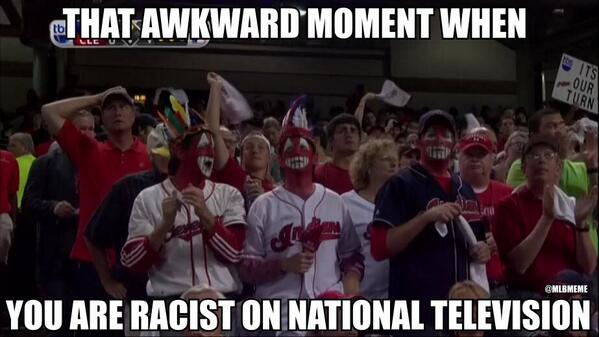
An odious scene: Indians fans wore redface to last night’s game

By Craig CalcaterraI saw these guys on last night’s broadcast. Hat tip to Ted Berg of USA Today for getting the screen cap:We wouldn’t accept it if these guys showed up at a party in blackface. We wouldn’t cite “tradition” or “enthusiasm” and act as if it wasn’t racist for them to do so. If they wore blackface at a ballpark I am pretty confident that security would have them removed, for their safety among other reasons.

But to pull Indian redface in Cleveland? Hey, no worries. Go Tribe. Quit your complaining, Calcaterra. Indeed, I’m assuming that for even mentioning this I will be accused of being an overly-sensitive P.C. liberal who doesn’t understand that no one finds this offensive and, hey, my Native American father-in-law has no problem with it. If they decided not to go the ad hominem route they’d probably offer something like, “hey, he’s on the caps. So obviously it’s about team spirit, not racism. It’s just a cartoon character, so it’s not offensive.”

But of course it is offensive. And disgraceful. And as long as the Cleveland Indians continue to use Chief Wahoo as their mascot and primary logo, idiots like these three will believe that it is socially acceptable to do with Indians that which we would never tolerate if it was done with other races. They will be given the official cover to make specious arguments excusing their racist acts.
Why Did TBS Show Cleveland Fans Dressed Up In Redface?

By Travis WaldronFans obviously don’t see much of a problem with this sort of dress-up, because they do it at Indians games and Washington Redskins games and at other sporting events featuring Native Americans. They Tomahawk Chop and depict Native Americans getting slaughtered and all sorts of other ignorant things because they are fans and because the appropriation of Native American imagery and culture in sports, not to mention in the rest of society, has desensitized them to the fact that Native Americans deserve respect. We’d never be OK with this if it was another racial minority being depicted, if fans showed up to games wearing blackface.

And neither would TBS. So why did they choose to focus on these fans? One possible explanation is that TBS itself is particularly desensitized to the whole issue because it used to be closely affiliated with another team that appropriates Native American culture. TBS’ founder, Ted Turner, used to own the Atlanta Braves, and the network used to broadcast the Braves’ every game. TBS played a major part in making the Tomahawk Chop a thing during the Braves’ worst-to-first playoff run in 1991 and during Atlanta’s incredible stretch of 15 consecutive division titles thereafter. If TBS doesn’t see a problem with this sort of dress-up, it isn’t hard to understand why.
Indians fans' redface raises eyebrows

Comment:  This should be the next target of the activists targeting the Washington Redskins. Heck, they should target both offenses simultaneously to take advantage of the growing concern about mascots.

For more on Chief Wahoo, see Make Indians' Owner into Mascot and Semipro Team Uses Chief Wahoo.

TV networks should challenge "Redskins"

Hey, Broadcast Chiefs: Time To Tackle Redskins’ Racist Mascot Problem

TV networks need to take the lead in nickname scrum

By Steven Gaydos
Perhaps the most overdue demonstration of one scintilla of the testosterone that drives the multibillion dollar sports broadcasting industry is for one leading figure from CBS, ESPN, Fox, NBC et al to stand up to the dude who owns the Washington Redskins and say, “We think your refusal to change the name of your franchise stinks.”

Perhaps that could be phrased in a slightly less contentious, confrontational manner, but hey, this is the big-time macho, masculine world of concussions, blown knees and lots of violent felony convictions.

Could the television, radio and online folks making billions off all of the crashing and banging on field demonstrate that they have one tiny gonad between all of them?

Or do the riches they make off the NFL render them as impotent as a pep squad full of castratos?
More opposition to the "Redskins" nickname:

Indian rapper wants you to "Say No to the R Word"

By Erik BradyThe protest over Indian team names in sports has taken another turn with release of "Say No to the R Word," a new song from Alvin Shawn Enfinger, an American Indian rap artist popularly known as Shadowyze (pronounced "shadow wise").

The R Word is a reference to the team name of the Washington pro football club. Shadowyze, who is of Muskogee-Creek, Cherokee and Irish-Swedish heritage, wears a T-shirt on the CD cover with a slash through the letter R.

Here is an excerpt:

Indian eyes are watching TV

Watching oppression as a rolling sea

Looking at a logo of an ugly face

And calling it Indian is such a disgrace
Comment:  So Variety the industry "bible" is getting involved? That means Hollywood execs may starting taking notice. If TV networks begin applying pressure, you can kiss the nickname good-bye.

October 02, 2013

Director: Native actors lack "charisma"

'Jimmy P.' Director: 'I Was Obsessed With Not Betraying the Community'

By Dominique GodrecheThis is the second part of our interview with Arnaud Desplechin, director of Jimmy P.: Psychotherapy of a Plains Indian, which stars Benicio Del Toro as a Blackfeet Indian suffering post-traumatic stress after returning home from World War II.

Did you choose Benicio Del Toro as Jimmy because you needed an actor capable of supporting the production, or had you also thought of a Native actor?

For economic reasons, I needed to arrive in the United States knowing which actor I had chosen. So I had to do the casting through watching Native actors in movies that my assistant brought me back from the United States. It was very difficult, as I could not find “Jimmy,” or anyone with enough charisma to play the role. Then I remembered The Pledge, and Benicio Del Toro‘s great performance as a Native; and it appeared to me that with this background of a Hispanic from Puerto Rico, settling in the US, and achieving such a career, he could have something in common with the Native people. So I brought him The Exiles, by Kent MacKenzie, and told him: “You would be the best Jimmy.” And strangely, with Benicio Del Toro, Jimmy appeared. So the decision really came from me; it was not just a production issue. Benicio liked the role of Jimmy, and found some common roots with the Native experience.

How did you cast the Native actors? Did you find directing them different from your previous experiences as a film director?

No, it was very easy; other than cultural differences, it was like working with any actors. I told them I knew nothing [about Native American culture], and asked them, “Do you agree with this, or that?” I was obsessed with not betraying the community. We discussed where to shoot and how to develop the dialogue. When I saw the movie Frozen River, I understood that Native Americans could represent themselves; I knew Misty Upham from Frozen River, and wrote the role [of Jane] for her. And the presence of Gary Farmer at the beginning of the movie, as a mythical figure, was important to me.
Comment:  Summing it up, Desplechin was obsessed with not betraying the Native community, but he couldn't find a Native actor with charisma, so he hired Benicio Del Toro. Okay, wow.

Natives scoff

Some reactions to this posting on Facebook:I'm sorry, but what a stupid statement to make: "Couldn't find a NA actor with charisma." You really should keep statements like that to yourself.

Yes it was a dumb thing to say there are lots of Native Americans who can act and have charisma.

Guess they didn't look too far for a NA actor to play the roll. Poor excuse. Sometimes covering up an "oops" becomes a bigger "oops."

He picked Benicio because he could sell the movie. Not because of charisma, what bullshit.

It all comes back to money. There are tons of Native actors with 'charisma' out there. But the reality is, if you want your movie to get made and be seen, name recognition is hugely important. Sad as it is to say, if he'd cast an unknown native actor this film might not have been made. That's the way the film industry works. I dislike that reality as much as any of you, but I'd rather have a great actor like Mr. Del Toro playing the role and having this important story being told to millions of non-natives than not being told at all. And yes, he took the easy way out because of financial reasons. I'm certainly not endorsing that or apologizing on his behalf. Just saying, we need to keep that in mind.
Del Toro has name recognition, certainly. But his films haven't made a lot of money. I don't see the point of hiring a "name" if he isn't a proven money-maker.

To reiterate, Desplechin said he couldn't find the right actor. Hundreds of Native actors in the right age range have professional experience, but none supposedly have the necessary "charisma."

Okay, but Del Toro explicitly said it was a money issue. Desplechin couldn't make the movie without him because investors wanted a "name" actor. So why exactly was Del Toro cast: for creative or financial reasons?

These comments represent a basic conflict that we see over and over. Producers and directors say they tried and tried but just couldn't find any qualified Native actors. Which sounds like a racist argument given all the movies with Native actors.

Then they switch and say they had to hire non-Native actors because of the bottom line. Which sounds like a racist argument given all the movies that flop with non-Native actors. And which contradicts the previous claims about the lack of Native actors.

Dishonest claims

I might respect someone who said, "There are dozens of qualified Native actors but the investors forced me to hire a non-Native." Or, "It has nothing to do with earning a profit; Native actors simply lack the necessary skills." These statements would be morally dubious, but at least they'd be honest.

But to my knowledge, no one has ever said anything like that. Hollywood people use whichever argument they think they can get away with--whichever one won't get challenged. If you raise the "qualifications" argument, they say it's about the bottom line. If you raise the "bottom line" argument, they say it's about qualifications.

Either way, it's really about racism. Which you can kind of see in Desplechin's comments if you read between the lines. He knew little about Native cultures other than what he read in a couple of books. He knew little about Native actors other than what he saw in a couple of movies. He didn't even realize Natives could represent themselves until he saw Frozen River.

When he thought about Native actors, nobody came to mind. Then he remembered Del Toro, who looks vaguely Native and may have played a Native once. Voilá! A "name" actor who's sure to placate investors and critics. Everyone thinks Del Toro is talented enough to play any role. No need to look any further for a Native actor.

In short, Desplechin believed non-Natives could do the job but Natives couldn't. I'd say this is basically a racist train of thought. He can dress it up with talk about qualifications or the bottom line, but he's distinguishing between actors on the basis of race. That's the definition of racism.

For more on casting decisions, see Del Toro: Redface Is "Tradition" and What's Wrong with Del Toro and Depp?

Below:  "Jimmy P. co-star Benicio Del Toro, director Arnaud Desplechin, and co-star Mathieu Amalric."

History class in Modern Family

Suddenly, Last Summer, the second episode of Modern Family this season (airdate: 9/25/13), included a Native-oriented sequence. Here's the scoop:

Cameron (Cam), a flamboyantly gay man, is asked to substitute-teach an Advanced Placement history class. He knows next to nothing about history, so he decides to dress as George Washington to get the students' attention.

His partner's niece Alex is one of the students in the class. She's embarrassed by Cam's antics and tries to get him on track.ALEX: Our syllabus says we're supposed to cover Native Americans on the eve of colonization.

CAM: Yes! Native Americans! Indians! A majestic, peaceful people who lived off the land and cried when they saw litter.

ALEX: The textbook says many tribes were often at war with allegiances shifting all of the time.

CAM [a beat slow as he tries to copy her]: --shifting all the time.

STUDENT: So...were the Indians friends with the colonists, or not?

CAM: Ah! Yes! I know one Indian who was friends with a construction worker, biker, and traffic cop.

[Cam laughs at his own joke, but notices no one else is laughing.]

CAM: Do you g--nothing, seriously nothing? Okay, your parents are going to love that joke.
Later:ALEX [diagramming on the white board]: The Native Americans and the settlers had two completely different ideas of land ownership. Eventually, these differences would lead to war.

[Cam gasps in surprise. He leans forward to talk to another student.]

CAM: Look, goosebumps.
Comment:  This is one of those ambiguous bits about Natives you often see on recent TV shows.

Alex is clearly more knowledgeable about Indians than Cam is. And her statements are basically accurate without casting Indians in a bad light.

Cam offers Native (mis)appropriations--the crying Indian, the Village People--as "jokes." But it's not clear if one comment--"A majestic, peaceful people who lived off the land and cried when they saw litter"--is really supposed to be joke.

Will viewers get that this superficial view of Indians--that they're all members of one eco-friendly tribe--is false and stereotypical? I wouldn't bet on it.

To be effective, Native-oriented humor should be clear about what's true and what isn't. These Native bits sort of pass the test, but not quite. Alex and the other students sort of reject Cam's ignorant views, but not quite.

That's why I say these bits are ambiguous. That some writers are trying to do Native-oriented humor properly, without mistakes or stereotypes, is good and commendable. But they haven't quite nailed it yet.

For more on Modern Family, see 1/16th Cherokee in Modern Family.

October 01, 2013

Government shutdown hits Indian tribes

Government Shutdown Frustrates Tribal Leaders

By Rob Capriccioso“What is just partisan game playing in Washington, D.C. is a battle for survival in Indian country where many of us barely subsist,” said Edward Thomas, president of the Central Council of Tlingit and Haida Indian Tribes. “Many of our 28,000 tribal citizens live at the very edge of survival and depend upon our tribe’s ability, with federal funding, to provide critical human services.

“Any interruption in federal funding, especially for a self-governance tribe like ours without gaming or other substantial economic development, means we must borrow money–from an expensive line of credit we cannot afford–to meet our payroll obligations to child welfare workers, to job trainers, to housing workers, and to natural resource subsistence protection,” Thomas said.
Shutdown hits vulnerable Indian tribes as basics such as foster care, nutrition threatened

By Associated PressFor the 13,000 members of southeast Montana’s Crow Tribe, the budget impasse had immediate and far-reaching effects: Tribal leaders furloughed more than 300 workers Wednesday, citing the shutdown and earlier federal budget cuts.

As a result, tribal programs including home health care for the elderly and disabled, bus service for rural areas, and a major irrigation project were suspended indefinitely.

“It’s going to get hard,” said Shar Simpson, who leads the Crow’s home health care program. “We’re already taking calls from people saying, ‘Who’s going to take care of my mom? Who’s going to take care of my dad?’”
Indian Country hit hard by government shutdown

By Kevin Taylor and Jenni MonetThe federal government plays a critical role for the 1.7 million American Indians and Alaska Natives in the 566 federally-recognized tribes, providing key services that include health care, schools, social programs and law enforcement protection, all supported by its long-standing treaty obligations made with Native Americans.

Some essential services will continue during the shutdown, such as law enforcement and firefighting, according to the Bureau of Indian Affairs. And the 176 Indian Health Service hospitals and clinics will stay open.

But the shutdown means freezes have already been placed on nutrition programs, foster care payments, financial assistance for the poor and anti-elder abuse programs. Some tribes risk losing all their income in timber operations if federal employees aren't there. Vital contracts and grants will be stalled.
NCAI urges Congress to reach budget deal

By Peter L. MorrisThe failure to come to a budget agreement threatens the capacity of tribal governments to deliver basic governmental services to their citizens. The federal government has made treaty commitments to our people, and in return we ceded the vast lands that make up the United States. The immediate shutdown crisis poses very real threats to tribal governments and denies health, nutrition, and other basic services to the most vulnerable tribal citizens.

Even if the shutdown is resolved soon, a greater crisis remains–both the House and Senate versions of the Continuing Resolution sustained the devastating FY 2013 sequestration cuts. The sequester has deeply affected tribal programs: the Indian Health Service, Indian education funding streams, law enforcement, infrastructure programs such as housing and road maintenance, Head Start, and others. These funding commitments serve some of our nation’s most vulnerable citizens and are part of the federal government’s trust responsibility to tribal nations.
The survival of the Indian people is taking a new turn

By Tim GiagoIt is quite easy for members of Congress to sit back on their fat haunches and not give a hoot for the health problems of the rest of Americans. After all, they have one of the best health care policies to be found in this country. In this land called America that touts itself as an example of democracy and fair play, there are more than 40 million Americans without health insurance who fall through the cracks.

But this isn’t just happening on the local scene. There are thousands of Americans, white, black, Hispanic, Native American, etc., who will go hungry when the budget cuts on food stamps take place. It makes us wonder what in the world is happening to this country. It is well documented that the rich are growing richer while the poor are growing poorer, and that seems to be the new norm in this country.
Why Race Matters in the Government Shutdown

By Imara JonesAs the parts of the government affected by the shutdown disproportionately impact economic opportunity programs for the working poor, historically marginalized communities are likely to the feel the effects of a shutdown acutely as time goes on.

What’s particularly distressing about the shuttering of the government is that it comes at a time when unemployment remains in the double digits for blacks and Latinos. As the Center for American Progress points out, federal, state and local governments since 2008 have eliminated 750,000 public sector jobs. Given unionization and strong anti-discriminatory hiring practices, people of color are more likely to have jobs in the public sector. This is particularly true for African-Americans, and it’s why joblessness remains so stubborn in communities of color.
Comment:  A quote from lawyer Chris Stearns sums up a key issue:Perhaps it might be fair, if during a shutdown, Indian tribes got to take back our lands in lieu of payments.Many government benefits to tribes are the results of treaties. Which are supposedly the supreme law of the land.

A treaty should trump any law or lack of law that cuts funding. Treaty benefits should be immune to political wrangling.

Stearns may be joking, but his point is correct. If the US government doesn't fulfill its obligations to tribes, it should give back their land. No payments, no land.

For more on the subject, see Republicans = Terrorists and Any Excuse to Hate Obama.

"Defund Obamacare" = "nigger, nigger"

The real story of the shutdown: 50 years of GOP race-baiting

A House minority from white districts want to destroy the first black president, and the GOP majority abets them

By Joan Walsh
When Democratic pollster Stanley Greenberg studied the voters of Macomb County, a hotbed of so-called Reagan Democrats—the county gave two-thirds of its votes to John F. Kennedy in 1960, and the same proportion to Ronald Reagan in 1980—he found that they no longer saw Democrats as working-class champions. “Blacks constitute the explanation for their vulnerability and for almost everything that has gone wrong in their lives,” and they saw government “as a black domain where whites cannot expect reasonable treatment,” Greenberg wrote.

So for a lot of Democrat-turned-Republican voters, “government” was all about black people, Reagan knew. You didn’t have to be racist to thrill to Reagan’s declaration that “government is not the solution; government is the problem,” though it didn’t hurt. Republican strategist Lee Atwater explained exactly how it worked in a now-infamous 1981 interview that was secret for 30 years. Atwater explained how the GOP dialed down its racial rhetoric for fear of alienating white moderates who might buy the GOP’s anti-government crusade, but be uncomfortable with outright racism.

This is Atwater talking to an academic interviewer in 1981, Year One of the Reagan revolution:You start out in 1954 by saying, “N–ger, n–ger, n–ger.” By 1968 you can’t say “n–ger”—that hurts you, backfires. So you say stuff like, uh, forced busing, states’ rights, and all that stuff, and you’re getting so abstract. Now, you’re talking about cutting taxes, and all these things you’re talking about are totally economic things and a byproduct of them is, blacks get hurt worse than whites … “We want to cut this,” is much more abstract than even the busing thing, uh, and a hell of a lot more abstract than “N–ger, n–ger.”And then you say “Defund Obamacare,” and everyone knows why.
Walsh's response to the right-wing racists who don't like their racism made plain:

Angry right gets mad when you accuse it of race-baiting!

Comment:  I've said similar things many times, of course. The Republican Tea Party protests against Obama, Obamacare, welfare, immigration, gun control, gay marriage, etc., etc., are about maintaining white Christian control over the country. White Christians see their power slipping away as the country's demographics change, and they're trying to stop it.

Probably the best evidence that opposing Obamacare = racism is the Republicans' complete lack of concern about Romneycare, a similar program on the state level. Both programs have individual mandates, which are supposedly what will enslave us like Nazi Germany. If your concern is about government interference in the healthcare market, you must protest Romneycare or you're a hypocrite and a fraud.

For more on conservative racism, see Indians Are Inconvenient to Americans and Republicans Want Poor People to Die.