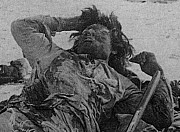
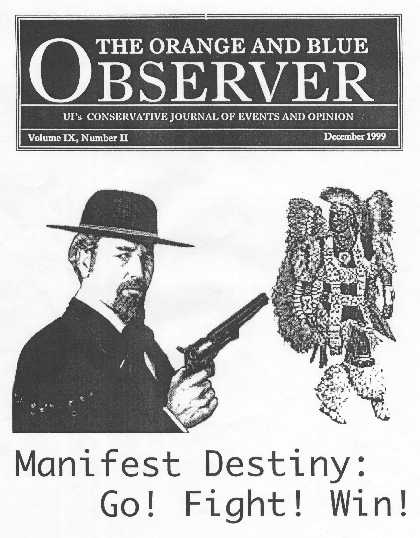
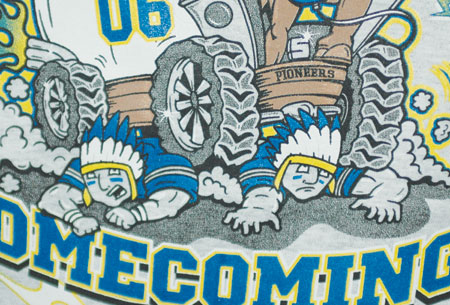
Showing posts with label King Philip's War. Show all posts

April 12, 2013

Barton lies about King Philip's War

David Barton, a right-wing Christian "historian," said Indians got what they deserved in Barton: Indians Fought to Keep Torturing. Here's a rebuttal:

David Barton's Lies About King Philip's WarVirtually everything written about Natives in colonial New England is viewed through an ethnocentric lens of the master narrative. Further it is structured by a religious zeal which proclaims their god given right of manifest destiny to “rid the world of heathens” and “proselytize the gospel.” In order to maintain this propaganda and justify the theft and slaughter of millions; a controlled and consistent "record" reflecting the dehumanization of Indians was required.

We don’t have to delve into a rustic dusty library to research an old text to note the malefic and racist attitudes towards Natives of long ago.

David Barton recently provided a stellar example of this myopic behavior on the appropriately named Wall Builder Show.

He views the attack and destruction of Native peoples as the linear and spiritual progression of god’s chosen people. He claims to speak from a “historical and biblical point of view” and that it’s “not about fairness but of justice…god’s justice,” he said.

When Barton referred to the cause of King Philip's War of 1675 he claims, “The Moravian missionaries went to the Indians and told them to stop torturing each other to death, so the Indians said the white guys are trying to change our culture. So they declared war on all the white guys, it was torture on one side and trying to be civilized on the other and that was King Philips War.”

This is brazenly false. The Moravian missionaries don’t arrive in America until 1735. And let’s use logic here-if the Indians were all torturing each other to death, I’m quite sure the English would be inclined to just stay out of the way. And we can’t discuss torture unless we mention one of the favorite punishments by the English, which was decapitation and displaying the head on pole. Then there was nailing you down by your ears to a frame, in a device called a pillory. We even see our first form of water boarding with the ducking stool. Whether it was piling stones on top of person, riding the timber mare, flogging or just burning you at the stake; it’s safe to say the first settlers were no strangers to divers’ methods of torture.

Barton’s mendacity is evocative of a time when race and religion supersede any human rights. And that’s what King Phllip's War was really about, human rights. After years of pent up anger, insults, murder and theft, war was inevitable.
One commenter added:This type of thinking about American Indians by David Barton, a highly regarded "authority" in many Christian circles, is an excellent example of how American Christians rationalized the ungodliness of their ancestors actions starting with the Pilgrims. Barton is not stating anything new, he's just articulating it in a more blunt fashion. It is unfortunate that American Christians starting with the Pilgrims failed to rely upon the Bible, their supposed basis for all their actions. The Bible tells Christians to "missionize" and "preach" NOT move in and take over. The Bible provides no justification for conquest, in fact it specifically prohibits these types of actions. But unfortunately no American Christian authorities publicly acknowledge this, so people like Barton continue to spread and re-enforce the lies. Adolf Hitler said it best: "Make the lie big, make it simple, keep saying it, and eventually they will believe it.”Comment:  For more on King Philip's War, see Roger Williams, Slave Trader and Radio Show on King Philip's War Game.

May 17, 2011

King Philip sculpted unstereotypically

Note how much care and effort this sculptor put into his portrayal of King Philip:

Mattapoisett Statue Honors Metacomet

By Laura Fedak PedulliThe 20-pound bronze head took Mr. Englund six months to complete, and the sculptor created a proud, angular face with high cheekbones and thin lips. Mr. Englund noted that representations of Metacomet often are ugly or unattractive, although his sculpture is a more dignified face of a man known for his bravery and ability to escape from colonist attacks. In the end, it was Captain Benjamin Church–with the help of Christianity-converted “Praying Indian” John Alderman–who killed Metacomet. His head was mounted on a pike and transported to Plymouth, where it stood for more than 20 years, Mr. Englund said.

“I wonder if I had been here [as a Wampanoag], whether I would have passed on defiance or acquiesce," mused Mr. Englund.

Details in Mr. Englund's sculpture are the product of his own research into the rise and fall of Metacomet. The feathers are pulled back on his head because Metacomet had worn them that way to avoid detection, Mr. Englund explained. Also, Metacomet is wearing a necklace of wolf teeth, another indicator of his bravery. In Metacomet's ear is a silver wire with a single earring attached, made from seashell. As a substance, seashell was so important to the area natives that the term Wampanoag actually translates to "seashell.”

Mr. Englund mounted the bust on a large solid oak base in recognition that Metacomet's capture occurred under an oak tree.

One noted trait of Metacomet and other pieces by Mr. Englund is the absence of eyes in the sockets. "Eyeballs block your entering into a piece," he explained. When approaching the statue, Metacomet's eyes seem to glint with the interaction of light on bronze.
Comment:  There's no picture of this statue, but the description is good. It sounds like the opposite of the approach Cyrus Dallin took with his stereotypical sculpture of Massasoit, King Philip's father.

For more on King Philip, see Roger Williams, Slave Trader and King Philip Chainsaw Statue.

March 20, 2011

The Pirate Prince Carlomagno

We learned what happened to King Philip's son in Roger Williams, Slave Trader and King Philip's War in After the Mayflower. Here's a press release about a novel that imagines a different outcome:

Wampum Books announces the release of The Pirate Prince Carlomagno, a Native American Pirate Adventure brought to life by award-winning journalist and author John Christian Hopkins.

Native American Author Brings New Twist to Pirate Adventure“Metacom meets Errol Flynn! John Christian Hopkins is one of the most important indigenous writers from New England today, and here he covers the region’s painful, complex history with insight and swashbuckling originality.”

Siobahn Senier, English Professor, University of New Hampshire
In an exciting, action-filled adventure, author John Christian Hopkins spins a historic tale of a young American Indian boy who is captured, marked for death and eventually sold into slavery in the Caribbean.

The Pirate Prince Carlomagno is the story of what may have happened to the actual historical figure, the son of King Philip or Metacomet of the Wampanoag tribe. The fate of the great chief’s son is lost to history, but in Hopkins’ version, the enslaved child yearns for freedom and a chance to return to his beloved New England home. With his choices limited, and enemies all around him, the young man becomes the legendary Carlomagno, fiercest of the Caribbean pirates. Immersed in action, adventure and political intrigue, and opposed by ruthless mercenary Chevalier de Fortenay, Carlomagno struggles to remain true to his Native heart as he relies on his mighty sword arm to keep his freedom. But his biggest challenge turns out to be the mysterious Anasarani.
Comment:  For more on the subject, see King Philip Chainsaw Sculpture and Preview of Ink--A Tale of Captivity.

March 09, 2011

Roger Williams, slave trader

Roger Williams plaque under review

By Paul DavisState officials met Tuesday to discuss a controversial plaque that will focus on Roger Williams’ efforts to sell Indian war captives into slavery.

The Department of Transportation has agreed to erect a plaque in Providence, but has yet to agree on how it will look or where it will go.

During a closed meeting, DOT officials talked about materials, size, design and location, but made no decisions, said DOT spokeswoman Dana Alexander Nolfe.

Native American Julianne Jennings suggested the plaque a year ago.

The public marker will be the first in the region dedicated to “an almost forgotten piece of New England history,” said Jennings, a former Rhode Island College professor now studying at the School of Human Evolution & Social Change in Tempe, Ariz.

In 1636, Narragansett Indian Sachem Canonicus and his people gave Roger Williams the land that later became the Rhode Island colony, according to Jennings’ wording for the plaque.

But, in just 40 years, “relations between the colony and the Narragansett Indians became strained as a result of frequent intercultural conflicts,” the text says.

Those conflicts erupted into the bloody King Philip’s War, which raged for several years during the 1670s.

After the fighting was over, Roger Williams and other Colonists held a town meeting on Aug. 14, 1676, Jennings said.

The town was full of Indian prisoners, and “slavery was regarded a fit punishment” for their crimes, Jennings said. They were sent to the Caribbean, Portugal, Spain and Africa, where they were sold as slaves.
Compare this to the conventional view of Roger Williams:

Roger Williams (theologian)Roger Williams (circa 1603–between January and March 1683) was an English Protestant theologian who was an early proponent of religious freedom and the separation of church and state. In 1636, he began the colony of Providence Plantation, which provided a refuge for religious minorities. Williams started the first Baptist church in America, the First Baptist Church of Providence, before leaving to become a Seeker. He was a student of Native American languages and an advocate for fair dealings with Native Americans.

Indian language and culture

Williams intended to become a missionary to the Native Americans and set out to learn their language. He studied their language, customs, religion, family life and other aspects of their world. As a result he came to see their point of view about colonization and developed a deep appreciation of them as people. He wrote his A Key into the Language of America (1643) as a kind of phrase book coupled with observations about life and culture as an aid in communication with the Indians. In it he talked about everything from salutations in the first chapter to death and burial in chapter 32. The book also sought to instruct the English, who thought of themselves as vastly superior to the Native Americans, that they were mistaken. He repeatedly made the point that the Indians were just as good as the English, even superior in some respects.

"Boast not proud English, of thy birth & blood;
Thy brother Indian is by birth as Good.
Of one blood God made Him, and Thee and All,
As wise, as fair, as strong, as personal."

Having learned their language and customs, Williams gave up the idea of being a missionary and never baptized a single Indian. He was severely criticized by the Puritans for failing to Christianize them, but Williams had arrived at the place in his own thinking that no valid church existed. He said he could have baptized the whole country, but it would have been hypocritical and false. He formed firm friendships and developed deep trust among the Native Americans, especially the Narragansetts. He was able to keep the peace between the Indians and English in Rhode Island for nearly forty years because of his constant mediation and negotiation. He twice surrendered himself as a hostage to the Indians to guarantee the safe return of a great sachem from a summons to a court: Pessicus in 1645 and Metacomet (King Philip) in 1671. He more than any other Englishman was trusted by the Native Americans and proved to be trustworthy. In the end King Philip’s War (1675–1676) was one of the bitterest events in his life as his efforts ended with the burning of Providence in March 1676, including his own house.
Comment:  Curiously, Williams's Wikipedia entry doesn't mention the slavery incident. I wonder why not.

Julianne Jennings is a friend who's appeared in this blog before. She led the protests against the King Philip's War game last year.

For more on King Philip, see King Philip Chainsaw Sculpture and King Philip's War in After the Mayflower.

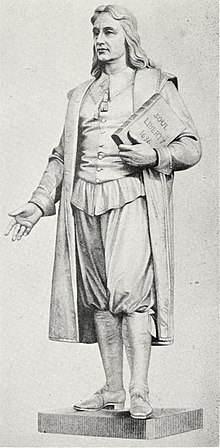
Below:  Roger Williams statue by Franklin Simmons.

March 02, 2011

King Philip chainsaw sculpture

Raynham was protected during bloody King Philip's War

By Rebecca HymanHow did the leader of Native American forces in a devastating war with settlers come to be seen as such an important and proud part of Raynham history?

Metacom, known to settlers as King Philip, is such an iconic figure in town the Cultural Council picked him to be the subject of artist Jesse Green’s chainsaw sculpture honoring a piece of Raynham history.

And it’s no accident there’s a King Philip Street in town.

Historical Commission Chairman Lou Pacheco said Metacom is remembered as a “benevolent” figure in Raynham because he forged a cooperative relationship with the owners of the old ironworks and, in effect, issued an order not to harm the people of Raynham.

As a result, Pacheco said, Raynham was a peaceful island during the horrific King Philip’s War that ravaged both sides across New England in 1675-76 and left neither with clean hands.
Comment:  For more on the subject, see Preview of Ink--A Tale of Captivity and Radio Show on King Philip's War Game.

Below:  "Chainsaw artist Jesse Green works on his King Philip sculpture at Raynham Pride Day in September."

October 06, 2010

Preview of Ink--A Tale of Captivity

Ink--A Tale of CaptivityInk--A Tale of Captivity is the Mary Rowlandson story. A new movie produced by Alice van Buren of Inkwell Santa Fe Productions. The Story: 1676 Boston--Taken by Indians, a preacher's wife becomes the first woman published in America.

Wes Studi is King Philip, the mysterious Wampanoag leader; Gary Farmer appears as the tratior Alderman.
Trailer One:  The Captivity Narrative--Mary Rowlandson (Angela Janda) reading from her captivity narrative.


Trailer Two:  Captivity Scene--Mary Rowlandson (Angela Janda) with King Philip (Wes Studi) discussing the terms of her captivity.


The history in question:

Mary RowlandsonMary (White) Rowlandson (c. 1637–January 1711) was a colonial American woman who was captured by Indians during King Philip's War and endured eleven weeks of captivity before being ransomed. After her release, she wrote a book about her experience, The Sovereignty and Goodness of God: Being a Narrative of the Captivity and Restoration of Mrs. Mary Rowlandson, which is considered a seminal work in the American literary genre of captivity narratives.Comment:  The trailers show a burning house, scalps nailed to a wall, King Philip riding a horse, and what looks like the interior of a tipi. I sure hope the movie doesn't have any mistakes or stereotypes.

For more on the subject, see The Best Indian Movies.

April 01, 2010

Radio show on King Philip's War game

King Philip's War game designer John Poniske wrote this summary of his appearance on a radio show Saturday:A wonderful thing occurred last week. Tim Weisberg extended an invitation to Brian Youse, Professor Jennings and myself to attend (by phone) a session of his late night radio show SPOOKY SOUTHCOAST. There IS a connection as the prevalence of supernatural occurrences in the area are attributed to the tremendous bloodletting in King Philip's War. I was assured that the discussion would be amicable.

The promised dialogue took place last night, Saturday, March 27 between 10 and Midnight. Professor Jennings described the War, its origins and its aftermath, I entered in at 11:15 and described my background, interest in the conflict, as well as my philosophy and purpose for the game. Moreover, Tim openly supported the title and called for preorders on the air!

The discussion was satisfyingly civil and even-handed. I admitted that American Indian input would help the game. Professor Jennings admitted that the game KING PHILIP'S WAR could prove to be a benefit in disseminating information about the New England tribes.

Neither of us surrendered to the other, nor did we fall on our respective swords. We did what rational people are supposed to do, we talked with a view toward understanding each other. Prior to the interview I contacted Professor Jennings at her university office so our meeting on the air would not be uncomfortable. I also took her advice and called the offices of the area Indian Council to clear the air. Positive dialogue has begun. Positive dialogue will continue.
Comment:  For more on the subject, see Dialog on King Philip's War Game and Gamers Defend King Philip's War Game.

March 23, 2010

Dialog on King Philip's War game

After the weekend protest of the King Philip's War game, the following exchange ensued via e-mail:Ms. Jennings,

We are currently working with members of the Wampanoag Nation, including a woman you may know who goes by the name Yellowfeather, whose husband and several other tribe members are playtesting our simulation on King Philip's War. Squa-Sachem Yellowfeather is not opposed to the nature or publication of this game, and her consultations with MMP about this game are invaluable.

My understanding is that Squa-Sachem Yellowfeather is a direct descendant of Massasoit, and we are confident that the final-production version of this game will meet her approval and will be a fine addition to MMP's line of games.

Sincerely,

Brian Youse

Vice-President, Multi-Man Publishing, Inc.
Jennings's response:Brian,

Thank you for writing to me.

What about giving other tribal groups in the region an opportunity to test the game and also give recommondations as we are not totally opposed to the game, but content and learning outcomes. Yellow Feather only represents one faction of the Wampanoag Nation as there are several (Pocassett, Wampanoad, Seekonk, Wampanoag, Nimpmuck, Wampanoag, Assonett Wampanoag, etc., Pequot, and the Narragansett Nation) each with there own concerns. Maybe you would be willing to organize a game demonstration held at the Rhode Island Council in a few weeks for the learders of these groups to help us understand more.

Thank you,
Julianne Jennings
Another round

Youse's response:Ms. Jennings,

We are interested in demonstrating the game in Rhode Island and would love to meet the Rhode Island Council. We would welcome the input, and I am sure there would be a beneficial exchange of ideas. However, neither the designer nor the two active owners of MMP live anywhere near New England, and we all have day jobs and families with commitments that often interfere with our ability to travel. Additionally, MMP is a very small company with our only full time staff being the office help who answer phones, pack orders, arrange shipping, etc. The expense of a trip to RI, and the time away from our "day jobs", is prohibitive. Expenses such as additional pre-production copies were not included in our budget and so must be limited to those that have already been produced. We would gladly offer to demonstrate the game to those who have an interest if we could do so at our facility here in Maryland.

We welcome input from all areas, but game design and development cannot be conducted by committee. We cannot commit to including the particular views of anyone outside the design team, and I don't think that anyone can realistically expect us to obtain input from every tribe or faction who might be interested. As far as testing the game play is concerned, we are fairly happy with our current playtesting process and do not see the need at this point to expand that process. I hope you can understand that we do not want too many pre-production copies of the game floating around, especially if one considers the expense involved. If we run into any problems down the road, we will certainly consider your offer.

Thank you again for your interest. For what it is worth our intent is to educate with a historically accurate game, provide entertainment, and balanced competition between players. We believe that we have done so in a manner that is reasonably sensitive. We will be reviewing the game materials before final production with an eye towards content and accuracy of the events portrayed.

Sincerely,

Brian Youse

MMP
Jennings's follow-up message to her supporters:I am having conversations with MMP. I am taking the role of educator on this. I don't think we are going to stop the game, but creating dialog to make improvements maybe the best compromise as people do enjoy playing war games. If this game is truly an opportunity to teach about the conflict, I am concerned with content and learning outcomes. I have no reservations about the historical material they collected to make the game as this is widley available. However, I am concerned about certain language. Due to having conversations with MMP, they seem to be willing to remove the word "eliminate" for "captured and defeating King Philip and other leaders." By changing the words it supports our continued existence and that all tribes were not "eliminated," and that many have sought re-acknowledgement post war. Also, I want to add a piece in the instruction/educational manual about post war/slavery and the affects of "blood mixing." Many living "outside" Indian communities see this as a dilution of blood and culture, when in fact membership was always based on community and society.

I am arranging a visit to meet with them personally. I would like 2-3 leaders to join me in this campaign. This is an out of pocket expense, driven by the heart.

Julie
Comment:  Glad to hear people are talking. Let's hope Jennings can get some learning outcomes into the educational manual, or whatever.

Also good to hear MMP consulted with one Indian while developing the game. But relying on one person is a little fraught with danger. Several tribes were involved in the war, and each has clans and factions. A few Native participants would've been better.

Also, MMP should avoid getting someone who doesn't like to be critical or rock the boat. And someone who isn't sensitive to stereotypical themes and language. I don't know if Yellowfeather is up to the job, but Jennings probably is.

Discuss first, then protest

As I said to Jennings or someone, this game isn't that big a deal to me. I see equally questionable things in the news several times a month. If I got as deeply involved in each controversy as she did in this one, I'd quickly burn out.

As I also said, I would've limited myself to a blogging and letter-writing campaign. A public rally against a game that's still in pre-production seems a bit much to me. I'm all about discussing and debating first and marching and boycotting last.

For more on the subject, see Gamers Defend King Philip's War Game and Reactions to King Philip's War Game.

P.S. Is the company called Multiman Publishing, MultiMan Publishing, or Multi-Man Publishing? Standardize your spelling, people!

Let's play the fun Rwanda game!

In Gamers Defend the King Philip's War Game, someone helpfully explained the purpose of war games to us. Here are his comments and my responses:We get an insight into human nature, often at its worst, that keeps us honest and makes us reassess what lies within. It makes us think.Does a war game make you think about anything other than "human nature at its worst"? Because our culture has stereotyped Indians as savage killing machines for about 400 years. How does the King Philip's War game do anything but reinforce this stereotypical view?We ignore our nature at our peril.In this case, you mean the Indians' nature. The nature that led them to fight vicious, ruthless wars involving scalping, torture, and mutilation. According to the white man's view, that is.

We don't need to learn more of this stereotypical view of Indians. We need to learn less of it. In fact, we need to learn its opposite.

You implied the goal was understanding. How does the game contribute to a true understanding of the Indians' nature: their intelligence, their creativity, their spirituality? To their thousands of contributions to the arts and sciences? Answer: It doesn't.

Anonymous favors genocidal gamesModern wars have been no less bloody and goodness knows the atrocities continue--news from Angola, and Serbia, and Rwanda speak to how little Man has changed in the last 300 years.Great...so Multiman Publishing is thinking of producing a Rwanda game? Good idea. One side can play the Hutus and try to kill as many people as possible. The other side can play the Tutsis and try to keep as many people alive as possible.

Just as John Poniske did in the King Philip's War game, we can make up an arbitrary goal to determine the winner. If the Hutus kill more than 800,000 Tutsis, they win. If they kill less than 800,000 Tutsis, the Tutsis win.

I assume an experienced game developer like Poniske can factor in all the Rwandan war crimes. For instance, if a Hutu rapes 10 Tutsi women, it's equivalent to one dead Tutsi. Remember, the goal is historical accuracy, so we'll want to include a plausible gang-rape factor.

Poniske uses a die to introduce a random "fog of war" factor, which will work here too. For instance, when the Hutus surround a village, the Hutu player rolls three dice. Depending on the outcome, the Hutus rape anywhere from three to eighteen Tutsi women. Another roll of the dice determines how many women live through the ordeal, get pregnant, or die of injuries or shame.

Looking forward to Rwanda game

This is starting to sound like a really instructive game about the nature of modern warfare. I'm gonna strongly encourage Multiman Publishing to pursue it. Are you with me, gamers?

Reread your comments above, Anonymous. Wouldn't a Rwanda game teach us about the horrible but true history of warfare? About the dark side of human nature? About "what lies within"? Yes, I think it would.

Since understanding these things is supposedly your goal, give me a valid reason for not producing a historically accurate Rwanda game. Good luck with your answer...you'll need it.

For more on the subject, see Train the Holocaust Game and Designer Defends King Philip's War Game.

Below:  The colonists win a game of King Philip's War. Yay!

March 21, 2010

Gamers defend King Philip's War game

John Poniske, who designed the King Philip's War game and his fellows react to Saturday's protest in Providence, Rhode Island. And I react to them and their lame arguments.

King Philip's War Outrage:  Round Two

We begin with Poniske's summary of the event:A street protest occurred against my King Philip's War design and a second article has been presented in the Cape Cod Times. The link follows

http://www.capecodonline.com/apps/pbcs.dll/article?AID=/20100320/NEWS/3200324

In my response to the reporter, I thanked her for keeping her word in presenting a more balanced piece. I understand that those who are angered by the game have to be approached and quoted, but at least this time the newspaper offered the true purpose of the game. The more I read about the arguments against KPW the more I agree with my wife, "Some people refuse to be confused by the facts!"
In the article, Poniske states the so-called "true purpose of the game:"It is simply an attempt to recreate on paper and cardboard an occurrence in history," game developer John Poniske said. "It's too important, both in Native American history and in the history of this country, to ignore—which most of our history books do."In other words, his purpose is blindingly obvious to everyone. It's the same superficial reason given for teaching kids about Columbus or the Pilgrims: because it's history. People should learn things, especially things they don't know. Duh.

Keep that in mind as we proceed.

Gamers respond

Now let's see some of the responses:How silly. I guess some people would rather protest a game than a real injustice.How stupid that you're ignorant of the profound role of cultural myths and stereotypes in Native history. Read The Harm of Native Stereotyping:  Facts and Evidence and educate yourself.It's like the satanic accusations to D&D players. People don't know/understand something, so it must be bad. My country was overrun by Germany, nevertheless I like to play the losers (i.e. germans).We understand what Poniske said (above). Do you understand that his statement doesn't address the game's ramifications?

Where's your evidence that replaying the war as an isolated event will educate people about its causes and effects? About its political, economic, and moral dimensions?

If there's some deep, meaningful aspect of the game we've missed, by all means let us know. Put up or shut up, in other words.I really think the problem is that most people outside the wargame community have never even heard of the concept of a historical simulation or consim. When most people here the word 'boardgame' they think Monopoly, Risk, Clue, or disposable games based on movie franchises.Hmm...I think the problem is your simplemindedness. I.e., your childish attempt to switch to an ad hominem attack rather than address the issues we've raised. Nice try if you can get away with it.

"True purpose" is obvious

Actually, I'm sure most people get the idea of historical simulations. I know I do. Poniske explained the "true purpose" above and seemed satisfied with his explanation.

The people leading the protests have visited the King Philip's War website and read the rules. Do you have any more information about the game than they do? If so, go ahead and present it. Again, put up or shut up.People see something they don't understand (i.e. this game or D&D) and hence they believe something which was never intended. The game does not glorify one or the other side. It tries just to simulate a conflict. In D&D it was similar, people pretended to be for example sorcerers. However, religious people thought the game would encourage teenagers to become satanists. They didn't grasp the idea of simulating something. I believe in this case it is the same, these people don't get the idea of simulating a conflict and why.So people who don't know about the war and haven't seen the game are lecturing us about both. Funny!

Here we see the ever-idiotic "intent" argument again. News flash: What people intend and what they achieve are two different things, bright boy. Duhhh.

Some of the protesters have talked about the game's glorifying the colonists or the war, but I haven't. My arguments are the only ones that matter here.

I say the game ignores the war's historical context and moral dimensions. In other words, it sanitizes the war. Feel free to stop blathering and start addressing this argument.

Gamer unclear on what "fact" isAs I stated in another thread on this unfortunate situation, I am 1/8 Native American, and I can't find anything remotely troubling about this game. It protrays a historical fact, period. How refreshing it would be if the alleged "historians" quoted in the article would actually have taken the time to research just what wargaming is, the motivations behind the design and play of the games, and perhaps even contacted the designer to discuss their concerns.Let's ignore the ridiculous assumption that the critics have never heard of wargames and don't know anything about them. This assumption is unwarranted and asinine.

The game is still in pre-production mode. As far as I know, no one except the designers have seen it. Yet everyone here is talking as if they're experts on this particular game.

Nice try, boys, but I'm calling you on it. Prove to us that you've seen and played this game--that you're not talking out of your asses. Go ahead...we're waiting.

Perhaps the stupidest statement on this page is, "It protrays a historical fact, period." Really? So it's a fact that both sides decided whom to attack or massacre by the roll of a die? That the colonists and Indians had different goals: capturing towns vs. capturing leaders? I'd love to see the historical basis of those "facts."

What the game portrays is a small slice of "historical fact" abstracted to the point of unreality. What it doesn't portray is the historical context, moral dimensions, or consequences of that "fact."

It's much like a Columbus game where the object is to sail across the ocean. Or a Nazi game where the object is to herd people into railway cars. Without context, the game is false or misleading even if it's technically "accurate."

Gamer tackles Rob...look out

Someone dared to comment on my Protesting King Philip's War Game posting:I read that snippet as well and didn't see anything any more helpful or enlightening than I saw in the quotes I noted earlier.Pretty funny coming from people whose sole defense seems to be, "We understand gaming, though we can't articulate what it's about, but you don't."It reminds me of religious organizations that immediately criticize movies or books dealing with religious subjects without having even seen the movie or read the book first.Even funnier coming from people who haven't seen the King Philip's War game because it doesn't exist yet. Can you say "hypocritical"?

The people defending Poniske without having seen the game are the only ones acting like religious nuts. These people have "faith" that games are harmless because their designers say so.I also think the people quoted in the article are far too quick to take offense at slights, both real and imagined, and tend to look for reasons to become enraged.Offenders who blame others for pointing out their offenses...ho hum. We haven't heard that pathetic line of defense more than a few thousand times. For a few responses, see Excuses for Racism in Video Games, The "Cool Down" Defense, Racist "Jokes" Are No Jokes, Denial Ain't Just a River in Africa, and Racists Can't Think Straight.I still think that people like those quoted in the article remain willfully ignorant of the motivations behind wargaming, both in this specific instance, and in general.Wrong, dummy. But if you still think you're right, tell us the motivations you think we've missed. I can pretty much guarantee you I haven't missed them, but go ahead and surprise me.

Gamer almost "gets it"

Poniske's posting isn't all bad. Someone named Nico actually tries to understand the Indians' position:It sounds like they're upset that it's potentially being treated in a sanitized way, like a sterile event that didn't really happen. Treating war as a Manichean clash of totally irreconcilable people is not realistic in any form or context.

Also, it doesn't help that all of the places on the map use the Colonist names and borders.
And:"People don't know/understand something, so it must be bad." This is probably one of the arguments of the tribes--ie that the designer has not understood the conflict or the tribes' role in history.And:The way I'm reading what professor Jennings is saying (a quick google search will reveal that she has written on both the Pequot War and the King Philip’s War)--even if it's a very short quote and probably angled by the journalist--is that what the game reproduces (which she would not be able to say without having seen it) is a non-native's view on the war and Indians, and by putting the Indians (yet again) in the center of a violent context--it reproduces the already cemented imperialist view of the savage Indian--an image that they have been trying to shed for a long time.Yes, that's one way of putting it, Nico. Even if the game were 100% accurate, like a recording of the war, it would be misleading. Why? Because it cements the view of Indians as people engaged only in warfare. I.e., as kill-or-be-killed savages.

As for your fellow gamers, it sure is funny to hear white people who know nothing about the war lecture Indians whose ancestors fought in it about historical accuracy. It couldn't be more obvious that these gamers are reflexively defending their pastime without thinking. That they're parroting Poniske because "white makes right."What Professor Jennings has missed of course is the abundance of board games that portrays the Pequot culture in a more nuanced way, away from the violence and savagery.Huh? I think we've all missed the "abundance of board games that portrays the Pequot culture in a more nuanced way." In fact, I don't know of a single game that mentions the Pequots. Please list this abundance of games for us, okay?

Gamers show their true color(s)...white

Finally, we see what's really behind the defense of this game. As in every other conservative protest recently, white gamers assert their power and privilege. They won the war(s), so they get to write history, and no one can tell them differently.

In other words, watch as the racists come out of the woodwork:Has anybody seen the people protesting this game? Are they even native Americans? Here in Oklahoma several tribes have adds on TV about their tribes but most of the time the people speaking do not even look like Indians! One add had a blond haired-blue eyed girl speaking for the tribe. I'm sure most of these people have some Indian blood in them. Yeah, enough to get on the rolls and collect the benefits!And:Yeah, they're right up there with the greedy half-breed shylocks roaming Europe and the US....Julianne Jennings probably collects the benefits on top of her professor's salary and any grant she can get her greedy hands on....And:If you don't think there are lots of people with very little Indian blood in them (I'm talking 1/8th to 1/16th) getting benefits you are full of it! Yes, I'll call them parasites. They take from the tribes and give very little back!There you have it...the conservative mantra about Indians. We saw it in Columnist Shows How Racists View Indians and we see it here again. Real Indians are dead, today's Indians are phonies, and they're protesting only because they want attention and money. I.e., because they're "greedy half-breed shylocks."

Nice that your game appeals to racists, Poniske. Good thing you stripped the war of its moral dimensions so the Indian haters can enjoy killing the greedy bastards. That should make the game popular with all the Indian-bashing conservatives out there. Congratulations.

For more on the subject, see Reactions to King Philip's War Game and "It's Just a [Fill in the Blank]."
March 20, 2010

Pix of the King Philip's War game protest

Photos from the rally against the King Philip's War game held in Providence, Rhode Island:

LeeLee Phillips' Photos--Stop the King Philip's War Game March 20, 2010

Julianne Jennings, who organized the event, offers some initial thoughts:We survived the rally.

We had about 75 people in attendance. Can't complain for such short notice.

We did receive lots of media coverage.

Hopefully it will get the ball rolling.

Indian Country Today, The Providence American, Providence Journal, and the Salem Gazett were all there.

Attendees were given the opportunity to voice their concerns.

Annawon Weeden, Wampanoag; Randy Noka, Narragansett; Sachem Seawolf from the Chappaquidick and the Eastern Medicine Singers drum group and many friends.

The event will run in papers in a few days.
An article reviews the event:

In Providence, tribal members protest planned board game

Comment:  For more on the subject, see Train the Holocaust Game and Designer Defends King Philip's War Game.


March 19, 2010

Train the Holocaust game

The Board Game No One Wants to Play More Than Once

By Jamin Brophy-WarrenThe phrase “board game” usually connotes the likes of ”Monopoly” or “Yahtzee”--fun pastimes for the beach or family outings. But Savannah College of Art and Design professor Brenda Brathwaite has created a game which is far from a trivial pursuit.

Brathwaite created “Train” to explore the tragedy and devastation of the Holocaust. It made its debut last month at the Games for Change conference in New York City. Players load boxcars with tiny yellow figurines and are asked to move the trains from one end of the course to the other. They pull cards that either impede their progress or free some of the characters. Once a train reaches the “finish line,” the game is completed and it is revealed that the destination of the trains is Auschwitz. Nobody “wins.”
How people react to the game:Not all players have the same experiences. I understand that someone who played the game compared it to “Halo”?

Yes, that has happened only once, and it was incredibly surprising to me, to the other players and to the people watching. It is not a common experience. The woman later told me she felt guilty about it, though. I think her callousness was an incredible learning opportunity for all of us. Some people approach the game and see it for what it is immediately, and their reaction is no less visceral than those who play the game. There are those who play all the way until the end and then realize where the trains were going-and it is such a steep drop. People become nauseated. Their faces flush. People have cried. There is always a one-hour period of discussion after (or two hours at MIT).

With that singular “Halo” exception, no one has ever wanted to play again. There is then the second experience, one of watching the game being played. I have watched it dozens of times now, and it still nauseates me when people put the passengers in the cars. I am fascinated when one player figures it out--puts it together--and suddenly stops his or her progression toward the end and instead works diligently to thwart everyone else. This player will often immediately request the rules wondering how he or she can subvert the system to save everyone. The dynamics of the experience are fascinating, moving and emotional for everyone, me included.
Comment:  This is a great rejoinder to the designer who developed the King Philip's War game. His game is full of factual historical content. It tells you the war happened and shows how it was fought. You apparently get a great sense of the military strategies.

What it doesn't seem to have is an emotional or moral content. People don't feel bad if the colonists massacre the Indians or win the war. A horrible tragedy is reduced to an academic exercise.

The Train game is the opposite. Apparently you don't get a lot of factual or historical information about the Holocaust. In fact, many people don't realize they're playing a Holocaust game until the end. But the game makes the harm of genocide clear. People have intense emotional reactions that are undoubtedly more profound than any intellectual game could impart.

Brathwaite said she invented Train after her daughter learned about the Middle Passage in school and treated it like a vacation cruise. That's kind of how I imagine people will react to King Philip's War. If it's a smart and engaging game, as it seems to be, people will say, "Gee, that was fun. Let's play again!" Which isn't exactly the reaction you want from a game like this.

Brathwaite says she's also making a Trail of Tears game. It would be interesting to compare that to the King Philip's War game. I suspect they'll impart rather different lessons about the rightness or wrongness of America's war against Indians.

For more on the subject, see Protesting King Philip's War Game and Reactions to King Philip's War Game.

March 18, 2010

Designer defends King Philip's War game

John Poniske, designer of the King Philip's War game, apparently posted this defense of it:I am the designer of King Philip's War and I'm sorry if any readers here have taken offense at the topic. I have great respect for Native Indian culture and it is obvious my purpose has been misconstrued.

I am a history teacher and I am offended every day by the events I teach. But teach I do, and despite their surprise and sometimes horror over their history, my students learn about changing attitudes and if they let me, I help them to view both sides of all conflicts.

As a teacher I know that people have different styles of learning. I take advantage of all styles and I firmly believe that simulation-gaming (recreating conflict via cardboard and paper) can turn players into learners. King Philip's War is a case in point. I did not intend to sensationalize anyone's suffering--the exact opposite. I designed the game to present to the world OUTSIDE of New England a tremendous conflict between American natives and the Puritan colonists who encroached on their tribal lands.

In my game's introductory history I present a balanced overview based not on a single magazine article as the article seems to intimate but on intense research and study ... which is still going on.

In the game itself I present some of the key historical characters and situations, not to glory in the defeat of Philip, but rather to offer the players the opportunity to learn about this little known but highly influencial historical event.

The purpose of King Philip's War? I love gaming and I love learning. I combined the two so that I could inform and educate, AND perhaps entice players into digging further into details of the conflict.

I would submit that the term "game" in and of itself assumes that the topic is trivialized. On the contrary. There is a world of simulation gaming that allows players insight into the past that they might never otherwise obtain.
Julianne Jennings responds:Still no forethought on how it would affect the descendents of King Philip's people or others. There was no Native participation/consultation in the creation of the game. It's unethical, racist and still in poor taste as it teaches children that violence is the only way to resolve conflicts. He contends there is an historical overview included in the game. I don't think the complexity of the war can be conveyed in a few short paragraphs printed on the inside of a box cover. There should be teacher training involved. That is why we must push for region specific, curriculum development on indigenous topics. What about a conflict-resolution game!

Julie
Comment:  I think I understand both sides here. Yes, the game could educate people about King Philip's War. And yes, it could send the wrong message about massacres being inconsequential or the colonists' victory being inevitable. It's not necessarily one or the other; it can be both.

But there's a fundamental problem here that we haven't discussed. Most war games based on history fit into one of these categories:

1) There's a good guy and a bad guy. Example: The US vs. Germany or Japan in WW II. Even if you take the Axis side, you know you're on the side that lost and deserved to lose.

2) The motivations and stakes of the two sides are clear and commonly known. Example: North vs. South in the American Civil War. Again, even if you take the South's side, you know you're on the side that lost and deserved to lose.

The situation is different when you have a game featuring colonists vs. Indians. In this case, the Euro-American invaders were in the wrong. They used immoral and illegal tactics to take what wasn't theirs.

Whatever the Indians did, they were defending their land and their way of life. They rightly concluded they were facing a cataclysmic assault of genocidal proportions. If they had known what would happen by 1890 (Wounded Knee), they would've slaughtered the Europeans without hesitation.

What game-players think

Yet most Americans, and most game-players, don't realize this. They think just the opposite: that the white invaders deserved to win because they were bringing civilization to the "wilderness." That the "savages" deserved to lose because they were primitive and superstitious and weren't doing anything productive with the land.

A game such as King Philip's War reinforces these messages. It tells players that war, violence, and massacres were "inevitable." That impersonal forces such as politics and economics led to the conquest of America; that no one was at fault. This ignores or obscures the fundamental wrongness of the situation: that Europeans sought to kill and enslave others in the name of God.

These arguments also would apply to a game of Nazis vs. Jews, which is why you don't see games like that. Anything that excuses or "sanitizes" the wrongness of a historical situation probably deserves to be criticized. Americans already get enough messages about how God has blessed their country and how exceptional they are. They don't need games to reinforce this message.

For more on the subject, see Protesting King Philip's War Game and Reactions to King Philip's War Game.

Below:  Examples of what the typical American thinks.


March 16, 2010

Protesting King Philip's War game

In response to King Philip's War the Game, Julianne Jennings writes:I am organizing a protest Saturday, noon, on the corners of S. Main Street and Old Crawford Street, Downtown Providence, near Hemmingways Restaurant (the spot where Narragansett prisoners of war were sent out of the colony and sold as slaves) to stop the manufacturing of the King Philip's War Game. Let's stop making tragedy fun!Jennings talks more about the rally's goals:We need to engage in the decolonization of American classrooms. Teachers and their students should have a wholly accurate portrayal of our history so they can be allowed to critically think for themselves about the history and culture of the First people, otherwise, myths and stereotypes prevail. Current issues affecting Native America will continue to be swept under the rug if people don't understand the facts before making a determination. For example, many people do not know that Indians in southern New England were sold as slaves. As early as 1638, Gov. John Winthrop writes in his journal that Africans were being imported into the New England colonies. This gave rise to communities of color. Most take this blood mixing as a dilution of culture, when in fact we always identifed ourselves by our communities...can a game offer that kind of information! ... If we do not advocate for creating new curiculum, we will be lost to history by the swipe of a pen, better yet a game!And:For those who will be attending, Gathering of the Nations (that's what I am calling it), boycotting the King Philip's War Game on Saturday, keep in mind we are also advocating for the creation of region-specific curiculum development that includes Native American scholars.Comment:  I'm glad to say that I brought the game to Jennings's attention. She might've found out about it anyway, but that's my role: getting people the information they need to act. This is 21st-century journalism: not only reporting the news, but disseminating and participating in it.

Jennings has taken the info and run with it. This protest will be an impressive display of outrage against the game. I trust something good will come of it.

The rally's goals

I'm glad to see the rally has broader goals than simply protesting the game. If that were all it was about, I'd say it would be overkill. The game is still in pre-production mode, awaiting enough orders to make it viable. It hasn't misinformed or misled anyone yet. A letter-writing and blogging campaign would be enough to get it shut down.

But the broader goals make the rally worthwhile. Raising awareness of Indians' continued existence. And the multiracial and multicultural nature of this existence, especially on the East Coast. Stumping for more Native culture and history in schools and better coverage in the media. Etc.

Ironically, the game developer said he wanted to do King Philip's War because few people know about it. Good idea, but the game isn't necessary for that. People should learns about all the wars we've fought, including the illegal and immoral ones, in school. If the only history Americans know is Columbus, the Pilgrims, and the Founding Fathers, that's a problem.

In short, we need more activism like this. More activism about the real economic and social issues affecting Americans, not the irrational rantings of teabaggers. In other words, more activism about class and race, not more racist activism.

P.S. As usual, I've cleaned up the spelling and punctuation a little to make the comments more readable.

Reactions to King Philip's War game

In response to King Philip's War the Game, Julianne Jennings has posted some comments on her Facebook wall. The invitation to a protest refers to this.Ron Henries (Little Crow): This King Philip's war game is not a game, it's a tool to teach how to be anti-Indigenous People. It's a tool to teach there's an us and them. It's time for inventors like them to realize that they didn't conquer us before and they never will now. The Elders have taught me that as long as our mind hasn't been tainted then we haven't been conqured. The Great Mystery gave us our path to follow and to respect All of Creation. Regardless of the color of our skin we are all a part of the Great Mystery's Creation which includes all of life and we must not allow people who seem to promote division pollute our minds. Thanks for the invite and I hope to be there.

John Goff: Yeah, this thing is in SUCH bad taste, it boggles the mind. We've got to get an amazing protest going on Saturday...and I would love it if a "new" King Phillip could speak about "his" war...and I'm going to see if maybe I could attend to photograph & film...because this is not just a Narragansett or Wampanoag issue. It's not just a Providence and RI issue. It is evidence of (sorry to say) dominant culture IGNORANCE...and this century needs to be better than that.

Dr. Carolyn Fluehr Lobban: Trust me, there would be no Wounded Knee game.

Robert Mcvay: Great article. Schmidt uses Davis's piece as a springboard for many excellent critical observations. This is good stuff.

Ann Mione: Wow--I am speechless. Unbelievable. Excellent that a protest is planned.

Ed Chandler: And the Colonial mistreatment continues towards Natives! This time, for the sake of the almight buck! Shall it ever stop? Massive and immediate protest is the only course of action.

Karen Salvucci: This is "HORRIFIC"....I feel there is no common sense any more....You used a good example, John, using the Holocaust....Another would be a game of Plantation Owners in a game of Winning Slaves....When does this all end??....There are still many prejudices amoungst Americans today toward Native Americans and a game like this only reinforces it in the minds of not only the small-minded, but their offspring....
Comment:  I'm glad Jennings's friends are getting so riled up about this. Such problematical things occur every week, but people usually don't take them this seriously.

For more on the subject, see Protesting King Philip's War Game and King Philip's War in After the Mayflower.

P.S. As usual, I've cleaned up the spelling and punctuation a little to make the comments more readable.

March 15, 2010

King Philip's War the game

Game based on King Philip’s War angers Native Americans

By Paul DavisA new board game that pits 17th-century Colonists against New England’s Indian tribes is sparking a 21st-century skirmish between the publisher and Native American leaders.

The game, called King Philip’s War, allows players to defeat Colonial or Indian forces in “a momentous example of New England frontier savagery,” says Multi-Man Publishing, a military game company in Millersville, Md.

The game features a New England map, dice, tokens and historic figures from the 14-month-long conflict, including King Philip or Metacomet, sachem of the Wampanoag Indian tribe, and Indian fighter and Little Compton resident Benjamin Church.

Publisher Brian Youse says the game mixes military strategy with history—and tells a story that many people outside of New England don’t know.

But tribal historians say it is in poor taste and perpetuates stereotypes of Native Americans as savages.

“It clearly demonstrates how—sadly—racism and misconceptions continue to exist in America, even in the 21st century,” says Rae Gould, tribal historic preservation officer for the Nipmuc Nation.

“I don’t know whether to laugh, cry or be angry,” adds John Brown, historic preservation officer for the Narragansett Indian tribe. “The message seems to be, it’s still OK to kill Indians.”

Colonial players win by gathering points or eliminating King Philip and other Indian leaders. Indian players win by accumulating points or seizing the settlements of Boston and Plymouth.

Game designer John Poniske, who teaches social studies at a Maryland middle school, created the game after reading an article about King Philip in the magazine Military History.

“I immediately saw the gaming potential in the historical situation,” says Poniske, who has designed games based on the Vietnam War, the Civil War and the teachings of Jesus.
More objections to the game:But Paula Peters, a member of the Mashpee Wampanoag tribe, says the game “seems to trivialize a very tragic event in our history.”

As a boy, King Philip grew up in a world where he was free to practice his beliefs in his ancestral land, says Peters, marketing director for Plimoth Plantation.

But as an adult “he and his people were pushed out.”

During an earlier conflict in Mystic, Native women and children were burned in their beds, she says. “It was no game.”
And:More than 5,000 people died in the war, more than three-quarters of them Indians. Half of New England’s towns were burned or pillaged. Philip was drawn, quartered and beheaded, and some Indian captives were shipped to the Caribbean as slaves.

“That a game would be based on this really bothers me,” says Peters. “Would we play a game called The Holocaust?”
Julianne Jennings, a Nottoway Indian and adjunct professor at Eastern CT State University, offers some additional objections to the game:Most educators are myth-informed or mis-informed about Native American history. If they can't cut it in a classrooms, how is the game suppose to do it?

Even if the board game gives opportunity to have the colonists lose the war and allows for critical thinking, what next? Will the learning extend beyond the board game and help students understand what's happening in "Indian" country today...?


Comment:  Good points. The game's creator is a social studies teacher who read about the war in a magazine, so how accurate is the game likely to be? Does it include any context--i.e., the 50 years of New England history leading up to the war? You know, the history chronicled here:

Losing ground in After the Mayflower
Pequot massacre in After the Mayflower
Praying towns in After the Mayflower

What if either side is faced with accepting defeat or massacring the other side in a surprise attack? Does the game present the "atrocities" mentioned above as a viable option? Does it encourage them? Should we really be teaching that conquering and killing people is the best way to achieve one's goals?

Inside the game

The game has a webpage, so we can begin to answer these questions. My impressions:

  • It appears the game concentrates solely on the war itself, with no pre- or post-history. If true, this means there's nothing about the colonists' greed before the war, and nothing about their cruelty after the war. The text notes that "6000 Indians were slain or captured, and sold into slavery" and "Metacomet himself was eventually ambushed, beheaded, and quartered," but this doesn't appear to be in the game itself.

    Focusing only on the war makes it seem as if the invading and occupying forces were morally equivalent to the people defending their homes and way of life. They weren't. The Europeans were morally wrong, but the game doesn't seem to reflect that.

  • The text says massacres are one of the six outcomes when you roll the Battle Effects Die. So massacres happen at random via an (un)lucky roll. This bloodlessness means players won't learn who committed massacres or why they occurred in reality. Nor will they learn the consequences of mass murder. It'll desensitize them to the horrors of war, creating the impression that "these things just happen."

    So if a massacre occurs next month in Brazil or Iraq or Tibet (to pick three hot spots)? Somebody rolled the dice and got a bad break. Too bad...now it's your turn. Roll again.

  • The game's objectives sound uneven:In King Philip’s War the Colonial player wins by eliminating the historical leaders of King Philip and Canonchet or being the first to accumulate 30 victory points. The Indian player wins by seizing the settlements of Boston and Plymouth, or by being the first to accumulate 30 victory points.Why should capturing two Indian leaders end the war? Does the developer think the Indians were fighting only because of a charismatic leader? That they were a bunch of children who couldn't act without a father figure to hold their hands?

  • Meanwhile, the Indians have to capture two major towns to win? Two towns vs. two leaders: How is that fair? What's the historical basis for saying the colonists would've fought until their biggest towns fell? Since this didn't happen in reality, how can the developer know whether the colonists would've given up sooner or later?

    The colonists seem to have an easier objective. Which means there's a bias toward the colonists winning. Just because this happened in reality doesn't mean the game should promote that outcome.

  • Finally, there's the box cover, which shows only Europeans. They're dressed as brave soldiers and gathered around a Christian flag. That sends the message that the Europeans are the heroes and the Indians are the villains. That the game's "lesson" is how the Europeans defeated their savage enemies, not why the Indians had to fight an evil empire.

    So the game seems questionable at best. I'm not sure any game featuring Europeans vs. Indians would be a good idea. Kids should learn America's genocidal history as a serious business, not as a game.

    For more on Indians in war games, see Natives Criticize Sid Meier's Civilization and Mayans in The Settlers.

  • April 27, 2009

    Outcome of After the Mayflower

    Continuing the discussion of After the Mayflower, the first episode of PBS's We Shall Remain series:

    The narrator concludes this documentary with something like, "It's hard to see how the conflict could've been avoided and outcome could've been different." No, actually, it's easy to see. If the Mohawks hadn't ambushed their fellow Indians, King Philip's confederacy might well have won the war.

    We see this outcome again and again in American history. It's almost a truism. If rival Indian tribes had united against their common foe, they could've won. They almost won under Tecumseh using this strategy. Even without this strategy, they fought the US Army to a standstill in places like Florida, the Great Plains, and Arizona for years.

    In King Philip's case, all it would've taken is a visionary leader to persuade other tribes to join him. Tecumseh managed to do this, and there's no reason other leaders couldn't have done it as well. As with Roosevelt, Churchill, and Stalin at Malta, all the Indians had to do was realize that they had a common enemy. That the Euro-Americans would betray them at every turn.

    It's easy to imagine a science-fiction scenario in which this visionary leader existed. Perhaps it was an Indian youth who was accidentally cut down by a random arrow or snakebite. Many Indians who died prematurely probably could have filled the role.

    In fact, sci-fi writers have imagined such a scenario. In Jake Page's Apacheria, the visionary leader was Juh the Apache. In 1812: The Rivers of War, it was Sam Houston speaking for his Cherokee brethren.

    Still some colonization

    Obviously, a united Indian front wouldn't have stopped the Europeans altogether. But note how the disappearance of Roanoke delayed the colonization of the Carolinas for 20 or 30 years. If the Aztecs had won over Cortés, or King Philip over the English, the Indians would've had several decades of breathing room. They would've gained some immunity to diseases, rebuilt their tribal strength, and obtained the guns and supplies they needed.

    The result would have been an amalgamation of European and Indian nations in the Americas, in my opinion. No one would have considered the situation ideal, but no one would've loathed it either. It would have been a reasonable compromise between one race and another race owning and ruling the entire hemisphere.

    Clearly I found After the Mayflower thought-provoking, which is a testament to its quality. It laid out how the Indians lost ground step-by-step until their cause was doomed. Most of the choices they made seemed sensible at the time, but cumulatively they were a mistake.

    What New England's Indians needed was a paradigm shift in their thinking. They needed to see the Pilgrims and other "innocent" colonists as the first wave of a invading army of conquerors. A visionary leader such as Tecumseh could've provided that insight.

    For more on the subject, see Was Native Defeat Inevitable? and Quality of After the Mayflower.

    April 26, 2009

    King Philip's War in After the Mayflower

    Continuing the discussion of After the Mayflower, the first episode of PBS's We Shall Remain series:

  • Massasoit died in the 1660s and his 24-year-old son, Philip, became chief. Philip rejected the English attempts to convert him and placed a moratorium on land sales. But it was almost too late. At this point, the English no longer considered the Indians partners and equals. The Indians had become second-class citizens in their own land.

  • Even their language change to reflect this. Previously, the word they used for "my land" meant, "I am physically the land, and the land is me." But eventually they began using a word in which "I" and "the land" were two separate entities.

  • According to After the Mayflower, the Indians complained about the loss of their "sovereign" rights. I don't know if anyone literally used that word or if it was a writer's invention. But it suggests the reality that we often forget or ignore. Indian tribes were separate and distinct nations long before America was "settled" and the US Constitution recognized this fact.

  • Philip realized the Indians must make a stand or they would be overrun. So the Wampanoags and the Narragansetts, their old enemies, launched King Philip's War. They burn something like 25 towns and killed 2,000 colonists. The war spread to Connecticut and eastern New York. The Indians were winning.

  • This is fascinating if you think about it. Remember, it was 50-plus years after the first English incursions. Diseases had decimated the Indian population. The English had guns while the Indians, unless they bought them, didn't. Yet the Indians were winning.

  • The English considered the Christian Indians in the praying towns akin to a "fifth column." In one case, they marched hundreds of their fellow Christians to Deer Island in Boston Harbor and left them there without food or shelter to die. I wonder what Jesus would've said about that.

  • Anyway, Philip's forces were winning...until the Mohawks, long-time English allies, mounted a surprise attack. This doomed Philip's confederacy. Many of the defeated Indians, including Philip's nine-year-old son, were loaded onto boats, shipped to the West Indies or Europe, and sold into slavery. Again, a sterling example of Christian charity.

  • Philip was dismembered and his body parts strewn among the colonies. His head was put on a pike and left there for 20 years. Message: This is how the conquerors will deal with rebellion and treason.

  • For more on the subject, see Praying Towns in After the Mayflower and Quality of After the Mayflower.

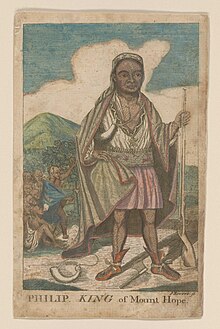
    Below:  "Philip, King of Mount Hope, 1772, by Paul Revere. Revere designed this pygmy like image to make King Philip look repulsive."