Okay, I'll give you a clue. Think of the "Vanishing Breed" stereotype. The good Indians (Uncas, Hiawatha, Winnetou) fade into the romantic mists of yesteryear. Only the bad (corrupt, immoral, degraded) Indians are left.
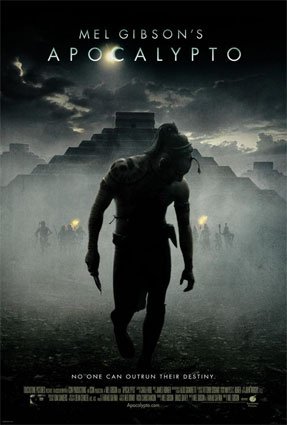
Thank you for your opinion. Now maybe you can tell us what you think the Apocalypto poster signifies. If Jaguar Paw is such a heroic figure, why does the poster show him with shoulders hunched and face downturned?
I suppose Gibson "accidentally" chose to present his protagonist in a negative light? (I mean that literally, since Jaguar Paw is shrouded in shadows.) And I suppose Gibson also "accidentally" chose to portray the Maya as death-dealing fanatics? Uh-huh, sure.
Yeah, I believe Gibson gambled millions of his own money on an image he "accidentally" chose. And I also believe he "accidentally" attacked Jews in a drunken rage and doesn't really hate them. Not.
That bridge is still available if you wish to buy it.
First, Gibson is responsible for every aspect of Apocalypto, since it's his independent production. If you think he didn't approve the poster, you're probably mistaken.
Second, the poster appeared everywhere movie posters appear: in theaters, in ads, on the Net. If you didn't see it in one particular theater, that doesn't tell us much. It's also irrelevant in comparing the poster to "End of the Trail."
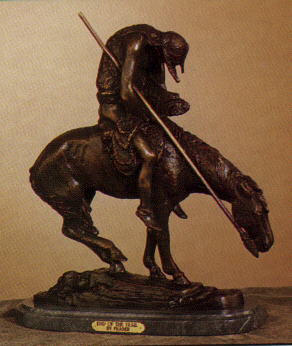
Third, if the message is one of shame over the Mayas' warfare, Jaguar Paw is expressing that shame by hanging his head. Similarly, the Indian in "End of the Trail" expressed his shame at experiencing and losing the US-led Indian Wars. Same hanging head, same message.
Fourth, I mentioned the Jews because Gibson's drunken tirade was an example of sending a message you don't intend to send. But your fourth point is irrelevant in comparing the poster to "End of the Trail."
Fifth, we've discussed Apocalypto's message at length. I covered the point of the movie's ending when I wrote, "The good Indians (Uncas, Hiawatha, Winnetou) fade into the romantic mists of yesteryear. Only the bad (corrupt, immoral, degraded) Indians are left."
Sixth, I didn't say "End of the Trail" caused or was correlated with the poster. I merely said they're independently sending the same message.
Seventh, lots of independent filmmakers finance their own movies. As Variety reported, Apocalypto was fully financed by Icon, Gibson's production company. Therefore, what you "know" about the movie is apparently wrong.


2 comments:
Thank you for your opinion. Now maybe you can tell us what you think the Apocalypto poster signifies. If Jaguar Paw is such a heroic figure, why does the poster show him with shoulders hunched and face downturned?
I suppose Gibson "accidentally" chose to present his protagonist in a negative light? (I mean that literally, since Jaguar Paw is shrouded in shadows.) And I suppose Gibson also "accidentally" chose to portray the Maya as death-dealing fanatics? Uh-huh, sure.
Yeah, I believe Gibson gambled millions of his own money on an image he "accidentally" chose. And I also believe he "accidentally" attacked Jews in a drunken rage and doesn't really hate them. Not.
That bridge is still available if you wish to buy it.
First, Gibson is responsible for every aspect of Apocalypto, since it's his independent production. If you think he didn't approve the poster, you're probably mistaken.
Second, the poster appeared everywhere movie posters appear: in theaters, in ads, on the Net. If you didn't see it in one particular theater, that doesn't tell us much. It's also irrelevant in comparing the poster to "End of the Trail."
Third, if the message is one of shame over the Mayas' warfare, Jaguar Paw is expressing that shame by hanging his head. Similarly, the Indian in "End of the Trail" expressed his shame at experiencing and losing the US-led Indian Wars. Same hanging head, same message.
Fourth, I mentioned the Jews because Gibson's drunken tirade was an example of sending a message you don't intend to send. But your fourth point is irrelevant in comparing the poster to "End of the Trail."
Fifth, we've discussed Apocalypto's message at length. I covered the point of the movie's ending when I wrote, "The good Indians (Uncas, Hiawatha, Winnetou) fade into the romantic mists of yesteryear. Only the bad (corrupt, immoral, degraded) Indians are left."
Sixth, I didn't say "End of the Trail" caused or was correlated with the poster. I merely said they're independently sending the same message.
Seventh, lots of independent filmmakers finance their own movies. As Variety reported, Apocalypto was fully financed by Icon, Gibson's production company. Therefore, what you "know" about the movie is apparently wrong.
Post a Comment