December 28, 2010

Jason Aaron = writer of the year

A hat trick for 'Scalped'

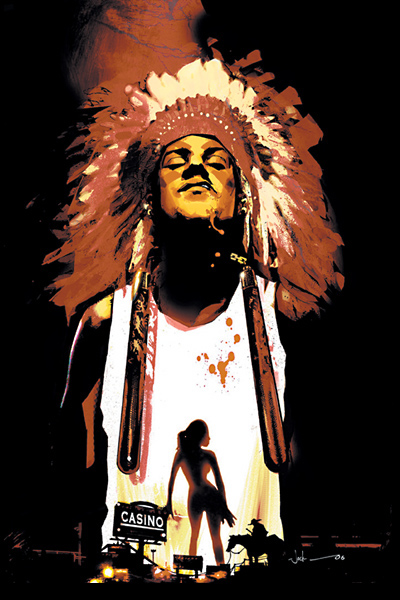
By Jerome MaidaComics Guy looked long and hard to see if any comic book was worthy of being named the best instead of the title that won Best Comic Series of the Year in 2008 and 2009. There were a lot of challengers, a lot of well-done stuff. Some issues of certain books can be called legitimate masterpieces.

However, with such a plethora of quality material to choose from, there still is only one choice when it comes to the best that the comic-book medium has to offer. So for the third year in a row, "Scalped" is Comics Guy's pick for Best Comic Series of the Year.

Once again, Jason Aaron--Comics Guy's choice for Writer of the Year--has given us characters and story lines that are extremely compelling.

He is mining the story possibilities few dare to touch, let alone explore, about life on an Indian reservation, and gives us sharp yet real dialogue.

Most of all, he gives us moments--not only in every issue, but on virtually every page--that readers will remember forever. Whether it's Chief Red Crow proving that he is the wisest, most dangerous mob leader ever put on the printed page, the emptiness and desperation evident in many of the lives there, double-agent Dash being confronted by his deadbeat father or Red Crow's daughter Carol deciding whether she should keep her baby--there is extremely powerful stuff here.
Comment:  These nominations are the kinds of things I won't comment on. Because I haven't read enough SCALPED or other current comics to judge which is the best.

In contrast, I have read enough SCALPED to judge whether it's stereotypical. It is.

Aaron isn't exactly exploring life on an Indian reservation. That would mean his stories are true to life rather than stereotypical. What he's exploring is his invented, imaginary idea of how hellish Indian life is. It's an exaggerated version of the worst Indian reservations in America and a complete fabrication of Indian life in general.

Even saying it "explores" rather than "invents" Indian life gives credence to the stereotypes. Would anyone say The Sopranos explores Italian American life? I doubt it. If someone said The Sopranos gave us an honest or revealing look at Italian Americans, people would protest in anger. As they actually did:

Italian-Americans eye 'Sopranos,' HBO protest

Italian Group Weathers The Rain In 'Sopranos' Protest

Italian-American groups protest 'Sopranos'

In short, SCALPED is to Indians as The Sopranos is to Italians. 'Nuff said about that.

The abortion issue

It's nice that Aaron is tackling issues such as abortion. It's about what I would do if I were writing a mainstream Native-themed comic. Stories about corruption, alcoholism, suicide, and other social ills are valid because these things definitely happen on reservations. And stories about legal victories, business openings, and cultural preservation are also valid because these things also happen.

Of course, Aaron has the freedom to write about abortion in a Vertigo comic for mature audiences. It's not as if he's pushing the envelope on a regular DC or Marvel comic. Speedy shooting heroin on the cover of GREEN LANTERN #85 (1971) is still more daring than an abortion story or any other comic in 2010.

I'm not sure Aaron's readers want stories about drug use, prostitution, and abortion...but they probably don't want stories about rebuilding a reservation with schools, clinics, and community centers either. In that sense, he's taking the easy way out: giving readers the dark, despairing, grim 'n' gritty stories they expect. Write a stereotype-free comic book about Indian life as it actually is and then I'll consider you a groundbreaker.

Conclusion

Anyway, I guess I missed the moments that "readers will remember forever." Other than Red Crow's murdering and scalping someone in SCALPED #1, that is--a heinous act for which any tribal leader today would be imprisoned. But that's probably not the kind of moment Maida is thinking of.

As I've said before, I found the comics good but not great. If you've never read or watched any noir fiction, SCALPED may impress you. If you have, you'll deem it a decent variation on hundreds of crime/mob/gang stories.

For more on the subject, see Native Women = Whores in SCALPED and Okay to Stereotype in Noir Comics?
Obama's UN "coup" is "chilling"

The right-wing craziness continues. Now the Pittsburgh Tribune-Review takes up the cudgel against Obama:

Shaky groundPresident Obama reaffirms his intolerable belief in all things Turtle Bay by agreeing to sign the United Nations' Declaration of Rights of Indigenous Peoples.

This "coup" supported by representatives from more than 300 American Indian tribes extends the presumptions of those outside the U.S. government on what plainly is America's own business. Oh, it's all "nonbinding," the State Department assures. But Mr. Obama is quick to point out that more important than words are actions.

The ramifications of which are chilling.

This U.N. declaration--which doesn't define exactly what's meant by "indigenous peoples"--supports any tribal claims on lands occupied centuries ago. A representative of the Mohawk Nation of Kahnawake in Canada tells The Washington Times that doesn't mean a land grab. But reparations? Well, that's a different matter.
Comment:  The phrase you're looking for is "Turtle Island," not "Turtle Bay," idiots.

Consider all the insinuations in this editorial. Obama shares beliefs with "Turtle Bay"--meaning his beliefs are foreign and un-American. The signing is a "coup"--meaning an attack on the US and its values. Actions count more than words--meaning Obama the Kenyan tribesman may try to circumvent the Constitution. The ramifications are "chilling"--meaning Obama threatens American lives and liberty. "Indigenous peoples" is undefined--meaning every minority may try to take what rightly belongs to white Christian Americans. "Reparations"--meaning unjustified handouts and welfare payments to undeserving brown-skins.

There's no serious attempt to represent the UN declaration and its ramifications accurately. It's all veiled racism and xenophobia against Obama and his fellow minorities. The message is: Get ready, real (white) Americans, because the brown-skins are coming to take back what you took from them.

Or as Sarah Palin put it: "Commonsense Conservatives & lovers of America: "Don't Retreat, Instead - RELOAD!" If necessary, you may have to shoot and kill the savage subhumans--blacks, Latinos, Muslims, Indians, et al.--who are out to get you.

For more on the UN declaration, see Farah Wants Manhattan Back and Right Fright Over UN Declaration. For more conservative attacks on minorities, see Racist Rhetoric Fuels Hate Crimes and Palin:  Racism Is a Ploy.

Below:  What supporting the UN declaration means to conservatives.

What my family got for Christmas

The Native-themed Christmas presents I gave and received this year:

To niece Alice:

  • The Birchbark House--Louise Erdrich
  • The Game of Silence--Louise Erdrich
  • The Porcupine Year--Louise Erdrich

  • To niece Lucy:

  • The Mayflower & the Pilgrims' New World--Nathaniel Philbrick
  • Water Sky--Jean Craighead George
  • Becoming Naomi Leon--Pam Munoz Ryan

  • To sister Karen:

  • Ten Thousand Miles with a Dog Sled: A Narrative of Winter Travel in Interior Alaska--Hudson Stuck

  • To brother-in-law Cullen:

  • Empire of the Summer Moon: Quanah Parker and the Rise and Fall of the Comanches, the Most Powerful Indian Tribe in American History--S. C. Gwynne

  • To me:

  • Trickster: Native American Tales: A Graphic Collection--Matt Dembicki
  • The 500 Years of Resistance Comic Book--Gord Hill
  • Fossil Legends of the First Americans--Adrienne Mayor

  • For more on the subject, see What My Nephews and Nieces Got and The Best Indian Books.

    2010 Christmas pix

    Christmas--December 25, 2010

    On the way to Las Vegas, I visited the Calico Early Man Archaeological Site. Oddly, "early man" doesn't necessarily mean "Indian." See the album to find out why.


    Christmas--December 26, 2010

    Christmas--December 27, 2010

    On the way back, I spend the day at Red Rock Canyon. Indians used to live there, though I didn't see many signs of them. But the scenery was spectacular.


    For more Christmas photos, see 2009 Christmas Pix.

    Shouting Secrets trailer


    Comment:  The cast looks strong. I don't know about the story. Stories about families that come together over a sick relative are sometimes good, sometimes not.

    For more on the subject, see Birmingham, Spencer in Shouting Secrets.

    December 27, 2010

    Farah wants Manhattan back

    The conservative carping over the UN Declaration on the Rights of Indigenous Peoples is starting to gain attention in the mainstream media. A mainstream blog, at least. In other words, it's starting to become a meme:

    Latest Right-Wing Freak-Out:  Obama Wants To Give Manhattan Back To Native Americans

    By Jillian RayfieldThe good news is that the right-wing isn't talking about President Obama being a secret Muslim right now. The bad news is that they're now concerned that he's going to use his honorary status as a Crow Tribe Indian to return the United States to Native Americans.The article summarizes the previous criticism:Obama was adopted as an honorary member of the Crow tribe during the 2008 campaign, and was even given the name "One who helps people throughout the land." Most of the outrage lobbed at the President in the wake of the announcement, naturally, references that fact.

    Last week, the "Director of Issues Analysis" for the Christian conservative American Family Association, Bryan Fischer, wrote a blog post claiming that "President Obama wants to give the entire land mass of the United States of America back to the Indians. He wants Indian tribes to be our new overlords."

    "Perhaps he figures that, as an adopted Crow Indian, he will be the new chief over this revived Indian empire," Fischer wrote. "But for the other 312 million of us, I think we'll settle for our constitutional 'We the people' form of government, thank you very much."

    Yesterday, the right-wing blog World Net Daily took it a step further in a post called "Obama to give Manhattan back to Native Americans? President believes nation can spare some sovereignty." The article describes how "President Obama is voicing support for a U.N. resolution that could accomplish something as radical as relinquishing some U.S. sovereignty and opening a path for the return of ancient tribal lands to American Indians, including even parts of Manhattan."

    The article continues: "Obama's interest is personal. He noted during the 2008 presidential campaign he was officially adopted by the Crow Nation, an Indian tribe in Montana, and he was given an Indian name."
    Finally, the article refers to a new example of the right-wing freak-out:

    I'll take Manhattan

    By Joseph FarahMaybe you missed it, but Obama has endorsed a United Nations resolution declaring the rights of indigenous people that could mean large swaths of the U.S. will be returned to native Americans like me.

    I'm hereby staking my claim to Manhattan.

    Maybe you didn't know I have native American blood coursing through my veins. I'm more well-known for my Lebanese and Syrian ancestry. But, truth be told, I have a fair amount of Indian heritage on my mother's side. So this proposed redistribution of wealth is welcome news for me.

    Where do I apply? I want to return wampum for Manhattan.
    Comment:  Note how Farah doesn't capitalize "native." Like other conservatives, he doesn't want to acknowledge the Natives' claims of being here first.

    In the first paragraph, Rayfield correctly links this attempt to smear Obama to previous attempts to link him to Muslims, Kenyans, terrorists, and other "tribal" people. Having failed to prove Obama is a Muslim or a Kenyan, they're now claiming he's joined another group of brown-skins who don't share America's values. Indians have refused every "opportunity" to assimilate and become white Christian Americans, so they're suspect by definition.

    That conservatives keep pointing out Obama's tribal adoption isn't a coincidence. Rather, it's a key part of their smear tactics. They're telling people he'll put his "tribal" identity ahead of his national identity. Because to "those (brown-skinned) people," blood is thicker than water.

    Clearly conservatives plan to keep smearing Obama until they replace him with the usual white Christian stooge of the military-industrial complex. And these Nazi-style Big Lies are working with the misinformed boobs who watch Fox News. These idiots are much more likely to believe Obama is a Muslim and a foreigner than the average American.

    Farah the Indian wannabe

    Anyway, Farah gets a Stereotype of the Month entry for his bogus claim that having some Indian blood makes him an Indian. It doesn't. He's not a member of a federally recognized tribe, which is a political entity, not a biological one. He could be a full-blooded Indian and he wouldn't be eligible to get land back.

    Obviously he doesn't meet the other criteria for being an actual Indian. And he doesn't let on that his claim is false and spurious. Ignorant readers will assume that fake "Indians" like him will come out of the woodwork to claim places like Manhattan.

    For more on the UN declaration, see Right Fright Over UN Declaration and Conservatives Criticize UN Declaration. For more attempts to smear Obama, see Limbaugh Lies About Thanksgiving and Obama Attacked Over Sitting Bull.

    Yellow Robe, Geiogamah, and Glancy

    Native playwrights don't get enough publicity, so here's a corrective:

    One Native playwright worth mentioning is William S. Yellow Robe Jr. Of Assiniboine and African-American descent, he's written such plays as Better-n-Indins and Grandchildren of the Buffalo Soldiers. The former presents a series of sometimes-funny skits, while the latter deals with mixed-race issues.

    Another notable Native playwright is Hanay Geiogamah (Kiowa). According to the Native American Authors Project, he "is known for plays in which he employs humor, realism, and idiomatic language to subvert negative stereotypes about Native Americans and to address the alienation felt by Indians in contemporary American society. He has taught at Colorado College, the University of Washington and the University of California at Los Angeles, and is one of the founders of the American Indian Theater Ensemble."

    Diane Glancy, of Cherokee and English/ German descent, has won numerous awards for her poetry, prose, and plays. She has been an artist in residence for the State Arts Council of Oklahoma and a graduate of the prestigious University of Iowa Writers Workshop. She now teaches Native American literature and creative writing at Macalester College in St. Paul, Minnesota. According to a website, her work shows how "traditional [Native] values and ways of life interact and are juxtaposed with those of modern America."

    Other up-and-coming playwrights include Rhianna Yazzie, Bret Jones, and Carolyn Dunn.

    For more on the subject, see Native Plays and Other Stage Shows.

    Litefoot's message of faith

    Spirituality provides strength, says Litefoot

    Cherokee speaks to Stoney Nation

    By Jamie Komarnicki
    The Stoney Nakoda First Nation can benefit from the strength that comes through spirituality, says a Native American hip hop artist.

    Litefoot, in Calgary recently speaking to members of the Stoney First Nation, said he has a special connection with the tribe after his father attended an ecumenical conference on the reserve in 1971.

    The musician and actor, a member of the Cherokee Nation of Oklahoma, was in the city to share the message of his book, The Medicine of Prayer. The book's forward was written on behalf of the Stoney First Nation, but the message is intended for a wider audience.

    "The message isn't specific solely to the Stoneys or to any tribal nation--I think it's a message for all people. That would be that we've all been put on this earth for a reason and our responsibility in this life is to find out what that purpose is," Litefoot said. "Sometimes we mistake that with what we want to do versus what we were born to do."
    Comment:  For more on the subject, see Litefoot's Four 2010 Releases and Litefoot's Sneakers for Diabetics.

    December 26, 2010

    Limited gushing at tribal summit

    Tribal leaders pushed Obama for proactive agenda

    By Rob CapricciosoGushing was kept to a limit this year, although tribal leaders were more than willing to applaud for positive steps they think the administration has made, including settling the Cobell and Keepseagle cases, signing the Tribal Law and Order Act, and reauthorizing the Indian Health Care Improvement Act.

    Their applause was especially loud when Obama told them his intention to have the U.S. begin supporting the U.N. Declaration on the Rights of Indigenous Peoples, although many immediately began wondering what that would mean in terms of specific policy dealings and changes to federal-tribal relations.

    They were also more than willing to be critical. In break-out sessions, some asked why the administration hadn’t done more to get Congress to pass a fix to the Supreme Court’s 2009 Carcieri decision, which limited Interior’s ability to take land into trust for tribes. Administration officials insisted they pushed hard on that matter, and promised to continue to do so–with tribal leaders promising to keep up the pressure.

    Seneca Nation President Robert Odawi Porter bluntly told Obama in a policy paper that he believed the president “has not put forward a strategic plan” to achieve goals to making tribal nations “full partners in America’s economy”–words Obama himself had used at his first tribal nations summit.

    “Instead, he has set forth 26 proposed action items on multiple subjects that reflect a scattershot approach that undermines his commitment to any meaningful or lasting change,” the paper said.

    Porter added in an interview that the Obama administration should be praised for the accomplishments it has made on Indian issues, but he cautioned that too much of the perceived progress has been focused on settling past injustices, like the Cobell case, rather than moving forward with proactive, visionary plans.

    Porter said that if the president fails to embrace an aggressive Indian country legislative agenda, he runs the risk of focusing solely on administrative policy changes and legislative appropriation that “only promotes cosmetic changes to the status quo.”

    In other words, lasting change will not be made.
    Comment:  Excellent points. This article mirrors what I've been saying. Settling old cases and increasing program funding is nice, but it doesn't change the fundamental relationship between the tribes and the government. Adhering to the UN declaration might do that, but the declaration is non-binding and few think it will cause a significant shift.

    Obama is doing better than previous presidents. But his accomplishments may be closer to the minimum than the maximum tribes expect. We're still waiting for "proactive, visionary plans" that go beyond the clichés and buzzwords.

    For more on the subject, see US Praises Itself on Native Rights and How to Consult with 564 Tribes.

    Right fright over UN declaration

    WND Exclusive THIS LAND WAS YOUR LAND

    Obama to give Manhattan back to Native Americans?
    President believes nation can spare some sovereignty

    By Eugene J. Koprowski
    President Obama is voicing support for a U.N. resolution that could accomplish something as radical as relinquishing some U.S. sovereignty and opening a path for the return of ancient tribal lands to American Indians, including even parts of Manhattan.

    The issue is causing alarm among legal experts.

    In recent remarks at the White House during a "tribal nations conference," Obama endorsed the "United Nations Declaration on the Rights of Indigenous People," which includes a sweeping declaration that "indigenous peoples have a right to lands and resources they traditionally occupied or otherwise used" but that later were acquired by occupying forces.
    And:The international agreement is very serious business, one legal expert tells WND, and could cause problems for the U.S. long after Obama is gone from the White House, if made part of U.S. law.

    "One can anticipate that some tribes will seek to use this resolution to re-litigate centuries-old land disputes that courts have already rejected," said Frank at the Manhattan Institute.
    Comment:  The radical-right World Net Daily joins the growing conservative drumbeat against the UN declaration. I suspect it's only a matter of time until this breaks into the Limbaugh/Beck/talk-radio echo chamber.

    These people aren't raising legitimate concerns. They're couching their complaints in imaginary terms: if the UN declaration becomes US law, if activist judges overturn 200 years of precedents. In reality, there are probably thousands of UN declarations and international treaties that conflict with US law...and we ignore them all. We'll ignore this UN declaration the same way.

    And we didn't sign or endorse the UN declaration as a nation. All Obama did was "lend his support" to it. It's not official US policy and future US governments will be free to ignore it.

    In short, conservatives are using the UN declaration as the umpteenth way to bash Obama as a Luo tribesman--as a foreign/socialist/Kenyan/one worlder. As with Obama's birth certificate and "death panels," they don't care about the merits of the issue. All they want to do is demonize the first black president.

    For more on the subject, see Conservatives Criticize UN Declaration and Obama Will Give US to Indians?

    Hunting the Rez magazine

    Magazine promotes Native land recreationA Rocky Boy man has launched an outdoor magazine promoting tribal hunting, fishing and recreational opportunities for nonenrolled people.

    The magazine is called Hunting the Rez, and is a full-color glossy print format. Plans are to publish quarterly. The first issue of the magazine is already on newsstands.

    "We are very pleased with Hunting the Rez's launch," publisher and owner Jason Belcourt said. "It's not only for the economic benefits afforded the reservation programs we'll be showcasing from issue to issue, but also for the millions of acres of hunting and recreational opportunities open to the nontribal members of the outdoor sportsmen community."

    Belcourt said that because North American hunting grounds are getting harder and harder to find, Indian Country is becoming the preferred spot for savvy sportsmen looking for abundant hunting and fishing opportunities.
    Comment:  For more on the subject, see Face Magazine About First Nations and Native Hoop Website and Magazine.

    December 25, 2010

    Christmas with Black Crow

    A Year of Cool Comics--Day 350

    By Brian CroninWe continue the Cool Christmas Comic Countdown with an intriguing Captain America story by J.M. DeMatteis, Paul Neary and Eduardo Baretto titled “An American Christmas”…The revelry is interrupted by the mysterious Black Crow, a Native anti-hero. He seems to think Captain America should die for America's sins against the Indians:

    The fight continues for a number of more pages and it ends with the sort of Christmas message that you would expect from a J.M. DeMatteis comic book. And if you haven’t read enough J.M. DeMatteis comic books to know for sure what would be an expected ending of a J.M. DeMatteis comic book, then you really ought to read more J.M. DeMatteis comic books, because he is neat-o.

    In any event, this was a good issue--a lot different than a typical Christmas issue. Very much off the beaten path.
    Comment:  Follow the link to see more of the story.

    I believe this was Black Crow's second appearance. He hasn't appeared much since then and we still don't know much about him.

    For more on the subject, see Black Crow to Replace Captain America? and Comic Books Featuring Indians.

    Conservatives criticize UN declaration

    I knew conservatives wouldn't like the UN Declaration on the Rights of Indigenous Peoples. Now they're starting to come out of the woodwork.

    Obama's Reversal on 'Indigenous Peoples' Rights Stirs Concern Over Legal Claims

    By Judson BergerJohn Bolton, the former U.S. ambassador to the United Nations, said the "abstract" document--which in several sections discusses the "right to redress"--will probably be used to fuel new legal claims. And he predicted the issue would complicate those cases more than it would help either side actually resolve them.

    "It's a kind of feel-good document that has so many unclear phrases in it that nobody's really sure what it means when you agree to it," Bolton told FoxNews.com. "It's wrong and potentially dangerous to sign onto a document that you don't fully understand the implications of."
    And:Bolton said plaintiffs will surely try to use this document in court, though it's not supposed to carry the weight of law.

    "Hopefully most judges will say it's not binding," he said. "But there are enough judges who couldn't care less about strictly applying the law."
    Yes, and many of those judges are conservative activists like the ones who dominate the Supreme Court.

    More carping conservatives:Rep. Steve King, R-Iowa, who has been particularly critical of the Pigford claims process, expressed concern about the potential implications of the U.N. document on indigenous peoples. He said he's curious what "special rights" the document could convey.

    Carl Horowitz, a project manager with the National Legal and Policy Center who follows discrimination cases against the federal government, used the r-word--reparations--to describe those implications.

    "It reflects a global egalitarianism," he said. "It's a shakedown."
    Comment:  "Global egalitarianism" is the opposite of the status quo, I presume: a plutocracy maintained by free-market fundamentalists to enrich themselves and their cronies.

    I expect Limbaugh, Beck, et al. to latch onto this issue eventually. I imagine they haven't yet because they haven't heard about the declaration yet.

    For more on the subject, see UN Declaration "Could Wreak Havoc" and UN Declaration = Status Quo.

    Chieftain's Challenge and Wargle

    We get e-mail:Hi, I am writing about 2 cultural appropriations in video games I've seen recently. Both of them are perpetuating the stereotype of the "native chieftain/warrior with headdress."

    The first one is from Team Fortress 2: Chieftain's Challenge. Not only it is a headdress worn as an cosmetic item, but it is a commodity to be traded and sold (in TF2, hats are rare cosmetic items that can be traded for). I find this caricature of a Native chief deeply offensive.
    The second one is the Pokemon Wargle. A red, white and blue eagle with feathers representing a headdress, with "war" in its name. "War + eagle," again perpetuating the Native warrior stereotype. Combining Natives with their American oppressors--abhorrent.

    Wilbur Fisher


    Comment:  Thanks for writing, Wilbur. I think you nailed the problems with these items.

    For more on the subject, see Video Games Featuring Indians.

    December 24, 2010

    Season's greetings!

    Merry Christmas, Happy Hanukkah, Ecstatic Eid, Krazy Kwanzaa, and a Wondrous Winter Solstice!

    Rob

    Matachines dance at northern Pueblos

    Matachines DanceThe Matachines dance (Spanish matachin, or religious dancer) is found in northern Mexico especially in the La Laguna Region (Coahuila and Durango), Sinaloa and Chihuahua. It is also very popular in Northern New Mexico and along the Rio Grande River. People who join the Matachines do it for a religious purpose, since the dance is intended to venerate either Mother Mary, a saint, Christ, or God the Holy Trinity.

    Dressed in fantastic Indian costumes, the chief characters are El Monarca, the monarch (Montezuma); the captains (Montezuma's main generals); La Malinche, or Malintzin, the Indian mistress of Hernán Cortés; El Toro, the bull, the malevolent comic man of the play is dressed in buffalo skins with buffalo horns on his head. Characters also include Abuelo, the grandfather, and Abuela, the grandmother. The Matachines dance portrays the desertion of his people by Montezuma, Malinche luring him back with her wiles and smiles, the final reunion of king and people and the killing of El Toro, who is supposed to have made all the mischief. The most basic symbol of the dance is good vs. evil, with good prevailing. Montezuma and la Malinche represent good, and the bull represents mischief. Hernan Cortes, represents Satan or evil.

    The costumes, rattles, and the arch and bow are all blessed by a priest, and as he blesses the equipment of that group, it signifies that the priest has agreed to adopt the specific dancing group for that specific church.
    Los Matachines:  A blend of cultures, a colorful dance into the past at Taos Pueblo

    By Rick RomancitoOne of the more curious aspects of this dance to the uninformed observer is the fact that although this dance is Hispanic in origin, it is performed by Native people, along with a few Hispanic participants. The distinctive fiddle and guitar music is obviously non-Native and the regalia is certainly not that of ancient Pueblo Indian tradition.

    According to historians, the dance evolved over hundreds of years, starting with the Moors and borrowed by Spanish colonists who brought it with them to the New World. By the time the dance made its way into New Mexico, it is thought that Spanish priests used it to help convert Native people to Christianity by illustrating spiritual ideals through its essential morality play.

    Over time, like many things here, an assimilation took place, blending elements from both cultures that resulted in the performance taking on a life of its own.

    While many Pueblo Indians here follow the Catholic religion, they also maintain extreme loyalty to their ancient Native religion, evidence that the initial motive behind the dance was not entirely successful
    Comment:  For more on Pueblo Christmas celebrations, see Three Kings Day at Pojoaque and Pueblo Christmas Dances.

    Below:  "Ruben Romero leads dancers through the alleys of Taos Pueblo's north-side homes." (Rick Romancito)

    UN declaration "could wreak havoc"

    The Rights of Indigenous Peoples

    By Shoshena BryenApplied to American Indian tribes, before which the president made his announcement, this may take the form of reparations and mineral rights. The Executive Director of the Indian Law Resource Center said, "International human rights law now recognizes...rights of self-determination, property and culture." It is unlikely to involve having Indian tribes secede from the Union.

    But applied to Palestinians and Kurds, not to mention minorities from Azeris in Iran to Uighurs in China to Armenians, Hmong tribesmen and Guatemalan Indians, it could wreak havoc.

    The Kurds form a tribal/national grouping that spans Iraq, Iran, Turkey and Syria. They are unquestionably an "indigenous people" with a distinct language and culture. Is the United States prepared to support border changes to allow them the right of self-determination? American lives were expended in the quest for a unitary Iraq, and we supported Turkey's determination not to allow Kurds to secede during the PKK war. But how can we deny the Kurds while supporting a Palestinian "right to self determination"?
    Comment:  Bryen is grossly overestimating the UN declaration's effect. As I said to someone, I'll doubt it'll affect a single decision in Congress or the courts.

    The answer to Bryen's question about the Kurds is: We can't deny the Kurds, morally speaking. They, the Palestinians, and the other indigenous groups all deserve more freedom.

    What kind of freedom? At a minimum they should have a quasi-sovereign status like America's Indian nations. Even better would be to have quasi-independent states with the option to leave the country by a popular vote. Canada has done this with Quebec and it hasn't destroyed the country.

    For more on Palestinians, see No Right of Return for Palestinians, Indians? and Palestinians = Na'vi. For more on the UN declaration, see UN Declaration = Status Quo and Obama Will Give US to Indians?!

    Longmire mysteries to become TV series

    Wyoming author's novels being made into TV seriesAward-winning Wyoming author Craig Johnson's mystery novels will provide the inspiration for a television series.

    A&E network gave the go-ahead for the hourlong pilot of “Longmire,” which will be based on Sheriff Walt Longmire, a Vietnam veteran who is the sheriff of a fictional northern Wyoming county.
    And:The novel's characters include Longmire's longtime American Indian friend Henry Standing Bear, also a veteran.

    Tribal beliefs and mysticism play into the stories, which also have Montana ties.
    Comment:  For more on Native-themed mysteries, see Coel Wins Emeritus Award for Mysteries and Jance's Tohono O'odham Mysteries.

    Below:  Craig Johnson.

    December 23, 2010

    Review of When Worlds Collide

    Yet another documentary I watched on PBS for Native American Heritage Month:

    When Worlds CollideIn 1492, two worlds that for thousands of years had developed completely independent of one another suddenly came into contact. In the following decades, those two worlds painfully and haltingly began to merge. Below, follow the story of When Worlds Collide; a story that examines power, religion, wealth, and the nature of identity and ethnicity in the Americas right up to our own times.You can read the entire transcript or watch the entire video online. Here's the key first segment:

    Chapter 1:  The Missing Branch of the Family TreeAfter news reached Europe in 1493 that Christopher Columbus had reached land west across the Atlantic Ocean, suddenly two worlds came into contact that for thousands of years had developed completely independently of one another. In the following decades, those two worlds painfully and haltingly began to merge, transforming the nature of identity and ethnicity in the Americas and resulting in a vibrant Mestizo culture that lives on to this day.

    For people who have ancestors from Europe and the Americas, the story of the European side of the family tree before contact has long been known. But it has taken far longer for the true story of the peoples of the New World before contact to become accepted in popular culture.

    Great New World Cultures

    According to the conventional narrative of the last five hundred years, before Columbus arrived the Americas were filled with primitive peoples who were easily conquered by a vastly superior European culture. Although scholars have long known that pre-Columbian America was home to some of the greatest cultures of the age, only recently has the general public's view of the New World started to change.

    We now know that, at the time the Spanish arrived in the New World, the Inca empire in South America was far larger than any in Europe, stretching 2,400 miles from modern day Colombia to Chile. Their 10,000-mile network of stone roads snaked through jungles and over mountain passes, all leading back to their capital, Cuzco, in present day Peru. Capable of great feats of engineering, the Incas created their cities, including their spiritual retreat Machu Picchu, with a standard of precision that far exceeded the abilities of European artisans at the time. The Indians who built these great South American metropolises still live and thrive in Peru today.

    It would be very ignorant to write the Incas off as just “Indians.” [In Cuzco] we can see the highest expression of a higher culture. It is evidence of how sophisticated their technology was for the time, their engineering, hydraulics and architecture. And it also reveals the relationship the Incas had with nature. They believed in maintaining an equilibrium between man and the earth. . .Man doesn't destroy nature to build something, but rather adapts his architecture to the setting.

    --Carlos Paz Sanchez, director, Peruvian Cultural Center, Cuzco

    In central Mexico, major civilizations had flourished since the time of the Romans. Later came the Mayas with their advanced mathematics and writing,

    and the Mexica, leaders of the Triple Alliance once called the Aztecs. The Mexica capital of Tenochtitlan was home to 200,000 people and cleaner than any city in Europe.

    Other civilizations lived farther north, including the Pueblo tribes with their planned communities built around one of the most sophisticated social structures in the world, and the cultures of the Mississippi River valley, who were among the most successful and productive farmers on earth.

    New World Advances

    The New World cultures were neither better nor worse than the cultures of Europe, but simply different. One difference was that the greatest advances of New World cultures did not involve inventing new machines but were instead driven by the effective use and management of the natural environment.

    New World inventors, for example, made a major advance in one of the most important industries of the age, textile manufacturing, by growing and harvesting cochineal, an insect that lives on the prickly pear cactus, to mass-produce a true red dye. In Europe, where true red dye was so rare and expensive that only the rich and powerful wore red, this New World dye would rank only behind gold and silver in value.
    See how New World inventors created a red dye that made Europeans swoon.

    The talent of the New World peoples also made possible a vastly more important set of inventions: new kinds of food. In one of the great food revolutions in history, Indigenous Americans succeeded through selective breeding in turning a weed called teocintle into maize (or corn), an achievement many botanists consider the most important feat of genetic engineering in human history.

    First of all, corn is a human invention. It is a creation of man. Ten thousand years ago, corn did not exist. . . Together with the early Americans, it built cities, it built cultures.

    --Amado Leyva, agronomist


    When corn was first introduced as a staple crop in the ancient Americas, it made tremendous population growth possible, from the Mayan peninsula all the way to what is today the United States and Canada. The people lived not just on corn but also on other crops like potatoes and tomatoes that they were the first to domesticate.

    Based on this diet, some scholars believe that in the 15th century, the average person in the Americas may have been better fed than the average person in Europe. They also might have been healthier—without pigs, goats, and cows, the Americas had no small pox, measles, or similar diseases that people on other continents had caught from those animals.
    More interesting points

    Some of the interesting points from the rest of the documentary:
  • Isabella and Ferdinand took another momentous step in 1492 in pursuit of religious unity: they ordered the Jews of Spain, some of whose ancestors had lived there for more than 700 years, to convert to Christianity or leave the country. Many of the Jews who converted and stayed in Spain, known as "conversos," were still suspected of being insincere in their conversions and arrested on charges of heresy by officers of the Spanish Inquisition.

    Even if their conversions were deemed sincere, Christians with Muslim and Jewish ancestors were treated as inferior to Spaniards who had Christian ancestors. Such were the origins of a policy of social discrimination, a caste-like system, which denied conversos access to important positions in church and state and reserved power for a supposedly pure-blooded Christian elite. Spain would later use similar policies in the Americas to keep native peoples at the bottom of the social scale.

  • In response to Queen Isabella's call to convert the peoples of the Americas, waves of Catholic missionaries flooded the New World, only to find that the people living there already had their own deeply held beliefs. As a result, the New World cultures gradually blended their native beliefs and Catholicism to create new spiritual traditions, images, and symbols.

    One example involves the now-legendary experience of Juan Diego, an early Indian convert to Catholicism. According to tradition, in the winter of 1531, Diego heard a woman's voice calling him from a hillside overlooking Mexico City. The woman had a serene countenance and was outlined by a luminescent glow. She also had native features, spoke Nahuatl, the pre-Columbian language of the Mexica, and looked very much the way the Mexica depicted Tonantzin, their revered fertility goddess. She told Diego that she was Mary, the mother of Jesus.

    The woman that Diego encountered in the form of an indigenous goddess came to be called "Our Lady of Guadalupe," the most important Catholic icon in the Americas. As the centuries passed, this story served as a kind of creation story for the Catholic Church in Mexico. But it is also a quintessentially Mestizo story, in which Catholic and native spiritual traditions became so thoroughly fused that it is difficult to tell one where one begins and the other ends.

  • For the next 300 years, virtually all of the indigenous men in the region would be forced to take turns working in deadly conditions in the mine.

    The historical records reveal that millions may have died while working in the mine. A metaphorical way of thinking about it is that so much silver was mined here that you could build a bridge of silver from Potosi to Spain. And with the skeletons of all the men who died here, you could build a bridge of skeletons back from Spain.

    --Soledad Fortun, expert on Potosi history


  • Comment:  "A policy of social discrimination, a caste-like system, which ... reserved power for a supposedly pure-blooded Christian elite." Not coincidentally, this is exactly why we're hearing so many protests against healthcare reform, welfare spending, illegal immigration, gay marriage, mosques, etc. Again, they're attempts to reserve power for a supposedly pure-blooded Christian elite.

    When Worlds Collide loses a bit of its power toward the end as the cultures merge and the story gets more convoluted. I might trim or rewrite some of that section. But for the most part, this is a well-written and dramatic account of the clash of civilizations. The information will be new to most people and may provide fresh insights even to those who have studied the history for years.

    Rob's rating:  8.5 of 10.

    For more on Native history, see Why We Believe in Columbus and America Is Ground Zero to Indians. For more PBS documentaries, see Review of For the Generations and Review of The Spirit of Sacajawea.

    Indians in FREEDOM FIGHTERS #1

    Here's a comic book about a superhero team that debuted a few months ago:

    Freedom Fighters #1 Review

    By WaylandFollowing on two limited series, DC gives the Freedom Fighters a shot at their own ongoing series, written by Jimmy Palmiotti and Justin Gray, who I really liked on Power Girl until they left the book. The story opens with Black Condor and Firebrand fighting yet another iteration of the Aryan Brigade at an Indian casino (before someone complains, I am part Indian and don’t like the term ‘Native American,’ so I don’t use it). The bad guys are written as savage, racist, and ignorant to a stereotypical degree, and are quickly beaten. Uncle Sam pops up and says he needs to speak with them about “a matter of National Security.”

    In a flashback of 14 hours ago, we see the Vice President get kidnapped from Air Force Two by a glowing blue foe. Somehow this ties into a newly discovered mystery document about a secret weapon of great power the Confederates were supposed to have had, but not used, in the Civil War (the historical one, not the recent Marvel one). Uncle Sam and the team, at Presidential request, go out to Devil’s Tower, Wyoming, and find a secret staircase inside. Investigating, they find powerful mystical beings calling themselves the “Four Corners,” and square off with them for a fight which will no doubt happen next issue.
    Freedom Fighters #1

    By Doug ZawiszaThe problem I had with this first issue, however, was the sheer volume of information jammed into it. There is a casino rumble, a meteor hurtling towards the Earth, the kidnapping of the Vice President, and hints of a secret society so secret, it makes the Freemasons look like Girl Scouts. This, naturally, leads to an adventure fit for Indiana Jones or Benjamin Gates.

    The Native storyline continues:

    Freedom Fighters #2The first arc of the new Freedom Fighters title continues here, with things looking not really good for anyone. A flashback shows the big nasty god like beings fighting powerful shamans centuries ago and being trapped, and in the present those same beings fight the heroes, swatting them down pretty easily. Most of the team, even powerhouses like Black Condor and the Ray, get put down with no real effort. Only Uncle Sam puts up a decent fight, and he isn’t doing well in the first pages.Freedom Fighters #3The rampage of the newly released demons goes on after they stomped all over the Freedom Fighters last issue. Black Condor appeals to the goddess that empowered him, and she says they can not be defeated, merely imprisoned, and that will require the woman he refuses “to admit you are in love with.” Condor then rallies his team and tells Phantom Lady she is the key to winning.Rob's review

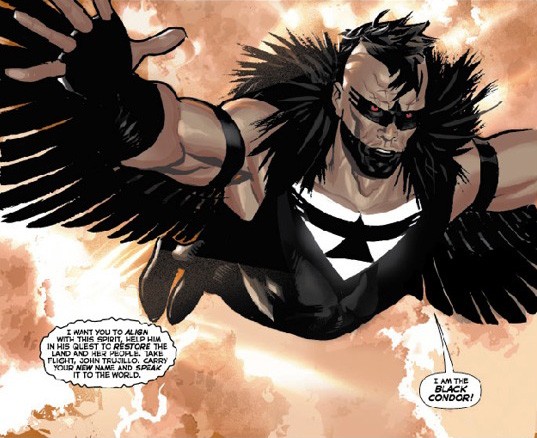
    As you may recall, Black Condor is a Navajo superhero. That means this comic book always has a Native potential. This time it gets realized.

    FREEDOM FIGHTERS #1 begins with a six-page sequence in an Arizona Indian casino. Other than a bear statue in front, it's blissfully free of Native stereotypes. There are no greeters in chiefs' headdresses, no waitresses in buckskin mini-skirts....nothing like that.

    True, the bad guys call the Indians "Pocahontas" and "Geronimo," but they're racists. I'd say the only misstep is when one neo-Nazi says of the Indians, "We shoulda driven these immigrants out of America centuries ago." This line is too stupid even for an ignorant bigot. Moreover, the rejoinder--"they were here first!"--is practically a cliché. Every Columbus Day and Thanksgiving we hear jokes about how the Europeans were the first illegal immigrants.

    Close encounters of the supernatural kind

    Later in the story, the Freedom Fighters visit Devils Tower (misspelled "Devil's Tower" in the comic). Black Condor says, "I sense a great power. This mountain is a sacred place to many tribes for different reasons." This is more or less an accurate summary of the situation, and it's nice coming from the Native hero.

    Black Condor adds, "The legend is that all of the tribes came together here and fought a great battle." I don't think this part is accurate. At least, I've never heard of a legend like that.

    The heroes explore the butte's interior and find four Native-style demons of earth, air, water, and fire. They say: "You have foolishly awakened us...imprisoned here by the shamans of a hundred tribes! We are the Four Corners! We are the renegades! We are death!"

    The Four Corners name is cute, but it doesn't make sense for demons that predate the Four Corners junction two states to the south. And elemental beings aren't very original or interesting. This is the kind of kid staff that has turned me off to comics.

    Alas, I wasn't interested enough to continue buying FREEDOM FIGHTERS. Judging by the reviews above, those who kept reading aren't happy with the results either.

    For more on the subject, see Comic Books Featuring Indians.

    Below:  Black Condor.