December 20, 2015

Miss Canada in a totem-pole loincloth

Miss Canada and the Free Bin

By Jessica R. MetcalfeWell, I was hoping this wasn't true, but alas, Miss Canada, Paola Nuñez, wore this lil "Totem Pole" number for the Miss Universe Preliminaries held two days ago in Las Vegas. The pageant will be televised live on Sunday, Dec 20, on FOX.

The past costumers for Miss Canada seem to have an identity crisis of sorts, not really knowing how to authentically represent their unique national identity in a flamboyant soundbite of an ensemble.

What makes Canada unique? In the past, they've featured Mounties, maple leaves, and even hockey sticks, but they always come back to old standby: "the Native."
An update:Well, you may or may not like what I have to say. We've found the designer of this costume. He's actually a young Dominican designer who also designed Miss Canada's evening gown and the outfit for her talent portion. In fact, she is also from the Dominican Republic and immigrated with her mother to Canada at the age of 10. As a newcomer to Canada, she was bullied and teased because of her dark skin and big lips. In addition, from reading the designer’s meaning behind this costume, it is clear that he genuinely tried to do research (if only we could all get gold stars for trying) and he found significance in the totem pole; he writes, "honoring these tribes which we pay tribute to the indigenous peoples of these Nations.”

So here we have a young lady wishing to represent Canada in the best way and make the nation proud. We also have a young designer wanting to honor Canada’s Aboriginal population through his garments. Why, then, when we have so many good intentions on the table, do we still come up shorthanded when it comes to representing Native people and our cultures appropriately and accurately? (And, as a sidebar, how does a person, who wants to win a global title, make this kind of cultural faux pas?) What’s the big hang-up? Where’s the glitch in the system? Why are we consistently excluded from having a say in how our cultures are being represented?


Some commenters on Facebook were more scathing than Dr. Metcalfe:This is ridiculous and super offensive...this is an example of why some Canadians need to learn more about our First Peoples...whoever organizes the pageant and chooses the wardrobe is obviously completely ignorant and very disrespectful!

My first problem with this is the use of a designer from the Dominican (as Miss Canada a Canadian designer should have been used). My second problem with this is if they wanted to showcase First Nations culture they should have gone with a First Nations designer. This is offensive!!

Did the pageant committee set her up for fail? Why wasn't her outfit made with a tasty beaded, deerskin dress and head band. I am an Alberta native and the ugly mask outfit is an insult to my Cree heritage. The whiteman wins again.
Dominican totem pole?!

Finally, the Miss Universe Canada organization offered a ridiculous explanation of its ridiculous stereotyping:

‘There’s been a tremendous misunderstanding’: Miss Universe Canada carved over totem pole outfit

By Tristin HopperBut after the 2015 contestant elicited cringes by donning a glittery totem pole costume, organizers tried to head off outrage by explaining that it was a Dominican-inspired totem pole.

“Unfortunately, there’s been a tremendous MISUNDERSTANDING regarding the context about Miss Canada’s National Costume,” reads an official statement by Miss Universe Canada.

“Yes, there are many different totem poles, NOT just First Nations totem poles.”
And:On Sunday, Miss Universe Canada put out a statement responding to “all of the negative comments.”

Despite earlier claims that Miss Canada had been embracing “native culture,” the statement said that they actually meant to say that she was “embracing her ethnic heritage of being a Dominican-born Canadian.”

When a commenter pointed out that the Dominican Republic is not known for its totem poles, Miss Universe Canada responded “her costume was not meant to depict First Nations people but rather the people of the Dominican.”
Comment:  Get freakin' serious, pageant people. The totem pole looks like a touristy version of typical Native totem pole. The animals appear to be an eagle, bear, and wolf--animals not found in the Dominican Republic.

Moreover, the rest of her costume resembles a giant raven--again a clearcut symbol of Canada's First Nations, not the Dominican Republic. If people realized the costume turned this revered being into a sex object, they might be even more upset.

Finally, the designer explicitly wrote that he intended to "pay tribute to the indigenous peoples of these Nations." So he lied? Or he's too stupid to realize what he said? Because his statement blatantly contradicts the pageant's statement.

Somebody's not telling the truth here. I'm guessing it's Miss Universe Canada.

For more on the subject, see Miss Universe Canada in a Headdress.

December 19, 2015

Conservatives enraged at losing power

The gun mania noted in the previous two postings comes from the white man's perceived loss of power. I've posted about this subject before, but it can't be stated often enough. Here's another take on it:

Rush Limbaugh and conservatives revolt! Their hatred for House budget deal could hand Donald Trump nomination

Right-wing media is lashing out against GOP congressmen after the budget deal, which only helps Trump's chances

By Amanda Marcotte
On this much, Limbaugh and I agree: Trump’s popularity is not due to the man having a unique charisma or some kind of major leadership skills. He’s just a cipher for this inchoate right wing rage. It’s hard to express the magnitude of rage that conservatives feel right now, after 7 years of the Obama presidency.

In their minds, this country belongs to them and any Democratic leadership is therefore, by definition, illegitimate. (Obama’s race isn’t helping things, but it’s important to remember they felt this way about Bill Clinton, too, which led to impeaching him under some flimsy pretense.) They keep sending more Republicans—and more and more conservative Republicans—to Congress with the sole mission to destroy Obama and restore the “natural” order of things, where conservatives, predominantly white male conservatives, rule and everyone else is, at best, given token representation.

Republicans don’t actually have the power to do this, but that hardly matters to the conservative base. When you believe in your heart of hearts that the natural order is people like you on top and everyone else under the boot, it feels like it should be relatively easy to get things back to the way you think they should be. So if it’s not getting done, it must be because of a lack of will. And if you have any doubts that it’s lack of will, here’s Rush Limbaugh, who seems like a smart guy who follows D.C. politics closely, telling you that’s exactly what it is. So they believe him.
And:In a sense, Trump didn’t have to do much to exploit this situation. His chest-puffing claims that all he needs to do to get his way is to say what he wants very loudly may make liberals laugh, but it fits right into the fantasy that Limbaugh and his fellow right-wing pundits are spinning out for the conservative base, who is ready to believe it.

Trump’s main talent is saying whatever his audience wants to hear, which he did, by telling Breitbart News that “elected Republicans in Congress threw in the towel.” He probably didn’t even need to know the specifics of what he was talking about, so long as he could imply that all you need is heavier balls and getting your way is a breeze.

There’s no easy way out of this dilemma for the Republicans. The conservative base is completely out of step with the general public on all these major issues. But it’s a minority who believes that their views should be triumphant over the majority’s, and that God agrees with them on this, to boot. Compromise and you lose your base. Give the base what they want and lose everyone else.
Comment:  For more on Donald Trump, see Trump Promises White Male Rule and "Restoring America's Greatness" = Disneyesque Dream.

December 18, 2015

Guns are central to America

White guys are killing us: Toxic, cowardly masculinity, our unhealable national illness

Race, guns and gender--the common denominator at the heart of so many problems--are what we need to talk about

By Chauncey DeVega
[T]here is another little-discussed factor that helps to explain America’s obsessive and near pathological gun culture, unwillingness to treat gun violence as a public health crisis, Right-wing domestic terrorism, and propensity for mass shootings. It transcends all of those issues. But this factor is usually treated as verboten, something to not be unspoken of, because of the rage, threats of violence, and animus it inspires.

The common denominator is white masculinity and the particular ways that it is connected to American gun culture and the color line.

The gun is central to the founding of an American society where hierarchies of race and gender were central to the country’s Herrenvolk white racial settler democratic project. America was born as, and remains, a culture and society dedicated to maintaining the dominance, privilege, and power of white men over people of color and women. This was not an accident, bug, or a glitch. It was a feature.

Guns helped White America to commit genocide against First Nations peoples and to steal land under the doctrine of Manifest Destiny. The gun maintained Southern society as a white over black racial military dictatorship. The gun was also a tool for white elites to control the working classes and poor.
Comment:  For more on gun control, see Guns as Penis Substitutes and Conservatives Let Mass Shootings Happen.

December 17, 2015

Guns as penis substitutes

America’s gun problem has everything to do with America’s masculinity problem

By Elizabeth WinklerAmerica’s gun problem can’t be distilled down to one single issue, of course, but it’s clear that on top of crime and fears of terrorism and insufficient mental health resources and the Second Amendment, America’s gun problem has something to do with America’s masculinity problem.

As Alankaar Sharma, a social worker and researcher, tells Quartz, “Possessing a gun is considered by many men, if not most, as a straightforward way of subscribing to dominant masculinity.” In his view, the patriarchal system, which privileges a certain set of masculine behaviors, values, and practices, provides men with “a clear and justifiable reason to own guns.” It cements their identity as masculine men.

And for many men today, it’s an identity in particular need of cementing. In this May 2015 op-ed for The Los Angeles Times, sociologist Jennifer Carlson argues that men are clinging to guns as a way to address a broad range of social insecurities. Author of a book on the social practice of gun-carrying in America, Carlson found that gun owners often characterized their fathers’ generation as an era when men had important roles to play as providers and breadwinners.

But men’s participation in the labor force has been declining since the 1970s. As The Economist’s cover story, “The Weaker Sex,” explained earlier in 2015, poorly educated men in rich societies aren’t coping well in the 21st century. Changes in the home and the labor force, especially the loss of manufacturing jobs, have created a class of disgruntled, financially insecure men. Meanwhile, women, who now earn more university degrees than men, are surging into the workforce.

This tracks with Carlson’s research as well. “As men doubt their ability to provide,” she argues, “their desire to protect becomes all the more important. They see carrying a gun as a masculine duty and the gun itself as a vehicle for a hardened kind of care-work.” Some envision scenarios where they intervene with their guns to save women and children.
Comment:  For more on gun control, see Conservatives Let Mass Shootings Happen and Republicans Allow Guns for Terrorists.

December 16, 2015

My Breaking the Code gif

Progress continues on Breaking the Code, my first effort to make a movie. Here's a gif that tells the whole story in a nutshell.

December 15, 2015

Netflix buries Ridiculous 6

Netflix's The Ridiculous 6 branded ‘unwatchable’ by critics and viewers

Proof Netflix Originals aren't always a safe bet

By Christopher Hooton
At the time of writing, The Ridiculous 6 has disappeared from mine and several others' Netflix homepage carousel, and can’t even be found among many ‘Trending Now’, 'Popular on Netflix' or ‘Recently Added’ sections.

Granted, these are all algorithm-based, but when pushing a new show Netflix will often try to promote its original content even if it doesn't 100% fall in line with what you've watched before, and you'd think 'Recently Added' would work fairly independently from taste.

The film still ostensibly has an average 4-star rating among viewers, but a glance at the multitude of 1-star user reviews paints a different picture.

'Seems like they forgot to put the jokes in this one,' one reads. 'And the acting. And plot. Anything, really.'
Are Netflix trying to bury failed Adam Sandler comedy, The Ridiculous 6?

By Olivia WaringNetflix have removed the Western from their main carousel in exchange for Bradley Cooper rom-com Aloha, which definitely means the situation must be very bad indeed.

Netflix is trying to bury The Ridiculous Six hoping no one notices

Despite being out for a mere three days, it now can’t be found for many on the ‘Popular on Netflix’ or ‘Recently Added’ sections of Netflix–only remaining in ‘Comedy’ and ‘Trending Now.’

Embarrassing. Don’t blame it on the algorithm, guys.
Comment:  For more on Adam Sandler, see So-Called Humor in Ridiculous 6 and Video Response to Ridiculous 6.

December 14, 2015

So-called humor in Ridiculous 6

As with almost every instance of racist entertainment, some suggested that critics should "lighten up" because The Ridiculous Six is "just humor." Here's what's wrong with that attitude:

Adam Sandler may never be funny again: Another unending parade of half-baked, offensive stereotypes disguised as comedy

A donkey-romancing Mexican is just a taste of the stupidity in the comedian's controversial new western spoof

By Matthew Rozsa
While reviewing the comedy “Jack and Jill,” critic Jay Bauman came up with a list of stale tropes that predictably appear in all of Adam Sandler’s movies. Nestled between entries like “general whorish product placement” and “scenes of forced sentimentality to trick the audience into thinking the movie has a heart,” there was one that applied perfectly to the inherently problematic nature of his comedy–namely, “jokes at the expense of physical abnormality or ethnicity,” or as Bauman puts it, “jokes at the expense of people who are different.”

In other words, Sandler movies contain lots of jokes that punch down.

Even before it premiered on Netflix today, “The Ridiculous Six” managed to incur controversy for punching down against Native Americans, who feature prominently in the film’s story. As I discussed last April, several Native American actors walked off the movie’s set to protest what they considered insensitive jokes about Apaches (more on those in a moment). Later a cellphone video leaked in which producer Barry Bernardi told the actors they “shouldn’t be in the movie” if they’re “overly sensitive” about those types of jokes. Shortly after that, another Native American actor from the picture spoke out in Sandler’s defense, observing that there were 150 other Native American extras who happily participated in the production and claiming the leaked video omitted Bernardi’s promise to include a disclaimer noting that the movie is historically inaccurate. He even noted that during a private meeting “the last thing that [Sandler] said before he got up was that the thing that made him feel the worst is that four people got their feelings hurt.”

Watching “The Ridiculous Six,” it’s easy to see how the filmmakers–including director Frank Coraci and co-writers Tim Herlihy and Sandler himself–could believe their movie was harmless. The Apache characters are depicted in unambiguously sympathetic terms, and while there are plenty of racial jokes, the movie seems determined to be an equal opportunity offender, even by occasionally putting white people in its cross hairs. Indeed, numerous white characters are depicted as vicious bigots (and as such worthy of being robbed or in other ways receiving karmic punishment), and one early joke shows an American Indian doing his white people impression by shouting, “Hey, guys, let’s play with our chest hair and eat potato chips.”

Nevertheless, when it comes to its underlying racial message, “The Ridiculous Six” still grates, and there are obvious moments when it appears to be punching down almost without realizing it. To understand why, it is necessary to briefly analyze the kinds of jokes that appear in the movie. Warning: Spoilers ahead.

The difference between telling a decent joke about historically marginalized groups and simply punching down is simple: While both expect the audience to laugh at sensitive subjects, the latter hold no meaningful social insight and go no further than laughing at someone else’s expense for being different.
The Ridiculous 6 Movie Review

By Brian Tallerico[T]hen there’s the broad racism and misogyny of the piece. After the controversial walk-offs, Netflix claimed that this was “satire.” It’s not. There’s nothing satirical about Sandler’s bad Native American accent (which totally comes and goes, by the way) or Schneider’s Hispanic caricature. Saying that this is satire is like the drunk guy at the bar telling you how many black friends he has after telling a racist joke. Don’t fall for it.Comment:  As this image suggests:


you don't need a joke to convey a stereotype. Regardless of her name, Julia Jones's character is the epitome of a "Pocahottie" or Indian princess. Adam Sandler's character is the epitome of the stoic and supernatural Indian. Their buckskin clothing is wrong; most Indians switched to Western clothing during the 19th century.

These things aren't jokes. They're false or misleading stereotypes. Beyond the alleged humor, they convey an erroneous picture of Native people. They're wrong for that reason, not because it's offensive to make fun of minorities.

For more on Adam Sandler, see Video Response to Ridiculous 6 and Scathing Reviews for Ridiculous 6.

December 13, 2015

Adam Sandler's wife in redface

On Facebook, Jacqueline Keeler wrote:Here's a recent photo of Adam Sandler and his wife who played "Wears No Bra." She is Italian American but they obviously painted her brown for the role. She was in #Redface to play a role originally titled "Sits on Face." I heard the entire scene was filmed--where she had to squat and pee while smoking the pipe by a tipi. They only showed the first part in the final cut.

Comment:  For more on Adam Sandler, see Video Response to Ridiculous 6 and Scathing Reviews for Ridiculous 6.

December 12, 2015

Video response to Ridiculous 6

Native Americans Dispel Stereotypes in Response to Adam Sandler Movie

The actors who protested Sandler’s ‘The Ridiculous 6’ speak out in a new video.

By Jennifer Swann
The actors who walked off the set of an Adam Sandler movie in April to protest its portrayal of Apache culture are back on screen together for a new project, but this time, they’re telling their stories. In a nearly three-minute video shot in New Mexico and released this week, four Native American actors who ditched Sandler’s production speak about their pride in their heritage, the importance of positive representation, and why they want to set a good example for the next generation.
Comment:  For more on Adam Sandler, see Scathing Reviews for Ridiculous Six and Adam Sandler Defends Ridiculous 6.

Anchor babies in Saturday Night Live

Will Ferrell as George W. Bush: "The way I see it, unless your name is Running Bear or Chief Two Rivers, we're all anchor babies. That's something to think about."Comment:  For more on Saturday Night Live, see Peyote, "Firewater" in Saturday Night Live and Blackhawks Logo in SNL's 40th Anniversary.

December 11, 2015

Scathing reviews for Ridiculous 6

The early reviews of Adam Sandler's The Ridiculous Six weren't good:

Review: 'The Ridiculous 6' Starring Adam Sandler, Rob Schneider, Taylor Lautner, Nick Nolte, Will Forte, Vanilla Ice, More

By Nick SchagerHumor is murdered over the course of 119 deathly minutes by Adam Sandler in “The Ridiculous 6,” a Western spoof that, like its protagonist’s feats of magical heroism, is best described as “some mystical shit.” Mired in pre-release controversy over its supposedly offensive characterizations of Native Americans—which drove some extras to abandon the project—Sandler’s first of four exclusive features for Netflix turns out to be distasteful in every regard, an abysmal riff on “The Magnificent Seven” in which hoary stereotypes and oater clichĂ©s are exploited for equally groan-worthy gags. Without an amusing instinct in its cowboy-hatted head, this painfully protracted, puerile effort meanders about the Old West as if it were making up its nonsense on the fly. The result is a torturous genre joke that marks a new low not only for the star, but for the art of cinematic comedy.

Boasting a stoic countenance and monotone voice that vacillates between Native American broken-English and cowpoke-y American twanginess, Sandler is Tommy, aka White Knife, a white man raised by the Apache, who taught him how to both handle a blade and fight with superhuman speed.
More on Sandler's stereotyping:Native American women possess names such as “Wears No Bra,” “Smoking Fox,” and “Beaver Breath;” Ramon talks about the deliciousness of tacos; and white people are ridiculed for being bad dancers—Sandler and co-writer Tim Herlihy’s script performs cultural mockery with all the incisive skill of a blind surgeon wielding a hammer. Not helping matters is a cavalcade of Sandler pals appearing in dim, one-note cameos. Will Forte is the leader of a gang of eye-patched bandits who utters things like “Kemo-slobby” and “Poca-hot-tits.”'The Ridiculous 6' Review: Should You Watch Adam Sandler's New Netflix Movie?

By Alex GarofaloFor "Aloha," "Entourage," "Mortdecai," and others, the arrival of Adam Sandler's "The Ridiculous 6" on Netflix Friday must seem like a Christmas miracle. Those films are off the hook. "The Ridiculous 6" is the worst movie of the year.And:Everything that has been written about the movie's clumsy treatment of Native Americans is pretty much true. That several Native American actors and a cultural adviser walked off the set of the movie in protest is well documented and it is not easy to see why they were offended. The reliance on stereotypes and the blunt novelty of Sandler playing a borderline mystical Native American warrior wear thin quickly and feel awfully dated for 2015.

Stereotypes galore

The reviews that followed weren't good either. Most of them mentioned the racist stereotyping:

The Ridiculous Six': How the West was wan with Adam Sandler

By Richard RoeperYeah, one can see that, given Sandler is playing a white man named White Knife, a.k.a Tommy, who speaks like a 1940s-movie version of the American Indian because he grew up with a tribe of Native Americans, including Screaming Eagle (Saginaw Grant), who is like a father to Tommy.

One of the women in the tribe is named Never Wears a Bra, because—well, you get it. In the world of “The Ridiculous Six,” Native Americans whoop it up and dance at night, and don’t seem to do much of anything in the day other than wait around for White Knife/Tommy to bring them supplies.

Tommy has mystical powers, including the ability to move at the speed of light, turn himself into a tumbleweed and literally castrate a buzzing fly with a knife. Sure. Why not.
Adam Sandler Keeps On Offending Everyone In The Ridiculous 6

By Courtney E. SmithWe meet Sandler's wife, the dutiful Smoking Fox (Julia Jones), a Native American woman with a name that manages to be both racist and sexist. That's the theme for all the Native American women we meet, who get one-note lines of introduction. They include Screaming Eagle, Never Wears Bra (a woman in the tribe who desperately wants to do it with Sandler for no apparent reason), and Beaver Breath (a woman whom a rival gang finds unattractive). The objections of the Native American community to this movie were well documented while it was still in production.Adam Sandler’s ‘Ridiculous Six’––so, how racist is it?

By Larry CarrollIs the film racist, is it harmless—or is it just business-as-usual Happy Madison?

Below is every instance of racism in “The Ridiculous Six”—read on, and then you make the call.


Year's worst movie?

Adam Sandler's 'The Ridiculous 6' Is Getting Some of the Year's Most Hilariously Scathing Reviews

Don't watch Sandler's two-hour Netflix slog, but enjoy reviews funnier than anything in it.

Comment:  For more on Adam Sandler, see Adam Sandler Defends Ridiculous 6 and Adam Sandler's History of Racism.

December 09, 2015

White fundamentalism breeds violence

The all-American terror of Donald Trump: Inside the nightmare ideology that’s made him a hero to white fundamentalists

Trump abandoned the GOP's traditional dog whistle for a megaphone—a successful strategy, and even more destructive

By Brittney Cooper
Using the extreme acts of a few to condemn the peaceful lives of the many is a hallmark of the American script of racism. White Americans do this to Black people when they suggest that Black intraracial violence justifies the overpolicing of all Black people. Americans do this to Muslims when we demand that key Islamic religious leaders step forward to quickly condemn the violence, so that we will not mistake lack of censure for allegiance.

Yet, we did not require or expect conservative white male politicians and religious leaders to issue statements after the Planned Parenthood shooting affirming that Christian social values are anti-violent and condemning the actions of the shooter as an egregious mischaracterization of Christian values and principles. We did not ask all white men to feel shame over the actions of the shooter. The myth of white individualism absolves white people of a collective reckoning with the ways that white fundamentalism breeds violence against people of all colors and social backgrounds.

This is why we must begin to understand whiteness as a kind of violent fundamentalism, one at the heart of the American project. Fundamentalism is always a struggle over values and an attempt by those who feel marginalized to order the universe through a set of moral absolutes that not-so-coincidentally also concede power to their particular worldview. Donald Trump is not particularly religious, despite his meeting with Black pastors. But he deploys whiteness as ideology with the fundamentalist zeal of the worst kinds of religious zealots and proselytizers. His rhetoric about protecting the U.S.-Mexico border—rhetoric that has been unfortunately taken up by two misguided Black female Trump enthusiasts—is just one more example of the kind of power laden demands for purity that adhere to fundamentalist ideologies. Whiteness as a fundamentalist ideology frames all others as enemies of the project of white supremacy. It authorizes violence against all who divest from the project of whiteness. It uses a narrative of marginalization and the need to regain power (to take America back) to justify aggressive and violent acts towards non-white groups. And it values and seeks to perpetuate whiteness as a way of life.

Until we dismantle white fundamentalism, no people of color will be safe. All fundamentalist belief systems view other belief systems in zero-sum terms. Evangelical Christianity believes that the truer it is, the less true every other belief system is. White/American fundamentalism and Islamic fundamentalism also engage each other in zero-sum geopolitical terms. They will be locked into an endlessly violent battle of wills. To make it more plain, on the homefront, white Americans respond so strongly to acts of Islamic terror and with such fear, because they recognize this same capacity for fundamentalist rage in themselves. In a zero-sum battle of fundamentalism, either we are invading their shores or they are invading ours. Game recognize game.
Comment:  For more on conservative Christians, see Planned Parenthood Shooter = Radical Christian and Conservative Christians Aren't Good Samaritans.

December 07, 2015

Coke pulls racist hipster ad

WATCH: Coke Pulls 'Racist' Hipster Ad, Issues Apology

By Jonathan WheelhouseThe Coca-Cola Company has a issued an apology for its new Christmas video showing young, jubilant white hipsters distributing Coke bottles to a community of indigenous peoples in Mexico.

The video opens with shots of sullen indigenous peoples, young hipsters happily quaffing Coke, and statistics, specifically that 81.6-percent of the indigenous peoples of Oaxaca, Mexico, feel marginalized because they don't speak Spanish.

Coke has since pulled the video from its YouTube channel, though it is still available online.

"Our intention was never to be insensitive to or underestimate any indigenous group," Coke said in a statement, Latino USA reported. "We have now removed the video and apologize to anyone who may have been offended."


Or as one tweeter put it:


Comment:  The stereotype here is that poor Natives want and need the help of white folks. It's a variation of the age-old belief that Natives are children who can't take care of themselves.

December 05, 2015

Conservatives let mass shootings happen

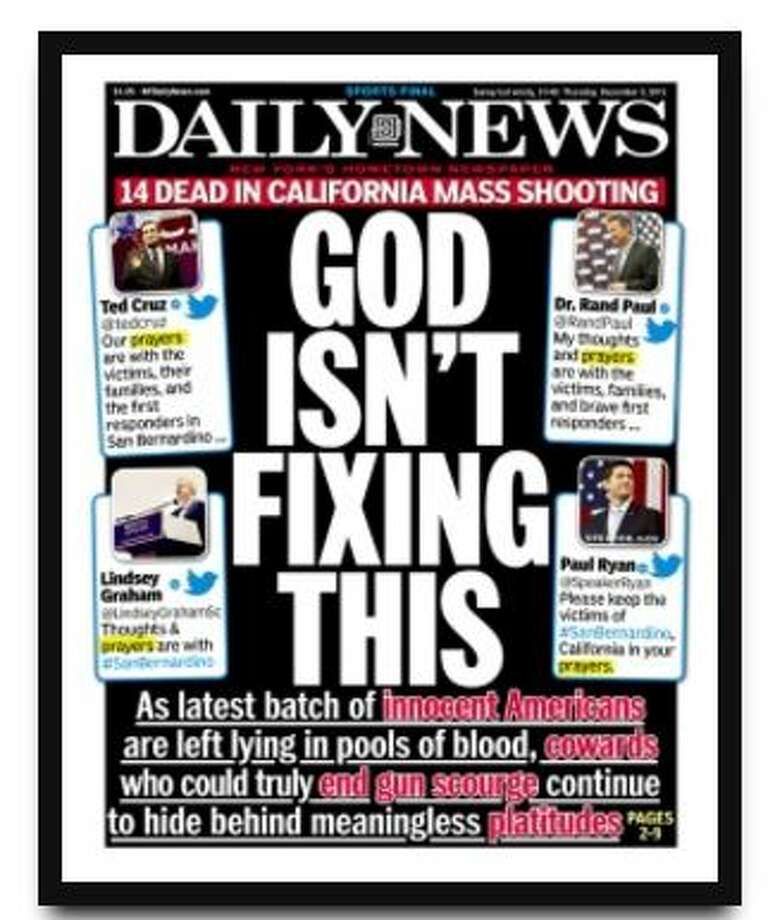
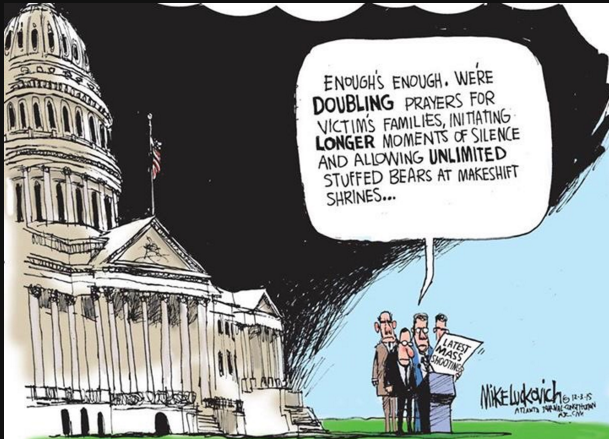
After the San Bernardino shootings, people are talking about how conservatives have nothing to offer but empty words and gestures. The Daily News conveyed this idea with its provocative cover:


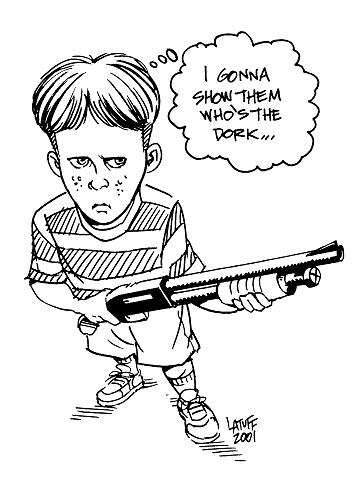
A good cartoon made a similar point:


"Who cares? Let 'em die," said every Republican to himself. "That's fourteen fewer votes for Democrat candidates, and $14,000 more in NRA donations for us."

"Prayer shaming"

Conservatives started crying about "prayer shaming," their latest attempt to silence people pointing out their lies and hypocrisies. The following posting puts that argument to rest:

It’s Not “Prayer Shaming.” It’s Hypocrite Shaming

By Rebecca WatsonI don’t think that the New York Daily News is “prayer-shaming.” To think that is to miss the point entirely: these politicians aren’t just praying for the victims, if they’re even actually praying at all. No, they’re Tweeting about praying for the victims of a circumstance that they themselves could prevent but choose not to. That’s not being a good Christian—that’s just being a huge hypocrite. That’s like praying for your aunt to recover from skin cancer while stuffing her in a tanning bed. “Stop struggling, Agnes, this is going to give you a healthy glow!”

And to really make the analogy work, in this case the tanning salon would be paying you to bring your aunt in. Because that’s the big problem, here: the National Rifle Association’s ridiculously wealthy and powerful lobby that has the GOP on the payroll. Gun control is the fastest way to fix this problem—it’s what Australia did in 1996 just days after a gunman murdered dozens of people. They cut gun homicides by nearly 60% and gun suicides by 65%, with no increase in other kinds of homicides and no increase in robberies and home invasions.

Of course, if we want to know more about the science of what works and what doesn’t work with regards to gun violence, we’ll have to lift the current ban on the CDC studying it. Oh that’s right, 20 years ago Republicans passed restrictions on gun violence research to make sure that no money accidentally went toward gun control advocacy.

So please remember all that the next time you hear a politician whine about prayer-shaming after citizens beg them to do something about the unbelievable rash of mass shootings happening in the US. It’s not prayer-shaming—it’s hypocrite-shaming.
For more on gun control, see Republicans Allow Guns for Terrorists and The Magical Power of Guns.

December 02, 2015

Planned Parenthood shooter = radical Christian

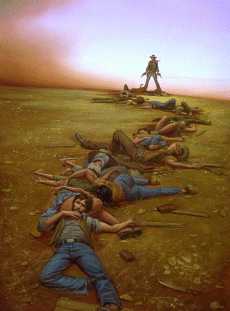
There's been a lot of talk about "radical Islam" recently. Meanwhile, radical Christians are shooting up America like it's the Wild West.

Here's a portrait of a typical radical Christian:

Accused Planned Parenthood shooter charged with rape in North Charleston in 1992

By Glenn Smith and Melissa BoughtonyDear has a history of arrests in South Carolina out of Colleton and Beaufort counties, records show. A background search completed by The Post and Courier found that Dear was arrested in 2003 on a cruelty to animals charge but was found not guilty in 2004. He was charged under the state’s Peeping Tom law in 2002 but that charge, too, was later dismissed, according to a background search.

In 1997, Dear’s then-wife reported that her husband assaulted her, according to incident reports released Saturday by the Colleton County Sheriff’s Office. She declined at the time to file charges against Dear.

Beaufort County sheriff’s deputies charged Dear with operating an uninsured motor vehicle in 2004 and he was later convicted and ordered to pay a fine, State Law Enforcement Division records show.

Dear, described as a loner by neighbors in Colorado and North Carolina, has been married at least three times and has four children.

His second wife, Mescher, described Dear in divorce papers filed in 1993 as a controlling, abusive, womanizing man who liked to gamble but was tight with his cash when it came to supporting his family. She stated that he threw her around the room by her hair during one argument and beat her head on the floor. She also said in a sworn affidavit that Dear “erupts into fury in a matter of seconds,” and she “lived in fear and dread of his emotional and physical abuse.”

“He claims to be a Christian and is extremely evangelistic, but does not follow the Bible in his actions,” Mescher stated in the affidavit. “He says that as long as he believes he will be saved, he can do whatever he pleases. He is obsessed with the world coming to an end.”
Comment:  Multiple wives, arrests, assaults, rage, abuse, cruelty to animals...and he's a Christian. He terrorizes women, children, and animals and kills them if he gets angry enough. If he was a millionaire, he could run as a Republican for president and get 25% or 50% of the vote.

For more on Christian terrorism, see Conservative Christians Aren't Good Samaritans and Let's Deport White Men.

November 30, 2015

Depp goes "sauvage" in commercial

This Dior Sauvage commercial is a couple of months old, but I just saw it the other day. I think one or two people mentioned it when it came out, but it didn't register with me then.

Here's the scoop:

Some find new Johnny Depp commercial a little confusing

By Dallas FranklinDior recently debuted a new television commercial that has a lot of people talking.

Dior’s new spot for its cologne “Sauvage,” features Johnny Depp leaving a city in a vintage car.

“I gotta get out of here,” he says.

After seeing a buffalo out in the middle of nowhere, Depp pulls over and starts walking through the desert.

“What am I looking for?” he asks.

Then, he digs a hole in the desert and takes off all his accessories.

“It’s something I can’t see,” he says. “I can feel it.”

He ends the commercial saying, “It’s magic…Sauvage.”


Johnny Depp For Dior Sauvage Commercial Doesn't Skimp On Drama Or Eyeliner—VIDEO

By Renata Certo-WareDior has been teasing us all summer, first with news of a Hollywood leading man as the face of Sauvage, the house's first new fragrance in a decade, and then with a 15-second trailer for the commercial. Now, the Dior Sauvage commercial with Johnny Depp is finally here in full, and it's basically a Depp-fueled fashion fever dream.

There were a lot of distinctly Depp-ian elements at play here—eyeliner and rows of hoop earrings a la Jack Sparrow, an electric guitar solo evocative of his Viper Room days, and that goatee-and-purple-shades look that's been more or less omnipresent since right around the time Blow came out. Even the appearance of animals like a buffalo, a wolf, and a hawk seem to be referential of Depp's claims to Native American ancestry. Most striking, perhaps, are the undeniable Fear and Loathing in Las Vegas vibes, from the sleek classic car making a lone desert crossing to the slightly hallucinogenic animal cameos.
Comment:  Certo-Ware notes the "Native" animal references, but I'd say the Native theme goes deeper than that. Indeed, I'd call the commercial a Native fantasy of sorts.

Let's recap:

  • Depp leaves civilization--represented by the big city--looking for something better.

  • He heads for the desert--the Mohave Desert, I believe--the stereotypical home of Indians.

  • He passes oil derricks, a common sight in Indian country (Oklahoma, North Dakota and Montana). Call it a transitional scene between the white man and nature.

  • He sees a buffalo, hawk, and wolf (or coyote), which together symbolize Native culture and only Native culture. Like stereotypical "spirit animals," they suggest he's on the right track.

  • He hears the hawk cry, a classic Native trope of movies and TV shows.

  • He sheds his accessories--basically everything that's loose and metallic. These items presumably stand for wealth or manufactured goods.

  • Finally, having left his material life behind, he declares his state "sauvage" (savage).

  • The commercial's message is clear: Depp = Indians = savages = people unconnected to civilization. Since today's Indians are lawyers and doctors, this is false and stereotypical.

    Depp the "star" presumably approved the commercial's plot and theme. This is more evidence that he knows little or nothing about real Indians. And doesn't care to alleviate his ignorance.

    Everything he says and does indicates he thinks of Indians as nothing but clichés. You know...the noble warrior, the wise elder, the trickster. Much like his portrayal of Tonto, his stereotypical thinking comes straight from the era of Sacheen Littlefeather and the crying Indian.

    For more on Johnny Depp, see Johnny Depp, White Man and Depp's Other Native Movies.

    November 29, 2015

    Conservatives project fears onto "others"

    This is the entire GOP plan: Credibility destroyed after Bush debacle, their only strategy is to scare us

    The party of security tanked the economy and unleashed Middle East disaster. Now they have nothing but fear itself

    By Paul Rosenberg
    Conservatives had always been comfortable with blacks as other, as containers for their most unwanted projections. But before blacks were demonized, the pattern was initiated with Native Americans. Another Kleinian theorist, Robert Young, has written about racism and projective identification (here and here, for example), noting that “the price of admission into a culture is the acquiring of its projective identifications.” Young cites the example of a 1503 decree by Queen Isabella citing Native Americans’ purported “hard habits of idolatry and cannibalism” as justification for authorizing slavery:

    The European charge of cannibalism was unfounded. Harmless and helpful natives were bad-mouthed as wild and bestial, thus legitimating the activities of a master race. The savagery of the conquistadors was projected onto their victims, who could then be seen as subhuman and could be treated in subhuman ways—which they extravagantly were.

    A similar dynamic applied to enslaved blacks, regardless of the colonizing power involved. The savagery of conquest was projected into the conquered. However, when situations allowed, there was often a place for a few “respectable” tokens who served a variety of different functions for white slaveholders, and later white leaders who followed them—to endorse their views, make them seem more reasonable, provide pacifying “leadership” for the masses, etc.

    Obama was threatening for a number of reasons, not least that he adopted a form of respectability politics, while remaining relatively loyal to the black base, and running as a Democrat, whose policies were anathema to movement conservatives. Hence, at the overt level, he disarmed the demonizing projective processes, particularly in courting conservatives outright—praising Ronald Reagan, inviting Rick Warren to give the invocation at his inauguration, reaching out to conservative opinion writers, dining with them within weeks of taking office, etc.—but he would not validate the projection of otherness onto other blacks as a whole, which is a core purpose of the “respectable black” figure. And thus the need to otherize him (and project white evil acts, impulses, phantasies, etc. into him), as blacks had always been otherized, needed to find a new form, a new rationale. Which is precisely what the birther phantasy did. It said that everything about him was a lie, so nothing he did could make any difference. It invalidated any action he might take, leaving it to be reinterpreted by those who most despised him, without any regard to the facts.
    Comment:  For more on the subject, see Conservative Freakout Over Denali = Racism and What the Crusades Controversy Is About.

    November 28, 2015

    Designer uses sacred Navajo symbols

    Navajos calling for apology from London designer who used sacred symbol in Fashion Week showcase

    By Stephanie ClaytorIndigenous designs being showcased at New York Fashion Week has many in the Navajo Nation upset. They're calling for the designer, Marjan Pejoski, to apologize.

    Pejoski's show included a dress with a Yei Bi Chei. Navajos consider the Yei Bi Chei sacred and holy, and not to be used as a fashion statement.

    "I was appalled," said Jana Pfeiffer, a Navajo woman. "I was shocked to see something that I hold so sacred in our culture, to see it on the fashion runway."
    And:"It's an atrocity to see this designer misappropriate our cultural imagery of such an important holy being," said Morgan.

    Both ladies said even they do not have the right to draw a Yei Bi Chei. Pfeiffer said Navajos have to be ordained before they can depict them on sand paintings or rugs.

    That's why both of these women want the designer--Marjan Pejoski--to apologize for stealing a sacred piece of their culture.
    Comment:  For more fashion faux pas, see KTZ Copies Sacred Inuit Robe and Jennifer Lopez Wears "Tribal" Outfit.

    November 27, 2015

    Criticism of Saints & Strangers

    Saints & Strangers, the two-night National Geographic movie that aired last weekend, got a decent amount of publicity. Many noted how it presented the Native side of the "first Thanksgiving." But not everyone was happy with how it portrayed Indians.

    How ‘Saints & Strangers’ Got It Wrong: A Wampanoag Primer

    By Alysa LandryLess than 60 seconds into the film, a band of whooping Natives descends on the pilgrims and the two groups exchange fire—bullets from one side and arrows from the other. The scene exhibits many of what the four Wampanoag tribal communities are calling “cultural, historical and linguistic inaccuracies” in the film.

    “It’s completely irresponsible telling of history,” said Linda Coombs, director of the Aquinnah Wampanoag Cultural Center. “This is one of the most well-documented parts of history, but it is distorted for the purposes of sensationalism.”
    And:At another point in the film, the Wampanoag deliver to colonists the bloodied clothes of a child who had been lost, intimating that they had killed the boy because pilgrims had stolen their corn. That is grossly untrue, Coombs said.

    “That’s an outright lie,” she said. “The Wampanoag took care of the lost child. When they returned him, he was happy and healthy and probably bedecked with beads. There’s nothing in history about knocking the kid on the head and bringing the bloody shirt to the colonists.”
    And:[S]traying from the Wampanoag language proved to be Nat Geo’s biggest film gaffe, Coombs said.

    “Abenaki is not Wampanoag,” she said. “This is the stereotype of the interchangeable Indian. If you can’t find an Indian who does what you want, keep going until you find one who will. It doesn’t matter. Indians are generic.”
    Positive views

    Perhaps not surprisingly, the Native actors defended the production.

    “The Experience Was Incredible!” Kalani Queypo on NatGeo’s Saints & Strangers

    By Vincent SchillingThere has been some criticisms of the film, but what do you think people are neglecting to notice in the face of making progress for Native actors?

    Queypo
    : The history of the portrayals of Native people in cinema is terrible, there have been gross misrepresentations, often times romanticized and fictionalized caricatures, that have been perpetuated and accepted as truth by the mass public. But more and more, native filmmakers are coming up and telling their stories. Even non-native filmmakers are rising to the challenge and making efforts to explore Native characters and storylines with truth and integrity. That is progress.

    Having strong Native actors who are bringing rich portrayals to their roles is progress. Seeing more Native language being utilized in film is progress. Progress is always happening. It may seem like it is never enough, but portrayals of Native people in film have advanced.
    “It Was Once in a Lifetime” Tatanka Means on NatGeo’s Saints & Strangers

    By Vincent SchillingThere has been some criticisms of the film, but what do you think people are neglecting to notice in the face of making progress for Native actors?

    Means
    : This story has never been told on screen before. It is a hard story to tell. It is a sensitive subject matter and time in our history. I don't think any film based on our history will ever be as perfect as we would like unless tribal nations write and produce it ourselves. I believe the world deserves to know more of the truth of what really happened. This movie is exposing some of those truths in a more gritty and less fabricated way than ever before on screen.
    “It Was a Gift” Native Actor Raoul Trujillo on NatGeo’s Saints & Strangers

    By Vincent SchillingThere have been a lot of positive comments on social media--how does it feel to represent on such a large scale?

    Trujillo
    : It's very powerful and something that makes you feel proud to represent culture and language of other people's but also to bring a humanity and multi dimensionality to historic real human beings as iconic as they are to us now.
    ‘Saints & Strangers’ Review: Close Enough is Great

    Comment:  For more on the subject, see The Wampanoag Side of Thanksgiving.

    KTZ copies sacred Inuit robe

    KTZ fashion under fire for using Inuit design without family's consent

    ‘This is my great-grandfather’s sacred garment copied right down to the tee,’ says Salome Awa

    By Sima Sahar Zerehi
    The U.K.-based fashion label KTZ's fall 2015 men's collection includes a number of garments based on traditional Inuit designs and a sweater that appears to be a replica of a shaman's jacket, which a Nunavut woman says was used without her family's consent.

    "I was in shock, I was furious, I was angry," said Salome Awa, who works as a morning show producer at CBC Nunavut.

    "This is my great-grandfather's sacred garment copied right down to the tee."

    It's the second year in a row that KTZ has been accused of copying a garment based on an indigenous design. Last year it came under fire for allegedly copying a dress from Bethany Yellowtail, a Northern Cheyenne/Crow designer from Montana. Twitter erupted with support for Yellowtail.
    Canadian retailer pulls 'stolen' sacred Inuit design from storesAfter our interview aired, we learned of a Canadian retailer that sells the KTZ sweater. The company is called CNTRBND and has stores in Toronto and Vancouver. They were selling the garment for $925 CDN.

    Owner Christopher Casuga says he was personally offended when he saw the story. On Thursday, Casuga pulled the sweater from his sales floor and removed it from the company's website.

    He says he didn't want to sell "anything that insinuates negativity toward native people. We want to make sure we are representing Canada in the best way possible."

    On Friday, KTZ issued an apology to Awa. You can read the letter here.
    KTZ apology for copying sacred Inuit robe 'bittersweet'

    'It's not right, they should have contacted us in the first place,' says Salome Awa

    By Sima Sahar Zerehi
    A Nunavut woman whose great-grandfather's sacred shaman robe was copied without consent by U.K.-based fashion label KTZ, says an email apology offered to her by the design firm is "bittersweet."

    "We sincerely apologize to you and anyone who felt offended by our work as it certainly wasn't our intention," stated KTZ in an email to Salome Awa this morning.

    The label's fall 2015 men's collection includes a number of garments based on traditional Inuit designs, including a sweater that appears to be a replica of a shaman's jacket, belonging to Awa's great-grandfather, used without her family's consent.

    "KTZ has always been inspired by and paid homage to indigenous cultures and tribes around the world," the apology said.
    Appropriation not a mistake

    Was this appropriation an innocent mistake that happened because KTZ didn't know the parka's significance? Probably not.

    In fact, probably the opposite. That is, KTZ probably knew of the coat and copied it precisely because it was famous.

    Inuit shaman parka 'copied' by KTZ design well-studied by anthropologists

    'It's the most unique garment known to have been created in the Canadian Arctic,' says Smithsonian researcher

    By Sima Sahar Zerehi
    An Inuit shaman's parka copied by KTZ, a U.K. design label, has been the subject of study for generations and is considered by experts as the "most unique garment known to have been created in the Canadian Arctic."

    The fashion label's fall 2015 men's collection includes a number of garments based on traditional Inuit designs, including a sweater that has a pattern almost identical to that on a shaman's caribou skin parka that dates back to the early 1900s.

    The design was used without the consent of the shaman's descendants in Nunavut. In response to a CBC News report last week, KTZ apologized to the family and pulled the sweater from its online stores.

    The story has sparked interest in the origins of the parka and the meaning behind its symbolic designs.
    Comment:  For more fashion faux pas, see Jennifer Lopez Wears "Tribal" Outfit and KTZ Rips Off Native Designs.