January 07, 2011

Crow in Stranger In Paradise

Here's a book I read recently:

Stranger In Paradise (Jesse Stone) [Paperback]Jesse Stone trades quips with his deputies, Suitcase Simpson and Molly Crane; struggles with his relationship with his ex-wife, Jenn; and grapples with a criminal's return in bestseller Parker's sizzling seventh novel to feature the Paradise, Mass., police chief (after 2007's High Profile). Ex-con Wilson Crow Cromartie, who claims to be Apache and who eluded the police after a shootout 10 years earlier in Trouble in Paradise (1998), wants Stone not to interfere in his search for someone in Massachusetts. A Florida mob bigwig, Louis Francisco, has hired Crow to kill his ex-wife and kidnap his 14-year-old daughter, Amber, but Crow has a policy of not harming women. In the end, Stone does more than leave Crow alone; he decides to make sure Amber, who's involved with a Latino gang, gets a chance, however slim, to overcome the odds stacked against her. Stone and Crow make an appealing odd couple as they first warily size each other up then become grudging allies in the pursuit of justice.And:Solid And Entertaining Crime Fiction From A Master, March 27, 2008
By Mel Odom (Moore, OK USA)

Parker plays fast and loose with the plotting. Several things are going on throughout the novel. The past encounter with Crow threads throughout, but I'm not quite sure I'm willing to buy everything Parker promotes this time. One of the things that most jarred me was the attraction to Crow by one of the former hostages from that armed robbery ten years ago. Parker sets Crow up to be this sexual fantasy figure for that woman and they have a "one-time deal" encounter.

Not only that, but Crow's sexual magnetism wins over the one character in this series that I thought would never stray outside her marriage. Parker has explored the nature of sex and attraction throughout this series, and I've gone along with it. But, to me, this encounter really cheapened what I thought was a fantastically solid character. This decision really bothered me, which is a good thing on one level because it shows how realistically the author has created his characters.
Rob's review

Crow is defined by two traits. One, his amoral ability to kill anyone (= savage Indian). Two, his love of women and their love of him (= Indian as sex object and fantasy figure).

So he's kind of a stereotypical: a stoic, sexy, savage Indian. But let's say his character is two-dimensional rather than one-dimensional. Parker's writing gives him some depth--hints at the complexity of his motivations.

Perhaps the oddest thing is how people doubt his claim to be a full-blooded Apache. Hello? Take a look at the guy. Does he look like a full-blooded Indian? If yes, then the question is whether he's Apache or something else. If no, the question is whether he's a mixed-blood or an Indian wannabe. But Stone and company never ask these questions.

Imagine if Wes Studi, a full-blooded Cherokee, walked into the room. You might not be sure if he was a Cherokee or some other kind of Indian. You might think he was a Latino or a Middle Easterner. But your first response wouldn't be to simply doubt him. He obviously looks like something out of the ordinary. The question would be what he was, not whether he was something.

Other than the above, the book doesn't make anything of Crow's Indianness. So it's kind of a mixed bag. He's in a modern rather than traditional role, but the role is somewhat stereotypical. Indian hitmen in thrillers and mysteries aren't that uncommon.

Anyway, Stranger In Paradise is an entertaining read. As implied above, it works because of the characterization more than the plot. Rob's rating: 8.0 of 10.

For more on Native-themed mysteries, see Longmire Mysteries to Become TV Series and Coel Wins Emeritus Award for Mysteries.

San Manuel's motocross team

AMA SX:  San Manuel Yamaha Previews Anaheim Opener

Superstar James Stewart is motivated to make up for his disappointing injury-hit 2010 campaign.Team San Manuel Yamaha--Presented by Red Bull--is excited to announce that it’s 2011 racing effort will be led by returning Team rider and multi-time Supercross Champion James Stewart, along with AMA MX Series 2009 450 Class “Rookie of the Year” Kyle Regal. After a disappointingly short season in 2010, Stewart has been intensely focused on his return to the track this Saturday, January 8th, at Anaheim Angel’s Stadium, in pursuit of his third Supercross Championship Title. “I’m super excited to get back to racing this weekend. I’ve been anticipating my return for months.”And:About Team San Manuel

Formed in 2006, Team San Manuel is a unique partnership between the San Manuel Band of Mission Indians and L&M Racing, LLC, with the sole purpose of reaching out to Native and non-Native communities and sharing with them the value of perseverance and dedication. Building a winning team comprised of top-notch talent and community service, Team San Manuel honors the Serrano belief of caring for our community. (www.sanmanuelracing.com)

About L & M Racing

L&M Racing was formed in 2006 by Owner/Team Manager Larry Brooks and partner Mike Kranyak. Operating as Team San Manuel Yamaha, the team has garnered two Supercross Championship titles in the last three race seasons.
Comment:  For more on the subject, see Pala Raceway's Origin and Barona's Motocross Training Center.

Below:  "San Manuel Yamaha's James Stewart."

January 06, 2011

Developing Native steampunk

Here's a genre of science fiction I've mentioned before:

SteampunkSteampunk is a sub-genre of science fiction, alternate history, and speculative fiction that came into prominence during the 1980s and early 1990s. Specifically, steampunk involves an era or world where steam power is still widely used—usually the 19th century and often Victorian era Britain—that incorporates prominent elements of either science fiction or fantasy. Works of steampunk often feature anachronistic technology or futuristic innovations as Victorians may have envisioned them; in other words, based on a Victorian perspective on fashion, culture, architectural style, art, etc. This technology may include such fictional machines as those found in the works of H. G. Wells and Jules Verne or real technologies like the computer but developed earlier in an alternate history.It doesn't seem to have anything to do with Native Americans. But some Natives incorporated their histories and cultures into the steampunk environment:

#50 Overcoming the Noble Savage & the Sexy Squaw: Native Steampunk

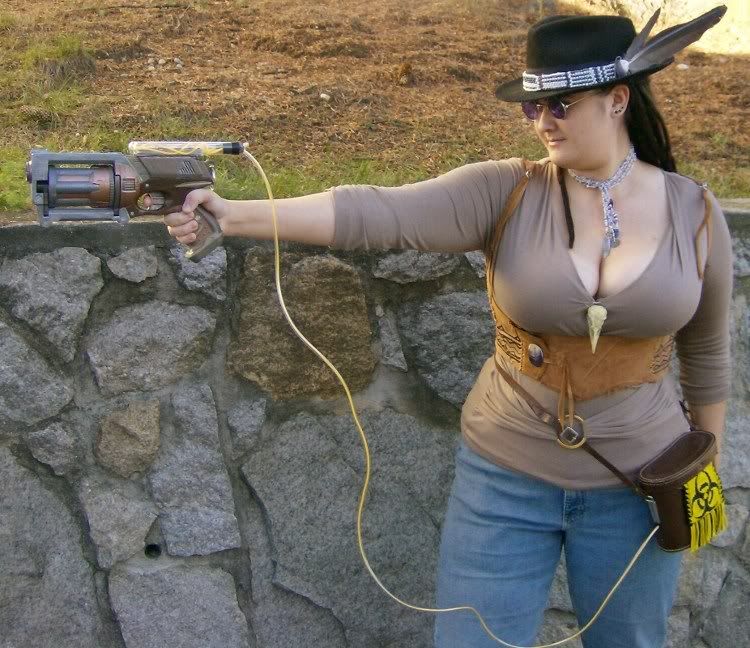
By Monique PoirierMaking a deliberate choice to construct my Steampunk attire around Native attire often involves deciding between which pieces are appropriate and which will be recognized by a wide audience as being Native. It means working with and against existent images of What Indians Look Like–and it becomes extra difficult when I have to work against the fact that Native Americans are already assumed in the popular consciousness to be anachronistic. Am I subverting Victoriana-centric Steampunk with my Native attire, or am I just reinforcing the stereotype that Native folks all dress like it’s 1899 all the time because that’s when they stopped existing? Is being a Steampunk Native American just rehashing Indians in Aspic? When I put on a pair of buckskin leggings, or wear bead work that I have spent hours making by hand with skills taught to me by my mother–clothing and jewelry that I’ve also worn to powwows–am I marking myself as Other-Than-European or am I just reinforcing Braids, Beads, and Buckskins?

It comes down to mythology, to narrative, and to what stories we’re telling with the personas we portray and how we present them. Some of the attire I own will never be worn outside of a powwow or tribal gathering. For example, I don’t wear prominent feathers–or any feather at all that look like this as part of my Steampunk attire; I treasure the feathers I’ve actually gained through ceremony and ritual too much to wear them to anything less solemn than a powwow or tribe meeting, and I am not comfortable in making mockup feathers that my character/persona would have similarly earned.

It’s pretty grating, then, to be at a convention and having someone comment, “If you’re trying to look like a Native American, you should incorporate more feathers,”‘ because I do understand where that comment comes from. How do you know that an Indian is and Indian if they’re not in the Hollywood Dress Code attire for Indians? A hard and fast rule I’m going by: “If I ran into another member of my tribe while wearing this here, would I feel the need to explain or apologize for it?” If so, I am not wearing that. Even if it means that I’m losing recognition.

There is a vast and predominantly grossly incorrect mythology surrounding Native Americans. Children in American Public Schools, unless they happen to be from an area that has a very prominent and active Native community (and sometimes even then) are generally spoon-fed the tidy and feel-good Story of Thanksgiving as their first lesson in Native American Culture–depending on whether or not they’ve already seen Pocahontas and Peter Pan. They generally graduate to Westerns and various other Hollywood mythologies so that by the time they’re attending cons all on their own they’ve built a distinct expectation of what ‘Native American’ should look like–and if an outfit doesn’t do that, it will not parse as Native American.

Which makes my costuming choices complicated.

Part of the fun of Steampunk is the aspect of alternate history; of deliberate anachronism and the application of alternate timelines and technological developments and the ration of ‘Steam’ to ‘Punk’. It means having the chance to create alternate histories in which Native Americans maintain sociological primacy and control over the North and South American landmass, if we so choose–my own Steampunk persona is an Air Marshall in a timeline in which Tecumseh’s Rebellion was successful and resulted in the creation of a Native American confederacy of nations that holds most of North America, as well as parts of Mexico and several island nations in the Pacific (most notably the Kingdom of Hawaii). She carries a ray gun–and as far as I’m concerned, this is still entirely Native Tech.


Some guidelines on developing a Native steampunk ensemble:

Native American Steampunk--An Approach

By Miss KagashiNative American steampunk is post-contact. While some Native American cultures possessed knowledge of working copper, there is no evidence of them using this for steam power. However, since the Age of Steam is post-contact, it's perfectly feasible that native peoples were using or adapting Western technology to suit their needs, even if it's using the scraps.

The story of Native Americans in the Age of Steam is one of survival. The peoples of the Plains used every portion of a slain buffalo--not only for spiritual respect of the animal, but common practicality. This mentality becomes even more important post-contact, as game decreases, lands are taken away, and army rations become nothing more than broken promises--so the need to scrounge, scavange, and improvise is dire. Both Western and traditional clothing was worn for necessity--as was the unfortunate and eventual adaptation to firearms and other Western products. This should be reflected in Nativepunk.

Unless you are of Native American descent and understand the reasoning behind it or have received permission from a tribal authority or researcher, do not involve religious or spiritual items in your steampunk. Certain objects and garments hold a lot of power or communicate the status of the wearer such as Plains war bonnets, Plains breastplates, and Woodlands wampum belts. What I'm going to condone is the use of certain garments and decorative styles instead of these items to create your kit. Furthermore do not wear your ensemble to a powwow or Native reenactment, I beg you.

Most important of all: DO YOUR RESEARCH. Each and every tribe is different--so do not assume that if you mix certain stereotypical elements together that you'll have a Nativepunk ensemble. If you don't do your research, not only will you look a mess, but people in the know can and will call you out on it (believe me, I know). Basically, don't be a bad Halloween costume, give these people the respect that their art deserves.
Comment:  Since Poirier links to my website several times, she must be cool.

For more on the subject, see Review of The Difference Engine and Steampunk in Colonial America.

Any change since Dances with Wolves?

Indians in Aspic

By Michael Dorris

Published: February 24, 1991
When I saw "Dances With Wolves" at an advance screening, I predicted that it would be less than a box-office smash. Though spectacular to look it, it struck me as too long, too predictable, too didactic to attract a large audience. Twelve Academy Award nominations and $100 million in revenue later, was I ever wrong. In fact, the movie probably sells tickets precisely because it delivers the old-fashioned Indians that the ticket-buying audience expects to find. Dunbar is our national myth's everyman--handsome, sensitive, flexible, right-thinking. He passes the test of the frontier, out-Indians the Indians, achieves a pure soul by encountering and surmounting the wilderness.

Yet, if "Dances With Wolves" had been about people who happen to be Indians, rather than about Indians (uniformly stoic, brave, nasty to their enemies, nice to their friends), it might have stood a better chance of acting as a bridge between societies that have for too long woodenly characterized each other.

With such tremendous popularity, the film is sure to generate a bubble of sympathy for the Sioux, but hard questions remain: Will this sentiment be practical, translating into public support for native American religious freedom cases before the Supreme Court, for restoration of Lakota sacred lands (the Black Hills) or water rights, for tribal sovereignty, for providing the money desperately needed by reservation health clinics? Pine Ridge is the most economically impoverished corner of America today, the Census Bureau says, but will its modern Indian advocates in business suits, men and women with laptop computers and perfect English, be the recipients of a tidal wave of good will?

Or will it turn out, once again, that the only good Indians--the only Indians whose causes and needs we can embrace--are lodged safely in the past, wrapped neatly in the blankets of history, magnets for our sympathy because they require nothing of us but tears in a dark theater?
Comment:  The answers to Dorris's 1991 questions are no and no. There was no tidal wave of good will toward Indians.

I'd like to think Dances With Wolves advanced the cause by increasing awareness of Indians. If not a tidal wave, it may have generated a steady stream of good will. It may have made everything from Hollywood movies and TV shows to Native American Heritage Month to the National Museum of the American Indian more possible.

But several factors washed out that good will in the last two decades. Among them were the public backlash against Indian casinos, Bush's uncompassionate conservatism against minorities, and 9/11, which made it more acceptable to denigrate brown-skinned people. I'm not sure people think any more favorably of Indians than they did in 1991.

If anything has advanced Indians, it's probably the economic and political clout that came with gaming revenues. Tribes with successful casinos are doing notably better than they were 20 years ago. "Money talks" in America; we respect people with cash.

For more on the subject, see Movies Convey America's "Master Narrative," Valenti:  Movies Are Merely Movies, and Ups and Downs of Hollywood Indians.

Jacques La Grange and Shadow Wolf

The Super Team Behind SpazDog Press Comics

By Colin Lecher"It's like the Beatles with George Martin," says Jacques La Grange, a San Carlos Apache Native American who came to Demumbrum with an idea for a Native American hero, Shadow Wolf. La Grange's story--inspired by his want to create a hero for Native Americans in the way Bruce Lee was for Asian Americans--turned into another series for SpazDog Press.SpazDog Press--The CreatorsJacques La Grange (Artist)

Jacques has a background in video production, but 7 years ago he got the idea for a story about a Native American Indian set in a post-apocalyptic future and his quest to find a new tribe. He has been working these last years to learn to draw and create comics so that he could make that story a comic book.
Comment:  For more on the subject, see Comic Books Featuring Indians.

January 05, 2011

New Huck Finn eliminates "Injun"

New edition of 'Huckleberry Finn' to lose the 'n' word

By Keith StaskiewiczWhat is a word worth? According to Publishers Weekly, NewSouth Books’ upcoming edition of Mark Twain’s seminal novel Adventures of Huckleberry Finn will remove all instances of the “n” word—I’ll give you a hint, it’s not nonesuch—present in the text and replace it with slave. The new book will also remove usage of the word Injun. The effort is spearheaded by Twain expert Alan Gribben, who says his PC-ified version is not an attempt to neuter the classic but rather to update it. “Race matters in these books,” Gribben told PW. “It’s a matter of how you express that in the 21st century.”

Unsurprisingly, there are already those who are yelling “Censorship!” as well as others with thesauruses yelling “Bowdlerization!” and “Comstockery!” Their position is understandable: Twain’s book has been one of the most often misunderstood novels of all time, continuously being accused of perpetuating the prejudiced attitudes it is criticizing, and it’s a little disheartening to see a cave-in to those who would ban a book simply because it requires context. On the other hand, if this puts the book into the hands of kids who would not otherwise be allowed to read it due to forces beyond their control (overprotective parents and the school boards they frighten), then maybe we shouldn’t be so quick to judge. It’s unfortunate, but is it really any more catastrophic than a TBS-friendly re-edit of The Godfather, you down-and-dirty melon farmer? The original product is changed for the benefit of those who, for one reason or another, are not mature enough to handle it, but as long as it doesn’t affect the original, is there a problem?
'Huck Finn' navigating choppy waters

By Martha T. Moore"When the younger reader is staring at that word five times on a given page and the instructor is saying, 'Mark Twain didn't mean this and you have to read it with an appreciation of irony,' you're asking a lot of a younger reader," Gribben says.

Readers will still be able to understand Twain's message without the blare of the offensive word drowning out the book's themes, Gribben says. "All I'm doing is taking out a tripwire and leaving everything else intact. All his sharp social critique, all his satirical jabs are intact. This novel cannot be made colorblind."

The book has been criticized for its language and characterizations since it was first published in 1885, says Barbara Jones of the American Library Association, which tracks how often books are banned from libraries. Huckleberry Finn was among the top five books challenged or banned during the 1990s.

Author Toni Morrison once wrote of the "fear and alarm" and "muffled rage" she felt during her first readings of it.

"Yeah, it's a tough book," says Millie Davis of the National Council for English Teachers. "Which is an excellent reason for teaching it."

Word is used 'for a reason'

Gribben's upcoming version of Huckleberry Finn, first reported in Publisher's Weekly, has educators and scholars readying the tar and feathers.

Twain once described the difference between the almost-right word and the right word as the difference between the lightning bug and the lightning. "Slave," Twain scholars say, is a firefly.

Twain could have used other derogatory words of the period, such as "darky," but chose not to, they say.

"The word is there for a reason," says Jeff Nichols, the executive director of the Mark Twain House and Museum in Hartford, Conn. "The word is terrible, it's hurtful, but it's there for a reason," to convey the language and attitudes of Missouri in the 1840s, in a book written in the 1880s when Jim Crow laws were being passed in the South to deprive blacks of their civil rights.

The new edition will also change "Injun Joe" to "Indian Joe" and "half-breed" to "half-blood."

"This is what's called a slippery slope," says Robert Hirst, editor of the Mark Twain Papers at the University of California-Berkeley. He says Huckleberry Finn is best taught in college, rather than high school.
A collection of links on the subject:

Voices:  The Huckleberry Finn Controversy

The final word:

Leave 'Huck' alone

Excising the 'N-word' does a disservice to students, since the language is very much part of the story and the history.Gribben has a point when he says that many modern school districts and teachers are reluctant to put "Huck Finn" on the curriculum because of its liberal use of the offensive word. His goal is to broaden the book's readership and acceptability by rendering it inoffensive. "Huck Finn" is No. 4 on the list of most-banned books in American schools, according to author Herbert N. Foerstal, and that's a shame, but attempting to sanitize it isn't the answer. Intelligent and sensitive discussion with students would be a better response.

Twain's masterwork is a moving reflection of attitudes in the pre-Civil War South (and of its author's postwar sensibilities, which were ahead of their time with regard to race but behind our own). It's the struggle of a white youth, Huck, to reconcile his recognition of the humanity and equality of an escaped slave with the views of a society that considers him little better than an animal and uses epithets to describe him. The language, then, is very much part of the story and the history. Trying to protect students from the full ugliness of racism by softening that language does a disservice to them, and it's all too easy to imagine the crimes against literature that would result if this kind of thing caught on. We hope nobody gives Gribben a copy of Shakespeare's "Merchant of Venice," because the Bard's attitude toward Shylock the Jew was distastefully Elizabethan.
Comment:  Of course, Huck Finn has many problems besides the n-word. It's questionable whether it deserves to be called a masterpiece or taught at all. I'd say it definitely should be held until high school if not college.

For more on Huckleberry Finn, see Scholar:  Huck and Twain Were Racist and Is Huck Finn Racist? For more on "Injun," see Steele's Hypocrisy on Racial Slights and Twain Invented "Honest Injun"?

Robertson works with Clapton, Reznor

Robbie Robertson Works with Eric Clapton, Trent Reznor on New Album

By Andrew VaughanRock and roll veteran and former member of seminal ’60s and ’70s group, The Band, Robbie Robertson is releasing a solo album on April 5. How to Become Clairvoyant will be his fifth solo album and his first release in more than 10 years.

After delving into his Native American roots for his past two solo records, Robertson returns to rock and roll with this album. Eric Clapton, Tom Morello, Robert Randolph, Steve Winwood and Trent Reznor guest on the record with Clapton co-writing three tracks with Robertson. Reznor contributes one song, an instrumental called “Madame X.”
Comment:  For more on Native music, see Review of For the Generations and Hip-Hop Album for Leonard Peltier.

Grouplove's stereotypical Colours video

Music Video Fail of the Week:  Grouplove ‘Goes Native’ for New Single

By Arturo R. GarcíaDirected by Jordan Bahat, the video starts with lead singer Christian Zucconi being led by two men toward a tree somewhere in the desert. A rope is slung around a tree and Zucconi’s kicked down. Yup, he’s about to be lynched. (One wonders how this led the magazine to compare the video to Where The Wild Things Are.)

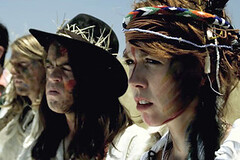
But wait! Zucconi’s fearless bandmates appear on the scene, clad in “warpaint,” feathers, “headdresses” and brandishing “tomahawks” and skinny jeans. They rescue Zucconi, who is revealed to be part of the “tribe,” as he’s also sporting feathers.
Comment:  Another case of hipster headdresses...sigh.

For more stereotypical videos, see Tribal Girls in Hot 'n' Fun Video and "Moccasin Scanks" Video.

January 04, 2011

Rising stars in Native animation

Here's an article from the September/October 2007 issue of Native Peoples magazine. It covers several Native animation projects, some of which I hadn't heard of before:

Indigenous Animation Movement Rising

By Kade L. TwistIndian Animation Capital

The Cherokee Nation capital of Tahlequah, Oklahoma might have more animation filmmakers per capita than any other community in the United States. And it’s a uniquely talented group of artists. The animation films of Joseph Erb (Cherokee), Nathan Young (Pawnee/Delaware/Kiowa) and Roy Boney, Jr. (Cherokee) have screened at film festivals nationally and internationally and have received numerous awards.

Recently, Erb teamed up with Boney and Matt Mason (Cherokee), another of his trainees, to create Hero, a 3D sci-fi animation series about a Cherokee named Runner who is leading a group of Cherokees fighting to retain their rights in the post–fossil fuel future, where the good guys speak Cherokee and the bad guys speak English.

IAIA Program

If Anthony Deiter (Plains Cree/Ojibwe) has his way, the Institute of American Indian Arts in Santa Fe will be the central hub for emerging Indigenous animation artists. Deiter is the chair of visual communications at IAIA. His experimental animation film Younghawk Seven, which utilizes a rich combination of digital photography and 2D and 3D animation, was featured in the National Museum of the American Indian’s exhibition Who Stole the Teepee and is exemplary of his creative vision.

Oneida Nation

The Oneida Nation has been investing in media for years and has established Four Directions Media, which operates Four Directions Productions (4DP). Through 4DP, the Oneida Nation has developed the premier HD video and 3D animation studio on the East Coast, as well as Web and interactive projects.

The first project for 4DP was the short 3D animation Raccoon and Crawfish, a traditional Oneida story about the evils of boastfulness, which had its world premiere on April 18 at the Syracuse International Film and Video Festival.

Canada Ahead—as Usual

Unfortunately, in the United States there hasn’t been a lot of opportunity for Indigenous-produced content. American media is notorious for its lack of diversity. The U.S. doesn’t have anything resembling Canada’s Aboriginal Peoples Television Network (APTN). American media executives “are quick to draw a line in the sand that Indigenous content is only for Indigenous people,” says Chris Keintz (Cherokee), co-creator of Raven Tales, a 3D animation series produced in Canada.

A Rising Star

Joseph Lazare (Mohawk) is hoping to join the ranks of APTN. He is the up-and-coming rock star of the Native animation movement. At the age of 19, in 2004, his film Might of the Starchaser, produced by Laura Milliken of Big Soul Productions, had its world premiere at the Sundance Film Festival. In the film Lazare uses multiple animation mediums—live action, stop-motion clay, computer-generated image (CGI) special effects and 2D—to tell the story of young space officer trying to save his planet from being destroyed by an evil baby lizard attempting to repopulate his species.

Lazare and Big Soul Productions have teamed up again to create a 30-minute pilot for the comedy series By the Rapids on APTN. The Mohawk-language 2D animation series is based on his hometown of Kahnawake (which means “by the rapids” in Mohawk). It’s an ensemble comedy that reflects “the humor of day-to-day life in Kahnawake, the people and all the strange things that happen in a small town.
Comment:  For more on the subject, see Aboriginal Animations on Display and Animation Enthralls Audiences.

Colbert satirizes UN declaration scare

Stephen Colbert exposes Obama's latest takeover plan on the Comedy Channel's Colbert Report, 1/4/11:


Comment:  I thought this bit was cute but also stereotypical at the end. It was a good subject to satirize, but in Colbert's final speech, it wasn't clear who or what he was satirizing.

A comment on Facebook:He is playing the part of a Sean Hannity or Bill O'Reilly. That is the point of his character. He is the modern-day Archie Bunker.Yes, we understand that. The question is whether Colbert is satirizing white men or Indians at the end. I'd say he crossed the line from one to the other.

True, it's similar to an Archie Bunker rant. But Mike Stivic or someone usually contradicted Archie's racist remarks and made him look stupid. Nothing like that happened to punctuate Colbert's remarks, which makes them a problem.

Colbert's bit really annoyed someone else:Shame on Comedy Central for choosing to take that story in the direction they did. I know that they are in the business of being funny and making light of serious topics--but the shame of it is that what could and should have been an opportunity to finally get the topic of the UN Declaration on Indigenous Rights in front of the general public and mass of uninformed Americans was turned into a farce---and worse, a farce that went right into the usual stereotyping and racism. Me heapum pissed off.Yeah, how are audiences supposed to take Colbert's Tonto talk? Is he talking like an ignorant Indian? Or like an ignorant white man's impression of an ignorant Indian?

Since he's supposedly directing his comments at Indians, the correct answer is the former, or both. That is, he's talking in a style intended to communicate successfully with Indians. If he's portraying himself as ignorant, he's also portraying Indians as ignorant. That's stereotypical.

If Sherman Alexie or someone came on and mocked Colbert's "ignorance" the way the Jeffersons used to mock Archie, that would be different. But nothing like that happened. Nothing told viewers that Indians are really educated and speak perfect English like everyone else.

In short, the bit was a nice try, but it failed in the end. Better luck next time, Comedy Central.

For more on the UN Declaration, see Modoc Nation Rips UN Declaration and Countdown Covers UN Declaration Scare. For more on how humor and satire work, see The Dudesons, Polish Jokes, and Minstrel Shows and Okay to Stereotype in "Satires"?

Ryan Huna Smith's diabetes comic book

A cell phone in every hand; a mobile app to teach

By Lisa FalkI’m excited that at the Arizona State Museum we are also working on a digital project to reach out to teens about an important message: preventing diabetes. Working with Native artist Ryan Huna Smith and consulting with teens, we are developing a digital comic as a mobile app to address healthy lifeways for diabetes prevention. The story has a Native American focus and is brought to life through Ryan’s cutting edge graphic drawings. The mobile app is being developed to compliment an exhibit we will host next fall, Through the Eyes of the Eagle, which features the original artwork from a book series of the same name that was developed by Indian Health Services and the Center for Disease Control. The app will be available initially in English and Tohono O’odham.Comment:  For more on the subject, see Eagle Books Promote Healthiness and Comics Good for Your Health.

Below:  "From Through the Eyes of the Eagle, illustration by Patrick Rolo & Lisa A. Fifield, cropped image."

January 03, 2011

The origin of yaomachtia

Speaking of Aztecs, here's an update on the Update on Aztec Martial Art from last September. It's another e-mail from Manuel Lozano, the "founder of modern yaomachtia," the alleged Aztec martial art. Apparently the poor guy uses a computer with a malfunctioning shift key, but never mind.Dear Rob,

listen Rob, i have researched this lost forgotten art all over Mexico for the past 32 years, a famous Mexican Archeologist from a famous University in Mexico City initially helped me back in 1977 - 78

the word Yaomachtia is found in old Mexican history books, this term translates as the art of war, the word Yao means war in ancient Nahuatl, as far as machtia, this is a term with latin/roman/greek connotations meaning training, so it looks to me that this word was invented by the spanish, it doesn't sound full nahuatl

my research took to many places all over mexico to witness the little training that was left, but this training was with the knife, machete and several types of sticks, throughout these 32 years i found many scattered fighting techniques dealing with bladed weapons, stick weapons and wrestling techniques

there was also a special type of old wrestling techniques as verified in person
by the Mexican Wrestling Legend himself (Mil Mascaras - the man of a thousand masks) who is a personal friend of mine, i produced his first ever course on self-defense based on his personal wrestling experience

the old Mexican wrestling techniques is called (Chingadate) by the old school guys, Mil Mascaras is the last of the old guys that knows this ancient Mexican wrestling techniques

this (chingadate) term is a vulgar term used by the old guys, meaning to do somebody in if they mess with you - the (te) part of it has nothing to do with any japanese thing

(date) means to give you - chinga means to do you in

i have not made a big deal of it because i haven't wanted to, but now i know that i must as people that do not know me are saying ugly things about me and they do not know my life story

at present,

i teach private intensive courses to many private executive groups from all over Mexico

i have also taught at several Mexican Military bases many times

The ex U.S Mexican Ambassador appointed by our ex-President George Bush is a personal friend of mine as we were in High School together here in Brownsville, Texas at St. Joseph's Academy, he knows personally of my efforts since the early 1970's

i don't mean any disrespect to you Rob as i don't know you as you don't know me

but the Mexican martial art history comes in three eras, the pre-colonial, the colonial, and the modern

in order to complete my research i had to train in the european fencing arts, mainly spanish fencing called "La Verdadera Destreza", my teachers are Maestri de Armas Ramon Martinez and Jeannette Acosta Martinez who is the world's foremost authority in french foil fencing and small sword

Destreza was brought to Mexico by Spain's greatest teachers, and it was taught here in new spain (Mexico), duels were fought all over mexico as i have proof, so Mexico's martial arts have to include destreza, and ecole d' armes (french fencing) i know all of Mexico's martial history and i have written a book on it, all i need is the actual filming of the techniques and from there i will get the pictures for the book

i could talk all night about this subject, but please don't trust anything on the internet, a man of your intelligence should better that to trust anything out there by people who never even crossed the border, especially now with the drug wars going on 5 minutes from here, i'm 2 miles from the rio grande river

and as far as the term yaomachtia, i use it to pay tribute to Mexico's Aztec Culture which most of us have direct roots to, the art as i teach it includes pre-columbian exercises and movements as taught to me from many friends that i have all over mexico

i've been training for 37 years and 32 of those i have researched and trained in these blade, stick and fighting techniques from mexico

my martial art resume is included for you to see what i've done

Rob please do no trust everything you find on the internet, as it most all false, you should know that by now

if you want to set the record straight for your readers about me please do a good job, i will send you some fighting techniques with the machete for you to see

i have 3 intensive courses to teach in the next 2 months to special interest groups from mexico that are coming to learn Yaomachtia as taught by me, these are 5 days of training 8 hours each day, many groups from mexico are in line waiting to come train

if i have been disrespectful to you then i'm sorry but you have to understand that many people that write opinions of others on the internet are false and have no factual basis

they must have nothing else better to do in life,

the training i had in mexico has been for many years and all over mexico, i have witnessed many traditional celebrations that included martial art techniques all over rural mexico i even participated in some of these rituals

like i said, my new book is ready and all i need is the filming of the techniques for the book, and soon i will do that

presently i sell 3 courses;
1. Secret fighting Techniques - one book and 8 dvds
2. Mil Mascaras Advanced Self Defense
3. The Secret Martial Art Newsletter - published monthly (launched Jan. 2010)

let me know how i can help you

Sincerely,

Manuel Lozano
Founder of Modern Yaomachtia

P.S. I didn't even bother to check that link out at all it's all false, it seems that everybody has an opinion, i doubt they have ever spent 32 years researching in Mexico
Comment:  Umm, I sure hope someone is helping you write your book, Mr. Lozano. And on a computer with a fully functional shift key.

I trust Lozano just set the record straight for Newspaper Rock readers. Now we'll continue to set the record straight.

First, let's dispose of our previous argument. Lozano accused me of not doing enough research on yaomachtia. The only sources he alludes to are "old Mexican history books" and his own course materials, neither of which are available to me.

Therefore, I continue to assert that I did all the research necessary and possible. If "yaomachtia" exists only in some musty old tomes in a Mexican biblioteca, it's ridiculous to expect me to know about it. Only a handful of people in existence may have seen the word in print.

And what about the claim that "the word Yaomachtia is found in old Mexican history books"? It's nice, but I don't necessarily believe it unless I see. I suggest Lozano scan the pages containing the word and include them in his materials and on the Web. It would bolster his dubious credibility.

Etymology of "yaomachtia"

Lozano doesn't seem certain about the origin of his own word. Some research suggests that in the Nahuatl language, yao means "war" and machtia means "to teach." So "yaomachtia" could mean something like "war training."

But a few huge caveats to that:

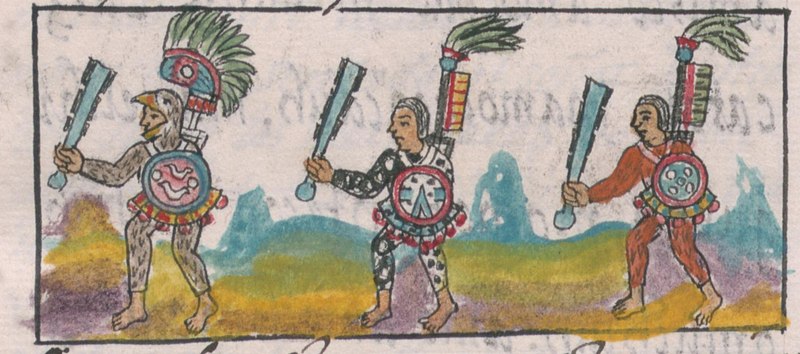
1) "War training" could mean anything from exercising to preparing one's weapons to fasting before a fight. There's zero evidence that it refers to a martial art, which one dictionary defines as:any of the traditional forms of Oriental self-defense or combat that utilize physical skill and coordination without weapons, as karate, aikido, judo, or kung fu, often practiced as sport.2) "Yaomachtia's" existence in old Mexican books suggests it was invented by the Spanish, not the Aztecs. Supporting this this is the origin of the word machete:1598 (in pseudo-Sp. form macheto), from Sp. machete, probably a dim. of macho "sledge hammer," alt. of mazo "club," probably a dial. variant of maza "mallet," from V.L. *mattea "war club" (see mace (1)).So machetes seem to be a Spanish import from Europe that didn't exist until after 1598. Sure, the Aztecs used something called a macuahuitl, a wooden club with cuts in the side to hold the sharpened obsidian blades. It's sort of a club/axe/sword hybrid, but it isn't a machete. So a martial art involving machetes probably didn't exist in Aztec times.

Even the Nahuatl word "yaomachtia" doesn't mean the training was invented in Aztec times. It's easy to imagine an alternative explanation. For instance, a Spanish soldier sees a post-Aztec Indian exercising in the year 1600 or 1700 and asks him about it. The Indian says he's practicing "yaomachtia." The Spaniard says, "Great! I just invented a martial art that uses machetes. I'll call it 'yaomachtia' to honor your people."

Despite the name, yaomachtia could easily be a Spanish rather than a Native invention. Without more evidence, there's no way of knowing.

Conclusion

In short, there remains zero evidence that the Aztecs practiced a martial art similar to "karate, aikido, judo, or kung fu" in pre-Columbian times. Best guess is that Lozano heard the word "yaomachtia" and decided to apply it to various "bladed weapons, stick weapons and wrestling techniques" he encountered in Mexico. In other words, he has no documentation about what the original "yaomachtia" was; he invented the amalgamation of practices he calls "modern yaomachtia."

So everything I've said about "yaomachtia" has been correct, basically. End of story.

Incidentally, Wikipedia has this to say about Native martial arts:Native peoples of North and South America had their own martial training which began in childhood. Most groups selected individuals for training in the use of bows, knives, blowguns, spears, and war clubs in early adolescence. First Nations men, and more rarely some women, were called warriors only after they had proven themselves in battle. War clubs were the preferred weapon because Native American warriors could raise their social status by killing enemies in single combat face to face. Warriors honed their weapons skills and stalking techniques through lifelong training.Well, of course they learned how to use their weapons. In that sense, yes, they had martial arts. But again, there's zero evidence they had the kind of unarmed combat we usually mean when we refer to "martial arts."

Below:  Aztec warriors practicing a martial art but not yaomachtia or an Asian-style "martial art."
Alternatives to Dark Horse's TUROK

In Review of Dark Horse's TUROK, I said what I thought was wrong with the new Turok comic book. But suppose Jim Shooter came to me and said he had a great idea for a new Turok series. It was based on a group of "bad savages" chasing Turok and Andar the "good savages." Rather than just saying "no, it's stereotypical," could we make it work?

Answer: Yes, of course.

For starters, I don't see why TUROK has to be set in pre-Columbian times. If you want, you can ignore the advent of Europeans and do the same stories. But setting it after 1492 means you can send conquistadors, monks, and other Europeans down the rabbit hole. Why should indigenous people be the only ones chomped by dinosaurs?

Use two real tribes

Okay. Instead of the horrible cliché of the bloodthirsty Mesoamericans (see Apocalypto), use two actual Indians tribes who are traditional enemies. Then they'll have a real, credible motive for fighting each other.

For instance, the Lakota and the Crow. Turok and Andar are Lakota who were trying to steal the Crow's horses. The Crow caught them in the act and a few of them chased our heroes down the tunnel.

You wanna stick with pre-Columbian times when there weren't any horses? Okay, Turok and Andar are Lakota who were trying to steal the Crow's women so they could keep them or trade them. The Crow caught them in the act, etc.

To make it (even) more interesting, Andar the Lakota was trying to steal horses or women from Turok the Crow. Turok and his men caught Andar in the act, chased him down the tunnel, etc.

But wait, you say. Turok and Andar are the good guys. They can't be shown stealing anything. It would mean they're not noble savages. Not...perfect!

Response: First, traditional Indians would consider these legitimate acts of war, not crimes. They might punish someone who stole their property, but they wouldn't be morally shocked and outraged. Rather, they'd admire the perpetrators for their courage and daring--for doing what they would've done in the same place.

Besides, comics companies have made millions off of anti-heroes such as Wolverine, the Punisher, and Deadpool. What's wrong with adding a little moral complexity to Turok's and Andar's cardboard characters? As with Wolverine, maybe they'll grow from selfish savages into self-sacrificing samurai. And make Dark Horse some money in the process.

What would enemies do?

Once our heroes are in the Land of the Lost, what next? In the present TUROK comic, murderous Aztecs hunt Turok for revenge or bloodlust or because they're there, I guess. Cardboard characters don't have to have real motivations. In my version, the Lakota and Crow find they have a lot in common compared to the dinosaurs and beast-men and other creatures they meet. They have to overcome their age-old differences and work together to survive.

Maybe the Lakota and Crow are enslaved for a time and learn that enslaving others isn't as justifiable as they thought. As a result, maybe they decide to lead a revolt against the lost land's slavemasters. Or maybe they're appalled to see all the barbarian kingdoms fighting and killing each other. Maybe Turok becomes this land's Hiawatha and forms a league of nations united under one law.

There you go. I've just taken Turok's limited premise and made it several times more interesting. If Shooter wants, he can still tell his one-dimensional stories of "evil" Indians chasing "good" Indians. But now he also can tell stories about rich characters who learn and grow.

This is why I'm trying to publish comics, kiddies. I think I can come up with better ideas than someone's who's been in the business 45 years. Who's been an editor-in-chief at several companies. If you need my help on TUROK, Jim, give me a call.

For more on the subject, see Shooter on Dark Horse's TUROK and 3.5 Arrowheads for Dark Horse's TUROK.

P.S. I'd give TUROK only 2.5 or 3 arrowheads on the five-arrowhead scale. And a couple of those would be for the attractive art.

Below:  A previous version of Turok.

Review of WARLORD OF MARS #1

Dynamite Entertainment is reviving John Carter of Mars in a new comic book. I decided to get the first issue because:

  • I've read all of Edgar Rice Burroughs's John Carter novels.

  • I recently wrote about Barsoom = Indian Territory and Stereotypes in A Princess of Mars

  • The story covered Carter's pre-Mars days and I wanted to see how Dynamite would handle it.

  • It cost only $1.00.

  • The main story invents a scene not in A Princess of Mars. Carter and his partner Powell are in an Arizona saloon when some ex-Union soldiers enter. They call the Confederates and their leaders cowards, but Carter ignores them. But when the Yankees insult Carter's beloved Virginia, he shoots them dead.

    Rob's reactions

    That was a great bit when I saw it in The Trouble with Tribbles 33 years ago. But it's a little unoriginal now.

    Carter is supposed to be a dignified, aristocratic gentleman. He's one of the last people who would fight his inferiors over an insult. And he wouldn't start shooting them when they hadn't shot first.

    The artist is drawing Carter to look much like Wolverine without the tufts of hair. His personality is Wolverine-like too. This Carter apparently will go into a berserker rage whenever he's provoked.

    Unfortunately, that's a total misreading of John Carter. It would be like portraying Sir Lancelot, James Bond, or Jean-Luc Picard as a barroom brawler. It has nothing to do with the original character except the name.

    The Indian aspects

    Alas, the Apache don't make an appearance in this issue. The Yankees call them "redskins" at the beginning so readers will know these white men are crude and rude. Near the end, Carter and Powell discover Indian scalps on the soldiers' horses. White men bad! Indians (possibly) good! That's different from the approach in the original novel, at least.

    Carter concludes by saying, "We'll have to be careful now. Apaches aren't going to be too pleased to see any more white faces." Yeah, because Carter and Powell plan to trespass on their land and take their mineral resources without permission. Who would be pleased at that?

    So some things haven't changed. John Carter still has a ridiculously inflated sense of white privilege and entitlement. Like a 2-year-old, he thinks that whatever he can find and see is his. He doesn't recognize the concept that other people have possessions and rights just like him.

    In that sense, he's a typical American. In the clash between sovereign Indian nations and selfish American greed, the latter wins.

    Anyway, I'd say WARLORD OF MARS #1 isn't even worth a dollar. You can safely skip this comic.

    For more on the subject, see America's Cult of Self and Capitalism Killed the Indians.

    Trying to ignore Cahokia

    America's Forgotten City

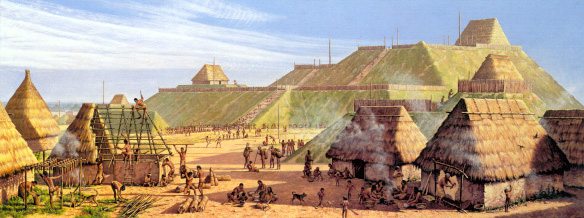
    By Glenn HodgesCahokia was the apogee, and perhaps the origin, of what anthropologists call Mississippian culture—a collection of agricultural communities that reached across the American Midwest and Southeast starting before A.D. 1000 and peaking around the 13th century. The idea that American Indians could have built something resembling a city was so foreign to European settlers, that when they encountered the mounds of Cahokia—the largest of which is a ten-story earthen colossus composed of more than 22 million cubic feet of soil—they commonly thought they must have been the work of a foreign civilization: Phoenicians or Vikings or perhaps a lost tribe of Israel. Even now, the idea of an Indian city runs so contrary to American notions of Indian life that we can't seem to absorb it, and perhaps it's this cognitive dissonance that has led us to collectively ignore Cahokia's very existence. Have you ever heard of Cahokia? In casual conversation, I've found almost no one outside the St. Louis area who has.

    Our ignorance has deep roots. The first person to write a detailed account of Cahokia's mounds was Henry Brackenridge, a lawyer and amateur historian who came upon the site and its massive central mound while exploring the surrounding prairie in 1811. "I was struck with a degree of astonishment, not unlike that which is experienced in contemplating the Egyptian pyramids," he wrote. "What a stupendous pile of earth! To heap up such a mass must have required years, and the labors of thousands." But newspaper accounts of his discovery were widely ignored. He complained of this in a letter to his friend former President Thomas Jefferson, and with friends in such high places, word of Cahokia did eventually get around. Unfortunately it was not word most Americans, including subsequent Presidents, were very interested in hearing. The United States was trying to get Indians out of the way, not appreciate their history. Andrew Jackson's Indian Removal Act of 1830, which ordered the relocation of eastern Indians to land west of the Mississippi, was premised on the idea that Indians were nomadic savages who couldn't make good use of land anyway. Evidence of an ancient Indian city—one that rivaled the size of Washington, D.C., at the time—would have mucked up the story line.
    Comment:  For more on Cahokia, see Human Sacrifice "Prevalent" Among Indians? and Touring America's Indian Heartland. For more on what Americans of the time thought, see Vanished Mound Builders in The Prairies and Empty Land in The Gift Outright.

    January 02, 2011

    Review of Dark Horse's TUROK

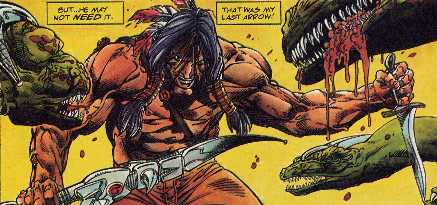
    I recently read Jim Shooter's new comic book starring Turok, Son of Stone. It was about what I expected from the comments in Shooter on Dark Horse's TUROK.


    Turok himself is a generic Indian. His appearance, almost identical to his look in his 1954 debut, is fine. As Shooter said, he's a "warrior wise and strong. He's not particularly interesting.

    His background, such as it is, is also generic. He's traveled across the American continent. He knows a few Indian words, including one in Ojibwe. He has a steel knife and axe he got from a Viking. He had no other tribal or cultural markers--nothing except generic talk of spirits and shamans.

    His initial adventure is also generic. He saves the boy Andar from the evil Aztecs. Turok and Andar flee down a mystical tunnel to the Land of the Lost with the bad guys in hot pursuit. After a couple of attacks and escapes, Turok comes face to face with--wait, you've probably never heard this one before--a scantily-clad high priestess and her dark-skinned minions.

    Those evil Aztecs

    The big problem here isn't Turok, it's the evil Lord Maxtla and his men. They're portrayed as renegades, too cruel and barbaric even for the Aztecs. But since they're the only Aztecs I think we'll see, it's fair to treat them as representative.

    Naturally, the comic portrays these Indians with the usual indicators of evil: bones, piercings, warpaint, earrings, necklaces, claws, plates, and the ever-popular shaved heads. No evil Indian ever goes unadorned. It's important to look like a scary demon or skeleton 24/7, even when no one else is around. Imagine going to the mess hall with your fellow evildoers and not looking like a vision from hell!

    Maxtla is the evillest of the evil because he wears a dinosaur or crocodile skull over his head. Never mind that this headgear occurs only in bad comic books and jungle movies, or that it would interfere with his peripheral vision and hearing during combat. Scary people wear scary skulls...case closed!

    There's plenty wrong with this portrayal of Aztecs, but most readers won't notice the flaws. Among them:

  • Aztec emperors usually didn't lead military expeditions. Rather, they sat in magnificent palaces and tended to administrative affairs while lackeys and slaves pampered them. Generals lead soldiers, not monarchs.

  • Maxtla and his small band of followers are supposedly seeking Aztláan--i.e., "paradise." What will they do when they find it? Meekly join it as common laborers until they prove their worth?

    When they find themselves in dinosaur land, they decide they'll conquer that too. Right, because a few dozen Aztecs can do pretty much anything. They could conquer Europe if they happened to wind up there.

    In reality, they might be able to conquer a small tribe or two, but any substantial civilization would quickly crush them. It's ridiculous to portray them as sticking to their psychotic goals no matter where they go or what they do. It means they're cardboard, cartoon villains, not worthy adversaries.

  • The sacrifice issue

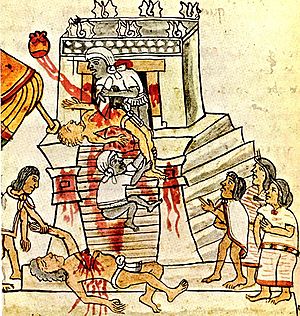
  • The Aztecs wouldn't perform a ritual sacrifice on the ground in the middle of nowhere. These sacrifices occurred in ceremonial plazas on top of pyramids for a host of religious, geographical, and astronomical reasons. A few Wikipedia quotes hint at how complex the matter was:

    Human sacrifice in Aztec cultureA strong sense of indebtedness was connected with this worldview. Indeed, nextlahualli (debt-payment) was a commonly used metaphor for human sacrifice, and, as Bernardino de Sahagún reported, it was said that the victim was someone who "gave his service."

    Human sacrifice was in this sense the highest level of an entire panoply of offerings through which the Aztecs sought to repay their debt to the gods. Both Sahagún and Toribio de Benavente (also called "Motolinía") observed that the Aztecs gladly parted with everything: burying, smashing, sinking, slaying vast quantities of quail, rabbits, dogs, feathers, flowers, insects, beans, grains, paper, rubber and treasures as sacrifices.
    And:A great deal of cosmological thought seems to have underlain each of the Aztec sacrificial rites. The most common form of human sacrifice was heart-extraction. The Aztec believed that the heart (tona) was both the seat of the individual and a fragment of the Sun's heat (istli). To this day, the Nahua consider the Sun to be a heart-soul (tona-tiuh): "round, hot, pulsating."And:[T]he strong emphasis given to human sacrifice may have stemmed from the great honour Mesoamerican society bestowed on those who became an ixiptla--that is, a god's representative, image or idol. Ixiptla was the same term used for wooden, stone and dough images of gods.And:Most of the sacrificial rituals took more than two people to perform. In the usual procedure of the ritual, the sacrifice would be taken to the top of the temple. The sacrifice would then be laid on a stone slab by four priests, and his/her abdomen would be sliced open by a fifth priest with a ceremonial knife made of flint. The cut was made in the abdomen and went through the diaphragm. The priest would grab the heart and tear it out, still beating. It would be placed in a bowl held by a statue of the honored god, and the body thrown down the temple's stairs.

    Before and during the killing, priests and audience (who gathered in the plaza below) stabbed, pierced and bled themselves as autosacrifice (Sahagun, Bk. 2: 3: 8, 20: 49, 21: 47). Hymns, whistles, spectacular costumed dances and percussive music marked different phases of the rite.


    Exactly none of this appears in Shooter's TUROK. None of this complex cosmology is equivalent to: "Butcher the innocent victim because we're evil and our evil gods demand blood!" This is why people think Indians were uncivilized: because the media fails to show the civilization.

    Conclusion

    Alas, TUROK gives us little but stupid stereotyping. Turok the noble savage is the exception to the rule: that most Indians are savage beast-men with no goal except fighting and killing. Shooter and company have "successfully" reinforced a century-plus of Native stereotypes.

    Ironically, the reprint of Turok's 1954 debut shows the original series was less stereotypical. Here Turok's and Andar's speech is somewhat stilted, and Andar sometimes grunts "ugh." But there are no huge swaths of savagery on display--just a man with good hunting and survival skills.

    For more on human sacrifice, see Human Sacrifice in Aztec Pantheon and Human Sacrifice "Prevalent" Among Indians?
  • Spirit Level is low in US

    Here's another variation of the argument I've used to explain the plight of Indians. This time it's in a book with "mountains of data."

    Equality, a True Soul Food

    By Nicholas D. KristofThere’s growing evidence that the toll of our stunning inequality is not just economic but also is a melancholy of the soul. The upshot appears to be high rates of violent crime, high narcotics use, high teenage birthrates and even high rates of heart disease.

    That’s the argument of an important book by two distinguished British epidemiologists, Richard Wilkinson and Kate Pickett. They argue that gross inequality tears at the human psyche, creating anxiety, distrust and an array of mental and physical ailments—and they cite mountains of data to support their argument.

    “If you fail to avoid high inequality, you will need more prisons and more police,” they assert. “You will have to deal with higher rates of mental illness, drug abuse and every other kind of problem.” They explore these issues in their book, “The Spirit Level: Why Greater Equality Makes Societies Stronger.”

    The heart of their argument is that humans are social animals and that in highly unequal societies those at the bottom suffer from a range of pathologies. For example, a long-term study of British civil servants found that messengers, doormen and others with low status were much more likely to die of heart disease, suicide and some cancers and had substantially worse overall health.
    Comment:  For more on the subject, see Poverty Makes People Sick and Intergenerational Trauma = PTSD.

    Sitting Bull joke in Mad Men

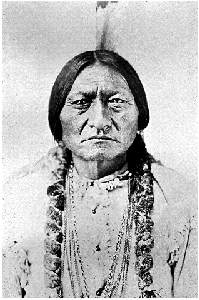
    In the third episode of Mad Men's second season, The Benefactor (airdate: 8/10/08), a comedian jokes about a fat woman. One of his lines is:Hey, get Sitting Bull on the phone. We found the last buffalo.I doubt an Indian joke would be among the first 100 retorts that came to mind in the early 1960s. Again, the writers seem to be going out of their way to mention Indians. Good for them, although it doesn't quite ring true in this context.

    Later, someone concerned about being fired says "I'm one gone paleface"--an oblique reference to Indians. So Mad Men has made several references to Indians in the space of its first 16 episodes. That isn't a coincidence; it's a conscious or unconscious choice by someone.

    For more on the subject, see Mohawk Airlines in Mad Men and Indians in Mad Men.

    Checklist for friends of Natives

    A short but good list for people like me who have taken an interest in another ethnic group. I'll highlight a couple of the points:

    What I Have Learned About Being an Ally to Native Americans

    By Elli Stern and Claudia A. Fox Tree2. To acknowledge my privilege as a white person and that I am not subjected to the same oppression, marginalization and discrimination as Native Americans AND to accept my responsibility to use my privilege and be a "voice" in places where the voice of Native Americans is silenced or goes unheard.

    3. To recognize the impact of social and cultural dominance as well as the historical legacy of efforts to exterminate and/or assimilate Native Americans AND to continue to remind others of the oppression Native Americans are subjected to whether by intent or not.
    Comment:  For more on the subject, see such postings as:

    Rob = moral police?!
    Rob unqualified to discuss stereotypes?!
    Rob shouldn't judge Natives?
    Telling Indians what to do
    Rob the presumptuous white man?

    January 01, 2011

    NMAI on Jeopardy

    The National Museum of the American Indian was featured on Jeopardy recently (12/27/10). It was a Double Jeopardy category consisting of video clues. A woman visiting the NMAI pointed to art objects and then narrated the clues.

    The first thing to note is that the contestants avoided this category like the plague. No one touched it until the end of Double Jeopardy, so only four of the five clues appeared. It's more evidence that people aren't familiar or comfortable with Indians.

    When I was a child, Jeopardy was a challenging game show. The questions were hard enough to stump most adults. Now it's been dumbed down incredibly for America's increasingly ignorant population. Although the show still throws in some tough questions, a smart 8th-grader could answer most of them.

    Here are the four NMAI questions along with photos (instead of videos) and my commentary:

    $1200:  "In a Native American origin story of this fish, two animals steal a baby of the sockeye people. The sockeye find the baby in a river, which becomes their home."

    (The video shows the reverse side of this artwork.)


    Short version:  Fish called sockeye.

    Answer:  Salmon.

    Better question:  "A US region indicated by a compass point, it produces this distinctive style of Native art."

    Answer:  Northwest or Pacific Northwest.

    $800:  "The figures in the middle of this sculpture acknowledge life in all directions, while the tribal dancers on either end pray for this, which is essential for life."


    Short version:  Substance Indians dance for.

    Answer:  Rain or water.

    Better question:  "Various interpretations of this ceremony can be found in many cultures from Ancient Egypt to certain Native tribes."

    Answer:  Rain dance.

    $1600:  "The Raven steals the sun and escapes through a sooty smoke hole to get its characteristic color. Those shenanigans are typical of this crafty folklore archetype."


    Short version:  Archetype exemplified by Raven.

    Answer:  Trickster.

    Better question:  "A folkloric archetype exemplified by this work of art."

    Answer:  Trickster.

    $400:  "Washington holds a wampum belt in this work honoring the Oneida who traveled 400 miles in the winter of 1777-78 to bring food to the starving men at this site."


    Short version:  Where Washington's troops starved.

    Answer:  Valley Forge.

    Better question:  "This tribe of the Haudenosaunee Confederacy brought food to Washington's starving men at Valley Forge."

    Answer:  Oneida.

    Comment:  Three of these questions are so obvious that Jeopardy could've used one-word clues: "Fish," "Ceremony," and "Archetype." The other one is obvious too. That demonstrates how simple-Simon the show has become.

    For more on the subject, see Pix of My 2009 Washington DC Trip and TV Shows Featuring Indians.

    Modoc Nation rips UN declaration

    Recently conservatives have had fun concocting a new racist smear campaign against Obama and liberals have had fun mocking them. Now let's return to the actual UN Declaration on the Rights of Indigenous Peoples and see how harmless it really is. Here's part of a press release from the Modoc Nation:

    State Department White Paper Contradicts Obama’s Statements at Tribal Nations Conference

    Shows U.S. Endorsement of UNDRIP Really Means Politics and Business as UsualU.S. State Department position: UNDRIP unnecessary to protect rights of Native Americans

    The white paper issued by the State Department fleshing out the details of the U.S. endorsement of UNDRIP is really quite disappointing. Largely a laundry list of everything the federal government has done for the indigenous people of this country over the last two years, its primary message can be boiled down to: “We’re already doing all these wonderful things to help out the native peoples that live in our country, so U.S. endorsement of UNDRIP is unnecessary. But since we want to continue in our role as the leader of the free world, and the United States always stands up for what is right, we’ll go ahead and endorse it anyway.” This conclusion is all but confirmed when one reads the fine print of the article and finds that the United States government’s application and implementation of UNDRIP will be limited largely to already existing federally recognized tribes and be carried out within the framework of existing US and state law. In other words, even though the United States is “endorsing” UNDRIP, it sees no need to alter any of its laws or policies pertaining to the indigenous peoples within its national boundaries and jurisdiction. In fact, the State Department says the United States should serve as a “model” to the rest of the world in this regard.
    And:US endorsement ignores UNDRIP’s obligation of nation-states to honor their treaties with indigenous peoples

    Article 37

    1. Indigenous peoples have the right to the recognition, observance and enforcement of treaties, agreements and other constructive arrangements concluded with States or their successors and to have States honour and respect such treaties, agreements and other constructive arrangements.

    2. Nothing in this Declaration may be interpreted as diminishing or eliminating the rights of indigenous peoples contained in treaties, agreements and other constructive arrangements.


    Incredibly, this critical issue is not even discussed in the State Department’s white paper. In fact the word “treaties” appears only twice, both times in the same paragraph, in which the State Department lauds the National Oceanographic and Atmospheric Administration (NOAA) for consulting with “Northwest treaty tribes” regarding the designation of critical habitat and with four other unnamed tribes regarding their “ocean treaty fishing rights for groundfish in conjunction with the Pacific Fishery Management Council process.” While we all are grateful for the rare occasions in which the U.S. government “consults” with us, it is laughable that the Obama Administration has announced its “support” of UNDRIP without even addressing the issue of honoring treaties, one of the bedrock elements of UNDRIP. Apparently, this Administration, like its predecessors, continues to view treaties with native nations, tribes and bands as documents that have no real force of law and, therefore, are subject to being breached or abrogated whenever it is convenient for the U.S. government to do so. In fact, the Supreme Court enshrined this practice and made it “legal” when it invented by interpretation the “plenary powers of Congress” doctrine (see Lone Wolf v. Hitchcock, 187 U.S. 553, 23. S. Ct. 216, 47 L. Ed. 299 (1903)). So, we now see that this Administration plans to make no change with respect to its recognition, observance or enforcement of treaties it has struck with indigenous peoples. Rather than come right out and say that, however, the State Department has just ignored the issue entirely.
    Comment:  As Wikipedia notes about the Modoc:The Modoc are a Native American people who originally lived in the area which is now northeastern California and central Southern Oregon. They are currently divided between Oregon and Oklahoma. The latter are a federally recognized tribe, the Modoc Tribe of Oklahoma. The Oregon Modoc are enrolled in the federally recognized Klamath Tribes.So the Modoc Nation is an unrecognized tribe, which is why it spends time bemoaning the administration's focus on recognized tribes. But still, this is a great critique.

    I think the second point is the telling one. How do you "endorse" or "support" indigenous rights without explicitly stating you'll honor the treaties you signed?

    That's why I have to shake my head at those who think this "aspirational" document will move Natives closer to a just world. One, it has zero legal force; it's not binding on the US, future administrations, or Obama himself. Two, the white paper offers no significant discussions of tribal sovereignty, treaty rights, or government-to-government relations. So tribes are "aspiring" to nothing except the status quo.

    For more on the subject, see UN Declaration = Status Quo and What Supporting the UN Declaration Means.

    Mohawk Airlines in Mad Men

    In the Season 2 episode For Those Who Think Young of the AMC series Mad Men (airdate: 7/27/08), the fictional Sterling Cooper ad agency works on a campaign for Mohawk Airlines. Paul Kinsey pitches a new slogan to his boss Dan Draper:KINSEY:  "Mohawk Airlines. There's a new chief in the sky."

    KINSEY:  And I thought, following that, "Most routes to Boston, circle the wagons, we've got it surrounded." And there'd be wagons around a dot that says "Boston."

    DON [skeptically]:  I can almost picture it. Sal.

    SAL:  This is the first I'm hearing it, too.

    DON:  So it's about an airline that's flown by Indians? Maybe a plane with some arrows stuck in the cargo door? That's funny. That's what gets people's attention now, right?

    DON:  There has to be advertising for people who don't have a sense of humor.

    KINSEY:  I understand, Don.

    DON:  What else you got?

    KINSEY:  Several more Indian puns.

    DON:  Stop writing for other writers.
    A minute later, Don has an inspiration:DON:  That Indian....It's not about the majestic beauty of the Mohawk Nation.

    DON:  It's about adventure. Could be a pirate. Could be a knight in shining armor. Could be a conquistador getting off the boat. It's about a fantastical people who are taking you someplace where you've never been. Blah, blah, blah, blah....

    DALE:  We could dress the stew as Pocahontas.

    SAL:  With the cheekbones.

    PEGGY:  How's his wife going to feel about that?

    FREDDY:  Air travel's too expensive to waste on your wife.
    Comment:  As you may recall, Mad Men mentioned Indians a couple of times in its first season. In its second season, the mentions continue. I guess creator and writer Matthew Weiner is interested in the subject.

    This sequence may approximate how so many Indians got on corporate logos and in ad campaigns. The ad men weren't overt racists; they were just oblivious to their blind spots. They thought it was "cute" to repeat the stereotypes they'd heard all their lives. They probably didn't think a single Indian was left alive to object.

    Note how Dale returns to the ridiculous Indian theme even after Don has shot it down. Though of course Pocahontas has nothing to do with the Mohawks. This shows how much Native stereotypes have gripped our imagination.

    Indians = adventure?

    Though Don doesn't like the puns, his thinking isn't much better. He explicitly links Indians to pirates and knights--i.e., fantasy figures from the distant past. To him Indians suggest adventure. If you take a flight on Mohawk Airlines, who knows what may happen. Romance, intrigue, even arrows stuck in the cargo door.

    I mention the arrows because Don's position is really no different than Kinsey's. Indians represent an escape from the drudgery of families and jobs--or more broadly, civilization. In other words, wildness and freedom. Adventure.

    You could trace this kind of thinking back to Turner's Frontier Thesis--if not to the Boston Tea Party. Indians represent(ed) the uncivilized frontier. Americans traveled west to tame that wilderness for themselves. Don is proposing an echo of this: Mohawk (Airlines) as the illusion of adventure.

    A little PC

    A couple of Don's lines ring totally false. I don't think the typical adult knew about, or would bring up, the Mohawk Nation or conquistadors in 1962. These seem like examples of present-day political correctness to me.

    I think the idea of calling tribes "nations" came into vogue much later--perhaps in the '70s or '80s. And I doubt Don would associate "majestic beauty" with an Indian reservation. The Mohawk reservation may be beautiful in some sense, but it's not "national park" beautiful.

    The "conquistador" line just seems out of place to me. I think it's the writer's wink-wink way of saying, "We know Indians are real and bad things happened to them. We're not exploiting them or ignoring their plight."

    For more on the subject, see Accuracy in Mad Men and Indians in Mad Men.

    Looking back at Indian Comics Irregular

    I just published the 200th issue of Indian Comics Irregular, the newsletter I've been writing and distributing since I began publishing PEACE PARTY. In honor of this milestone, let's look back at previous milestones:

    ICI #1:  Animaniacs Stereotypes Indians  (Nov. 1998)The cartoon show Animaniacs recently ran an episode titled Jokahontas. It was a takeoff on Disney's animated movie Pocahontas, of course. Part of the cartoon satirized Disney's many cliches--especially, having Pocahontas want to leave her safe life and explore the world, just like the Little Mermaid, Beauty, and Princess Jasmine.

    But part of it satirized Indian life. The cartoon showed the Powhatan nation--actually Yakko, Wacko, and Dot, which is itself questionable--living in tipis, wearing feather bonnets, capturing a buffalo, and smoking a peace pipe. Maybe "satirize" is the wrong word, because the cartoon made no attempt to say this part of the show was false also. Viewers could reasonably conclude that despite the comical antics, Powhatans did live in tipis and wear feather bonnets, etc.

    Indian stereotypes still live and breathe, even when people should know better.
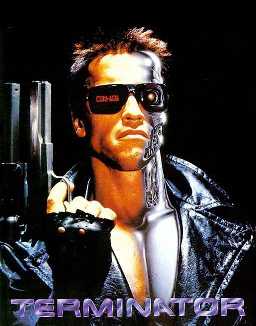
    ICI #100:  The Terminator vs. the Tribes  (Oct. 2003)The focus of this newsletter has always been "the intersection of pop culture and Indian country." What better example of that than Arnold Schwarzenegger's bid to be governor of California? Schwarzenegger is running on pure celebrity, since he has no political experience or acumen to his name. Indeed, he has no plan or agenda except being "for the people" and against "special interests."

    Like so many crusaders before him, Schwarzenegger's primary bogeymen are the Indians. Like a latter-day Übermensch, he'll "terminate" the bad guys for truth, justice, and the American way. How dare those money-grubbing tribes try to get rich (i.e., pull themselves out of poverty) at the expense of "real" people?

    In Schwarzenegger's script for this election, Indians are the perfect movie villains. They're the heartless land barons who will foreclose on our mortgages and the half-naked savages who will scalp us in our sleep. Either way, they must be stopped.

    Like the fictional Arabs and drug dealers he's fought before, Arnold's Indians are barbarians who pretend to be civilized. If the Duke isn't available to bring them to heel, he'll do the job. He'll clean up Dodge City (Sacramento) and run the varmints (gaming tribes) out of town.

    If you're a Californian reading this on Oct. 7, it's not too late to send the Terminator (or should I say the Predator?) a message. Don't let a woman-groping, Hitler-admiring muscleman trample tribal sovereignty beneath his boots. We have enough problems on the national level without electing an intellectually and morally suspect frat boy as governor too.

    For more on the subject, see "Have Gaming Tribes Bought California for $120 Million? No" and "Top 15 Reasons Why Indians Shouldn't Vote for Arnold Schwarzenegger" at http://www.bluecorncomics.com/120mill.htm.
    Comment:  Schwarzenegger dropped his anti-Indian rhetoric once he was elected. Nevertheless, he proved to be as bad a governor as I expected. Go back to Hollywood, Arnold, and let a real man (Jerry Brown) do the job.

    Horned frogs in Native lore

    In honor of Texan Christian University's victory in the Rose Bowl today, here's some lore about their mascot, the Horned Frog:

    Horned lizardHorned lizards (Phrynosoma) are a type of lizards that are a genus of the Phrynosomatidae family of lizards. The horned lizard is popularly called a "horned toad," "horny toad," or "horned frog," but it is neither a toad nor a frog. The popular names come from the lizard's rounded body and blunt snout, which make it resemble a toad or frog.

    In culture

    Some Native American peoples regarded horned lizards as sacred. The animal is a common motif in the art of many Native Americans in the Southwestern U.S. (namely, Navajo) and in Mexico. In the Clint Eastwood film The Outlaw Josey Wales, the character played by Chief Dan George decides to go to Mexico based on signs given to him by a horned toad.

    The horned lizard is the state reptile of both Texas and Wyoming, and the horned frog is the mascot of Texas Christian University (TCU).

    The legend of Ol' Rip, a horned toad (allegedly) discovered alive in the cornerstone of a demolished courthouse in Eastland, Texas in 1928, has been well-publicized. A horned toad had been placed there in 1897 as part of a time capsule.

    The story of Ol' Rip is thought by some to have inspired the Looney Tunes short One Froggy Evening. Presumably, creator Michael Maltese, being from outside the lizard's range, either took the amphibian nomenclature literally, or just went with it because it made a better story.
    What's a Horned FrogIn stories of Native Americans in the Southwest, horned frogs are depicted as ancient, powerful and respected. Archaeologists find horned frogs on petroglyphs, pottery and other crafts painted hundreds of years before Columbus set sail for America. In some parts of Mexico, folklore persists that these creatures which weep tears of blood are sacred.Comment:  For more on Native rock art, see Oprah to Visit Aboriginal Rock Art and Rock Art = 3rd-Grade Doodling?

    Ethnic studies ban in effect

    Arizona ethnic studies ban goes into effect

    By Megan Gordon and Mary K. ReinhartA new law aimed at ending ethnic-studies classes went into effect today.

    For three years, state Superintendent of Public Instruction Tom Horne pushed the bill in hopes of terminating the ethnic-studies curriculum in the Tucson Unified School District.

    House Bill 2281 bans classes in kindergarten through 12th grade that promote the overthrow of the U.S. government, promote resentment toward a race or class of people, are designed primarily for pupils of one ethnic group, or advocate ethnic solidarity.

    If districts are found in violation of the new law, the Arizona Department of Education can withhold 10 percent of the district's state funding.
    Comment:  As I'm sure you'll recall, I and other critics trashed this law repeatedly in 2010. Here are some of those postings:

    Arizona laws = manifest insanity
    Conservatives hope minorities will forget
    Arizona laws = clash of civilizations
    Custer's Last Stand and ethnic studies
    Ethnic history corrects American history
    Mainstream history = pro-white propaganda

    Below:  How white Europeans tamed the American wilderness: the lesson conservatives would like students to learn.

    Welsh documentary on Indians today

    Iolo learns from American Indians

    By Sion MorganWales should learn from the mistakes of American Indians to ensure the future of its language and culture, according to nature-loving TV presenter Iolo Williams.

    The 48-year-old has just returned from the United States where he has filmed a six-part documentary exploring how American Indians cope with life in the 21st century.

    In each of the six programmes in the series Iolo visits a different tribe of American Indians and spends a week living with each group.

    “One thing that was perfectly obvious was that the groups in Canada fare much better than those in America,” said Williams. “Almost every American Indian tribe in America suffers in terms of the language, culture and life in general–their traditional way of life being swallowed up in modern American society.
    Comment:  For more on the subject, see Native Documentaries and News.