September 07, 2010

Greg Burgas reviews Native Heart

Here's another review for the graphic novel I covered in Review of Native Heart. You can read the whole review, but I'll give you the highlights:

A review a day:  Native Heart

By Greg BurgasThere’s a lot to like about this comic, even though it’s not perfect.

McMurtry does a marvelous job with the art, which is the stronger part of the book by far. Occasionally his faces are a bit grotesque and unreal. ... But other than that, the book reminds me of classic Western paintings, with delicate linework and expansive vistas even when the scene is a bit more claustrophobic.

McMurtry’s story doesn’t hold up as well, unfortunately. It’s not terrible and it’s interesting to read because we get to know something about a person we may not know much about. ... McMurtry doesn’t get into his life enough prior to the murder, although he does try.

This is a refreshing book because it doesn’t show Native Americans who are battling to hold onto their lifestyles in the face of American encroachment--there’s nothing wrong with that story, but we’ve seen it before--it’s a story of a tribe who holds onto some aspects of their traditional culture but also tries to do what the Americans claim they wanted the Indians to do...and it still doesn’t matter.

Despite the gaps in the storytelling, McMurtry does some nice work. He moves the tale along well, and the brief insights he gives us into Christie’s life and world are better than nothing, to be sure. It just seems like Christie was far more interesting in real life than he is in this comic, and that’s too bad.

You can get this book at McMurtry’s web site, where you can also find some other stuff he’s done. I imagine he’ll get better at writing, which will make his books much better. He’s an interesting talent and I hope to see more from him.
Comment:  For more on Christie, see Mock Trial for Ned Christie. For more on the Native comic books, see Comic Books Featuring Indians.

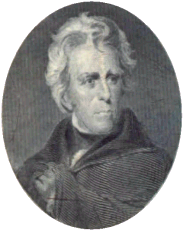
Racism in Bloody, Bloody Andrew Jackson

Play satirizes Jackson, but insults Native Americans

By Albert BenderThe play, although claiming to be satirical, is an extreme exercise in racism, in that all the Native American characters are demeaned and caricatured. Historic Indian leaders are portrayed as slow–witted and dull-minded, ever ready to sell their tribal homelands for a few paltry blankets and dream catchers. The great Muscogee Creek patriot Menawa, who fought Jackson’s forces at the Battle of Horseshoe Bend in 1814 and was wounded seven times, is depicted wearing a dime-store headdress and signing a treaty he refused to even consider (keep in mind that Jackson’s armies were composed overwhelmingly of Tennesseans). The valiant, iconic Sauk leader Black Hawk, who fought a war to hold his ancestral lands in 1832 against the American military juggernaut, is seen as a traitorous collaborator disposing of his tribe’s birthright.

The drama is permeated with crude, artless anti-Indian humor. Euro-American audiences have frolicked at this dreadful performance in its off-Broadway run, to the extent that an internationally prominent Native American literary figure, a good friend of mine who attended the play to review it, left halfway through the performance because she felt in physical jeopardy.

Some critics have pointed out in defense of this sordid drama that other groups are also lampooned—Spaniards, gays, Southerners in general and rich whites. But where are the black people? Jackson was as much pro-slavery as he was anti-Indian, and the Hermitage was maintained by African-American slaves. There are no black characters in the play at all, much less any demeaning African-American stereotypes. Can anyone imagine a white audience in this day and time evincing riotous, knee-slapping guffaws at the portrayal of demeaning stereotypes of African-Americans or any other race in this country? If there had been even one demeaning stereotype of black Americans, there would have been a national uproar.
Comment:  The same analysis applies to The Dudesons and every other "spoof" or "satire" we've seen recently. As you probably know, I've ripped the "satire" argument in postings such as these:

Deadliest Warrior vs. The Dudesons
The Dudesons, Polish jokes, and minstrel shows
Okay to stereotype in "satires"?

Again, the key point that no "spoof" defender has ever addressed: "If there had been even one demeaning stereotype of black Americans, there would have been a national uproar." Yet we not only tolerate the equivalent Native stereotypes, we defend and champion them. Why is racism against one American minority still perfectly acceptable?

For more on the play, see Stereotypes in Bloody, Bloody Andrew Jackson and Bloody, Bloody Andrew Jackson Reviewed.

Inuit throat singers bust stereotypes

Inuit women preserve unique tradition

Throat singing is a traditional game among Inuit women. Taqralik Partridge and Nina Segalowitz explain it here in its interlocking styleTaqralik Partridge:  Throat singing is a traditional Inuit game, usually played by women. The songs or sounds are made up by different women. They imitate sounds that you would hear in your environment in the North, including the wind, the river and there are some ladies that do one that's called the bumble bee and there's one we do called the saw. You have two people who play with each other and echo each other and the object of the game is to make the other person stop either by exhaustion, laughing or losing the rhythm.

When I was a kid, we used to see throat singing on TV. Although I lived in Nunavik, an Inuit region in northern Quebec, there was nobody in the community who still knew how to throat sing and it was not widely practised. So, we children used to pretend to throat sing and make weird sounds because there was nobody to teach us how to do it. Then, when I was at university in Montreal, I was lucky enough to have a friend who knew how to do it and I just thought I would give it a try. I wanted to learn throat singing to fulfil a childhood aspiration and Nina wanted to learn it because she was searching for different ways to connect with Inuit culture, from which she was completely cut off when growing up.
And:TP:  Throat singing gives us an opportunity to share our culture and meet many people from different backgrounds. We've been to many festivals. We performed at a Finnish church once. We were at a festival of world cultures in the nearby city of Sherbrooke late last summer. We saw Japanese drummers and all kinds of different performers. It's a way for us to open up our ideas about the world and for other people to open up about us.

NS:  It's also a way for us to show the contemporary and traditional sides of our lives, that we can do traditional activities and have traditional knowledge and language and yet also be contemporary in our lifestyle, where we live, what we eat and how we see the world. Throat singing is for me a way to bridge two worlds.
Comment:  Look! These Inuit women sing. They wear regular clothes, not parkas. They live in a city with trees and buildings, not in an igloo. One has a Jewish father and a Filipino mother. Amazing how different the reality is from the stereotypes, eh?

For more on the subject, see Inuit Throat Songs as Ringtones and Eskimos:  The Ultimate Aborigines.

Below:  Inuit throat-singers Taqralik Partridge and Nina Segalowitz. (Nachammai Raman)

Coyote-Loki mash-up

Local artist presents exhibit at Brave New World

Local artist Isaac Brynjegard-Bialik presents an exhibit of his "fine art mash-up" works like this one at Brave New World Comics in Newhall on Saturday, Sept. 11.Local artist Isaac Brynjegard-Bialik figures he's purchased about 500 comics this year from Brave New World Comics in Newhall.

On Saturday, Sept. 11, he's bringing them back-cut up into little pieces as part of his new art exhibition, "You did WHAT to my comics!?!"

Brynjegard-Bialik refers to the show as "a fine art mash-up," as it brings together the traditional art of papercutting with the pervasive lowbrow art of comics and yields a unique artistic vision.
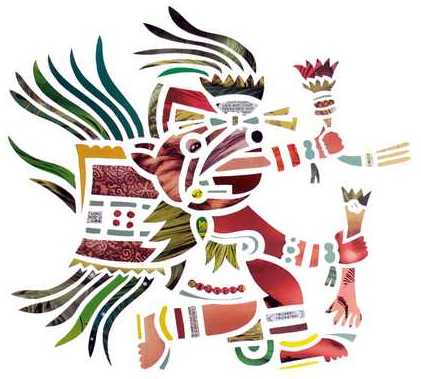
And:"We've got these caped superheroes that are almost god-like in their power and influence, and we read and revisit and revere them," he says. "I enjoy chasing down connections between the stories and characters in these comics and the stories we've been telling for thousands of years through religion and other expressions of culture."And:In "Trickster Coyote," a traditional representation of the Native American god Huehuecoyotl is bolstered by the use of cut-up comics featuring Loki, the Norse god of lies and trickery who was a foil for the comic book hero Thor.

"So many cultures have this idea of a god who is both smart and foolish, advocate and nemesis. Bringing Coyote and Loki together illustrates how these same ideas pop up in different places and times."
Comment:  I can't see any hint of Loki in the image below, but I trust he's there.

For more on tricksters and Coyote, see TRICKSTER's Starred Reviews and Tricksters Around the World. For more on comic-book art featuring Natives, see Indigenous Comic Art and The Search for Aztlán. For more on the superhero-god connection, see Why Write About Heroes?

Below:  Trickster Coyote.

Preview of Growing Native

Tulalips back TV documentary on American Indians

By Bill SheetsIf an ambitious, 13-part TV documentary on American Indians becomes reality, its producers will have the Tulalip Tribes to thank for helping it get off the ground.

The tribes have donated $35,000 toward the production of "Growing Native," being planned jointly by KCTS (Channel 9) of Seattle and Native American Public Telecommunications, Inc., of Lincoln, Neb.

In 13 half-hour episodes, "Growing Native" will be fashioned as a cultural travelogue, exploring the people and cultures of tribes all around the United States--especially their environmental initiatives, according to its producers.

Tulalip Tribes Chairman Mel Sheldon said the Tulalips are excited to promote American Indian culture and share their own environmental projects in the series.

"Native American tribes are an economic, cultural and environmental force in this country," Sheldon said.

"Growing Native" plans to highlight tribes that practice sustainable agriculture and aquaculture and are re-establishing use of indigenous foods through hunting, fishing and gathering. The series also plans to showcase tribes' increasing use of renewable energy.
Comment:  For more on the subject, see Native Documentaries and News.

September 06, 2010

Indians in Turtledove's Timeline-191

Timeline-191Timeline-191 is a fan name given to a series of Harry Turtledove alternate history novels, including How Few Remain as well as the Great War, American Empire, and Settling Accounts series. The name is derived from Robert E. Lee's Special Order 191, which detailed the Army of Northern Virginia's invasion of the Union in September 1862 during the American Civil War. The divergence occurs when Union forces do not find a copy of Special Order 191, on September 10, 1862. The novels detail the consequences of this until 1944 in the alternate world.Comment:  I've read How Few Remain and the American Empire trilogy. I plan to read the Settling Accounts books next.

The biggest change for Indians comes after the US loses the "War of Secession." This happens before the Great War trilogy, which I haven't read. The Wikipedia entry seems to speculate what might've happened between books.

1862–1881: American ChangesShortly after the conclusion of Camp Hill, Confederate general Braxton Bragg completes the conquest of Kentucky; sometime after the U.S. agreed to mediation, Kentucky becomes the twelfth state to enter the Confederacy. In addition, the pro-Confederate Five Civilized Tribes of the Indian Territory are given territory of their own in the C.S., later to become the State of Sequoyah. The Caribbean island of Cuba is subsequently purchased by the Confederate States from Spain in 1878, becoming the 14th Confederate State.And:The United States, probably in reaction to their defeat in the War of Secession, appears to have sped up the conquest and settlement of the Great Plains relative to our timeline. George Armstrong Custer and his brother Thomas Custer are still alive in 1881 because there were (presumably) no Sioux Indians around in 1876 to fight him at Little Bighorn. In reaction to the (historical) Sioux uprising of 1862, the Army conducts a war of extermination against them. Prior to the Great War, Dakota itself enters the Union as a single state, possibly either as a result of the swiftness with which the Army (necessarily larger than in this timeline because of the Confederate threat) pacifies the Dakota Territory and allows settlers to move in. (In our timeline the Dakota territory split because of an ongoing debate about the placement of the capital.)

In addition, the USA may have had a significant and victorious Indian War prior to the Second Mexican War, suggesting that massive firepower and a national need for some kind of martial victory propelled the United States to a much quicker and clear-cut answer to their Native American question, namely the extermination or deportation of the Natives.
US loses again

The US also loses the Second Mexican War, with the following consequences:

1881–1882: The Second War Between the States (Second Mexican War)In return for British and French assistance, Confederate President James Longstreet is obliged to propose the nominal manumission of the country's slaves, which proceeds throughout the 1880s.

The defeated United States, realizing it needs powerful allies to counter the Confederate alliances with Britain and France, begins an alliance with the German Empire and adopts many of its military and economic practices.

One of the few victories for the United States in the war, a battle in the Montana Territory against the British, produces two U.S. heroes who will be rivals for the next forty years: Brigadier General George Armstrong Custer and Theodore Roosevelt, Colonel of the Unauthorized Regiment.

Witnessing the collapse of the Republican Party, former President Abraham Lincoln, now an orator, allies with U.S. socialists and leads left-wing Republicans into their fledgling Socialist party. The Republicans soon begin a long descent into the general obscurity of becoming a solely Midwestern regional party, never again winning the presidency or a Congressional majority, losing around a third of its supporters to the Democrats, and all of its left-wingers (around one third) to the Socialists.
Because of their two defeats, the United States commemorate Remembrance Day, have a Statue of Remembrance in New York's harbor, and name their first aircraft carrier the Remembrance. Other notable changes include the Socialist Party's success and the US occupation of Canada and Utah.

In the Great War between the United States and the Confederate States, the US overruns and eventually wins the state of Sequoyah. The US considers Sequoyah a territory and doesn't admit it as a state.

The CSA's defeat leads to the rise of the Freedom Party, a Nazi-like organization led by Jake Featherston. Featherston demands the return of CSA territory, including Sequoyah. In a 1941 plebiscite, Sequoyah is the only territory that votes to remain with the US. The explanation is that Sequoyah's white settlers outvoted the Indians, who would've preferred the CSA.

Mixed results for Indians

As always in alternate histories, it's fascinating to see what might've happened to the Indians.

On the negative side, there's the whole extermination thing. But this scenario--that the US Army would've wiped out the Indians earlier and more easily--seems questionable to me. It's just as easy to imagine that the US would've been too weak, distracted, and demoralized to pursue the Indians. The US might've left them alone long enough to organize an effective resistance.

On the positive side, the CSA created Sequoyah, a state primarily for Indians. And the US kept Sequoyah intact, even though it may have let whites overrun it. So the Indians did better in some cases and worse in others.

The overall message of this and other alternate histories is that Native defeat wasn't inevitable. Most alternate histories posit that if the Euro-American powers had been more divided, the Indians would've done better. Instead of fighting a unified America, the Indians could've helped themselves during a series of internecine wars. While the Americans were killing each other, they could've established one or more Indian nations in the unsettled West.

A key point is how easily this timeline could've occurred. All it took was one piece of paper not falling into the wrong hands. In the real world, the Aztecs almost killed Cortés, the Founding Fathers almost created an Indian state, Andrew Jackson almost died in a duel, and Cherokee relocation won by only one vote in Congress. Native defeat was a lot less inevitable than most people realize.

Rob's review

As in many of his books, Turtledove builds Timeline-191 by shifting between a large cast of characters. We see the changed history through many eyes and slowly learn how it differs from our reality. Some critics say these books have too much characterization and not enough plot, but not me. I love the rich blend of history and fiction in these books.

Turtledove's invented history seems totally plausible to me. There hasn't been one moment when I've said, "No, I don't believe that could've happened." When you consider that this series runs 11 books in all, it's a masterful achievement. If there's a longer alternate history with more basis in fact, I don't what it is.

Rob's ratings for the books I've read:

How Few Remain--8.5
Blood and Iron--8.0
The Center Cannot Hold--8.0
The Victorious Opposition--8.0

For more on the subject, see Indians in Turtledove's Worldwar and Was Native Defeat Inevitable?
Amazon Indians weren't savages

Scientists find evidence discrediting theory Amazon was virtually unlivable

By Juan ForeroTo the untrained eye, all evidence here in the heart of the Amazon signals virgin forest, untouched by man for time immemorial--from the ubiquitous fruit palms to the cry of howler monkeys, from the air thick with mosquitoes to the unruly tangle of jungle vines.

Archaeologists, many of them Americans, say the opposite is true: This patch of forest, and many others across the Amazon, was instead home to an advanced, even spectacular civilization that managed the forest and enriched infertile soil to feed thousands.

The findings are discrediting a once-bedrock theory of archaeology that long held that the Amazon, unlike much of the Americas, was a historical black hole, its environment too hostile and its earth too poor to have ever sustained big, sedentary societies. Only small and primitive hunter-gatherer tribes, the assumption went, could ever have eked out a living in an unforgiving environment.

But scientists now believe that instead of stone-age tribes, like the groups that occasionally emerge from the forest today, the Indians who inhabited the Amazon centuries ago numbered as many as 20 million, far more people than live here today.
Some of the evidence:Outside Manaus, Brazil, Eduardo Neves, a renowned Brazilian archaeologist, and American scientists have found huge swaths of "terra preta," so-called Indian dark earth, land made fertile by mixing charcoal, human waste and other organic matter with soil. In 15 years of work they have also found vast orchards of semi-domesticated fruit trees, though they appear like forest untrammeled by man.

Along the Xingu, an Amazon tributary in Brazil, Michael Heckenberger of the University of Florida has found moats, causeways, canals, the networks of a stratified civilization that, he says, existed as early as A.D. 800. In Bolivia, American, German and Finnish archaeologists have been studying how pre-Columbian Indians moved tons of soil and diverted rivers, major projects of a society that existed long before the birth of Christ.
Comment:  Not only does this evidence discredit old scientific theories, it discredits old Native stereotypes. And stereotypes about Amazon Indians are among the most persistent. Convincing people that North America's Indians had art, science, and culture seems easy compared to making the same case for Amazon Indians. How many jungle movies have we seen portraying them as savages, headhunters, and cannibals whose only technology is how to kill people creatively?

The evidence also suggests that the movies portraying lost jungle civilizations have some basis in fact. But these lost civilizations didn't build massive temples so they could sacrifice people to their dark gods. They built farms, irrigation systems, and villages of wooden structures.

When you see a movie such as The Librarian: Quest for the Spear, think about it. Where did the stones for a massive temple come from, and how did the Indians lug them through the forest? Answer: They didn't. It's illogical, and it implies the Indians were too irrational to understand the time and energy they were wasting. In reality, they had better things to do than build temples for Indiana Jones types to discover.

For more on the subject, see What "Primitive" Indians Really Think and Amazon Towns Disprove Stereotypes.

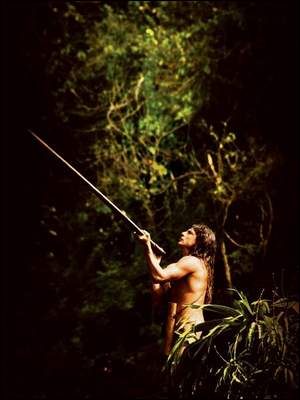
Below:  Historically speaking, the exception, not the rule.

Cameron's and Weaver's anti-dam films

In Cameron Helps with Anti-Dam Films, I noted James Cameron's contributions to the battle against the Belo Monte Dam. Now here are the two films in question:

A Message from Pandora

James Cameron produced this special feature about the battle to stop the Belo Monte Dam and defend the Amazon Rainforest.


Sigourney Weaver Narrates New Google Earth Animation on Brazil's Controversial Belo Monte Dam

10-minute Tour in 3-D Highlights the Dam's Harmful Impacts on Xingu River and Greener Alternatives


Comment:  The second film especially is a devastating indictment of the Belo Monte dam. It's hard to believe anyone would support the dam after watching it.

Really, the age of massive engineering projects is or should be over. We need to start living with nature instead of trying to destroy it.

You can see another point that I make frequently: that Amazon Indians are no longer primitive spearchuckers, if they ever were. Sure, these people sometimes dress in traditional costumes, but they also wear shirts and pants, use modern implements, live in villages, speak Portuguese, go to schools, etc.

Like most indigenous people around the world, they live in two worlds. Portraying them as hidebound captives of their old lifestyle is a blatant stereotype.

For more on Cameron's efforts, see Cameron to Film Tribe Opposing Dam. For more on Amazon Indians, see Amazon Indians Weren't Savages and Amazon Indian Students on the Net.

First tribal national park?

Proposal would create tribal national park

By Wayne OrtmanThousands of acres taken from the Oglala Sioux Tribe nearly 70 years ago would be returned and managed as a tribal national park under a proposal from the National Park Service.

The change involves the 208 square-mile South Unit that's part of Badlands National Park in southwest South Dakota.
And:Giving the tribe responsibility for the land is the preferred option from four management alternatives for the South Unit. It would be the first tribal national park in the nation and require congressional approval, said Steve Thede, deputy superintendent of Badlands National Park.

"We're setting precedence, kind of a scary place but kind of an exciting place to be too," said Thede.
Comment:  For more on the subject, see Giving the Badlands Back.

September 05, 2010

Teepee for Oregon's Tea Party?

Why Did We Select the TeePee for the TP?Through all that's happened since, that tent emerged as a symbol. The inhabitants of that home were people of courage who lived in tune with the parameters of nature. And, people who got really upset when the cowardly, smelly, money-worshipping, selfish Europeans destroyers of all that is natural came along to turn paradise into steel-framed buildings, garbage dumps, chemical factories and rat-infested alleys populated by folks whose descendants, when called upon, saved the whole damned world twice, so far.

It's just like the tea parties. These folks are upset by the cowardly, smelly, money-worshipping, selfish European socialists who have brought their fatal political disease to the New World. Collective ownership of the assets of the nation. Professors of Propaganda in our schools and universities. And, now comes Obama and Friends. They were the last straw.


Comment:  This would be a good April Fool's joke, but it's not April 1. Therefore, I'll take it seriously for one blog posting.

Let's ignore the fact that the teepee is blatantly stereotypical. And that it has nothing to do with the state of Oregon. That it's a bad choice for that reason goes without saying.

Appropriating Indians as the symbol of liberty goes back to before the Boston Tea Party. It's a perennial subject in American politics. I wrote about it in The Political Uses of Stereotyping.

But this rationale is one of the stupidest ones I've ever seen. It's as if these teabaggers are admitting, "We're totally ignorant about the last 500 years of history and politics. We don't have a clue what we're saying. We're literally so stupid that we're making stuff up out of thin air."

Facts for the fanatics

Here are a few points for these idiots to consider:

  • The European invasion of the Americas began in 1492. Socialism didn't exist until the late 19th century, when Marx and Engels invented the economic theory. That's almost a 400-year gap.

  • Many of the first settlers were financed by business consortia that wanted a return on their investment. Others were financed by monarchies that wanted a return on their investment. The common denominator was their greed, which the teabaggers even acknowledge with the words "money-worshipping" and "selfish."

    This is the pure capitalist ethos at work, dummies. It has nothing to do with socialism and everything to do with our present economic system. You know, the "greed is good" system championed by Ronald Reagan and George W. Bush? The one that led to Reagan's and Bush's recessions, Reagan's and Bush's deficits, Reagan's savings and loan crisis, Bush's mortgage crisis, etc.?

    Taking the world's land, gold, oil, and other resources is what this ethos is all about. That was true in 1492 and it's true today (with Enron, Goldman Sachs, British Petroleum, et al.). This ethos of greed and avarice is what destroyed the Indians, not "socialism."

  • European states were the opposite of socialist throughout the imperialist period. Instead of redistributing the assets of the elite (themselves), they kept these assets. A small aristocracy of kings, nobles, churchmen and merchant princes controlled most of Europe's wealth and power.

    The "socialists" weren't the kings and czars of places like France and Russia. You know, the people who initiated and oversaw Europe's global conquests? They were the commoners who overthrew the kings and czars and put themselves in charge.

    Duhhh.

  • "Professors of Propaganda"? What does that have to do with 500 years of European colonization? Do teabaggers think left-wing universities have existed for centuries? And that these universities were in charge of Europe's foreign policy? Idiocy.

    Teabaggers are today's Indians?!

    Let's look at more facts these idiots are too dumb or dishonest to admit. Conservatives have complained about tribes having communal cultures, jointly owning their land, and being the last bastion of socialism. Because there's some truth to this, Indians are overwhelmingly Democratic, voted 9 to 1 for Obama, and are still among his biggest supporters. Meanwhile, the Tea Party movement is financed by the billionaire Koch brothers and publicized by billionaire Rupert Murdoch and his Fox News. It's increasingly merging with the Republican Party because both groups have similar goals.

    So the Tea Party movement stands for "free markets" (i.e., handouts for corporations and the rich). And Obama, Indians, and the rest of the Democratic Party stand for helping their fellow humans (i.e., "socialism"). But Oregon's teabaggers think a teepee is the right symbol for them?! Maybe Oregon's Democrats should adopt Milton Friedman or the Wall Street bull as their symbol, because that would be just as appropriate and valid.

    Sheesh.

    For more of this ridiculous "teabaggers = Indians" meme, see Indian on Tea Party T-Shirt and Teabaggers = Indians?! For more on the Tea Party in general, see:

    Conservative rallies = white self-pity
    Tea Party believes in taking
    Angry white Christians want the country back

    And the proverbial much more.

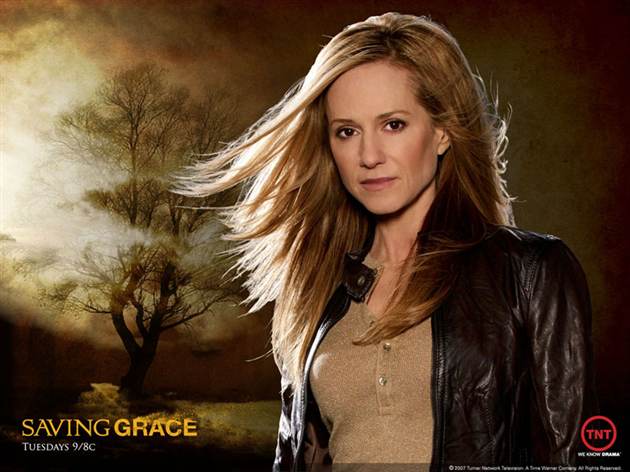
  • Saving Grace the Choctaw

    In the Yeehaw, Geepaw episode of Saving Grace, Bobby Stillwater (Gregory Cruz) mentions his Indian and Mexican halves. Stillwater could've been speaking figuratively, but let's take him literally. He's half Indian and half "Mexican." What does that mean?

    Well, it could mean that he considers himself half Indian and half non-Indian. But he may understand that his "Mexican half" is also part Indian. Perhaps he considers himself three-quarters Indian (half American Indian, one-quarter Mexican Indian, and one-quarter Mexican non-Indian).

    I mention this because Geepaw (August Schellenberg) says he's a quarter more Indian than Stillwater. If Stillwater is half Indian, that could mean Geepaw is three-quarters Indian. If Stillwater is three-quarters Indian, that could mean Geepaw is a full-blooded Indian.

    The latter scenario would agree with online descriptions of Geepaw as Grace's full-blooded Indian grandfather. But again, this isn't clear from the episode itself. It's not even clear that Geepaw is Grace's real grandfather rather than an "honorary" grandfather.

    Grace's Choctaw roots

    But in the next episode, Everything's Got a Shelf Life (the eighth of the first season), things become a little clearer. Grace confronts a black informant about whether he's telling the truth. The informant says he wouldn't lie to her because "I'm Choctaw, you're Choctaw."

    This confirms the supposition of the previous episode. Holly Hunter's character is indeed supposed to be part Choctaw. We can even estimate how much.

    First, a couple of points. Grace refers to her grandmother, Geepaw's wife, as Meemaw. We don't know anything about her. She could be anything from full-blooded Choctaw to white.

    Jessica Walter plays Grace's mother. She doesn't look or act the slightest bit Indian. Let's assume she's a pure Anglo, as she appears. Presumably Grace is connected to Geepaw and Meemaw through her father, who is dead.

    How much "Indian" is she?

    With these assumptions we can establish the boundaries of Grace's "blood." If Geepaw and Meemaw are full-blooded Choctaws, then so is her father. That would make Grace half Choctaw by blood.

    On the other hand, if Geepaw is three-quarters Choctaw and Meemaw is white, then Grace's father is 3/8 Choctaw. That would make Grace 3/16 Choctaw by blood.

    So Grace could be anywhere from 3/16 to half Choctaw. Actress Holly Hunter doesn't look much like an Indian, so perhaps the lower estimate is more realistic. In any case, that may be enough "blood" for her to be an enrolled member of the Choctaw tribe.

    In fact, Grace may be an enrolled Choctaw. In the first eight episodes, she hasn't said anything to preclude this possibility. No references to Indians as "them" rather than "us," for instance.

    A cast of Choctaws?

    The same would apply to Grace's five or six siblings. None of them looks the slightest bit Indian either. But unless they're half-brothers and sisters, they're all 3/16 to half Choctaw.

    Perhaps this point will become clear in future episodes. I just think it's interesting that Grace could be an enrolled Choctaw Indian. If true, this would be a remarkable case: a lead character who's an Indian but nobody realizes it.

    For more on the subject, see Yeehaw, Geepaw in Saving Grace and Gregory Cruz in Saving Grace.

    Below:  Grace Hanadarko the blonde Choctaw Indian?

    Cameron to film tribe opposing dam

    Avatar director vows to return for Amazon tribe fightFilm director James Cameron said Sunday he will return to Brazil this year to make a 3D film on indigenous people of the Amazon who oppose construction of a huge dam for fear it could flood tribal lands.

    "I want to return to meet some of the leaders of the Xikrin-Kayapo tribe who invited me," the Canadian director said in an interview published in the Folha de Sao Paulo newspaper.

    "I want to take a 3D camera to film how they live, their culture," said Cameron, whose blockbuster movie Avatar tells the story of the peaceful Na'Vi people who live in harmony with nature on the planet Pandora and wage a bloody fight against strip-miners from Earth.
    Comment:  For more on the subject, see Cameron Helps with Anti-Dam Films and Cameron Suffering "Cause Fatigue."

    September 04, 2010

    DJs learn not to satirize Natives

    When the conflict is race, don't feed the fire

    By Julia O'MalleyIt began in May, when Rochene Rowan-Hellén, who is Alaska Native, was listening to their show in her car and happened to catch a radio comedy skit called "Cash for Tlingits." Bob and Mark are not known for being politically correct, but the skit took it too far, she said. It was more than off color, it was cruel and degrading, tapping into a current of anti-Native feelings in the city. She fired off an e-mail to the press and Alaska Native leaders. She was tired of Alaska Natives being the butt of the joke.

    At this point, something predictable could have happened, along the lines of what happened to KBFX personalities Woody and Wilcox, who made a similar on-air gaffe in 2008. That provoked rebuke statewide, from the Alaska Federation of Natives, to the mayor, to the Anchorage School District. The dee-jays were suspended and ordered to sensitivity training. And people whispered that Alaska Natives couldn’t take a joke.
    And:[A]s criticism rolled in at the station, Lester and Colavecchio were caught off guard. They have Native friends, they didn’t think of themselves as racist.

    “It was catchy, clunkers and Tlingits, it just sounded like it would be funny,” said Lester, who wrote the skit. “At the time you don’t think about how your words could be hurtful while you’re in the mode of humor.”

    But when they realized how their skit came across, they felt sick. Along with Anchorage Media Group General Manager Dennis Bookey, they agreed to go to a meeting with 20 people from the Native community, including Rowan-Hellén.
    And:At KWHL, they reviewed all their radio skits and deleted the ones that had racial overtones. They apologized formally. They started planning some outreach events in the Alaska Native community. They discussed the possibility of having an Alaska Native intern on their show. And, the two guys, who over the years have flirted with shock-jock status because of edgy humor, thought hard about what it means to be funny. Funny can be irreverent. Funny can poke at public figures. Funny doesn’t have to rely on stereotypes.

    “If I’m going to have fun, it’s with my arm around somebody,” Lester said. “I’m not going to punch them in the face.”

    “You can’t satirize a culture,” Colavecchio said. “If nobody ever tells you that, you don’t know that. You are ignorant.”
    Comment:  "You can't satirize a culture"...wow, brilliant deduction, Sherlock. After a century or two of minstrel shows and other racist "satires"...followed by 30 or 40 years of their being socially unacceptable if not taboo...you finally figured that out? What was the big clue? The last episode of Good Times fearing JJ Evans as a black buffoon? The last episode of Get Smart featuring a Charlie Chan knockoff? The last episode of F Troop featuring a comical Indian tribe?

    This incident shows you what we're up against. People who don't consider themselves racists, who wouldn't think of satirizing blacks or Latinos, somehow think Indians are fair game. It's as if they can't think straight on the subject.

    Intellectually they seem to know that Indians still exist. But in their hearts, they consider Indians to be what they've seen in movies, TV shows, cartoons, books, and paintings. These imagined Indians have no thoughts, feelings, beliefs, or values. They're the sum of what one can see--feathers, buckskins, tomahawks, and warpaint--and nothing more. They're basically two-dimensional cardboard characters--like sports mascots or product advertisements--not three-dimensional people.

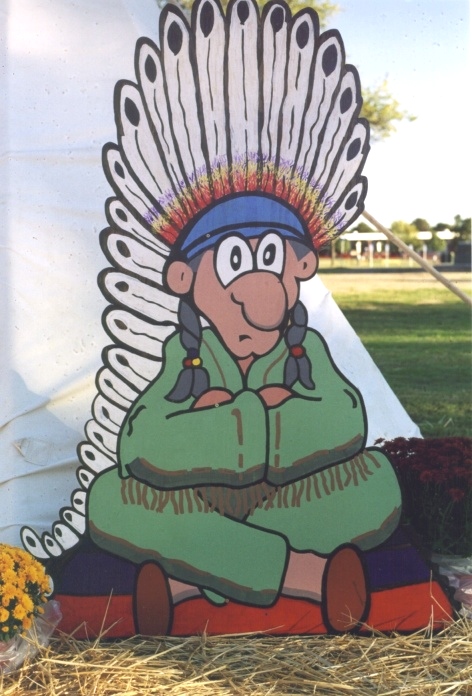
    "Me stoic Injun chief. Not real person, just big-nosed cartoon. Go ahead and make'um fun of me. Me no care."


    This is what happens when you repeat stereotypes thousands of times. We've associated blacks with crime so often that we believe blacks are criminals. For similar reasons, we believe Latinos are illegal immigrants and Muslims are terrorists. And we've associated Indians with savagery so often that we believe they're wolfish animals in human form.

    Our thought patterns mirror what we've seen and experienced. For every impression that tells us Indians are real, a thousand impressions tell us they're primitive people of the past. Why would anyone expect one true impression to dominate a thousand false impressions? Even if you "know" better, as these DJs supposedly did, that's not how the human mind works.

    This may explain why the Quileute werewolves in Twilight are so appealing. They have no culture, religion, or history to make them real, so you don't have to think about them or their plight. Like their vampire counterparts--or the Smurfs or the Simpsons--they're just colorful pieces of fiction. Cartoon characters. You can't hurt Wile E. Coyote by abusing him, and Indians are no different. Or so people think.

    For more examples of radio "humor," see DJs Lampooned Makah Whalers and DJs Whoop Over Running Bear. For more on the subject in general, see Background Research on Native Stereotypes and The Harm of Native Stereotyping:  Facts and Evidence.

    Below:  "Bob Lester talks about what he's learned from a working group on race relations, after an on-air skit offended some in the Alaska Native community."

    Beck:  Indian mounds are Egyptian

    In Analyzing 8/28 Rallies and Marches Part I:  Restoring Honor and Reflections on the Native, Adair Hill covers Glenn Beck's "Restore Honor" rally. To understand why Beck chose a Native pastor to speak, she posted this video from Beck's TV show:


    Beck veers into Chariots of the Gods territory, implying the Indians came from Egypt or the Middle East. Many of these von Däniken-style theories are based on the similarity of Mesoamerican and Egyptian pyramids. We know the subtext of these claims: that Indians weren't smart enough to invent civilization or build pyramids on their own. But one man has shown how Indians could've raised monuments without help.

    Beck got most of his "information" from a DVD called The Lost Civilizations of North America. I haven't seen it, but I'm sure it's the usual mishmash of speculative theories presented uncritically. Clearly that's Beck's approach also. He admits he doesn't know anything about Indians, but he presents the DVD's claims uncritically.

    Adair's take on this:It's wacky, I don't know what else to say. He says a couple of times that "mainstream archaeologist say they debunked this" and then goes on like it's fact, and covered up by some conspiracy. It's total hogwash is what it is...but anyway, he clearly believes that Native Americans are special. Thanks, we are.Beck's views seem consistent with those of other Mormons. According to them, Indians are probably descended from a lost tribe of Israelites who helped build the pyramids. When these people came to America, they lost their holy connection, but God guided Columbus to "help" them. Most ignored the Gospel and continued their depraved and degenerate ways. Now they care only about booze and gambling. But a few have embraced the "correct" path of Christian fundamentalism.

    For more on the "lost civilization," see Lost Tribe Settled Around Great Lakes? For more on Mormons, see The Indian-Mormon Connection. For more on Beck, see Beck's Stupidity About Tribal Summit.

    Below:  Wow, they look just like Indian mounds!

    Yeehaw, Geepaw in Saving Grace

    I discussed Gregory Cruz's supporting role as a Native detective in the first season of Saving Grace. Things start to get interesting in the seventh episode of the series:

    Yeehaw, GeepawThe body of a Native American veteran, just home from the war in Iraq, is found buried face down in a shallow grave in the woods. Such a burial is intended to condemn the soul of the victim, according to Native American belief. Grace seeks advice on the case from her Native American grandfather, Geepaw, and is shocked to learn he is suffering from Alzheimer's Disease and in need of constant supervision.August Schellenberg plays Geepaw as an atypical Indian elder. He's not a fount of wisdom or spirituality. Rather, he's childishly enthusiastic and eccentric--partly because he has Alzheimer's. He lives in a trailer, plays cards with his buddies (including Saginaw Grant), and likes to ride horses.

    Other than the burial ritual, which someone identifies as Lakota, there's little Native lore in this episode. Just Geepaw reminding Grace of the Native constellations he used to teach her when she was young. On the other hand, there's nothing stereotypical, which is good.

    Bobby Stillwater (Gregory Cruz) has a bigger role in this episode. We learn he mentors Native youths, including the murder victim Ryan. We eventually learn that Ryan was Arapaho, which is plausible since Oklahoma has a Cheyenne-Arapaho tribe.

    Geepaw calls Grace "Champuli," which we eventually learn is a Choctaw word. This is plausible since Oklahoma also has a Choctaw tribe. But the show doesn't identify Geepaw as Choctaw. Indeed, it doesn't say whether "Geepaw" is a grandfatherly friend of Grace's family or her actual grandfather. (Grace and her siblings give him enough attention to imply he's their grandfather, but they don't say it.)


    Grace and company unravel the mystery of the murder victim. Ryan was a squad leader in Iraq when one of his troops was killed. Because of his sunny disposition, he kept smiling during the war and after his return. Someone killed him because he was too happy, which is a novel fate for an Indian character. (The killer wasn't Native, so we can attribute the misleading Lakota ritual to his ignorance about Indians.)

    My take on the whole series:

    Saving Grace isn't about the whodunits or the angelic lessons--both of which are standard for TV dramas. No, it's all about showcasing Holly Hunter as a hard-talkin'/drinkin'/lovin' woman. If you enjoy this kind of character, you'll probably enjoy Saving Grace.

    For more on Schellenberg, see Schellenberg's NBA All-Star Promo and August Schellenberg on Grey's Anatomy.

    The Paiute-Burning Man relationship

    Burning Man helps locals make some money

    By Mark Lundahl“They get a bad rap because of the way they dress, but they’re very nice,” he said.

    Such is the symbiotic relationship between the Pyramid Paiute tribe and the annual Burning Man festival.

    The Paiutes help make the drive to the Black Rock Desert an easy, straight shot. In return, the Burning Man organizers give the tribe a yearly economic shot. They also give tribal members special deals–tickets for $40 and two guests for $160 each–according to two tribal members.

    “It is very advantageous economically to the tribe,” Tribal Planner Scott Carey said.

    “It offers tribal members an opportunity to start up their own businesses.”

    Tribal members offer tacos and supplies on the way up. On the way back, they offer food and supplies as well as trash services, car washes and bicycle donation services.
    Comment:  For a previous story about Burning Man devotees, see Old Natives Lecture Young Burners and "Go Native" at the Visionary Village.

    September 03, 2010

    Native pastor at Beck rally

    Analyzing 8/28 Rallies and Marches Part I:  Restoring Honor and Reflections on the Native

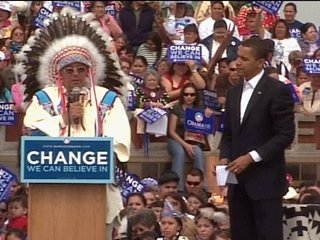
    By Adair HillGlenn Beck had insisted on the air, and in all the rally literature that this was NOT a political rally. He discouraged people from bringing signs of any kind. Despite this, someone was handing out tea party flags about every 10 feet, and Obama-with-a-Hitler-mustache signs every 5. Many many people wore Tea Party shirts. It was clear to any observer that the undertone of the whole even was the Tea Party political message and belief in small government. Nonetheless, the speeches themselves did more closely resemble a religious revival. Glenn Beck himself sounded like a televangelist, seeking fame instead of money perhaps, but his tone and the cheesy music playing with him, definitely stank of a disingenuous sales pitch.

    After Sarah Palin spoke, they began to hand out awards, when out of nowhere, a Native American was speaking! I became excited and tried to move closer to a jumbo-tron so I could hear (I couldn't get close enough to capture on video, but luckily someone else did and put it on YouTube):


    Adair Hill continues:I feel like Glenn Beck wanted a Native American presence at his rally, not because he is for Native sovereignty or rights or anything of that sort, but because he thinks we are...special. Plus, having a Native guy there, introducing an African American leader plays into his whole unity thing. Never mind that 99.9% of attendees I saw at the rally appeared to be of European descent.No looking back

    Adair is particularly annoyed by one of Bigpond's claim: that we shouldn't look back. It's a claim echoed by Beck and others whenever they want to tout the country's greatness and deny its problems. Adair rightly rips this apart:I also found "We shall never look back to the past, we shall look forward to the great awakening which we prayed for" extremely disconcerting. Let me break it down.

    "Never look back to the past" = We're gonna forget about the whole physical and cultural genocide against our people.

    Why that disturbs me:

    1. Many Native Americans and other historically oppressed people in this country are still suffering from the legacy of that oppression, and, many would say, are still actively being oppressed. Kinda hard not to look back when you're still feeling the effects.

    2. It is extremely hypocritical of the rally in general to try to tell people not to look back to the past, when every other minute they were referring to "The values our country was founded on...," "our founding fathers said...," "William Penn wrote...," "returning America to greatness...." Isn't that all looking back to the past too? I mean...hello?

    "We shall look forward to the great awakening" = we shall look forward to everyone believing our fundamentalist Christian doctrine and values.

    Why this disturbs me: Umm, let's see...freedom of religion, "values" are not universal.

    In addition to all this is the fact that many of the American "founding fathers" were deists, and all believed in freedom of religion.

    Do I feel like Negiel Bigpond got used? Yes. However, his speech reflects his own ideas and religious beliefs, and he got a public forum to express them in, so he did get something out of it. Do I feel like this speech represents Native beliefs accurately? Absolutely not.
    It's funny to watch conservatives contort themselves over the idea of "going back" to the old days but not going back. Here's an imaginary dialogue on the subject:CONSERVATIVE:  We need to return to the original intent of the Constitution.

    ROB:  You mean the original intent that treated Indian tribes as sovereign foreign nations? Whose chiefs were equal in stature to Europe's monarchs?

    CONSERVATIVE:  No, not that original intent. Tribal sovereignty and treaties are outdated concepts that have no place in America today.

    ROB:  Then which original intent? The one where only white property owners could vote and hold office? Where blacks, women, and other minorities had no rights?

    CONSERVATIVE:  Yes! That's the original intent I'm talking about! When real Americans like Glenn Beck didn't have to cry over socialism and immigration and a Muslim takeover of America!
    For more on the subject, see Beck:  God Ordered Indians Killed and Conservative Rallies = White Self-Pity.

    America is Ground Zero to Indians

    Author Tim Wise makes a point similar to the one I made in Opposing Churches Near Massacre Sites:

    Your House is on Ground Zero (and Quite Without Permission)

    By Tim WiseIn all the rancor over whether or not one group of Muslims should be allowed to build a cultural center and worship space near the site of the 9/11 attacks--which were committed by a separate and totally unrelated group of Muslims--there is one thing above all else that no one appears anxious to point out: namely, that for any white Christian to say "Ground Zero" is off limits to anyone is possibly the most deliciously and yet grotesquely ironic thing ever suggested.

    After all, there is scarcely a square foot of land upon which we trod that is not, for someone, Ground Zero. I am sitting atop one now: a killing field for Cherokee, Chickasaw, Choctaw and Creek; a graveyard in which are buried the bones--and if no longer the bones, then surely the dust--of peoples whose evisceration occurred not so long ago, and is still remembered by those who have not the luxury of forgetting.

    And so the New Yorkers who believe against all evidence that their trauma is unique in the history of the world--or even their city for that matter--prattle on about the "defiling" of the former World Trade Center location. Meanwhile they overlook that their precious island was itself cajoled from indigenous peoples for a handful of worthless beads. And white men have been swindling those we viewed as inferior--be they of color, or even other white men--ever since, especially (and this is where the geographic symbolism of their protests becomes revealing) in and around Wall Street, where the actions of wealthy investors and financiers have done far more damage than Osama Bin Laden ever could. Would that we might prohibit the construction of banks anywhere in New York so as to make a point about terrorism and our unwillingness to collaborate with it.

    Indeed, if those protesting the Cordoba House were the least bit interested in consistency--as opposed to being content to wallow in a type of hypocrisy both profound and typical--they would, to a person, vacate downtown Manhattan immediately. And this they would do out of respect for the lives destroyed by people such as they: black peoples forced to build Fort Amsterdam for the Dutch, which is where Battery Park is now, or the walls that gave the famous street its name, or the roads, or the very auction blocks upon which their compatriots would be sold, thereby allowing 40 percent of white New York households to possess other human beings as property by the mid-1700s.
    Comment:  Consider some of America's hallowed or sacred" places. For instance, the Alamo, Gettysburg and other Civil War sites, or Pearl Harbor. The common denominator is that we fought in these places to keep someone from taking "our" land. The irony, as Wise points out, is that we previously took this land from the indigenous people who owned it.

    When Muslim terrorists attack and kill the white owners of America, that's bad. But when European terrorists attacked and killed the Native owners of America, that was good. In fact, it was so good that we celebrate it with events such as Columbus Day...enshrine it in our monuments, parades, and textbooks...and thank God for making it happen. Yay us!

    For more on the subject, see White Christians Say What's Sacred and Muslim "Tribes" = Indian Tribes?!

    Gregory Cruz in Saving Grace

    I'm watching the first season of Saving Grace, the TNT cop series starring Holly Hunter. Here's the story:

    Saving Grace (TV series)Saving Grace is an American television crime drama series which premiered on TNT on July 23, 2007, and ran until June 21, 2010. The show stars Academy Award-winner Holly Hunter in her first television series, as well as Leon Rippy, Kenny Johnson, Laura San Giacomo, Bailey Chase, Bokeem Woodbine, and Yaani King. It is set in Oklahoma City—including numerous shots of local buildings and landmarks (such as the Oklahoma City National Memorial and the downtown skyline)—while much of the show was filmed in Vancouver and Los Angeles.

    Plot

    The plot focuses on Grace Hanadarko (Hunter), a smoking, heavy drinking, and promiscuous Oklahoma City detective. In the series opener, Grace meets up with her "last-chance" angel, when after a night of drinking she runs down and kills a pedestrian with her Porsche. In desperation she calls out for God's help, and a scruffy, tobacco-spitting man who calls himself Earl (Rippy) appears. Unfolding his wings to reveal his divine origins, Earl tells her that she's headed for hell, and asks if she's ready to turn her life over to God.
    Since Saving Grace is set in Oklahoma City, one might expect a Native presence. And there is one in the character of Bobby Stillwater, the fourth detective on Grace's team. Played by Gregory Cruz, Stillwater basically does chores or fills in information when the other detectives are busy. He isn't even listed as a cast member; rather, the show announces "Guest-starring Gregory Cruz" after the opening credits.

    In short, he's a token Indian, at least in Season 1. But at least he's there. And he isn't spouting Native clichés like a walking stereotype. He's just a normal cop doing his job.

    Stillwater's tribe?

    Stillwater hasn't stated any tribal affiliation so far. With his name and location, "Cherokee" would be the best guess.

    In the seventh episode, Yeehaw, Geepaw, he mentions his Indian half and his Mexican half. This is consistent with Cruz's background, which one person described as "1/8 Apache (Chiricahua, I believe), and 3/4 Mexican (Mexican Native American)."

    I guess he's supposed to represent all the minorities not covered by the white officers and the black captain--a common ethnic setup for cop shows. Heaven forbid that an Indian could be one of the top three or four characters, not to mention the star.

    For more on the subject, see TV Shows Featuring Indians.

    Below:  Gregory Cruz, Holly Hunter, and Bailey Chase.

    Native Journeys with Comanche Tribe

    Telling ‘our story’ through tourism

    By Wilhelm MurgFor decades, travel agencies and tourism boards have used local Indian tribes in their marketing without giving anything back. The Comanche Nation has found a way to turn that around so the tribes benefit from the tourism by setting up Native Journeys, a company devoted to creating bus tours and working as booking agents for other tribes.And:With the mission statement “Promoting cultural and traditional awareness through Native American travel and tourism,” the company offers extended tours on the Comanche Tribe’s buses.

    “We have many different tour packages. One is the ‘Eastern Trails,’ one is called ‘Lords of the Plains,’ which deals with our area, dealing with the Comanches. We also have ‘Cultural Destinations,’ which also deals with the Comanches down by Amarillo; and we have ‘Western Native Trails.’ Last year we did a tour called ‘Northern Exposure,’ and that was our tour to the Northwest territory, like Wyoming, Montana, South Dakota--that was a nine day tour. We have anywhere from 15 to 40 people per tour.” They offer one tour that is based around the Oklahoma casinos, but all of the others are site-seeing tours.
    Comment:  Tourism seems to be busting out in Indian country. We've gone from something like a dozen stories in 2009 to two dozen in the first half of 2010, which is a fourfold increase.

    For more on the subject, see Chickasaw Tourism Center, First Urban Indian Destination, and Aboriginal Kiosk at Tourism Center.

    Below:  "The Comanche Nation has found a way to benefit from tourism by setting up Native Journeys, a company devoted to creating bus tours and working as booking agents for other tribes. Some of the tours include 'Eastern Trails,' 'Lords of the Plains,' 'Cultural Destinations,' and 'Western Native Trails.' For more information visit http://NativeJourneys.biz." (Geneva Hedley)

    Many Native cuisines, not one

    Native cuisine explosion

    Chef looks to disassemble the one-size-fits-all concept

    By Lee Allen
    With a rising popularity of a concept called Native American Cuisine, he had found his calling. But it came with some consternation. “French people eat French food and Italian people eat Italian food. Does that mean that all Native Americans eat Native American food?” he asked and then answered: “It’s not that simple.

    “Food is a product of culture and all Native American cultures are different, so how can all Native foods be the same? Within my own Navajo culture, food preferences and preparation differ and the differences of food culture between various tribes throughout the Americas become even more pronounced.”

    Bitsoie wants to disassemble the one-size-fits-all concept and by combining aspects of history and anthropology, re-assemble ancient foodways, similarities and differences, to honor the old and adapt past ingredients and techniques into modern kitchens.

    “It’s through the old stories that we learn how to respect food, respect culture, and continue to preserve our way of life,” said Bitsoie, who directs the Native American Program at the Classic Cooking Academy in Scottsdale. “Native tribes throughout the Americas need to be respected for their culturally-specific foods and unique dishes they gave to the world without being placed into one generic category of Native American Food.”
    Comment:  We've seen several restaurants that serve Native dishes. But as Bitsoie notes, "Native food" is as flawed a concept as "Native culture" or "Native religion." Or as "European food" or "Asian food." You can't combine cultural elements from across a continent and get more than a gross generalization.

    For more on the subject, see Native Foods at Fancy Food Show and Bringing Native Foods to the Fore.

    September 02, 2010

    Inca roads better than Roman roads

    Construction Methods of the Ancient Inca Offer Sustainable Lessons

    By Tudor Van HamptonCivil engineers and other researchers working under a $90,000 National Science Foundation grant are studying the Great Inca Road of South America for clues to help modern society build roads, bridges and other infrastructure that last longer and have a less harmful impact on the environment.

    “Where modern engineers really try to tame the environment—cut through rock, move it out of the way—the Inca tried to work with the natural terrain,” says Christine Fiori, who teaches at Virginia Polytechnic Institute and State University, Blacksburg, Va., and is the research team’s lead investigator. “It might take longer, but it lasts.”
    And:“In most places, it was paved for water,” says Schexnayder. “When the Conquistadors came, they said that the road was better than the Roman roads in Spain.” Incas also built other stone structures near or integrated into the road—culverts, ditches, sidewalls—to accommodate water flows and support side slopes. Hydraulic pressure, as with today’s solid-concrete retaining walls and levees, was likely not a problem due to the permeability of these stones. Today, some asphalt and concrete pavements now are being designed with permeability in mind.And:Amazingly, the Incas also standardized much of the road’s design and construction—using local labor and materials—without a written language. Though the Andean civilization employed a system of accounting, called Quipu, using knots tied in rope, much of its knowledge is thought to have been passed down orally. “Oral training and memorization was the methodology in military training,” explains Jose Barreiro, a Latin America expert at the Smithsonian. “Education in engineering technique likely followed the same method.”Comment:  I reported more on the Inca's complex engineering in Ghosts of Machu Picchu. The takeaway from these articles is that the Inca were engineers just like the Romans. That alone should crush the idea of Indians as uncivilized savages.

    For more on the subject, see Review of American Indian Contributions and 100 Amazing Indian Discoveries.

    Below:  "The condition of the Great Inca Road across Peru is imperiled by lack of maintenance and development. In this section near the town of Castillo, a new paved road cuts through the ancient thoroughfare." (Photo: C.J. Schexnayder)

    Syfy's Peter Pan prequel

    Bob Hoskins returns as Smee in Made for TV film 'Neverland' from SyfyThe buzz at the moment is that Syfy, the cable network is starting production next week in Genoa and Dublin on a 4 hour Peter Pan prequel entitled 'Neverland' that will star Welsh actor Rhys Ifans and Anna Friel.

    The 4 hour film event will also see veteran British actor Bob Hoskins reprise his role of Smee from the Steven Spielberg directed 'Hook'.

    The brilliant cast are joined by Charlie Rowe who was last seen as the young Robin Hood in the Russell Crowe epic 'Robin Hood' and Raoul Trujillo [in] 'Tin Man'.
    The story according to the official press release:“Raised on the streets of turn-of-the century London, orphaned Peter (Rowe) and his pals survive by their fearless wits as cunning young pickpockets. Now, they've been rounded up by their mentor Jimmy Hook (Ifans) to snatch a priceless--some believe, magical--treasure which transports them to another world.

    Neverland is a realm of white jungles and legendary mysteries of eternal youth, where unknown friends and enemies snatched from time welcome the new travelers with both excitement and trepidation. These groups include a band of 18th century pirates led by the power-mad Elizabeth Bonny (Friel), and the Native American Kaw tribe led by a Holy Man (Trujillo), which has protected the secret of the tree spirits from Bonny and her gang for ages--and that has meant war.

    But as the fight to save this strange and beautiful world becomes vital, Hook, Peter, and the ragamuffin lost boys consider that growing old somewhere in time could be less important than growing up--right here in their new home called Neverland.”
    Comment:  Well, this sounds less stereotypical than every other version of Peter Pan. It even gives a reason for the co-existence of pirates and Indians. Sounds like it could be decent.

    For more on the subject, see:

    Canadian theaters rewrite Peter Pan
    Peter Pan = harmless fantasy?
    Stereotypes in Peter Pan sequel
    Making Peter Pan authentic?
    Peter Pan deconstructed

    Beck:  God ordered Indians killed

    Glenn Beck's kind of university teaches Young Earth creationism, fines students $500 for "involvement with witchcraft"

    By Ben DimieroIn May of this year, Glenn Beck gave a tear-soaked commencement speech at Liberty University, the largest evangelical Christian university in the world. The speech included Beck's usual over-the-top rhetoric, including his advice to grads that they should "shoot to kill." In a preview of his dramatic recent turn towards hyper-religiosity, Beck declared that God's "finger was on the back of Columbus," and that "God's finger...wrote the Declaration of Independence and the Constitution." He added, "This is God's country. These are God's rights."Beck is basically restating the American doctrine of Manifest Destiny. In other words, that God took the land from the Indians and gave it to the Euro-Americans. In other words, that conquering and killing the Indians was God's will. Hence this posting's title, which is a paraphrase of Beck's position.

    What other idiocies does Beck endorse?According to Liberty's curriculum, a "bunch of nonsense" includes the theory of evolution. Liberty's "Center for Creation Studies" states their purpose as promoting "the development of a consistent biblical view of our origins as students. The Center seeks to equip students to defend their faith in the creation account in Genesis using science, reason and the Scriptures." In other words, Liberty teaches its students the scientifically baseless theory that is Young Earth creationism, which posits that the earth is 5,000-10,000 years old and was created exactly how it was described in the Book of Genesis in the Old Testament.For more on the subject, see Conservative Rallies = White Self-Pity and Glenn Beck:  Racist or Ignoramus?.

    Seminoles influence Florida musician

    An article about guitarist, singer, and songwriter Raiford Starke notes his Seminole connections:

    Raiford Starke:  He blows the doors off the bar

    By Chris Curle, Don FarmerStarke also plays often at the Seminole Casino and has a long, close relationship with a lot of the Seminoles. He met and became musical director for Native American singer/songwriter and Seminole Tribal Chairman, Chief Jim Billie. The Seminole chief’s influence on Starke was seminal.

    A song Starke and a friend wrote is emblematic of that. It’s called “Girl From Immokalee,” a tune that sticks in your head after you hear it once and you can’t escape it unless you have an Ambien night. And you really don’t want to.

    “‘Girl from Immokalee’ is kind of a composite. When I was working with the Seminole Tribe, playing lunchtime at a little café back in the ‘90s, there was a group of girls there, mostly Mexican-Americans and a girl from the reservation. If you listen to the song, you’ll know she’s half Mexican and half Seminole. The Indians love that song. I’ve sold hundreds of CDs to the Indians because of that one song.”
    Comment:  For more on the Seminoles and music, see Native Music Rocks! Tour and Seminole Rock 'n' Roll Park.

    September 01, 2010

    Background research on Native stereotypes

    Here's a good summary of what stereotypes are and how they affect people:

    Of Warrior Chiefs and Indian Princesses:  The Psychological Consequences of American Indian Mascots

    By Stephanie A. Fryberg, et al.Stereotypes are cognitive tools that people use to form impressions of others (Gilbert & Hixon, 1991; Macrae, Milne, & Bodenhausen, 1994). They are persistent features of human discourse, and the media is a powerful source and communicator of this discourse (Blair & Banaji, 1996; Davies, Spencer, Quinn, & Gerhardstein, 2002; Devine, 1989; Macrae, Bodenhausen, Milne, Thorn, & Castelli, 1997). Stereotypes are particularly powerful when the target group (i.e., the group represented by the stereotype) is unfamiliar. As Lippman (1922) wrote in his original definition, stereotypes are “pictures in the head of the world beyond our reach.”

    Contemporary American Indians, for example, exist beyond the reach of most Americans. That is, most Americans have no direct, personal experience with American Indians (Pewewardy, 1995). The relative invisibility of American Indians is, in part, the result of population size and segregated residential living. American Indians constitute 1.5% of the American population (U.S. Census Bureau, 2006), and about 34% of American Indians live on Indian reservations (U.S. Census Bureau, 2006). Moreover, only 57% of American Indians live in metropolitan areas, which is the lowest metropolitan percentage of any racial group (Office of Minority Health, 2008). One consequence of this relative invisibility is that the views of most Americans about American Indians are formed and fostered by indirectly acquired information (e.g., media representations of American Indians).

    American Indians, for example, are relatively invisible in mainstream media. In a composite week of U.S. prime-time television in 1996, no American Indian television characters were identified (Mastro & Greenberg, 2000). In a 2-week composite of prime-time television programming in 2002, 1,488 television characters were identified by race or ethnicity and of those characters, 6 (0.4%) were American Indian (Mastro & Behm-Morawitz, 2005). Similarly, content analyses of newspapers in 1997 and films from 1990 to 2000 revealed that approximately 0.2% of newspaper articles and popular films featured American Indians (Fryberg, 2003). The relative invisibility of American Indians suggests that media representations play a powerful role in defining how people see American Indians.

    A stereotype accessibility perspective (Bodenhausen & Macrae, 1998; Dijksterhuis & van Knippenberg, 1999; Kawakami et al., 1998; Macrae et al., 2002) suggests that if American Indians are frequently and consistently associated with only a few traits, images or behavioral tendencies, then powerful, hard-to-break, mental links or stereotypes will be formed between the social category “American Indian” and these behaviors or traits (Dijksterhuis & van Knippenberg, 1999; Major & Eccleston, 2004). A guiding concern, with respect to the use of American Indian mascots, is whether these indirectly acquired stereotypes of American Indians have psychological consequences for American Indians.

    Extensive social psychological research on stereotyping suggests that the answer is likely to be, “yes” (Brown & Day, 2006; Cohen & Garcia, 2005; Cole, Matheson, & Anisman, 2007; Spencer, et al. 1999; Steele, 1997; Steele & Aronson, 1995). Given the literature, one might safely assume that if American Indian mascots are regarded as negative stereotypes then their psychological effects will also be negative. For example, activating negative stereotypes is associated with disengagement (Major et al., 1998; von Hipple, et al., 2005), lower self-esteem (Cohen & Garcia, 2005), and decreased aspirations for careers and leadership (Davies, Spencer, & Steele, 2005; Murphy, Steele, & Gross, 2007). Negative stereotypes are also associated with impaired performance in various domains. For example, when negative stereotypes are present in the classroom, students perform less well on tests (Cole et al., 2007; Good, Aronson, & Jayne, 2007), and when stereotypes are present in sports, athletic performance is compromised (Stone, Lynch, Sjomeling, & Darley, 1999; Stone & McWhinnie, 2008). Negative stereotypes even influence interpersonal relations. For example, Goff and colleagues found that when a negative stereotype was activated, European Americans sat further away from their minority conversation partner (Goff, Steele, & Davies, 2008).
    Comment:  I've read about Stephanie Fryberg's research before, but I don't think I've read one of her actual studies.

    She seems to have mastered the stereotype research, which is good. I'm less convinced by the study she conducted. Basically, she showed people a couple of stereotypical images and asked them to write the first words that came to mind. From that she extrapolated whether stereotypes affect people positively or negatively.

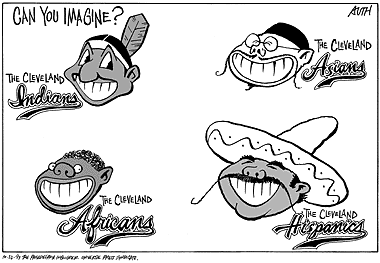
    But my whole argument is that you can't consider stereotypes in isolation. First, the context matters. A chief on a pemmican package sends one message (traditional, wholesome). A chief on a sports logo sends another message (savage, warlike). A wooden chief sends a third message (stoic, dull). A chief monument sends a fourth message (past, gone).

    You can look at any stereotype except the most racist ones and find something positive about it. For instance, consider an ad featuring a woman in a bikini. On the one hand, she's young, healthy, and attractive. On the other, she's treated as a sex object with no intellectual qualities.

    Stereotypes have cumulative effect

    Which leads to the second point: that stereotypes are a cumulative problem. One stereotype is unlikely to harm someone or influence someone's perceptions. It's only when you see the same stereotypes over and over that they begin to have an effect. People don't learn that Indians are primitive people of the past from the first movie or cartoon they see. They learn it from the hundredth or thousandth movie or cartoon.

    Chief Wahoo, an image that Fryberg used in her study, proves my point. If you show it to a roomful of sports fans or average Americans, they won't necessarily see a problem. That's because they're used to seeing an endless parade of stereotypical Indians. One more doesn't trigger a negative response.

    Now consider the practice of slavery. The pogroms against Jews. The slaughter of the buffalo. The torture at Abu Ghraib. Large numbers of people didn't think anything was wrong with these practices either.

    You often have to tell or show people the problem with something before they understand it. You have to impose a paradigm shift on their thinking. I.e., slaves, Jews, buffaloes, and Arab suspects deserve life and liberty too. Without it, they'll continue not to think about things that are plainly wrong when you think about them.

    So I'm not sure that Fryberg's conclusions are valid, even though they tend to support the case against mascots. I'd say the problem is worse than she makes it out to be. But read the study and decide for yourself.

    For more on the subject, see Team Names and Mascots and The Harm of Native Stereotyping:  Facts and Evidence.

    Below:  This might seem like a time-honored symbol of the Cleveland Indians, signifying tradition and success...


    ...unless you think about it.

    3rd NB3 Challenge raises $1.25 million

    Hitting the fairway every time

    NB3 Challenge continues success in Indian country

    By Leeanne Root
    Coming in 10 under par, Hunter Mahan and Cristie Kerr beat a field of PGA and LPGA stars to win the third annual Notah Begay III Foundation Challenge. Their final score was two better than the runner-up pairing of Rickie Fowler and Annika Sorenstam.

    This year’s event, held again at Atunyote Golf Club at Turning Stone Resort & Casino, was a little different than last year. The format changed from skins to a mixed team, best ball format, and the laid back nature of the charity event made for more crowd interaction and banter between the players.
    And:Fowler, who has finished second on the PGA Tour twice as of June 2010 and is currently ranked No. 34, is one-quarter Navajo.

    “This is part of who I am and I definitely want to be able to give back to my people,” Fowler’s grandmother is full Navajo. He said getting to know Begay and being able to play at the Challenge has made him want to get closer to the Native part of his heritage.

    But in the end, the day was about the kids, the foundation and helping Begay raise money to combat Type 2 diabetes and obesity in Native American children. After the players finished, a check for $1.25 million was presented to the foundation.
    Comment:  For more on the subject, see NB3 Foundation Fights Obesity and 2nd NB3 Challenge Raises $1 Million.

    Below:  "Notah Begay III teed off at the first hole while his partner, Lorena Ochoa, (to the left in a green shirt) who has 27 LPGA Tour wins and was ranked No. 1 in the world when she retired in May 2010; and Rickie Fowler, (to the left in pink) who has finished second on the PGA Tour twice as of June 2010 and is currently ranked No. 34, watched." (Leeanne Root/Indian Country Today)

    Cameron helps with anti-dam films

    Brazil dam project prompts animated response from director Cameron

    By Matthew Knight"Defending the Rivers of the Amazon" is a 10-minute interactive presentation created jointly by Amazon Watch and International Rivers and highlights the environmental issues surrounding the building of the Belo Monte dam, in Para state.

    Narrated by the actress Sigourney Weaver, the video explains how the dam--scheduled to be built on the Xingu River, a tributary of the Amazon River--will flood 500 square kilometers of agricultural land and rainforest, displacing over 20,000 people who have lived there for generations.

    Cameron's help on the project has been invaluable, Amazon Watch's program director, Leila Salazar-Lopez told CNN. The Oscar-winning director helped enlist the services of Weaver and Google Earth.
    And:In addition to helping produce the Google Earth Animation, Cameron has also released "A Message from Pandora." The three-minute feature premiered the same time as the recent re-release of his 2009 box office hit, "Avatar."Comment:  Glad to see Cameron is still helping the Amazon Indians despite his "cause fatigue."

    For more on the subject, see Okay to Meddle in Brazil? and Dam Suspended with Cameron's Help.

    Bloomberg, mosque, and frybread

    Indian Comics Irregular #196:  Cowboys 'n' Terrorists in NYC